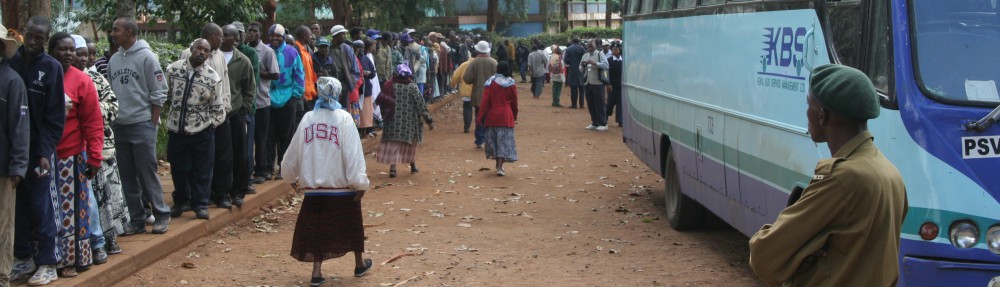
Kenya’s party primaries Thursday will be key test for credible elections–international community should speak candidly this time

A key indicator of major Kenyan general election problems ahead that was downplayed in 2007 was the magnitude of problems in the party nominations process.  All of us who were involved in supporting and watching the process were aware from our own experiences and from the Kenyan media that things were messy.  As it turned out, the U.S., at least, conducted a more systematic observation of the primaries and saw a lot of things that would have raised more red flags for the rest of us had anything been said publicly (or even shared privately with others working election observations).

For the latest this year, see “Confusion ahead of Jan 17 party nominations deadline” from The Star today and  “Rivals prepare for tough nomination fight” from the Sunday Nation.  Of course, the challenges now are much greater because of the addition of the Senate and county offices.  See “Fairness a Must In Party Nominations” from Jerry Okungu in The Star.

[Update Jan. 16 0200 Nairobi time, Daily Nation: “Lobby names possible nomination hotspots“:

Nairobi, Siaya, Nakuru and Migori have been identified as possible violence hotspots in party nominations tomorrow.

The Elections Observation Group said on Tuesday it was concerned about the rise in sporadic violence in parts of Kenya, particularly in Nairobi’s slums and Tana River.

The group has deployed 290 observers countrywide, with a concentration on the hotspots, to monitor and report on the primaries.]

Through my 2009 FOIA request for documents from the State Department on the Embassy’s own 2007 election observation endeavor, I was provided in addition to a minimal amount of information on the general election observation a copy of an e-mail about the primaries, as discussed in Part Eight of my FOIA Series, especially noteworthy regarding the role of the ECK, as well as hate literature, and the overall mess:

The one document released that substantively describes observation of voting by State Department personnel is a November 20, 2007 e-mail which is a headquarters “readout” of a video conference held “with Post to discuss the experiences of Post’s first-ever observation of the political primary process in Kenya.”:  Here is the text:

The Observation Effort:
*21 teams (total about 60 people) deployed to the field. This is our first time observing the primaries. We expect to deploy about 50 (100+ people) teams to the general elections as part of the larger international observer effort. The EU plans to deploy 150 people.
*These will be Kenya’s 4th multiparty elections but only the second “free and fair”.

Negatives Observed:
*The process was very poorly organized. We would say the the parties embarrassed themselves, except most of the party leaders have no shame and are thus immune from embarrassment. General feeling is that apparent total lack of organization is not an accident, but reflects efforts to rig/manipulate the outcomes.
*There were obvious deals between the incumbents and local party operatives.
*The process was well-run and by the book only in where parties had no hope of winning in that area anyway. Where there were real stakes, manipulation was rampant and obvious.
*Ballots were delayed for many hours in many locations; some politicians felt this was intentional and especially disenfranchised women voters, who either couldn’t wait all day or had to go home before dark for safety reasons.
*Hate literature observed to date is overwhelmingly generated by PNU supporters.

Positives Observed:
*Turnout was surprisingly good. People were very determined to vote. Many waited from 6 a.m. to 3 p.m. or later for ballots to arrive. In some cases where ballots were delayed, people agreed amongst themselves to vote on whatever pieces of paper and honored the results.
*Dozens of outgoing MPs (including some we are very happy to see go, i.e. [REDACTED] were eliminated at this stage, which suggests that you can’t always manipulate the results.
*Our sample was biased as we purposely went to areas where trouble was expected and/or stakes were high, so we likely observed a disproportionate amount of rigging, etc.
*With the recent passage of the Political Parties Bill, this is the last time that the party nomination process will be run by the parties themselves. In the future, the Electoral Commission of Kenya (ECK) will run it (at least, for all parties who want public money). PNU contracted with the ECK to run their primary this time, but it didn’t happen in practice–party leaders took over and wouldn’t let ECK do its job.

After the Primaries:
*We expect a lot of horse trading. Some winners were DQed on appeal and even without an appeal. There were also many “directed nominations,” which led to the resuscitation and handpicking of many old dinosaurs/unpopular incumbents notwithstanding voter opposition.
*There may be blowback with an impact on turnout for Dec. 27. There were widespread feelings of bitterness and disappointment, especially among ODM supporters, who expected to participate in a “new beginning.” Many people complained that, populist image notwithstanding, ODM is run like a dictatorship and that the way of doing things is no different than KANU used to do in the past. The positive difference is that the electorate is much more vocal and active in demanding transparency and participation in the electoral process. The howls of protest regarding some of the directed nominations show the electorate’s increasing maturity and lack of interest in this kind of politics.
*Many unsuccessful candidates have jumped to smaller/marginal parties. There is a cottage industry of sorts selling nominations.

Possible Impact on Main Parties:
*The disappointment and frustration with the nominating process was greatest among ODM supporters. Will this experience sap the energy of ODM supporters, or can ODM redeem itself? Will people continue to be willing to take a chance on an unknown quantity?
*Fear/stability is a powerful motivating factor in Kibaki’s reelection prospects. The contest between ODM and PNU can be characterized as “hope vs. fear.”
*PNU has much less internal discipline and message consistency. Virtually all PNU parties are fielding their own candidates for Parliamentary seats, so not much of a real coalition.

Political Violence
*Two possible types. One, aspirant (often incumbent) MPs use paid gangsters (and sometimes local police officials) to intimidate or disrupt the polling process (trash polling stations, threaten voters waiting in line and/or election officials). Two, spontaneous voter uprisings, where voters feel they are being disenfranchised and attach the presiding officers. If the ECK runs an efficient process as expected, this should lessen the possibility of voter violence. —–END—–

For context, this November 20, 2007 summary of what was observed during the primary election was roughly a month after the Ambassador’s intervention in the public opinion polling as described in previous documents and a month before the Ambassador’s public statement predicting a “free and fair” election the week before the general election. Nairobi is the State Department’s biggest Sub-Saharan post; it was staffed with smart and observant people and obviously well funded–the problem was not what the State Department didn’t know, rather it was what it wouldn’t say.

Election Day in Somaliland

Ministry's Murals
MINISTRY OF TOURISM AND CULTURE

[Update: Polls have now closed. Here is a VOA story with interview with Dr. Steve Kibble of Progressio.]

Voters in Somaliland will chose local officials around the country, and the results will determine the three officially recognized political parties for the next ten years under the Somaliland Constitution. Kulmiye, UDUB and UCID have been the three parties, and will face competition from recognized “political associations”. The three parties will then compete in the future parliamentary and presidential elections.

Here is the link to the “From the Ground” blog from Progressio, which is leading the international monitoring.  Also follow the hashtag #SomalilandElection.

From the Somaliland Press:

Here in the capital voting started around 7 a.m. in most of the 404 polling stations including Ga’an Libah, where President Ahmed Mohamed Silanyo cast his vote. He was joined by first lady Amina Sheikh Mohamed Jirde and members of his cabinet including minister of presidency, interior, minister of finance and members of the ruling Kulmiye Party.

The president expressed a sense of opportunism and congratulated the people of Somaliland for their commitment to democracy and stability.

He urged everyone to vote peacefully and respect the electoral officials, volunteers, observers and the outcome of the result.

An international observation team of 56 from 15 countries is on the ground monitoring the elections. They see this as a crucial step in the democratization of the whole Horn of Africa region. Two teams from Puntland and Mogadishu are also there to observe and discover their neighbour’s voting system.

The polls close 6 p.m. and results might not be known until the weekend. . . .

Fighting was reported with militias in the town of Hudan in Sool, in the uncertain eastern border region with Puntland.

Weekend reading on Somalia and the Somaliland elections

The Daily Nation’s Rashid Abdi reports on a new review of security in Mogadishu:

The 27-page report by Saferworld, a conflict-prevention research and advocacy organization based in London, entitled Mogadishu rising? – Conflict and governance dynamics in Mogadishu”, notes tentative gains in security.

It acknowledges that there is an improved public perception, but says progress “remains inadequate and uneven with significant areas of Mogadishu – particularly the city’s northern districts – almost entirely unpoliced.

“In the absence of state-provided security, residents and officials have formed an array of neighbourhood vigilante groups and private militia to protect themselves and their property.”

The report, based on a comprehensive field research that involved opinion surveys and focus groups, from April to July 2012, accuses the TFG of failing to capitalise on the military gains achieved to improve security and instead fuelling a “privatization of security” likely to undermine the efforts to stabilize the capital in the longer term.

Here is the link to Saferworld’s summary and to download the full report.

Lisa Otto at the South African Institute for International Affairs writes in yesterday’s Africa Portal “At the End of the Transition Period Somalia is Going Nowhere–Slowly.  Her piece is dated August 10 and doesn’t reflect the latest developments in the final week of transition, but provides a pessimistic summary of the TFG’s eight years.

Super Market & Baby Shop

In Somaliland, delayed local elections are now set for November, with a new court ruling upholding the selection of six “political associations” to participate in addition to the three established parties (Kulmiye, UCID and UDUB) in the last two presidential elections.  Progressio has released a report on August 31 entitled “Preparing for local elections in Somaliland: plans, challenges and progress.” From the announcement:

The lack of a robust voter registration system could also lead to issues such as multiple voting.

There are also concerns about the process of assessing new ‘political associations’, which are vying to join the three existing authorised political parties and so be able to participate in the elections. According to the report, there is “the potential for six political associations to join the three existing political parties to contest the elections, and for each of those nine parties/associations to stand a candidate in every seat”.

Recent and continuing challenges to press freedom also pose a barrier to legitimate elections, and there are worries that recent gains in promoting women’s involvement in democratic processes could be undermined by the ‘open list’ system.

Despite highlighting these concerns, the report makes recommendations and suggestions for improvements by a number of key players, including the government of Somaliland, the National Electoral Commission (NEC), political parties and associations, civil society organisations, and the international community including donors.

Michael Walls says: “Our hope is that this report will help encourage all concerned to pull together and ensure that these elections become another significant milestone in Somaliland’s progress towards democratic accountability.”

Here is the Somaliland Press this week on the court ruling on the political association registration:

A High court in Hargeisa has dismissed a civil case filed by a group of political parties to contest the decision by the political associations and parties Registration & Approval Committee (PPR&VC).

The case which had been filed by a cluster of parties namely UDHIS, NDB, HORYAAL and jamuuhiriga were part of the nine out of fifteen political organizations which failed to qualify verification and approval process hence their disqualification from the process.

The chairman of the High Court Prof. Yusuf Ismael Ali while reading the court’s ruling said that with all due respect, we hereby find no evidence of the irregularities in the qualification process contrary to what was alleged by the disqualified political parties.

Progressio notes the complementary British-funded work of the International Republican Insitute (IRI) in the Somaliland election preparation, along with Interpeace and others.

Part Eight–new Kenya FOIA documents: Diplomacy vs. Assistance Revisited or “Why Observe Elections if We Don’t Tell People What We See?”

We are in full swing now in the 2012/13 presidential campaign in Kenya, but unfortunately there remains much confusion, misunderstanding and simple lack of awareness over what actually happened in the 2007 elections.  I have gotten a couple of additional partial releases of a few documents from the State Department in December and again this month from my 2009 Freedom of Information Act requests about the State Department’s 2007 election observation and the exit poll, and since we are running out of time to get ready for the upcoming elections, it seems time to start introducing some more of this information.

New this month is the release of a grand total of three documents purporting to be the entirety of the releasable documentation from the Africa Bureau (as opposed to the cables in the central State Department records) related to and derived from the State Department led observation of the Kenya elections.  One (undescribed) document was withheld in full bringing the total Africa Bureau documentation to four items.  In other words, in sprite of the fact that “160 Embassy officials in 56 U.S. Embassy observation teams successfully deployed nationwide to monitor the elections” according to the election day Africa Bureau press guidance (one of the documents released) they did not generate records.

The question could be raised then whether the point of the State Department observation through the Embassy became not so much to observe as to be observed observing.  Being observed observing gives an extra patina of gravity to whatever narrative you wish to present about the election afterwards; and who can question without an independent look at your data? [or an independent exit poll?]

Again, this highlights the difference between the diplomatic function with its command structure to carry out foreign policy with its multiplicity of interests and objectives, but clarity in who is being served, on the one hand, and the function of an independent international election observation mission, funded as a matter of “democracy assistance” intended to serve the very much narrower interest of the internal democratic process in the host country to advance values shared by the funding nation/s and a broader international community (and accepted in theory by the host country).

The one document released that substantively describes observation of voting by State Department personnel is a November 20, 2007 email which is a headquarters “readout” of a video conference held “with Post to discuss the experiences of Post’s first-ever observation of the political primary process in Kenya.”:  Here is the text:

The Observation Effort:
*21 teams (total about 60 people) deployed to the field. This is our first time observing the primaries. We expect to deploy about 50 (100+ people) teams to the general elections as part of the larger international observer effort. The EU plans to deploy 150 people.
*These will be Kenya’s 4th multiparty elections but only the second “free and fair”.

Negatives Observed:
*The process was very poorly organized. We would say the the parties embarrassed themselves, except most of the party leaders have no shame and are thus immune from embarrassment. General feeling is that apparent total lack of organization is not an accident, but reflects efforts to rig/manipulate the outcomes.
*There were obvious deals between the incumbents and local party operatives.
*The process was well-run and by the book only in where parties had no hope of winning in that area anyway. Where there were real stakes, manipulation was rampant and obvious.
*Ballots were delayed for many hours in many locations; some politicians felt this was intentional and especially disenfranchised women voters, who either couldn’t wait all day or had to go home before dark for safety reasons.
*Hate literature observed to date is overwhelmingly generated by PNU supporters.

Positives Observed:
*Turnout was surprisingly good. People were very determined to vote. Many waited from 6 a.m. to 3 p.m. or later for ballots to arrive. In some cases where ballots were delayed, people agreed amongst themselves to vote on whatever pieces of paper and honored the results.
*Dozens of outgoing MPs (including some we are very happy to see go, i.e. [REDACTED] were eliminated at this stage, which suggests that you can’t always manipulate the results.
*Our sample was biased as we purposely went to areas where trouble was expected and/or stakes were high, so we likely observed a disproportionate amount of rigging, etc.
*With the recent passage of the Political Parties Bill, this is the last time that the party nomination process will be run by the parties themselves. In the future, the Electoral Commission of Kenya (ECK) will run it (at least, for all parties who want public money). PNU contracted with the ECK to run their primary this time, but it didn’t happen in practice–party leaders took over and wouldn’t let ECK do its job.

After the Primaries:
*We expect a lot of horse trading. Some winners were DQed on appeal and even without an appeal. There were also many “directed nominations,” which led to the resuscitation and handpicking of many old dinosaurs/unpopular incumbents notwithstanding voter opposition.
*There may be blowback with an impact on turnout for Dec. 27. There were widespread feelings of bitterness and disappointment, especially among ODM supporters, who expected to participate in a “new beginning.” Many people complained that, populist image notwithstanding, ODM is run like a dictatorship and that the way of doing things is no different than KANU used to do in the past. The positive difference is that the electorate is much more vocal and active in demanding transparency and participation in the electoral process. The howls of protest regarding some of the directed nominations show the electorate’s increasing maturity and lack of interest in this kind of politics.
*Many unsuccessful candidates have jumped to smaller/marginal parties. There is a cottage industry of sorts selling nominations.

Possible Impact on Main Parties:
*The disappointment and frustration with the nominating process was greatest among ODM supporters. Will this experience sap the energy of ODM supporters, or can ODM redeem itself? Will people continue to be willing to take a chance on an unknown quantity?
*Fear/stability is a powerful motivating factor in Kibaki’s reelection prospects. The contest between ODM and PNU can be characterized as “hope vs. fear.”
*PNU has much less internal discipline and message consistency. Virtually all PNU parties are fielding their own candidates for Parliamentary seats, so not much of a real coalition.

Political Violence
*Two possible types. One, aspirant (often incumbent) MPs use paid gangsters (and sometimes local police officials) to intimidate or disrupt the polling process (trash polling stations, threaten voters waiting in line and/or election officials). Two, spontaneous voter uprisings, where voters feel they are being disenfranchised and attach the presiding officers. If the ECK runs an efficient process as expected, this should lessen the possibility of voter violence. —–END—–

For context, this November 20, 2007 summary of what was observed during the primary elections was roughly a month after the Ambassador’s intervention in the public opinion polling as described in previous documents and a month before the Ambassador’s public statement predicting a “free and fair” election the week before the general election. Nairobi is the State Department’s biggest Sub-Saharan post; it was staffed with smart and observant people and obviously well funded–the problem was not what the State Department did not know, rather it was what it would not say.

Meeting

Lessons for Kenya’s 2012 elections from the truth trickling out bout 2007–new FOIA cables (Part One)

Election Observation–Diplomacy or Assistance?

“How Kenyan Politics is Shaping Uganda Election Campaign”

New Standard item on linkages between Kenyan and Ugandan parties/factions.  This has a lot of potential to contribute to indirection and lack of transparency in both countries, with lots of extraneous interests–and one more thing to distract Kenyan politicians from getting anything done in the Government of National Unity in the meantime.