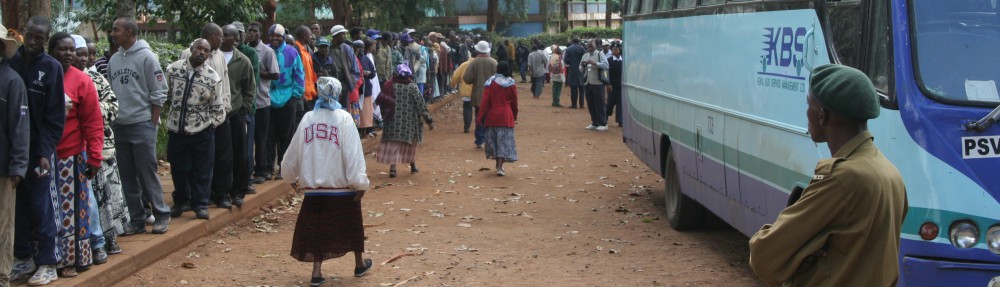
“After the Dust Has Settled” shiny new Kenyan institutions left dingy

Dr. Stephanie Burchard has a piece in the current issue of the Institute for Defense Analyses’ Africa Watch entitled “After The Dust Has Settled: Kenya’s 2013 Elections”, noting the unexplained failure of the IEBC to release election results that were required in mid-March until mid-July.  The key takeaway:

Unfortunately, after all that has happened since, it is unclear how much respect or trust Kenyans continue to have in their political institutions.  Politicians seem wary of Kenya’s political institutions.  Raila Odinga promised that he and CORD would boycott future elections until changes within the IEBC take place.  Even more troubling, public trust in Kenya’s new institutions appears to be eroding.  In early July a national survey conducted by Ipsos Synovate revealed that confidence in Kenya’s new political institutions, including the Supreme Court and the electoral commission, had fallen precipitously over the course of the past few months.  In particular, confidence in the IEBC had fallen by 30 percentage points–from a high of 62 percent in February to 32 percent less than five months later.


Bonus reading on the American foreign assistance political and policy process: from the Lugar Center, “Lessons for the Next QDDR” by Diana Ohlbaum and Connie Veillette.


“Choosing Peace Over Democracy”

“Kenya’s 2013 Elections: Choosing Peace Over Democracy” has been published in the new Journal of Democracy by James D. Long, Karuti Kanyinga, Karen E. Ferrer and Clark Gibson.  Important and worthwhile reading for anyone interested in Kenyan politics or democratic process in Africa or the developing world more generally.

This is the first of formal publications using the exit poll and other polling data that were presented by Professors Gibson and Long at Johns Hopkins’ SAIS on May 2 and widely covered in the Kenyan media.  See my post with the video:
“Fraud and Vote Patterns in Kenya’s 2013 Election: Evidence from an Exit Poll”–Gibson and Long event in Washington Thursday.

Long and Gibson were the researchers who also carried out the 2007 IRI/USAID/UCSD Kenyan exit poll that showed an opposition victory.

Voting Procedure

134 days after election, Kenya’s IEBC fails to produce election results in Parliament

Daily Nation, July 16, “IEBC fails to submit final poll tally” :

The electoral commission failed to furnish Parliament with the final results of the March 4 General Election Tuesday amid claims that some commissioners refused to sign the report.


The commission was expected to submit the final tally to the Justice and Legal Affairs committee at a meeting scheduled with the team at Parliament Buildings Tuesday. The committee was to relay the report to Parliament.


Independent Electoral and Boundaries Commission chairman Issack Hassan and chief executive James Oswago appeared before the committee but were turned away after the chairman indicated that the tally was not ready for submission as per the request from Parliament. . . .

Here is the Standard story.


Are “free and fair” elections passe in Kenya?

Uganda Debt NetworkHappy American Independence Day–it has now been a full four months since Kenya’s 2013 election, yet the results have still not been released by the Independent Electoral and Boundaries Commission.

The 2012 Kenyan Constitution mandates in Article 81: “The electoral system shall comply with the following principles––

(e) free and fair elections, which are—

(i) by secret ballot;
(ii) free from violence, intimidation, improper influence or
corruption;
(iii) conducted by an independent body;
(iv) transparent; and
(v) administered in an impartial, neutral, efficient, accurate
and accountable manner.

Thus “free and fair” is the legal standard in Kenya. So what standard did the international observer missions that issued their reports on Kenya’s elections without waiting for the official results apply?

Note this from Mienke Mari Stetytler’s “Observing the observers: how the Kenyan election was verified” republished in the Daily Maverick this week:

One month after the election, on April 4th, the Carter Center released its postelection statement. “In spite of serious shortcomings in the Independent Electoral and Boundaries Commission’s management of technology and tabulation of final election results, the paper-based procedure for counting and tallying presented enough guarantees to preserve the expression of the will of Kenyan voters.”
Kenneth Flottman, an independent elections consultant, noted that not one of the observer missions referred to the elections as “free and fair” in their preliminary or post-election reports. “Holding back on calling the election ‘free and fair’ reflects the reality of the known problems with the election,” Flottman said. “At its most crass, this is a way to say that the government in power cheated some, but the opposition probably would have lost anyway.”

He conceded that “there is a tendency to apply lower standards to achieve a ‘free and fair’ election in Africa compared to other regions [of the world]. If anything, this makes the decision not to apply the label to this election in Kenya more noteworthy.”

David Pottie, associate director of the Carter Center’s democracy programme, contested this view. “It isn’t that African elections are held to a different (higher or lower) standard than countries elsewhere in the world,” Pottie said in an e-mail. “Rather, the Carter Center bases its assessment on a) Kenya’s international obligations and b) Kenya’s constitutional and legal framework.” He added that “free and fair” is no longer the “language of choice in international public law”.

Peter Visnovitz, EU election observation mission spokesperson, agreed: “The ‘free and fair’ phrase fell out of use because defining an election as ‘free and fair’ is very black and white—it requires a yes or no answer. Whereas, in fact, electoral processes are complex and it is very difficult to come up with a concept of ‘fair’ that would please everyone.”

Ilona Tip, operations director at EISA’s South African office in Johannesburg, explained that phrases like “transparent and credible” or “the expression of the will of voters” are now preferred.

.  .  .  .

“The long, long vote count” –new reporting from Kenya in Africa Confidential

Election Observers

The new “free article” from this month’s Africa Confidential says better what I have been getting at about the extraordinary delay in releasing the results from the Kenyan election, along with new independent reporting on the facts:

. . . In the longer term, such doubts could prompt a re-evaluation of foreign election monitoring missions in Africa. Some on the European Union mission, for example, had serious doubts about the integrity of the process, but it quickly endorsed Kenyatta’s election. By that stage, the EU had contributed more than 50 million euros (US$66 mn.) to the cost of the elections, reckoned to total over $400 mn. One diplomat in Nairobi joked that it was a case of ‘responsibility without power’, meaning that the EU would be blamed for a messy result due to its financial involvement but had no power to change anything.

The IEBC found that a million more votes were cast in the presidential election than in any other, Africa Confidential has learned, although all were held on the same day. Opposition and civil society activists have raised questions about such discrepancies for several months.

An unnamed electoral commissioner quoted in the Nairobi daily The Star appears to confirm their suspicions: ‘We are having sleepless nights reconciling the presidential results and those of the other positions. Over a million votes must be reconciled with the others and if the requirement is not changed, then it will cast the IEBC in a negative light.’

Kenyatta’s supporters reject the concerns, arguing that it is natural that voters were more worried about selecting the national president than candidates for other positions. Few neutrals see this as credible. In the past, dramatically higher turnouts in presidential elections than in others on the same day have been taken as a sign of ballot-box stuffing.

It seems far-fetched that over a million Kenyans would queue for several hours to vote and then ignore all of the ballots apart from the presidential one, especially since there was great excitement about the contests for new, powerful positions such as senator and governor. None of the many election observers we asked said they had seen significant numbers of voters putting a ballot paper in the presidential box but not the others.

. . . .

Please read the whole piece; this is important for the future of Kenya and for future elections everywhere.


Somaliland rejects local UNSOM presence; Kenya reading

Khat Shop Hargiesa

Khat Shop Hargiesa

The Somaliland Sun reports that the Government of Somaliland has informed the visiting head of the new United Nations Mission to Somalia (UNSOM) that Somaliland will not host a UNSOM office. Somaliland wishes to continue hosting and receiving aid through various individual UN agencies and organizations but considers the overall UNSOM mission in support of the Federal Government of Somalia incompatible with Somaliland’s independent status.

In the meantime, the questions of governance for Kismayo and the “Jubaland” region remain an immediate challenge as does the unsettled Somaliland-Puntland border. Somaliland has indicated a desire to strengthen relations with Kenya, which shares a common interest in some degree of regional autonomy for Jubaland on the Kenyan border.

Of note on Kenya:

Wachira Maina–“ICC: Kenya’s is a lose-lose strategy even if African Union has its way” in The East African.

Dr. Stephanie Burchard, “How Fraud Might (Indirectly) Promote Democracy in Africa” in the Institute for Defense Analyses’ Africa Watchdiscussing the judicial review of Ghana’s presidential election in contrast to the procedure in Kenya.

David Anderson on the Mau Mau case, “Atoning for the Sins of Empire” in the New York Times.

Wycliffe Muga on “A Brief History of Election Rigging” in The Star.

Jaindi Kisero on “There is more to the Kenya Pipeline Company saga than nepotism; is it someone’s turn to eat?” in the Daily Nation.

Paul Wafula on “Hidden pain in financing Jubilee’s bag of goodies” in The Standard.

George Kegoro, “There’s need for an independent team to probe conduct of election” in the Daily Nation.

It’s mid-June: another month goes by without Kenya’s election results while Hassan goes to Washington [revised]

Form 34 Posted

Form 34 Posted

IFES, the International Foundation for Electoral Systems, hosted the latest round of its “IEBC goes to Washington” events with Chairman Hassan on June 12–this one purporting to discuss “lessons learned” from the March 4 election (link to webcast). A key lesson for the Kenyan government so far appears to be that if you sit on the election results long enough you can outlast the observers and the donors will pat themselves on the back anyway.

I didn’t make the trip to Washington for this event, in part because I don’t think the event should have taken place until after, at a minimum, the election results were released, if not other basic information we have all been waiting for. I did watch on-line. Here is my take:

My impression was that the objective of this event was indicated by the introduction and the conclusion. These were extravagant conclusory statements from IFES CEO Bill Sweeney about what a great success the Kenyan election was and what a great job the IEBC and its chairman did (and by implication of course IFES). Otherwise, there was just nothing new here. IFES’s Country Director Michael Yard gave a sober reminder of all the many things associated with basic electoral reform, like campaign finance laws, gender balance,etc. that remain undone–as he cautioned back in April 2012 with Hassan in Washington about the challenges of trying to do too much in too little time in introducing technology. The Washington triumphalism is “tone from the top” stuff that I haven’t heard from Yard or anyone else at IFES and I don’t doubt that everyone involved in actually working on the programs in Kenya did their best to avoid the kind of mess that actually came to pass.

From Sweeney’s argument, the reason this was all a great success–end of story–without even having results released three months later, is that “Kenya didn’t burn.” If I were a Kenyan I would be a bit offended by that. First of all “Kenya” didn’t “burn” last time–there was major violence in some places, including arson by militias, major sponsors of which, based on the confirmed ICC charges, got together this time. Kenyans of all tribes and persuasions were chastened by the post-election violence last time. Because of the experience, religious and community groups, civil society and the international community invested heavily in peacebuilding and conflict warning and resolution approaches. Threat of further ICC prosecutions hung over the key political actors that used violence last time. Thanks to a ruling by Speaker Kenneth Marende in Parliament and the High Court at the time, after passage of the new constitution in 2010, a new Chief Justice was appointed who was acceptable to the opposition as well as to the President, giving the opposition some hope in going to court after the IEBC ruling that the Uhuruto ticket had reached 50.07%. The Government of Kenya heavily deployed military, paramilitary and police force, especially in areas most supportive of the opposition, and the new Inspector General (chief) of police announced a ban of political assembly and peaceful protest, irrespective of the constitution–while gangs patrolled many of the slum areas. The biggest number of people killed last time were shot by the police, as reported by the Waki Commission. Last time the shoot to kill policy was unexpected; this time it was understood in advance. People stayed home after voting for many reasons that do not constitute an endorsement of the work and conduct of the IEBC.

Saying that the IEBC did a “great job” because “Kenya didn’t burn” is part of what I mean about having lower standards for elections in Africa–sorry if it’s impolite to notice.

The obvious question, of course, is that if Kenya not “burning” warrants so much public chest beating this time, should we include public discussion of “lessons learned” or any accounting or apologies for last time when so many people were killed and maimed?

Meanwhile back in Nairobi, the election results are being missed.

The Star: “Raila wants IEBC results released”:

“If indeed the IEBC conducted a free and fair poll, why is it delaying the computation of the election results three months later? They should announce so that we know what TNA, ODM, Wiper among other parties got,” Raila told the crowd at the Kabiro Primary School.

The Supreme Court on April 9 upheld the IEBC declaration of Uhuru as the winner after Raila’s Cord challenged the outcome of the presidential election.

The court ruled that the process was within the law and that Uhuru had been validly elected as the president.

Raila’s sentiments come against the backdrop of divisions within the IEBC over the computation of the results. An IEBC commissioner, who did not want his identity revealed, told the Star that the final figure was to be released before the end of last week but the disagreement among them had caused the delay.

The figures, according to the commissioner, were to be finalised before presentation of budget estimates to the parliamentary committee.

Whereas some commissioners want the the process finalised, others want the section of the Political Parties’ Act providing for the computation of results amended to give the commission more time. Those pushing for the amendment want the parties to share the monies on the basis of their representation in the Parliament and the county assemblies.

According to the commissioner, the variation of the results between the presidential and other positions was “irreconcilable”.

“The IEBC was to release the results before the end of the week but the huge variation between the presidential results announced on the 9th of March this year and the other positions combined is the source of the headache,” the source said.

[Updated June 3] “Kenya’s Elections: Observing the observers”

The new June issue of Africa in Fact published by Good Governance Africa based in South Africa has an article, “Kenya’s Elections: Observing the observers” by Mienke Mari Steytler.  I hope you will take time to read it.

The article included some observations on the work of the Election Observation Missions from interviews in Nairobi with yours truly as an independent consultant and responses and comments from others.  Here is one example:

The EU and the Commonwealth missions are also known for their independence and diplomacy, but others—particularly groups representing intergovernmental bodies—are less critical and independent, according to Mr Flottman. The AU mission had 69 observers and visited 400 polling stations throughout the country. The IGAD/ EAC/COMESA coalition deployed 55 observers to this year’s election.

Kenya is a member of the AU, IGAD, the EAC and COMESA, and they share geopolitical interests. Mr Flottman emphasised that observer missions representing the regional groupings are unlikely “to challenge any position of government”. For instance, the IGAD coalition mission declared the party nominations stage a success, Mr Flottman said. “They said the primaries were good. This is a nonsense statement. No one said that, come on.”

“Observer missions from the AU, SADC [Southern African Development Community], EAC, ECOWAS [Economic Community Of West African States]…because they are intergovernmental bodies, there is the ‘you rub my back, I’ll rub yours’ approach to certifying elections,” EISA’s Mr Owuor said, supporting Mr Flottman’s view. “In other words they were not very critical in an effort not to offend the current government.”


Update: on the issue of the use of the term “free and fair”, see The Star, “March 4 polls free, fair – EU”:

EUROPEAN Union election observers have said that the March 4 general elections in Kenya were “overally successful, free and fair” despite reported flaws.

They have however said the processing of the final results by the Independent Electoral and Boundaries Commission “lacked the necessary transparency as party agents and election observers were not given adequate access to the tallying centres”.

Speaking yesterday in Nairobi while releasing the final report, EU elections observation mission chief observer Alojz Peterle said there are several lessons from the difficulties that arose during the process.


Here is the link to the entire issue for pdf download:  Africa in Fact:  June 2013–Elections: Make Them Count.

So who is “Good Governance Africa”?  Here is an interview by Africa in Fact editor Constanza Montana of John Endres, CEO of this “new kid on the block” of organizations working to improve governance in Africa.

Update:  See also this recent piece from Think Africa Press by Dr. Judith Kelley at Duke: “Watching the Watchmen: The Role of Election Observers in Africa”:

. . . There are certainly sometimes questions about the conduct of outside observers.

Elections in Kenya unfortunately often provide a case in point and the latest is no exception. The EU monitors have been dragging their feet, with their final report now overdue. EU observer mission spokesman, Peter Visnovitz, reportedly promised the report would be made public by 4 May, but we are still waiting. Furthermore, in its initial press release (before the counting was complete), the EU was positive despite noting that the biometric voting process disenfranchised more than 3 million voters.

Why is the EU taking so long for its final assessment? The Kenyan Star claims that an internal report revealed strong reservations about the processing of the results. Meanwhile, the International Crisis Group (ICG) noted numerous problems and criticised the swiftness with which international observer groups pronounced all well in Kenya’s vote.

Earlier commotion around international observers in Kenya includes their muted response to the problems in the 1992 election; the mission was eager to send positive signals to calm fears of upheavals and resume aid. Their conduct in Kenya’s 2007 election also drew criticism from the UN Independent Review Commission; the body reported that monitors had at times based their claims on misunderstandings.

Time for an African solution?

International observers are clearly not perfect. But the final part of Obasanjo’s argument – that cure for the problem is for African monitoring groups to take over from international missions – rests on equally shaky grounds.

It is true that African groups have become more active. The AU, SADC, ECOWAS, and the electoral Institute of South Africa (EISA), among others, all now feature election observer missions. The AU started as far back as 1989, and the other groups have joined in the last 10 years or so.

That, however, is where the argument stalls. By and large, these groups are not ready to take over as the sole option for election observation on the continent. They have limited resources and experience, their sponsors or member-states are often not particularly democratic themselves, and most importantly, because these organisations are even more embroiled in politics on the continent, they are often more biased than non-African observers.

Kenyan Parliamentary committee summons registrar of parties; issues include failure to publish election results

Old KANU Office

The Star reports on the latest round of the IEBC controversy:

Acting Registrar of Political Parties Lucy Ndung’u has been summoned by the National Assembly Committee on Justice and Legal Affairs. The committee wants to find out why she is holding two offices, the management of party affairs and budget allocation.

As the acting registrar, Ndung’u is yet to take the oath of office because her term expired with the coming into force of the Political Parties Act in late 2011. . . .

. . . .

Chepkonga also wondered how the registrar will distribute parties’ funds when the IEBC had not computed the March 4 election results. In the financial year 2013/14, the office of registrar of political parties has been allocated Sh344,650,758 by the National Treasury. But the House will have the final say in approving the expenditure.

The Act provides that ninety five per cent of this fund be shared proportionately by reference to the total number of votes secured by each political party in the preceding general election. Five per cent is left for administration purposes.

In effecting the 95 percent, the total number of votes secured by a political party shall be computed by adding the total number of votes obtained in the preceding general election by a political party in the election for the President, MPs, County Governors and members of county assemblies.

“These are some of the things we will be seeking explanations a committee. The management of public finances must be open,” Chepkonga said. William Cheptumo (Baringo North), who is also a member of the legal committee, said parties want to know the number of votes they got.

“Am also wondering why they have taken too long to compile the number of votes per political party,” he said. Ndungu is also said to be interested in retaining her position as the registrar once a new process has been initiated.

Ndungu is also said to be interested in reapplying for the job once a new process has been initiated. However, a number of MPs vowed to ensure that she doesn’t get the job. “She has been the stumbling block to party discipline in the country. We will ensure the motion is defeated,” an MP who declined to be mentioned said.

Here is yesterday’s story in the Standard in which Ms. Ndung’u is interviewed: “Political parties pay day here as Treasury opens purse”.

In the meantime, IFES has announced it is hosting IEBC Chairman Issac Hassan in Washington on June 12 for a discussion about “lessons learned” from the election and the EU Election Observation Mission released its Final Report.

Kenya’s IEBC dangles “kitu kidogo” for political parties to avoid publishing election results

The Star reported this week that the “IEBC wants political parties act amended“. From the headline one would expect to read perhaps an article on some type of reform arising out of the failed primary elections early this year, or the problem with “party hopping” . . .

But of course, it would be silly to think that the IEBC would concern itself with such things to improve accountability in the Kenyan electoral system.

No, the IEBC is faced with a problem. It doesn’t want to publish the election results. For the reason noted in my last post: the numbers of votes for the other offices don’t add up to the numbers of votes for president–according to the anonymous Commissioner quoted in the story, adding a direct confession to the clear circumstantial evidence that we have all seen for many weeks now.

The IEBC is attracting no visible pressure from Washington or London or the other “donors” who helped underwrite the IEBC. Whether this is because, as in 2007-08, the foreign policy mavens think it’s “better not to know” or whether because, as always, the foreign assistance mavens want a “success story” as much as a better democracy in Kenya in the future–or both–I don’t know.

So the immediate rub is the delay in providing public funding to Kenya’s political parties based on the election results. How to relieve pressure from pols who want the tax dollars doled out without publishing the election results that determine how the money is allocated? Change the law of course! So the money can be paid out without disclosing the results! An elegantly Kenyan solution.