The Foreign Policy establishment will continue to hold Beltway confabs and hearings about “Africa policy” but the author of “The Flight 93 Election” is running Policy Planning at State and Congress has neutered itself.

I think it is probably a sucker’s game to do too much mastication around the idea of what Trump II may do in or in relation to Africa by reference to the Kennedy through Biden 1961-2025 “A.I.D./USAID Era” of African relations.

Take a moment to read Michael Anton’s famous opinion piece in the Claremont Review of Books from July 2016 entitled “The Flight 93 Election”. This is the very same Michael Anton who is the Trump II Director of Policy Planning at the State Department.

As far as I am concerned the wood chippering of USAID, programs and especially people, is best understood in the intellectual “Cold Civil War” environment as a subspecies of “Defunding the Left” (something that I had some involvement in as a College Republican leader back in the”Reagan Revolution” days) rather than a more specific foreign policy pivot. The impact on Africa, Africans, and relations with African states specifically is just collateral damage in “The Third World” in Flight 93 terms.

Probably better to study the Eisenhower Administration—when decolonization was close enough to warrant standing up a separate Africa Bureau in the State Department but many in Congress addressing foreign policy represented segregated Jim Crow States and districts and the question of civil rights for Black Americans generally was much in contest. And perhaps a counterfactual to identify what a Goldwater Administration Africa policy might have been. [Recognizing that Eisenhower was seen as a proto-Communist by many of the ideological godfathers of the current Trump II core thought leaders.]

The most important American regarding Africa policy is likely Elon (“We’ll Coup Who We Want To“) Musk, and ProPublica has an expose about how aggressively the new Trump II State Department leaned on Gambia for Musk’s Starlink business.

Musk has used his X megaphone (the repurposed Twitter) to spread accusations of a genocide against white Afrikaners in snyc with the rest of the Trump Administration declaring same as the basis for the new program to designate Afrikaners as “refugees” and resettle them in the US. In the context of “The Flight 93 Election” view of seeing “Third World” immigration as the most daunting failure of the pre-Trump Conservative Movement and pre-Trump Republican Party as well as the ultimate goal of the Left “enemy within”, it makes perfect sense to affirmatively bring in Afrikaners while expelling “non-Western” refugees impacted by wars or terrorism elsewhere in Africa or “The Third World”.

Beyond the barriers of “culture” and “development” to finding time out from the Cold Civil War to develop an actual foreign policy strategy for Africa, the Trump II Administration will not be able to take this on without having first a strategy for China. I do not expect that four years will be long enough for Trump to make many of the necessary choices. So far the most important fork in the road in the Trump II China policy (and foreign policy writ large) is the announcement by Treasury Secretary Bessent that the US does not seek to decouple with China.

In the meantime, gutting the State Department means that more of the burden of diplomacy as well as development will be left to AFRICOM by default. Of course the Trump policy of refocusing the Pentagon on “warfighting” by a more lethal warrior class and enhanced technology cuts away from the likelihood that AFRICOM as a Combatant Command will be more rather than less dexterous and ultimately successful at diplomacy than it has been since starting to take up that burden at inception in 2008 as what the G.W. Bush Administration conceived as a “different kind of Combatant Command.”

Congress has elected to defer wholly to Trump II on Africa policy so far as the major changes have been effectuated with the demise of USAID. The Senate Foreign Relations Committee didn’t even hold a hearing (!) on the demise of USAID and the hearing in the House was not of any legal relevance in spite of the preponderance of the testimony debunking the basic rationale of Musk for the “woodchippering”.

Last week the Senate Committee solicited the thoughts of Joshua Meservy of the Hudson Institute, previously Heritage, and Michelle Gavin of the Council of Foreign Relations on “East Africa & The Horn: At a Turning Point or Breaking Point” but again, no real indication that Congress will do anything to get involved as opposed to deferring entirely to Trump II.

While some associated with the Trump II administration pay lip service to an approach of “trade not aid” in the aftermath of the death of aid, there is no evidence of comparative substance to the words. The UAE is the latest country after China to completely dwarf U.S. current and planned financial investment in Africa and like China provides a counter to previous U.S. expressed values on governance and the rule of law, and not just in relation to war and mineral smuggling in Sudan and Central Africa.

See “UAE Pouring Money into Africa, Seeking Resources Resources and Power” in the New York Times on May 17:

“In 2022 and 2023, the Emirates announced a total of $97 billion in investments in Africa — three times China’s total, according to fDi Markets, a database of foreign investments. U.S. investment in 2023 was about $10 billion.”

“Meanwhile, Mr. Trump has fast-tracked America’s exit from Africa, ending billions of dollars in funding, dismantling the U.S. Agency for International Development and ending all contributions to the African Development Bank. The State Department’s reorganization plan also calls for the elimination of most operations in the region.”
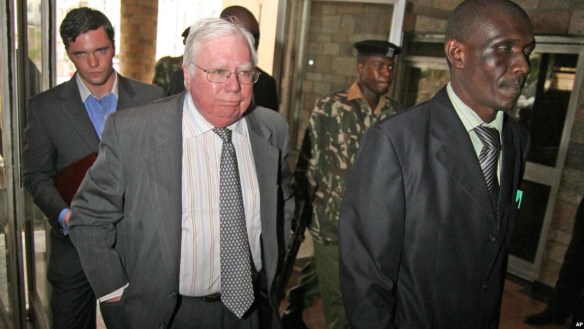
Birther John Corsi in Kenya to investigate Senator Obama
Jerome Corsi, bestselling “Obamanation” and “Where’s The Birth Certificate” author in Nairobi during early Birtherism era.

Deal with the reality that the Kenyattas are richer than the Trumps to understand politics in Kenya, in the US, and the relations between us

Uhuru  Kenyatta “UhuRuto” Kenya presidential campaign

I am not going to invest a great deal of time mapping this out because the substance is obvious but details are deliberately obscured. If you are at all serious as a “Kenya Watcher” and are familiar with the basic public news trail on the Trump Organization, it is quite apparent that the net business wealth of the Trumps and the Jared Kushners is simply not at the US dollar value level of the Kenyatta family business empire (assuming as I do that the Trumps are not holding hundreds of millions of dollars of hidden assets overseas).

If you doubt me, work it up and show me that there is real reason to doubt the disparity.

These facts are critical to understanding the realities of the value of the presidency in Kenya and the relatively modest value of the presidency in the United States, even for a politician with perhaps an unprecedented view of the acquisitive opportunities.

If Trump were to get re-elected and get favorable dispensations from the Internal Revenue Service and his private sector creditors, and daughter Ivanka or son Eric were to be elected President in the future, and the Kenyattas fall off the pace somewhat in the next generation, then we can talk about the two families as “dollar peers”. As it stands, Donald Trump is a “first gen president” who had a father and grandfather who made a collective fortune that Donald did not succeed in breaking even with.

As an American I like to hope that a billion dollars still cannot buy everything a billion dollars could buy in Kenya, and that this will still be true even if Donald Trump actually becomes a billionaire someday through his children.

Updated: Burgeoning South Sudan crisis will increase Kenya’s leverage over donors, NGOs, international media

The news from South Sudan seems quite serious and disturbing. This is an area of special responsibility for the United States, and needless to say, I hope we are able to help.

Nairobi’s role for many years as the “back office” for international assistance to South Sudan has always given the Government of Kenya extra leverage through control of visas and work permits. My twitter feed indicates that the U.S. is recommending that Americans evacuate South Sudan as the current crisis swells with reports indicating 400-500 people may have been killed.

This brings to bear what I have called “the Nairobi curse” for Kenyans seeking political space, democracy and civil liberties of their own and hope for support from the international community. The thing you always hear, but never read, from internationals working in Kenya is “what if I can’t renew my work permit” because of some offense taken by someone in the Kenyan government.

Back in 2007-08 when I was East Africa director for IRI in Nairobi, we shared space with our separate Sudan program, which was much, much bigger than our Kenya program (and was IRI’s second largest program worldwide I was told, after Iraq). Under my East Africa office, our Somaliland program also got more funding than Kenya. Obviously there would have been repercussions from soured relations with the Kenyan administration. The same situation would pertain for NDI or other international organizations with large permanent regional operations based in Nairobi.

In my case, I arrived in Nairobi on the job in June 2007 expecting my work permit to come through within perhaps a few weeks of ordinary bureaucracy. With no explanation, it was not forthcoming until February 2008 during the late stages of the post election violence period. Thus, I did not have my permit issued yet when I was dealing with our controversial election observation and the issues about whether or not to release the exit poll that showed the opposition ODM winning the presidential race rather than the ECK’s official choice of Kibaki.
At some point that month I was summoned to an Immigration office at Nyayo House (where political prisoners where tortured in the basement during the Moi era) for no readily apparent reason and received the permit shortly thereafter. Of course Nairobi was a much more easy going place before the 2007 election than it is now. Nothing was ever said to connect any of this delay to anything to do with politics or the election and it may have been strictly a coincidence.

Fortunately for me, I was on leave from my job as a lawyer back in the United States, so being denied a permit and thus losing my job in Kenya and having to move my family back precipitously would not have been consequential for me in the way that it would have been for the typical young NGO worker. Everyone has their own story I am sure.

Earlier this year the Kenyan government announced, for instance, that it would start enforcing work permit rules for academic researchers on short assignments. Lots of room to maneuver for creatively repressive politicians.

By the way, Uhuru did end up signing that Media Bill.

Update: See the editorial in today’s Star: Work Permit Crackdown Is Counter-Productive. And the news story, “Rules on Work Permits Tighten“.

More links for Kenya’s Election; Chief Justice’s “bombshell” press conference; Debate loses a “horse”

Kenya Voting: "Curriculum Cooking"

AllAfrica.com has put together a special feature page on the Kenyan elections that is a good source for the latest stories from the main Kenyan media sources:  “Kenya Decides: 2013 Elections”. (h/t @GeorgetownDG)

On Thursday, February 28, the Institute for Security Studies Nairobi office will host a “Seminar on Kenya’s 2013 Elections: issues, actors and scenarios.”  Register on-line through the link.

IRIN has published on on-line “multimedia documentary” entitled “No Ordinary Elections” which does a nice job of informing an international audience of the basic context of the upcoming Kenyan election and includes good interviews discussing humanitarian concerns and preparations in general terms.  A work of art in internet publishing.

In the latest developments, there is a lot of buzz in the human rights community regarding the announcement by Chief Justice Mutunga at a press conference today that he had received a letter threatening judges and others regarding any ruling against the candidacy of Uhuru Kenyatta purporting to be from a Mungiki-associated group, Further, as reported in the Star story “Chief Justice Raises Concern Over Threats to Judges”:

The CJ also revealed that he was asked by an immigration officer at the JKIA to seek travel clearance from the Head of Civil Service Francis Kimemia a day after the letter was posted.

“I was stopped at the Jomo Kenyatta International Airport (JKIA) by an Immigration Officer, who insisted that I could not travel because I had not been cleared by Mr. Francis Kimemia, the Permanent Secretary, Head of the Public Service, and Secretary to the Cabinet.” Mutunga said.

The CJ further asked Inspector General of police David Kimaiyo to take the necessary steps to protect judges from threats and intimidation so as not to give constitutional rulings. “The Judiciary will not flinch from interpreting the constitution as required. The constitution must be guarded jealously,” He said.

From The Standard: CJ Mutunga bombshell”.

From the Daily Nation: “Chief Justice Speaks Out on Threatening Letter.”

Obviously a lot of difference among the media houses in how to report this.  Thus the need to read widely to put together the pieces in getting the facts and understand the interests.

While I would completely reserve judgement as to exactly what to make of the threatening letter, the “immigration” harassment is disturbing in light of Kenya’s short but unduly “colorful” history involving politics at these highest levels.  Certainly the President himself should address this if he wants to reassure the country at a time in which no one needs any more tension than can be helped.

This has overshadowed the other big political story of the day, that Uhuru Kenyatta’s campaign has announced that he will drop out of the second presidential debate scheduled for Monday, complaining of the allegedly unfair amount of emphasis on the charges he faces from the International Criminal Court and “ganging up” by the other candidates on this point.

My sense of the political strategy here would be that Kenyatta feels he is in solid position to make a runoff, and not in striking distance to win in the first round, so there is nothing major to be gained from another debate, while there are risks from undesired questions and unscripted situations.  He has plenty of money and media access as a top candidate so he probably doesn’t feel a need to share the stage to  communicate whatever he wants to say in the last days of the campaign.  Likewise, part of his approach since the ICC charges have been confirmed has been to portray himself as a victim of other politicians and interests, so claiming that he was treated unfairly in the debate fits with that theme, too.