Part Six–What did the U.S. Ambassador report to Washington the day after the Kenyan election?

See the previous posts in this series:  Part One, Two , Three , Four and Five.

There were additional machinations with the Ambassador’s approach to IRI up through election day that I think raised legitimate concern about what his objectives and intentions were in regard to the election, as reflected in my complaint to USAID, but for present purposes, I will skip ahead to the next cable I have received, a report by the Ambassador to the Secretary of State and others on December 28, 2007 entitled “Kenya’s Elections – A Positive Process Thus Far”  [Ed.  Note:  the group of cables I have been discussing is limited to five items from the Central Foreign Policy files in Washington,  whereas the Africa Bureau has made no response to the Department FOIA office as to its records on the same FOIA request, including those kept at the embassy in Nairobi.  Follow up: In October 2011, two years after my request was filed, my status inquiry finally indicated that documents from the Africa Bureau were under review for release.]

So what did the Ambassador say on the day after election?  Here is his summary:

“The relatively smooth and peaceful way in which the elections were carried out on December 27 represents a victory first and foremost for the Kenyan people and their democracy.  Herculean efforts by the Electoral Commission of Kenya (ECK), the responsible statements made by the leaders of the main parties, the constructive role played by the media, and strong U.S. support and observation all contributed to this positive outcome.  All observers share a relatively positive view of how the election process was carried  out.  I have made an informal positive statement to the Kenyan media.  It is, however, too early to make final pronouncements.  Septel will provide text of a proposed draft statement that can be issued by Washington on December 29 .  The vote counting will not be completed until the 29th.  The potential for last minute fraud cannot be ruled out.  The electoral process in some areas was characterized by delays and problems with voting procedures and electoral registers, but these were largely resolved in a way that did not disenfranchise voters, who turned out in record numbers.  Initial informal results show opposition candidate Raila Odinga leading President Kibaki by between 3 and 8 points, but this reporting is uneven and not systematic.  The election is still, in our view, too early to call.”

. . .  The most striking impressions from all observers about election day are the peacefulness and orderliness of the process.  Even the most problematic and contentious constituencies completed voting in an acceptable fashion.

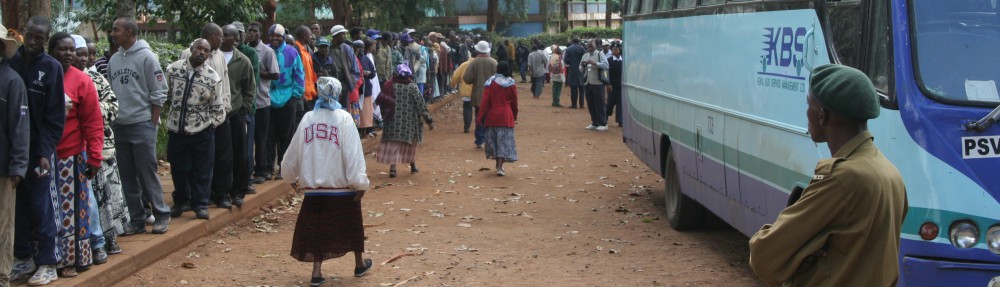
For example, I observed the opening of the polls in the Kibera slum, which is a key part of Langata constituency, where presidential candidate Raila Odinga was a candidate for Parliament.  This race was ground zero in the election process given widespread fears that extra-legal efforts would be made to defeat Odinga there, thus making him ineligible to become President (since whoever is elected President must also be an elected member of Parliament).  At 0600 there was already over 5,000 people lined up to vote at the largest polling station in Langata, which is Olympic School in the Kibera slum.  The bigger problem was confusion over voting procedures.  People had begun lining up since just after midnight.  [Ed. Note:  Why?  According to one account I have been provided this was done in the context of the exposure of organized efforts to bus in large numbers of people to disrupt the voting.]  . . . Calls from us to ECK were instrumental in getting senior ECK officials to act quickly to resolve the issues [the need for more full copies of the electoral register for the polling station], and I was able to make some reassuring statements to the media.  ECK Chairman Kivuitu went to Kibera himself to calm people.  In another remarkable testament to the professionalism of ECK officials, all those waiting to vote were eventually processed, and by late evening Kibera was quiet (a truck standing by with riot police was not needed).  .  .  .

“One embarrassing stumble by the ECK actually became on the the day’s best examples of Kenya’s maturing commitment to a responsible democratic process.  The ECK inexplicably failed to include Raila Odinga’s name in the voting register in his own polling station in his Langata constituency, resulting in a potential crisis when Odinga was turned away.  Instead of inflaming the Kibera slum, Odinga simply drove to ECK headquarters and officially protested the omission.  The ECK offered no excuses and acted immediately to amend the register to include Odinga’s name.  There were a few quick press conferences and the situation ended peacefully with Odinga casting his vote.

That the voting process was so relatively smooth and peaceful despite delays and organizational problems testifies to the commitment of the Kenyan people to democratic values.  The leadership of the President and the opposition candidates in calling for peaceful elections and respect for the results was also crucial to this positive outcome.

The other remarkable aspect of the elections was the unprecedented high turnout (which will average somewhere between 65 and 80 percent).  Not surprisingly, Kibaki’s team produced a record turnout of around 85% in his home area of Central Province, and Odinga produced a high turnout in his home area of Nyanza Province.  Many people waited in line for six hours or more.  Some of the turnout was clearly the result of increased participation by youth.  It appears that Odinga will profit from youths’ perception that he represents a younger generation (though he is 63 to Kibaki’s 76, and both are from the same political class) and that he will be more decisive against corruption.

The electoral process thus far deserves a strong statement of support, and clearly meets a high standard for credible, transparent, free and fair elections.  I made an informal statement last night that was carried extensively on Kenyan television.  It is, however, too early to make definitive pronouncements.  The ECK will likely not announce final results until December 29.  The EU and Kenyan domestic observation missions will make statements on the 29th.  By COB Washington time on the 29th we will send a proposed draft for a statement by Washington.  IRI will make a largely positive statement the afternoon of the 28th.

The ballot counting process is carried out in three stages, each fraught with the potential for fraud.  First, the ballots are counted at each polling station in front of party agents.  Party agents were given copies of the results and they were also posted publicly at each station.  My observations and those of our observers indicate that this counting process was generally transparent and efficient.  Second, the ballots were taken to central tally stations in each of the 210 constituencies.  Observations indicate that this process has also been carried out well.  Finaly, the ballots and results of the tally stations are, where possible, being called or sent by e-mail to the ECK and then physically carried to ECK headquarters.  This process, which will be carried out during the course of today and this evening, is where the potential for trouble is currently greatest.  Ballots can be lost, burned, or otherwise destroyed.  Even though results will have been posted at polling stations, any interference with the final phase of the count would raise serious issues that the ECK would have to address (especially if the ballots delivered to the ECK in any way differed from results tabulated at polling stations).  During this period tensions will rise as inevitable rumors circulate (given the history of extensive fraud in all previous elections except the one in 2002).  We have received, unconfirmed reports that the police had to fire into the air at several tally centers to disperse unruly crowds worried that ballots were being tampered with.   Commissioner of Police Ali gave a press conference this morning and said all the rights things to assure people of his commitment to ensure protection for ballots and to highlight the non-political role of the police.

As a result of its generally responsible, extensive, and timely reporting, the media also deserves credit for how well the process has proceeded thus far.   Since before the polls closed the media has been reporting on a 24-hour basis.  They are reporting vote totals based on the results posted at polling stations, but making clear that only the ECK can announce official results.  The results that the media are reporting reflect uneven inputs from around the country, but so far show Odinga leading Kibaki by about almost 10 points.  Two exit polls (with uncertain methodology) also show Odinga winning by 3 -8 points.  The race is, in our view still to [sic] early to call.   It appears, as expected, that these elections will result in a sea change in Parliament, with up to 70 percent of incumbents replaced.  This may in part be due to a wave of ODM support, but is even more the result of dissatisfaction with the incumbents’ perceived inattention to their constituencies and to the exorbitant pay raise that they awarded themselves.  Initial reports indicate that some of the most corrupt incumbents have been defeated.

“Advancing U.S. Interests”

We will keep the Department closely informed as results become clearer.  At this point, there are sound reasons to believe that this election process will be a very positive example for the continent and for the developing world, that it will represent a watershed in the consolidation of Kenyan democracy, and that it will, therefore, significantly advance U.S. interests.  The Kenyan people will view the U.S. as having played an important and neutral role in encouraging a positive election process” [End]

All told, a smashing success then, reports the Ambassador.

No particular security concerns.  Kudos to the ECK, kudos to the police, kudos to the media and kudos to the State Department.  “And that exit poll I commissioned through USAID to ‘provide an independent source of verification of electoral outcomes’ as I described it in my December 14 cable (and to provide ‘early intelligence’ for me as the USAID officer said on the afternoon of election day)?   Its methodology is ‘uncertain’ ” (even though it was developed by experts, at the expense of USAID and UCSD, with open consultation with USAID all along). [Ed. Note:  The other exit poll Ranneberger referred to in the cable is apparently one conducted by the Institute for Education in Democracy in Nairobi with funding from the British Westminster foundation as I was told.  I was told that the IED, unlike IRI, was not able to obtain complete results from the field in the context of the violence and was not able to publish final results.  I could, arguably, say that its methodology is “uncertain” because I don’t personally know anything about it.]

IRI was criticized by members of the EU Observation Mission for releasing its “largely positive” statement of that day, the 28th, while all the other observation delegations waited.  Ironically, the U.S. was the largest and lead donor for the UNDP election coordination effort, through which other delegations cooperated in waiting to make preliminary statements for the ECK to announce results.

[See Part Seven–One Last FOIA Cable on the 2007 exit poll.]

Part Five–Lessons from the Kenyan 2007 elections and the new FOIA cables

Getting back to the narrative, I also remember Tuesday, December 18, 2007, the date that Ranneberger wrote the second of the cables that I received recently through a 2009 FOIA request.

That morning’s Standard featured a big, full page exclusive interview with Ambassador Ranneberger, nine days before the election.  For me this article was something of a benchmark in terms of my “no more b.s.” from the Ambassador instructions.  There are several reasons I found the article troubling, part related directly to the independence of  our IRI election observation mission, and part related to the Kenyan campaign itself,  in particular the corruption issue.  On corruption:

[From “Envoy Predicts Free and Fair Election”, The Standard, December 18, 2007–an interview with U.S. Ambassador Michael Ranneberger nine days before the Kenyan election]

Q: What are your views on corruption?

A: Lots of people look at Kenya and say lots of big cases have not been resolved because of Anglo Leasing and Goldenberg. I always point out that we have lots of corruption even in the US. These cases take a lot of time to bring to justice. We had the famous Enron case. It took over four years to resolve in a system that works efficiently, yet only a couple of people were convicted. These things take a long time.

There has been substantial effort to fight corruption in Kenya and the award the country won for Civil Service reform [from the World Bank] is a pointer to that effect. The fact that the Civil Service is more professional than ever before is progress as are the new procurement laws recently put in place and the freedom of the Press to investigate and expose corruption. More, of course, needs to be done.

The economy has grown by 7 per cent. How much of that has actually trickled down to the people will again be determined by time.

A career diplomat, Ranneberger has been in Kenya for close to one-and-a-half years, and has served in Europe, Latin America and Africa.

This was a full page “exclusive” feature interview in The Standard nine days before the 2007 Kenyan election.

During previous days The Standard had been running new revelations about corruption in the Kibaki administration from documents from exiled former Permanent Secretary for Ethics and Governance  John Githongo. Rumor had it that Githongo wanted to be able to return to Kenya and might want to be able to return to government after the election, although I had no knowledge one way or the other about whether that was true. Githongo’s personal adventure trying to address corruption in the Kibaki administration is the subject of Michela Wrong’s It’s Our Turn to Eat. Wrong rightly noted in her book that stealing the election was the ultimate corruption.

Githongo had previously alleged that the Anglo Leasing scandal that Ranneberger referred to was intended to fund the campaign to re-elect Kibaki. See this from BBC News, January 26, 2006, “Kenya ‘safe’ for anti-graft czar”:

On Wednesday, the World Bank urged Kenya’s president to take tough action against any cabinet ministers found to be corrupt.

The warning came as the World Bank approved a new $25m loan to help fight corruption – a decision slammed by former UK Kenya envoy Sir Edward Clay.

Sir Edward, who has condemned Kenya for not tackling graft, said the new loan would feed the “pig of corruption”.

‘Insensitive’

“The Anglo-Leasing cases represent an excellent opportunity for the authorities to invoke the disciplinary provisions of the code of conduct signed by the new cabinet weeks ago,” said World Bank Kenya director Colin Bruce.

“I believe that this is an historic moment for the government to signal where it stands on the issue of political accountability,” he said.

Kenyan President Mwai Kibaki

President Kibaki is under increasing pressure over corruption

President Kibaki was elected in 2002 on a pledge to fight corruption.

Some donors, including the UK, have suspended some aid to Kenya over concerns about corruption and Sir Edward, who retired last year, thought the World Bank should have sent out a tough message.

“How can the World Bank be so insensitive and hapless to announce new loans to Kenya?” reports the Guardian newspaper.

“They have added insult to injury by feeding the pig of corruption in Kenya when many Kenyans were beginning to hope they might smell the bacon beginning to fry.”

Over the weekend, Mr Githongo’s leaked report said his attempts to investigate the Anglo-Leasing scandal were blocked by four top ministers – Vice-President Moody Awori, Energy Minister Kiraitu Murungi, Finance Minister David Mwiraria and sacked Transport Minister Chris Murungaru.

Mr Murungi and Mr Awori have publicly denied the claims.

Mr Murungi said the report was “untrue” and an attempt to bring down the government.

Mr Githongo resigned last year amid reports that his life had been threatened.

The money raised by the alleged scam was to be used to fund the ruling Narc coalition’s campaign in elections due next year, Mr Githongo said.

Following the leaking of the 31-page report, the opposition has urged President Kibaki to dissolve cabinet.

Opposition Orange Democratic Movement leader Uhuru Kenyatta said: “This is clear evidence that the government can no longer be trusted to conduct detailed and honest investigations into this saga.”

Other diplomats were maintaining effective “radio silence” in the sensitive closing days of the 2007 campaign, while Ranneberger was speaking out to defend the Kibaki administration’s corruption record. In the meantime, after my December 15 experience at the Embassy residence I was quietly preparing the new last-minute pre-election Langata survey, along with all the other work for the exit poll and Election Observation Mission.

After reading the Standard article, I e-mailed my local USAID officer on the Election Observation and Exit Poll to complain, noting my opinion about the article and where things seemed to be going in regard to my obligation to supervise an objective and independent Observation Mission and the Ambassador’s alternative approach.

Part One;   Part Two;    Part Three;    Part Four;    Part Six;    Part Seven;   Part EightPart NinePart Ten

Part Four–Lessons from the 2007 Kenyan Election and new FOIA cables

See Part One, Two and Three of this series. And the full Freedom of Information Act Series.

Also see Election Observation–Diplomacy or Assistance?

The fourth cable I received last weekend under the Freedom of Information Act was a lengthy unclassified report from Monday, December 24 entitled “Kenya on the Eve of National Elections”.  The most noteworthy items are the Kibera issue discussed in my last post and, as also discussed there, Ranneberger’s very explicit position regarding what he considered U.S. interests to be in the whole matter–being able to treat the announced outcome as credible.  Otherwise, the cable is pretty much the kind of thing that I would have expected him to write based on my interactions with him personally and more generally with the Embassy, and as an observer of his very conspicuous role as a media figure in Kenya during the campaign.

Overall, Ranneberger was uniformly positive about Kibaki, even on the corruption issue.  He offered no real positives on Odinga other than, if it can be viewed in a positive light, noting that he was generally a more effective campaigner and speaker than Kibaki, but at the same time his criticisms of Odinga were in context fairly mild. Generally the view in the cable seems to be what I saw in muted form in Ranneberger’s statements to Kenyans through the media, and more strongly in his speech to the delegates of the IRI Election Observation at a reception at the Embassy residence that same Christmas Eve and in private conversation:  it certainly seems that Ranneberger preferred a Kibaki re-election, but in this writing to Washington he acknowledged Odinga as a “friend of the United States” like Kibaki and did not suggest at all that Odinga was seriously dangerous, threatening or sinister in some way along the lines of the some of the attacks from hardline Odinga critics in the U.S. or in Kenya.

Likewise, nothing about ideology;  whereas the New York Times picked up on concern back in Washington about Odinga’s background association on the left during the Cold War, going to college in East Germany and naming his son Fidel, I never talked to anyone with the U.S. government in Kenya that gave any indication that they found Odinga to present ideological or economic concerns to the U.S.  Ranneberger did make one derogatory comment about Odinga to me privately, but I would not let the Times use it when they interviewed me because I felt that it could be misleadingly inflammatory and was said only in private in his office in the context of doing legitimate business.

Another statement that he made to me separately in October in the context of the discussion about the pre-release Steadman poll showing Odinga leading Kibaki by a large margin was that “if we’ve been wrong about this all along” in what was reported to Washington about Kibaki’s standing “we might as well not even be here”.  I have no way of knowing what any of his previous reporting had been, but I was certainly struck when I first arrived in Kenya by how positive he seemed to be about the Kenyan administration and political climate in the context of what I had read in the my preparations for taking the post.  He said that he wanted to have an election observation with the notion of telling an African success story.

Under the heading “Messy, But Probably Credible Elections” Ranneberger wrote:

9.  Election day will almost certainly be messy, meaning some violent incidents, and a fair amount of allegations of interference with the voting process.  Both Kibaki and Odinga have senior people around them who are desperate to win, and who are willing to do whatever it takes to achieve that.  While the potential for dangerous actions must be taken seriously, the track record of the well-run elections in 2002 and the national constitutional referendum in 2005 (which the government lost) bodes well.  The Chairman of the Electoral Commission, Samuel Kivitu, is highly respected and determined to run a clean election.  Elaborate procedures are in place to assure a credible and transparent process.  The large number of international observers will also help to limit misconduct.  The EU has about 120 observers, the U.S. Mission is fielding almost 200 observers plus funding an observer mission of the International Republican Institute led by former A/A Connie Newman, and there will be over 17,000 Kenyan domestic observers.  Finally, as we have traveled the country, average Kenyans have emphasized their determination to participate in a free and fair election (even if this is mixed with underlying tribal sentiment).

10.  If Kabaki loses, Odinga supporters will be riotously happy.  At the same time, most of the Kikuyu elite, with their business interests, will want to work out accommodation with the with the new government (many have already launched feelers).  The greater danger is if Odinga loses.  He and his supporters will be very tempted – even if the Electoral Commission and observers deem the process credible — to declare the election fraudulent and to resort to violence.  In that case, there could be significant violence and several tense days while things calm down.  While there is no likely scenario that would lead to generalized instability, substantial violence along tribal lines would be a setback for Kenyan democracy.

Lessons from 2007 and New FOIA Cables–Part Two

Continued . . .

So on Saturday afternoon, December 15, 2007, I drove to the embassy residence in Muthaiga and was served tea by a woman from the house staff while waiting a few moments for the Ambassador.  I had understood from IRI’s president that Ranneberger was going to talk to me and my general impression or assumption was that he wanted to smooth things over after twisting my arm so hard toward getting Ambassador Bellamy, his predecessor, off the IRI Election Observation delegation.

As it turned out, the purpose of the meeting was more substantive.  I am not writing to “dish” on a private conversation and I won’t recount everything in general here, but this did involve public business of the U.S. as well as the Kenyan election, regardless of the fact that it took place without witnesses or records on a Saturday afternoon.  All circumstances considered I think I ought to explain a couple of salient points from this meeting that remain to me significant in trying to learn what happened with the election twelve days later.

To start, Ranneberger elaborated on the importance of removing Bellamy from the delegation because of the notion that he was perceived as “anti-government,” obviously meaning the Kibaki administration.  As mentioned in the New York Times story, what was new in this conversation is that he seemed to be saying that the objection had come from someone in the Kenyan government, although that was not completely explicit.  When Ranneberger had originally raised this objection to Bellamy earlier in the month, I had asked for input from our Kenyan program staff who indicated that they did not think that this was Bellamy’s general reputation in Kenya and IRI staff had checked this with State Department contacts in Washington and found no support for that view there either.

The Ambassador definitely did not apologize for giving me “the treatment”, but he was smoothly back to his usual more pleasant/diplomatic self and I certainly did not take the matter personally–I was just the guy on the ground who provided an available pressure point.

Ranneberger did let me know that he knew what Bellamy had been told as to why he had been dropped from the delegation.  In other words, he was letting me know, without taking responsibility for the situation himself, that he knew that “we” at IRI had lied to Bellamy.  This may not have put us in the best position to hold the “no more b.s.” line with Ranneberger going forward.   He didn’t say how he knew about the “story line” to Bellamy and I have no idea myself.  IRI was in a difficult situation not of our making on the Bellamy situation–would we cancel the Election Observation (as the only international NGO scheduled to observe, and raise lots of questions we couldn’t very well answer) or let the Ambassador interfere with the delegation? Regardless, once the directive from the top was given to lie to Bellamy about why he was off the list, IRI no longer had completely clean hands.

There are a variety of things from the more substantive part of the discussion that leave open questions in my mind now after what ultimately happened with the ECK and the election.  One in particular that stands out now in light of the FOIA disclosure.

The Ambassador told me that Saturday that “people are saying” that Raila Odinga, as the leading opposition candidate for president, ahead in the polls as the vote was nearing, might lose his own Langata parliamentary constituency (which under the existing system would disqualify him from becoming president even if he got the most votes nationally).  This was “out of the blue” for me because I certainly was not aware of anyone who thought that.  Odinga’s PNU opponent Stanley Livando had made a big splash and spent substantial money when he first announced, but he had not seemed to get obvious traction in the race.  Naturally, I wondered who the “people” Ranneberger was referring to were.  Ranneberger said that a Raila loss in Langata would be “explosive” and that he wanted to take Ms. Newman with him to observe voting there on election day.

Ranneberger also went on to say that he wanted to take Ms. Newman separately to meet with Kibaki’s State House advisor Stanley Murage on the day before the election with no explanation offered as to why.

After midnight Nairobi time I had a telephone call with the Africa director and the vice presidents in charge at IRI in Washington in the president’s absence.  I was given the option to “pull the plug” on the observation mission based on the concerns about Ranneberger’s approach following my meeting with him.   The Ambassador, rather than either IRI or USAID, had initiated the observation mission in the first place, and IRI was heavily occupied with other observations.  Nonetheless, based on assurances that Ms. Newman would be fully briefed on our agreement that she needed to steer clear of separate interaction with the Ambassador and that the Murage meeting must not happen, and my belief that it would be an “incident” in its own right to cancel the observation, we agreed to go forward with precautions.

I got the idea of commissioning a separate last-minute poll of the Langata parliamentary race.  I thought that the notion that Livondo might beat Raila in Langata seemed far fetched, but objective data from before the vote could prove important.  We hired the Steadman polling firm for this job, to spread the work.  Also Strategic was already heavily occupied with preparing for the exit poll, and  Steadman was the firm that Ranneberger had instructed his staff to call (too late as it happened) to quash the release of poll results that he knew  would show Raila leading back in October, so I thought that it was that much more likely that word would get back. Further, in the partisan sniping which I generally did not credit, Steadman was claimed by some in opposition to be more aligned with Kibaki so would be extra-credible to verify this race.  I also made sure that we scheduled an “oversample” for Langata for the national exit poll so that we would have a statistically valid measure of the actual election day results in the parliamentary race.

On to the new FOIA release:  On Tuesday, December 18, Ranneberger sent another cable to the Secretary of State entitled “Kenya Elections:  State of Play on Election”.  This cable says nothing about the “explosive” Langata parliamentary race issue that Ranneberger had raised with me on Saturday, three days earlier.  It concludes:  “Given the closeness of the election contest, the perceived legitimacy of the election outcome could determine whether the losing side accepts the results with minimal disturbances.  Our staff’s commendable response to the call for volunteers over the Christmas holiday allows us to deploy teams to all sections of the country, providing a representative view of the vote as a whole.  In addition, our decision to host the joint observation control room will provide much greater access to real-time information; allowing a more comprehensive analysis of the election process.”

Next, we have a cable from Christmas Eve, December 24, three days before the election.  The first thing that morning the IRI observation delegates were briefed on the election by a key Ranneberger aide.  I told him then that we had commissioned the separate Langata poll.  He said that the Ambassador would be very interested, and I agreed to bring results with me to the embassy residence that evening when the Ambassador hosted a reception for the delegation.  The results showed Odinga winning by more than two-to-one.

There are a number of noteworthy items that I will discuss later from this cable, but for today, let me note that  Ranneberger has added in this cable a discussion of the Langata race:

“11.  We have credible reports that some within the Kibaki camp could be trying to orchestrate a defeat of Odinga in his constituency of Langata, which includes the huge slum of Kibera.  This could involve some combination of causing disorder in order to disenfranchise some of his supporters and/or bringing in double-registered Kikuyu supporters of the PNU’s candidate from outside.  To be elected President a candidate must fulfill three conditions:  have a plurality of the popular vote; have at least 25 percent in 5 of the 8 provinces; and be an elected member of Parliament.  Thus, defeat of Odinga in his constituency is a tempting silver bullet.  The Ambassador, as well as the UK and German Ambassadors, will observe in the Langata constituency.  If Odinga were to lose Langata, Kibaki would become President if he has the next highest vote total and 25 percent in 5 provinces (both candidates will likely meet the 25 percent rule).

12.  The outside chance that widespread fraud in the election process could force us to call into question the result would be enormously damaging to U.S. interests.  We hold Kenya up as a democratic model not only for the continent, but for the developing world, and we have a vast partnership with this country on key issues ranging from efforts against HIV/AIDS, to collaboration on Somalia and Sudan, to priority anti-terrorism activities.

.  .  .

14.  As long as the electoral process is credible, the U.S.-Kenyan partnership will continue to grow and serve mutual interests regardless of who is elected.   While Kibaki has a proven track record with us, Odinga is also a friend of the U.S. . . .

15.  It is likely that the winner will schedule a quick inauguration (consistent with past practice) to bless the result and, potentially, to forestall any serious challenge to the results.  There is no credible mechanism to challenge the results, hence likely recourse to the streets if the result is questionable.  The courts are both inefficient and corrupt.  Pronouncements by the Chairman of the Electoral Commission and observers, particularly from the U.S., will therefore have be [sic] crucial in helping shape the judgment of the Kenyan people.  With an 87% approval rating in Kenya, our statements are closely watched and respected.  I feel that we are well -prepared to meet this large responsibility and, in the process, to advance U.S. interests.”  END

None of this material was mentioned in the briefing to the observation delegation or to me that day.  Long after the election, the Standard newspaper reported that the original plan of the Kibaki camp had been to rig the Langata parliamentary race, but at the last minute a switch was made to change the votes at the central tally, supposedly on the basis of the strength of early returns for Odinga in Western and Rift Valley provinces.

To be continued .  .  .  .

Lessons for Kenya’s 2012 Elections from the Truth Trickling Out About 2007–New Cables From FOIA (Part One)

The time for Kenya elections under the new constitution should be August, although there remains some uncertainty on the date of the first election for “the second republic.”  See “The Election Date not Clearly Spelt Out” by Yash Ghai and Jill Ghai in The Star.  Regardless, the point is that elections are in a general sense “next year”, and that since I started this blog in December 2009 we have gone from roughly “40% done” with the allotted time for reforms under the “Government of National Unity” to “80% done”.

One of the points of the mediated settlement agreement between PNU and ODM negotiators that provided for the formation of the “power sharing” coalition government was the investigation of the facts of the disputed 2007 elections. Toward this end, and as part of my own desire to learn what I could about what had been going on around me in the context of my work managing the IRI poll program and election observation program in Nairobi, I submitted three Freedom of Information Act requests to the State Department back in September and October of 2009. One of the requests was denied back at the first of this year on the basis that the records were classified, but this weekend I finally received the first partial release of unclassified documents under one of the other two requests.

Regular readers will know that for the last several months my professional circumstances have just not allowed much time for original writing here–that hasn’t changed, but I think this is an important area where I can add value to the learning process and preparations toward more successful elections in 2012, so I will be working my way through what these newly public documents tell us, and don’t tell us, about the last Kenya elections over the next few posts.

This FOIA request covered State Department communications about the 2007 exit poll that was conducted by Strategic Public Relations and Research under contract with IRI, funded under an agreement with USAID and by the University of California, San Diego. This initial partial release covered the “central records” of the State Department in Washington and identified six “cables”, of which four were released in full, one was released with some redaction, and one was held for review with another agency of the government prior to a decision on release.  To date, the Africa Bureau has provided no response to State’s FOIA office regarding the Embassy records.

We’ll start for today with basic points from the first cable, a December 14, 2007 report from Ambassador Ranneberger to Washington on the preparations for the December 27 elections. I remember that day well–it was a Friday.

The day before I had gotten a call from the USAID Democracy and Governance head to fax to the Ambassador our delegate list for the election observation mission. After I had done so I was driving to lunch with my wife and an American friend who had recently been an election observer in another African country for another U.S.-based NGO and wanted to assist the Kenya observation as a volunteer. The Ambassador called and I had to pull over to the side of the road and step out of the car as I was getting loudly “chewed out” about the inclusion of former Ambassador Bellamy on the delegate list. Ambassador Ranneberger elaborated that he did not want to hear that it was not my decision as he was holding me “personally responsible” as the person in charge “on the ground”. He went on to say that he would pull the funding and cancel the election observation if I didn’t get Bellamy off the list, and not to think that he couldn’t do it.

After my calls to USAID and my immediate superior in Washington, IRI’s president called Assistant Secretary of State Jendayi Frazer on his way to the airport for a trip to Thailand, as he related to me, to tell her to “get her Ambassador under control”, then called Ranneberger from Thailand.  As a result, IRI capitulated and removed Bellamy as a delegate, but I was instructed to accept “no more b.s.” from the Ambassador.  Bellamy was told (not by me) that there was a problem funding his plane ticket.

The next day, on Friday, Ranneberger sent his cable to the Secretary of State touting his election preparations.  Some points of interest:

*Ranneberger notes regarding the UNDP’s $11.3 million comprehensive election assistance program, that the U.S. is the largest donor, providing nearly $3 million.  “As USAID/Kenya’s Democracy & Governance officer is the lead coordinator for all/all donor related election activity, USAID represents the donors on the joint ECK/Donor Steering Committee managing this program.”

*Ranneberger writes regarding Election Observers:  “The Mission is funding an international election observer team headed by the International Republican Institute (IRI).  The team will have about 20 members, and will be headed by former Assistant Secretary Constance Newman.  This team will be strategically deployed to high-profile locations and will coordinate with other international observer missions being fielded by the EU and the Commonwealth.  In addition to the international team, we will field over 50 three-member teams of Mission observers (American and Kenyan staff).  Locations for deployment focus on election “hot spots” where we anticipate the greatest potential for violence or other irregularities as well as constituencies with viable women candidates.  As circumstances on the ground evolve, we can continue to adjust our deployment strategy.”

* Regarding the ECK:  “Developing the capacity of the Electoral Commission of Kenya (ECK) lies at the  heart of our strategy.  The USG funded International Foundation for Election Systems (IFES) has been providing support to the ECK since late 2001.  Activities focus on providing appropriate technology for more efficient and transparent elections administration while improving the skills of the ECK technical staff.  This support additionally includes capacity building and technical assistance to support election administration.  Technical assistance includes computerization of the Procurement and Supplies Department, which is responsible for printing and distributing election materials.  Assistance will also support implementation of the ECK’s restructuring plan, strengthening logistics capacity, and accelerating the transmission and display of results.”

*On “Public Opinion Polling”:  “The Mission is funding national public opinion polling to increase the availability of objective and reliable data and to provide an independent source of verification of electoral outcomes via exit polls (emphasis added).  The implementing partner is IRI.  In addition, we were concerned that other widely published public opinion polls, which showed ODM’s Raila Odinga well ahead of President Kibaki, did not accurately reflect the true status of the contest.  Given the rising political temperature, partially due to the use of blatant ethnic appeals by both sides, we were concerned about the reaction of ODM supporters should their candidate lose in a close outcome when they were led by public opinion polls to expect a landslide victory.  The solution involved quietly reaching out to polling firms and their clients to suggest that poll sampling distribution should be based on the regional distribution of registered voters, not on raw population.  Today, the major polling firms have all adjusted their sampling and limited their responses to those who at least claim to be registered voters.”

That afternoon, Friday, December 14, I got a call as I left the offices of Strategic, the polling firm, where I had been working on exit poll preparations.  A caller who identified himself only as working with the Ambassador said that the Ambassador would like me to see him at the residence the next afternoon and I agreed to come.  In the next post, I’ll pick up the story with that meeting and two more pre-election cables.

Part Two;    Part Three;    Part Four;    Part Five;    Part Six;    Part Seven.