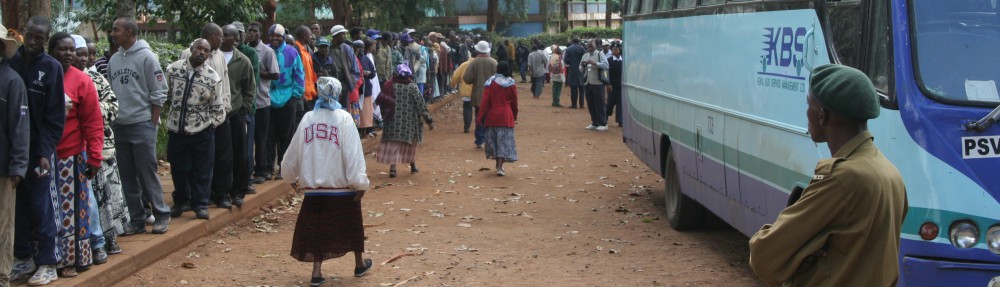
Thirty eight years after the U.S. started Kenya police training in 1977, yet another failure in Garissa University massacre

The trained elite forces of Kenya’s Recce Company Crisis Response Team of the Kenya Police Service’s paramilitary General Service Unit (GSU) do not lack for personal courage and technical competence, as they showed once again in dispatching the four terrorists who spent the day Thursday murdering Christian students at  Garissa University College after killing the two guards and seizing control of the campus.

Sadly, as we also saw in the Westgate tragedy, the top ranks of leadership in Kenya’s security apparatus lack the will and/or the focus that would be required to use such forces effectively to protect Kenya’s citizenry from even such small bands of terrorists.

The infuriatingly obtuse mediocrity of Kenya’s political elite was perhaps most conspicuously on display in Foreign Minister Amina Mohamed’s characterization of the police response to the university siege as “adequate” in her interview yesterday with CNN’s Christiane Amanpour, going so far as to conclude “we did all that we could do.”  While it is true that the Kenya Defense Forces did not intervene with “friendly fire” as at Westgate, the terrorists were left in control of the school for hours on end while the Recce Squad remained in Nairobi before finally departing by plane in the early afternoon, followed by two hours of briefings on the ground in Garissa before the successful assault.  Reporting in the Sunday Nation indicates that the Recce Company members, trained in the U.S. and Israel, are regularly being diverted to ordinary policing tasks in diverse locations and not maintained as intended on standby for the emergency Crisis Response Team at their Nairobi headquarters.

Surviving students reported being aware of their insecure environment long before the attack, which was preceded by specific warnings of attacks on university campuses, as well as the British and Australian warnings of threats which so angered President Kenyatta in the preceding days.  Most individual politicians in Nairobi have more security than this inviting cluster of “upcountry” Christian young people sitting in Garissa which has long experienced small scale church attacks and other terror incidents, as well as mass “security” repression on a periodic basis.

In an interview with the Daily Nation about the background of the middle class Kenyan among the terrorists, the assistant principal of the high school attended by the now notorious killer noted that student had finished at the school “way back in 2007 when radicalization was unheard of.”  “Terrorist was a gifted, obedient student

Even “way back in 2007” when I went to Garissa to train prospective parliamentary candidates the area was insecure enough that police escort was required from a checkpoint on the highway east of Mwingi in Eastern Province on into Garissa, crossing the Tana River into North Eastern Province.  It is hard for me to understand the idea that some grand foresight would be required to see the need for more security for this particular campus.  On its website, the University reports that it “benefits greatly from Garissa’s urban setting.  It feels closely tied to and responsible towards the city and county.  For its part it contributes to the cultural life of the city and region, and in all its activities pays regard to community and urban needs.”  The University came into being as the first full university in the old North Eastern Province in 2011 as an upgrade to an older Garissa Teacher Training College.  A noble initiative toward the crucial long term endeavor to begin the work of bringing this historically neglected region more fully into the Kenyan nation–one that made it an obvious target for Islamist extremists opposed to this endeavor.  And now shuttered indefinitely in the wake of the horrific mass executions.

Jeffrey Gettleman’s story in the New York Times “Shabaab Militants Learning to Kill on a Shoestring” identifies the extremist ideological counter-narrative. In claiming credit for the attack on one of the largest concentrations of non-Muslims in the area a Shabaab spokesman called the University part of a scheme by the Kenyan government to spread “their Christianity and infidelity” in a Muslim area that the Shabaab consider a “colony” under Christian control.

Nonetheless, Radio France International in a story headlined “Not enough Kenyan police in Garissa because its considered a ‘punishment zone'” quoted analyst Adam Hussein Adam saying “This is something that has been there since independence, and we continue to see that place [Garissa] as an outlier, and therefore we don’t deploy enough state authorities there until we have a problem like we now have.”

To me, the idea expressed in various quarters that pulling the Kenya Defense Forces out of AMISOM in Somalia now would resolve the underlying contested nature of the broader northeast within Kenya seems naive.  I don’t think the original 2011 incursion into Somalia was well considered or the best priority for Kenyan security at the time, and the AMISOM role for the KDF ought to be evaluated on its own merits now and going forward.  Nonetheless, I do not believe that there is a de facto bargain to be struck by withdrawing the KDF that would assuage those fighting what Nairobi-based security consultant Andrew Franklin has described for many months now as an insurgency within Kenya’s border counties.

Attention also needs to be paid to the experience and motives of the 27 year old Nairobi law graduate and banker, the son of a local chief from Mandera County who came to the capital for high school, followed by university.  Reportedly he wanted to join IS but settled for Al-Shabaab because he did not have a passport to travel to the Middle East but could transit the porous border into Somalia.

U.S. press coverage of Garissa University massacre

The Big Picture: Attack in Kenya” photographs in The Boston Globe.

Kenya attack targets Christians, putting new pressure on religious leaders” Ariel Zirulnick in the Christian Science Monitor.

Kenya faces grim aftermath of school massacre” Abagail Higgins and Jessica Hatcher in the Washington Post.

Kenyan religious leaders urge unity after Shabab Muslim extremists slaughter Christian students  Carol J. Williams in Los Angeles Times.

Christians warned, then killed in Kenyan university massacre” Margot Kiser in The Daily Beast.

“University attacks marks Al Shabaab’s pivot to ISIS” Ashish Kumar Sen interview with Bronwyn Bruton in New Atlanticist.

Kenya mourns 148 dead in university attack by militants”  Christopher Torchia and Tom Odula for Associated Press.

3850455481_f0db94e43c_bKenyans agonize over student massacre” Martina Stevis in The Wall Street Journal.

US Military may be uniquely situated to help in ebola crisis [updated]

[Sept. 19:  For a contra view see this column from @MeanCharlotte in the Los Angeles Times, reflective of views on the right that the military, at least under this president, is not the right tool for “wars” that are metaphorical rather than involving combat (“Ebola isn’t the Islamic State.  It’s a virus.”). Likewise, some of those on the left, particularly in Africa, who are suspicious of AFRICOM in concept, are leery of hidden motives. Many envision a deployment heavy on combat-ready “warfighters” to conduct a mission skewed toward policing or physical security in a way that I don’t expect to be what is planned or what will transpire.  Not disputing the basis for wariness based on experience with recent wars and some relief and development efforts, I “stick to my guns” (metaphorically) in seeing this crisis and the balance of options available differently.]

Regarding the AFRICOM deployment to lead/assist the U.S. response to the ebola crisis in West Africa, here is a link to a fact sheet describing the basic work of the U.S. Army Medical Research Institute of Infectious Diseases at Ft. Detrick, Maryland.  The Institute was established in 1969 and has as a primary function ongoing work on botulism, plague, anthrax and ebola, among other threats to military personnel and to public health.  They do pioneering work on vaccines in these areas, for instance.

The U.S. military is not necessarily well suited for all the various tasks that it gets assigned because no one else in the U.S. government is staffed or funded or otherwise able to do them.  Addressing an infectious epidemic on a crisis basis is much more suited to military leadership, and our specifically planned for and developed capacities, than general “development” or disaster relief work, I believe.

The U.S. military has a huge medical capacity in its own right to serve the military itself, in peacetime and as deployed around the world, along with civilian dependents and others, separately from combat-specific capacity.  We have a volunteer military, but once you volunteer you are subject to being assigned on a “command and control” basis that makes the military more flexible in a crisis than a civilian governmental or private entity.  I am one of those people who have concerns that we should have more capacity in other parts of our government, including civilian development and diplomacy functions, but such concerns should not makes us unduly reticent to use the resources that are available to help address an immediate human crisis as best we can.

Likewise, I am not an advocate of promiscuous use of the military either for war or as a substitute development agency–see my post from  2010:  “Provocative Question: To Eliminate Redundancy, Should We Move USAID From DOS to DOD?” –so I understand the general concern or skepticism, but in this specific instance we in the United States, and people at risk in West Africa, need to make use of the resources developed and available through the military.

[Update: See this from Foreign Policy: “Can the U.S. Army Degrade and Destroy Ebola?” from an expert who had an opportunity to have input on the planning.]

Catching up on some prior must reads:

“John Githongo: corruption in Kenya is poisoning politics” from The Guardian, July 3.

“After Westgate: opportunities and challenges in the war against Al-Shabaab”, a Chatam House paper by Paul D. Williams, July.

.  .  .  As Al-Shabaab loses territory and its popularity among Somalis continues to dwindle, other clan- and region-based actors will become more salient as national debates over federalism, the decentralization of governance mechanisms beyond Mogadishu and the place of clannism will occupy centre stage. As a consequence, AMISOM’s principal roles should gradually shift from degrading Al-Shabaab towards a broader stabilization agenda: encouraging a national consensus over how to build effective governance structures; developing an effective set of Somali National Security Forces; and ensuring that the Federal Government delivers services and effective governance to its citizens, especially beyond Mogadishu in the settlements recently captured from Al-Shabaab. As it stands, however, AMISOM is not prepared to carry out these activities. More worryingly, nor is the Somali Federal Government.

Kenya Defense Forces essentially collaborating with Al Shabaab in illegal charcoal exports

The Institute for Defense AnalysesAfrica Watch publication (PDF below) has a discussion by Amb. George Ward of the recent report for the UNEP and Interpol on the banned charcoal trade from Somalia (“The Somali Charcoal Industry–Strange Bedfellows”). Rather than shut down the trade that has been the primary revenue source for Al Shabaab, the Kenyan Defense Forces have continued the trade out of Kismayo, which they captured nearly two years ago, along with their present day allies in the Ras Kamboni militia. Further, the KDF is apparently participating in the same overall network of deforestation, charcoal production and brokered export trade that includes continued unmolested shipping by Al Shabaab itself from Baraawe. The traders include businessmen established in Nairobi and Garissa, so Kenya profits on that end too.

Fortunately for the Kenyan taxpayers, the EU and the United States primarily fund the AMISOM mission which has covered the Kenyan forces since mid-2012. Something tells me the charcoal proceeds generated through the KDF are not going to the Kenyan treasury.

africawatch-july-10-2014-vol5.pdf

Of course, other reports of KDF dealing in the charcoal trade have been out there for a long time.  See my post “Kenya’s persistent national security corruption continues to burden Somali endeavors”.

Mpeketoni: Terrorism and Politics as Ususal

Muthoni Wanyeki’s column this week in the East African strikes me as hitting exactly the right point:  “Mpeketoni: Get on with finding out who and why”.  Take time to read it.

The Jubilee Government was in a tizzy about stopping Raila Odinga from leading opposition CORD rallies around the country before the Mpeketoni attacks just over a week ago.  The attacks then became the focus of attention for Kenyans and the Kenyan media, with Uhuru Kenyatta deflecting things back to Raila and CORD by as much as accusing them of undertaking the attacks and explicitly denying a role for Al Shabaab.

Any reasonable observer recognizes that the Mpeketoni attacks in a sensitive area very near the border have less ambiguity about them as an incidence of terrorism than most of the individual bombings routinely attributed to Al Shabaab in Nairobi or even the Westgate attack last year. Yes, the methodological details vary–as they did in each of these from the previous Al Shabaab World Cup attack in Kampala.  Here is former Marine and security expert Andrew Franklin, who has written here previously, discussing Al Shabaab and Mpeketoni, along with unfulfilled security reform, on KTN.

With the victims largely now out of sight and out of mind in the hinterlands the media has moved on to the incessant tribal politics that makes for easy punditry in lieu of actual investigation and in-depth reporting.

I have never been a big fan of rallies in Kenyan politics–not in 2007 campaign when I was trying to help support a better process, not in 2011-12 when they were used to try to stop the ICC, and again, not in the 2013 campaign.  Nonetheless, I am pretty well inured to the fact that the usual suspects in Kenyan politics, on whatever side they happen to be at any given time, use these rallies as a primary means to connect directly to their supporters and to get national media for their messages.  I wish Kenya’s politics was a little more creative, but then, the political class as it exits always wins, so I guess they don’t feel a lot of incentive to change.  Regardless, the rallies are not in and of themselves generally dangerous except to the extent the security forces are engaged to make them so.

Tribal animosities were clearly more raw and pervasive in the spring of 2013 when I was in Nairobi for the election than they were when I left in May 2008 during the immediate post-election period.  It appears that the last year has not seen marked improvement.  An obvious reason why all this should be expected is that the parts of the February 28, 2008 election peace deal that were to address the underlying issues have not been implemented and the politics of 2011-2013 were so explicitly tribal.

Why haven’t they been implemented?  One reason is that the February 28, 2008 deal was made by Kibaki and Raila with Kofi Annan after the larger mediation process between PNU and ODM broke down.  PNU was a coalition of parties and not all of them ever supported the deal from the inception.  Uhuru Kenyatta’s KANU being one such at the time.  Raila and Kibaki cooperated to support the passage of the new constitution in 2010, but the Truth, Justice and Reconciliation Commission plodded along on the backburner.  The biggest single thing to galvanize government attention during the remainder of Kibaki’s second term was the fight to block the ICC, and, of course, Raila was running for president again, along with Saitoti and Uhuru and some others.  By the time the TJRC report was finalized, the new State House was not prepared to accept it as written.

Rallies will come, and rallies will go.  The question is whether the long term work of protecting Kenyans from the persistent threat of terrorism and the long term work of “tribal” reconciliation will be taken up or yet again deferred for some future generation.

Uhuru Park March 3, 2013

After the Rally  (Uhuru Park)


Kenya’s persistent national security corruption continues to burden Somali endeavors

In the wake of the incomprehensible looting at Westgate, Ben Rawlence, Open Society fellow and former Human Rights Watch researcher has published a candid look at the context in “Kenya’s Somali Contradiction” at Project Syndicate:

. . . if the Kenyan government’s aim was, as it claimed, to destroy al-Shabaab, the intervention has been a spectacular failure . . . In fact, retaliation against the militant group was little more than a convenient excuse to launch the so-called Jubaland Initiative, a plan to protect Kenya’s security and economic interests by carving out a semi-autonomous client state . . .

. . . the United Nations monitoring group on Somalia and Eritrea reported in July that Kenya’s Defense Forces have actually gone into business with al-Shabaab.  .  .  . [T]he Kenyan state’s endemic corruption constantly undermines its policymakers’ goals.  Indeed in Kismayu, Kenya’s officials have reverted to their default occupation — the pursuit of private profit. . . .

Read the full piece.

if the Kenyan government’s aim was, as it claimed, to destroy al-Shabaab, the intervention has been a spectacular failure. But there is much more to the story. In fact, retaliation against the militant group was little more than a convenient excuse to launch the so-called Jubaland Initiative
Read more at http://www.project-syndicate.org/commentary/kenya-s-contradictory-strategy-in-somalia-by-ben-rawlence#rC0Jau4qyOYbHqeO.99

Going back to my time in Kenya during the 2007 presidential campaign, it is well to remember that the multimillion dollar Anglo Leasing scandal that was subject to John Githongo’s whistleblowing involved corrupt contracts that were to have provided for the purchase of passport security technology, a forensic lab, security vehicles and a Navy vessel, among more than a dozen national security procurements.

Ultimately the exposure of the scandal proved to be a huge missed opportunity for the U.S. and the international community as a whole to address a pervasively corrupt security apparatus that we have continued to help underwrite.  While everyone was grateful for Githongo’s courage, we didn’t match it with courage of our own to take risks for reform and we ended up letting the Kenyan people rather than the Kibaki administration bear the burden.  See my post “Part Five–Lessons from the Kenyan 2007 election and new FOIA cables”.

Unfortunately corruption does not fix itself.

Uganda Debt Network

Leaders

Furthermore, contrary to claims that securing Kismayo put al-Shabaab at a disadvantage, the United Nations Monitoring Group on Somalia and Eritrea reported in July that the Kenyan Defense Forces have actually gone into business with al-Shabaab. The group’s profits from illicit charcoal (and possibly ivory) exported from Kismayo have grown since Kenya took control.

CommentsView/Create comment on this paragraphThis highlights a fundamental problem: the Kenyan state’s endemic corruption constantly undermines its policymakers’ goals. Indeed, in Kismayo, Kenyan officials have reverted to their default occupation – the pursuit of private profit. Instead of working to achieve the diplomatic objective of defeating al-Shabaab, Kenya’s military, politicians, and well-connected businessmen have been lining their own pockets.

Read more at http://www.project-syndicate.org/commentary/kenya-s-contradictory-strategy-in-somalia-by-ben-rawlence#rC0Jau4qyOYbHqeO.99

if the Kenyan government’s aim was, as it claimed, to destroy al-Shabaab, the intervention has been a spectacular failure. But there is much more to the story. In fact, retaliation against the militant group was little more than a convenient excuse to launch the so-called Jubaland Initiative,
Read more at http://www.project-syndicate.org/commentary/kenya-s-contradictory-strategy-in-somalia-by-ben-rawlence#rC0Jau4qyOYbHqeO.99

While mourning, and One_dering . . .

A piece that you might have missed on the Westgate attack that touches more of the bases than most: The Real Reason al-Shabab Attacked a Mall in Kenya by Bronwyn Bruton at DefenseOne.com.
Also: “Terror Strikes Nairobi, Crossing Borders” from Lauren Hutton at the Netherlands Institute of International Affairs (Clingendael).

And if you missed a wise perspective on the human context, here is Karen Rothmyer in The Nation: “Reflections on the Kenya Terror Attack”

Other lessons so far: from Abdul Haji, son of the Garissa Senator and former Defense Minister, who drove from another shopping mall (Yaya Centre) and helped rescue many at Westgate after a cell call from his brother who was stranded by the attackers, we learn that real heroes drink Dormans (and pack a pistol), and leave notes for the owners of cars they back into while rushing to rescue their brothers.  The story of the Haji-on-the-spot collaboration with the Kenyan Red Cross, a handful of plainclothes police and a kitted out group of what we might call “neighborhood watchmen” is just so deeply “Kenyan”.

Ambassador David Shinn appropriately noted on his blog that his biggest surprise about the Westgate attack is that it hadn’t happened sooner.  People I touch base with expect more, and we have additional attacks in Mandera and Wajir.  In order to stay safe and protect each other, it seems to me that Kenyans need to calmly but firmly and persistently press to get as much truthful information as possible about what happened at Westgate and take responsibility for their neighborhoods and surroundings.

The #WeAreOne_dering hashtag on Twitter has brought people from all over the world into the conversation about what really has really happened with this attack.

The United States, in particular, has spent millions on an ongoing basis, through the State Department and the Defense Department directly and indirectly on  “capacity building”, training, etc. for Kenyan security.  Given the meager preparation for and response to an attack like Westgate, we need to quickly recalibrate to account for the present reality and the immediate threat.

Here is my post from 2009 “Corruption and Terrorism/Security”. And from 2010 “U.S.-Kenya Relations: A counterterrorism versus reform tradeoff?”

And to address the religious dimension, here is an important post from African Arguments via allAfrica.com: “Somalia: To Beat Al Shabaab Kenya Must Expel its Religious Leader “Sheikh Hassaan” From Nairobi”.  And the National Council of Churches of Kenya has posted this flyer from the Inter-Religious Council of Kenya announcing a “We Are One in Prayer” event on October 1.

Two things to read after the Westgate attack (updated)

Simon Allison in The Daily Maverick has a piece today entitled “Nairobi attack: Why Kenya and why now?”  that strikes me as solid and recommended priority reading.

As far as where things are in Somalia this is probably a good time to read, if you missed it, Matt Bryden’s report “Somalia Redux?: Assessing the new Somali federal government” for the Center for Strategic and International Affairs, which provides a sobering corrective to any notions that recent progress in Somalia is more than a set of limited early steps toward any long term formation of a stable state.

Add this on the Kenyan security situation: “Kenya mall al-shabaab attacks reveal security cracks” Africa Report.

Why Westgate? [updated 9-24]

I certainly claim no special insight into the minds of Al Shabaab, but by virtue of having been around long enough to have been marked in childhood by the memory of the “Black September” attack on the Israeli athletes at the 1972 Munich Olympics, it isn’t a surprise to read that “Westgate Shopping Mall is one of several Israeli-owned businesses in Kenya.” “Shopping mall in premier complex that is home to international brands”, Saturday Nation.

Likewise, Nairobi’s upscale malls are hubs for internationals and expats, as well as symbols of the prosperity and comfort that can be found by the affluent in Nairobi and a source of local pride. The psychological and economic impact from mass murder at such a place is entirely different than mass murder of a similar scale in some other town or village, or in the slums.

I have to say I don’t believe these people would be sated if they ruled all of Somalia without challenge.

[Update: This post was an early reaction to news of the attacks. With the crisis nearing an end after three days, we don’t seem to really know much yet about the attackers and the specifics of the operation. Variety of contradictory information and lots of opinions, some derived from some substantial amount of experience and knowledge, some from little.]

“Must Read” Opinion Links from Kenya, Somalia and the U.S.

“Let’s Face It, Religious Conflict is Already Here” from Muthoni Wanyeki in this week’s East African.

“Coast Problems Are Deeper Than Riots” by Aly Khan Satchu in The Star.  

Dr. Nic Cheeseman’s Democracy in Africa blog: “Kenya’s Election 2013: An Eye on the Rift Valley” by Gabrielle Lynch, Associate Professor of Comparative Politics at the University of Warwick and author ofI say to you: Ethnic politics and the Kalenjin in Kenya’.

“Al-Shabaab and Post-Transition Somalia” by Abdi Aynte in African Arguments.

“Africa Doesn’t Need the Pentagon’s Charity: Why I’m Grumpy About the DOD’s Development Programs in Africa” by Kate Almquist, now of the Center for Global Development, recently the deputy director of the National Defense University’s Africa Center for Strategic Studies and before that, Assistant Administrator for Africa for USAID.  Ms. Almquist’s response to Rosa Brooks “Pivot to Africa” in Foreign Policy captures my personal feelings well.