
Gaddafi and Museveni
Reply
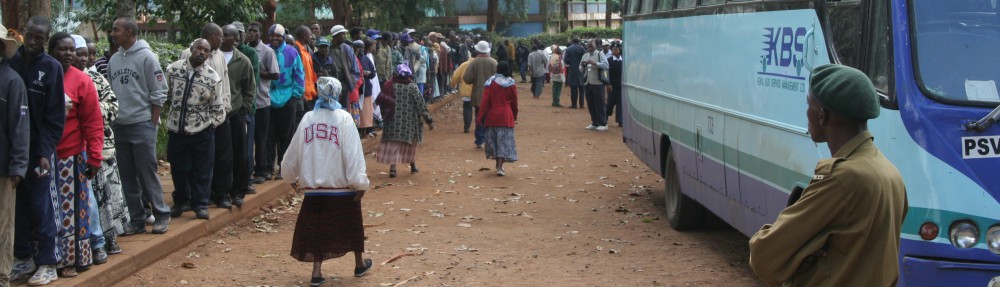
Qaddafi demise helps African Union at Africa Works by G. Pascal Zachary:
The collapse of Qaddafi’s dictatorial regime in Africa has concrete benefits for the African Union, whose international standing has repeatedly been undermined by the Libyan leader’s eccentric Pan-Africanism and past embrace of terrorism. . . . . Qaddafi and Libyan cronies invested in African real estate but they never provided either finance or expertise to promote industrial enterprises. Should Qaddafi vanish permanently from the club of African leaders, the African Union will be the beneficiary. The AU struggles with legitimacy and effectiveness; Qaddafi made the tests of pragmatism and idealism much more difficult. His absence from the AU governing body will make the renovation of this disappointing regional body easier, though even without the burden of Qaddafi, the task facing reformers of the AU remains daunting.
In Uganda, a new inflation–in the price of votes, Jina Moore
Sixth Fleet Frigate USS Stephen W. Groves is spending roughly two weeks at Dar Es Salaam for African Partnership Station program training East African sailors, along with some community relations.
“Real Conservatives Don’t Slash Foreign Aid: What House Republicans Can Learn From David Cameron and the Tories” Thomas Carothers in The New Republic.
“Wako reserves his most potent sting for Kibaki” Emeka-Mayaka Gekara in the Daily Nation. A good example of how things really work in Kenyan politics.
“Somalia: The Transition Government on Life Support” International Crisis Group report, February 21. Says the international community has continued to fail to appreciate the reality that attempts to create a European-style centralized national government are doomed to failure. The TFG is further hampered by corruption and irresponsibility. Without serious progress and reform by August, the attention of the international support should shift:
Yet, the situation is not as bleak as it may seem. Some parts of Somalia, most notably Somaliland and Puntland in the north, are relatively stable, and as the ill-fated Union of Islamic Courts demonstrated in 2006, it is possible to rapidly reestablish peace and stability in central and south Somalia if the right conditions exist. Contrary to what is often assumed, there is little anarchy in the country. Local authorities administer most areas and maintain a modicum of law and order. Somalis and humanitarian agencies and NGOs on the ground know who is in charge and what the rules are and get on with their work. The way forward needs to be a more devolved political and security structure and far greater international support for local administrations. Furthermore, if by August, the TFG has not made meaningful progress in coping with its internal problems and shown itself genuinely willing to work and share power with these local authorities, the international community should shift all its aid to them.
Daily Monitor: “Chaos in the City: Details on how Sematimba’s rigging plan was hatched”
Kampala mayoral candidates, observers and legal minds have demanded the disqualification of the ruling party candidate, Peter Sematimba, from the contest after leaked ballot papers pre-ticked in his favour were intercepted in various parts of Kampala.
Large-scale ballot stuffing and other electoral malpractices yesterday forced the Electoral Commission to suspend the voting exercise in Kampala and promise an investigation into the source of the ballot papers and boxes found in possession of private individuals.
Calls for disqualification
The local government elections went on in other parts of the country even though our correspondents talked of a very low voter turn-out, largely blamed on voter disillusionment and fatigue.
Mr Michael Mabikke, Mr Erias Lukwago, Ms Sandra Ngabo Kateblirwe and Capt. Francis Babu accused the NRM party of hatching a plan to help Mr Ssematimba win through dubious means, an accusation the NRM candidate stoutly denied.
The Uganda Law Society and the Democracy Monitoring Group (DemGroup) and other observers also called for disqualification of mayoral candidates implicated in the ballot stuffing. However, the EC said any action will be taken only after an investigation.
. . . .
Rigging began at Bat Valley polling station, where five pre-ticked ballot boxes were intercepted at 3am by mayoral candidate Erias Lukwago’s agents. A fracas later ensued in this area after it emerged that Kampala Metropolitan Police commander Andrew Sorowen was allegedly among the police officers protecting ballot stuffers, a claim the police spokesperson denied.
But after hours of standoff, police later allowed the counting of the stuffed ballots but couldn’t put a finger on the suspects. In one of the boxes counted at around 7:30am in the presence of our correspondent at Bat Valley, there were 399 pre-ticked ballot papers– all in favour of Mr Sematimba, who is also a pastor.
In a second box, there were 424 ballot papers pre-ticked in favour of the National Resistance Movement councillors and the remaining three boxes were confiscated before they were pre-ticked. The intercepted pre-ticked ballot papers at Buganda Road polling station had not yet been counted by 9:50 am waiting for Electoral Commission instructions.
. . . .
According to the source, Mr Sematimba’s henchmen were only discovered because another mayoral candidate, Erias Lukwago, and his loyalists somehow came into the know of this plot. Sematimba and Lukwago’s supporters were involved in violent confrontation for most of the night until the wee hours of Wednesday morning when police intervened. It is also emerging that several Electoral Commission officials and police officers were facilitated to look the other way as the malpractices happened.
“African Union observers fault Uganda election”, AP story at RealClearPolitics.
The leader of the AU observer mission, Gitobu Imanyara, said that many voters couldn’t vote due to the poor management of polling centers.
“Many voters with voter cards were turned away from polling stations because names could not be found on the voter registrar,” Imanyara said. “A good number of polling officials did not seem to have adequate training or confidence to perform their responsibilities and as a result procedures were not properly followed.”
Imanyara also said the large deployment of security forces on voting day could have intimidated some voters, and that allegations of vote buying by Museveni’s side undermined the integrity of the process.
Despite those shortcomings, Imanyara said the AU mission believed the 2011 election was better than the 2006 vote.
Chief Observer of the EU EOM, Mr Edward Scicluna, Member of the European Parliament (MEP), said the elections showed some improvement on those held in 2006. However, he said the electoral process was marred by avoidable administrative and logistical failures which led to an unacceptable number of Ugandan citizens being disenfranchised.
“In addition to this, we have found that the power of incumbency was exercised to such an extent as to compromise severely the level playing field between the competing candidates and political parties.” Mr Scicluna said the campaign was conducted in a “fairly open and free environment, in which freedoms of expression, assembly and association were generally respected”. At the same time, he noted a significant increase in campaign spending on 2006 and raised concern at what he described as the “monetisation” of the election.
“The distribution of money and gifts by candidates, a practice inconsistent with democratic principles, was widely observed by EU EOM observers.”
Mr Scicluna noted the lack of trust shown by stakeholders in the electoral process towards the Electoral Commission and the National Voter Register, the compilation of which it oversaw. At the same time, he welcomed the Commission’s adherence to best international practice by publishing the results as they became known polling station by polling station.
Joint EAC-COMESA-IGAD Uganda Observation:
In most polling stations visited, some teams observed general low voter turnout in the first six hours of voting; less than 50% of the voters had cast their votes. In some places such as Mbale, the team observed a few incidences of violence.
There was high presence of military personnel in fatigue uniforms which may have intimidated and frightened some voters. The capacity of the Election polling personnel to manage the voting process was inadequate. In some cases they did not have sufficient knowledge and skills on voting operations.
This was exemplified by slow voting process, unsealed ballot boxes and abdicating the role of guiding assisted voters to unauthorised personnel including the police and members of the public; Even though the open air voting lends itself a transparent voting process, it however compromises the secrecy of the ballot as witnessed in some areas. In certain cases, rain interfered with the voting process;
Uganda Commonwealth Observer Group:
Key Findings
- The 18 February Presidential and Parliamentary Elections in Uganda were the country’s 2nd multi-party elections. It is clear that in some respects the country is still in the process of consolidating its multi-party political system. There was a largely peaceful campaign and a reasonably calm Election Day in most areas but regrettably marred by localised incidents of violence.
- However, some serious concerns remain which mirror findings highlighted after the 2006 elections. Of particular note is the lack of a level playing field and the “commercialisation of politics”, both of which will need to be addressed.
- It is encouraging that during the election campaign basic freedoms, including freedom of association, freedom of movement and assembly, were generally provided for. Parties conducted extremely active national campaigns which attracted large crowds. The campaign was generally peaceful, though some localised incidents were reported. The Electoral Commission (EC) coordinated the campaign schedules and thereby contributed to the generally peaceful conduct of the campaign by ensuring party rallies did not overlap.
- The 2011 elections were contested by more candidates compared to previous polls. But the lack of a level playing field and strong advantage of incumbency compromised the competitive nature of the polls. The ruling party in Uganda is by far the largest and best-resourced party and following many years in power, elements of the state structure are synonymous with the party. Further, reports regarding the “commercialisation of politics” by the distribution of vast amounts of money and gifts are most disturbing.
- The EC undertook to improve the voter register with an extensive update and cleaning exercise aided by the use of Information Technology. Overall the register shows some improvement, but it is clear that it remains a work-in-progress with some names still missing and some voters lacking awareness of their place of poll. It is regrettable that the National Identification Card was not made ready for use during these elections.
- On the day of the elections, our teams reported a reasonably calm process in the majority of areas, but with some localised incidents. We also noted reports of some other serious incidents of violence, which is deplorable. Our teams reported that in most areas the voting process proceeded reasonably well. The main problems encountered related to the widespread late delivery of materials and late opening of many polling stations; inconsistent application of procedures by polling officials and instances of voters not finding their names on the list, the scale of which varied. In some areas the nature of the presence of security forces, particularly the military, was a concern.
- Our teams followed the count at polling stations and tabulation in a number of Districts. Overall, the polling station count was transparent, but again inconsistencies were observed, notably in the completion of documentation. At the District level, the process was again transparent and proceeded smoothly, but the poor completion of paperwork at polling stations became evident.
- The new results aggregation system is welcomed as it helps increase transparency and the National Tally Centre provided access to timely and transparent information. During the tabulation, Observers did report tensions in Mbale outside the District office, reflecting tensions encountered in the area during voting, but elsewhere the process was calm.
- We continue to follow the process and our Final Report containing our conclusions and recommendations will be made public in a few weeks.
Election Campaign
The election campaign was generally calm, with Presidential and Parliamentary candidates holding meetings across the country. The Electoral Commission’s coordination of campaign schedules to help to avoid direct clashes between party supporters was a great help in this regard. While a number of isolated incidents were reported these were the exception and not the norm, which is heartening. However, media monitoring reports indicate that the ruling party enjoyed a large advantage in coverage by state-owned radio and TV.
The main concern regarding the campaign, and indeed regarding the overall character of the election, was the lack of a level playing field, the use of money and abuse of incumbency in the process. The magnitude of resources that was deployed by the ruling National Resistance Movement (NRM), its huge level of funding and overwhelming advantage of incumbency, once again, challenged the notion of a level playing field in the entire process. Indeed, the ‘money factor’ and widespread allegations of bribery, and other more subtle forms of buying allegiance were key features of the political campaign by some, if not all, the parties. By all accounts, the 2011 elections were Uganda’s most expensive ever. It is therefore important that for the future serious thought be given to election campaign financing and political party fundraising.
This is more so given that there are virtually no checks on the levels of campaign financing and expenditure due to the cash-based nature of the campaign and the lack of stringent campaign financing regulations, both of which facilitate the use of illicit payments to voters as inducements and has the potential to undermine their free will.
Electoral Framework and Management of the Electoral Process
The legal framework provides the basic conditions for a competitive election. However, in some ways it still reflects the pre-multi-party era. For instance, EC and senior District officials are directly appointed by the President. This has raised questions about their ability to be independent.
The late changes to the legal framework for the elections impacted on some of the Election Commission’s preparations. But overall it stuck to its published road map. The Election Commission held numerous meetings with stakeholders from political parties and civil society, but there were still complaints of lack of information on all issues. Further, the poor voting and counting procedures showed that the Election Commission had not adequately trained its staff.
The voter register remains a work-in-progress. While some improvements have been made following cleaning of the list and public verification exercises, many anomalies remained. The extent of this varies from area to area but the phenomena are consistent. The absence of voter cards or some other regulated form of ID together with the inaccuracies in the voters register opened the process up to abuse and disenfranchisement.
Uganda will next go to the polls for President in 2016.
Uganda

Certainly the United States, as a major donor, and others, seem to have tried hard to persuade Ugandan President Museveni to relinquish his unilaterally appointed electoral commission. An independent electoral commission is to me clearly a necessary pre-condition for a fair electoral process–and we know now that allowing the incumbent president running for re-election to control the electoral commission was the fundamental thing that went wrong in Kenya’s election in late 2007.
Today’s Daily Monitor reports on the latest dust up about the suspect voter registration rolls:
A fresh disagreement is creeping between the Electoral Commission and the civil society after the latter said there could be about half a million or more duplicated voters particulars in the national register to be used on Friday. EC officials reportedly first unearthed the ‘ghost’ voters and the Democracy Monitoring Group (Dem-Group) yesterday said the official figure of 13.9 million registered voters is exaggerated. Dem-Group officials, presenting to the EC team their findings following analysis of the national voter’s register, reported wide disparity between the official voter figures and probable adult population based on the 2002 population census.
Nonetheless, the EU, Commonwealth and COMESA observers are proceeding to observe the final stages leading to voting on Friday. If Museveni wins without major violence, then it would seem that he will have successfully bested the “international community” which has made possible much of what he gets credit for in his tenure as president through assistance to his government. One more bad example unless the donors find a will and a way to exact some cost.
See “Uganda goes to the polls in 5 days” at Chris Blattman’s blog, along with “The Africanist” for perspectives on the campaign itself.

LISTENED: Mr Steinberg (L) and Mr Carson received the Ugandan opposition leaders. PHOTO BY EMMANUEL GYEZAHO, Daily Monitor
The front page of Monday’s Daily Monitor: “Museveni will rig, opposition tell US officials”:
Three opposition presidential candidates on Friday told two US secretaries that they strongly believe that the February 18 general elections will not be held in a free and fair atmosphere. The short but intense meeting was held at the US embassy between the US Deputy Secretary James Steinberg, Ass. Secretary Johnnie Carson, Dr Kizza Besigye of Inter-Party CooperationPC, Mr Olara Otunnu of Uganda Peoples Congress and Democratic Party’s Norbert Mao among other officials.
The meeting was primarily to brief Mr Steinberg and his team on what the opposition has seen as challenges in the coming elections.
The three leaders openly expressed disappointment over, among other things, what they called an organised rigging machinery that has been set in motion.
. . . .
The US mission in Kampala kept the arrival of the two US secretaries a secret. The Public Affairs Officer at the US embassy, Ms Joann Lockard, on Thursday declined to comment on their visit. “I can only say that a very high profile visitor will be coming into the country soon,” Ms Lockard said.
In his message, Dr Besigye asked the army not to dishonour the memory of 300,000 people who died in the liberation war that brought the NRA into power. “Thirty years today, the ideals which huge risks were taken, have been forgotten by the NRM government. Uganda is still be-deviled with the same ills that sparked the actions of Tarehe Sita,” Dr Besigye said.
“Soldiers welfare is almost non-existent and promotions are made without proper guidelines. This is why many soldiers are demoralised,” he said. “Retired generals and politicians are using the UPDF as an outfit for business to enrich themselves at the expense of junior officers and this nation.”
Fear of Upraising
Dr Besigye added that the situation in Uganda was ripe for anything. “Anything can happen in Uganda now. It could be the same situation that took the NRA to the bush or a popular uprising. Trying to stop me from saying it will not solve this problem.” “Dictators cannot be removed by free and fair elections,” Dr Besigye added.He declared that if the February 18 elections were rigged, they would be the last elections of the kind Uganda will ever see. “The struggle for change is not mine alone. I will not go to the court of law if these elections are rigged. It is useless. I will seek the court of public opinion,” Dr Besigye said.
He said Uganda has never had free and fair elections and that he will move with the will of the people. “I will support a popular protest against an illegitimate decision of the election.” He added that the Inspector General of Police, Maj. Gen. Kale Kayihura, has never had a day’s training as a police officer “He is just like a militia man. I wish the police well in their preparations. I do not think Kayihura has tools that could prevent a protest like the ones in Tunisia and Egypt.”
. . . .
Relations between Washington and Kampala have been smooth in the recent past. Uganda is a key strategic partner to the US in its role in maintaining regional stability. This relationship suffered a slight setback in 2009 when the US Congress, as part of its foreign appropriations Act, issued a directive to US Secretary of State Clinton to monitor Uganda in its preparation for the 2011 general election, the voting process and the eventual outcome.
Government criticised
In her first report, Ms Clinton heavily criticised the government on its handling of the opposition, the heavy handedness on the media and the continued restriction on journalists, Uganda’s deteriorating human rights record and the restrictions in freedom of expression among other key issues.It was also highly critical of the independence and the composition of the Electoral Commission of Uganda and the method its commissioners are selected, an issue that has concerned the opposition time and again. Reacting to the report, the government dismissed it saying it was biased, had not been made in good taste, and was not representative of the views of the majority in Uganda. In her response to the Clinton report the NRM party spokesperson Mary Karooro Okurut said the report lack legitimacy.
The second and third reports were expected in August 2010 and January 2011 respectively. “The next report has not been submitted yet,” Ms Lockard told Sunday Monitor on Thursday. “It is due later this month.” She added that a final report will be released 30 days after the elections.
Some members of the opposition are worried that the US was softening its stand on government and may have abandoned its initial efforts to monitor the country’s track record.“Support for democracy in Uganda remains a top priority for the United States in our bilateral relationship,” Ms Lockard insisted. “We urge Uganda to ensure that the Feb. 18 elections are free, fair, and peaceful.”
The Daily Monitor also features an interview with Graham Elson, the deputy chief of the EU Election Observation Mission which has now set up shop with staff and long term observers. Graham was in the same role in Kenya in 2007 and I found him to be very professional and a pleasure to work with. The EU team provided us at IRI with information on security and other areas of common concern that we were not able to get from our own Embassy. Obviously there was a divergence of opinion between the EU, which called initially for a recount and remedial action on the Kenya vote and the US, which initially congratulated Kibaki, then withdrew it but called for “power sharing” instead of remediation of the election.
“Why Tunisia’s winds of change aren’t blowing south to sub-Saharan Africa” Scott Baldauf in CSM
County Council of Nakuru website. An example of action to carry out the opportunities for devolved government under the new Kenyan Constitution.
Paul Muite: Runaway insecurity a symptom of a failed state in Kenya.
Somaliland journalist jailing More from the Committee to Protect Journalists
“Ugandan Who Spoke Up for Gays is Beaten to Death” Eloquent Jeffrey Gettleman coverage of the Kato murder.

A quote from Museveni. The story in the Monitor today, via allAfrica.com, is headlined “Museveni Willing to Let Besigye Rule”:
President Museveni, who marks 25 years in power today, will hand over power if he is defeated in next month’s election.
In an interview with the BBC World Service, Mr Museveni, the incumbent, said he would retire if he lost in a democratic process but said he expected to win with a big majority.
President Museveni, who is fighting a fourth election and the third against main challenger and former ally, Dr Kizza Besigye, has previously said he would not hand over power to his rival.
I will accord at least some significance to Museveni saying this. I thought it was conspicuous at the time in the run up to Kenya’s 2007 presidential election that Kibaki, so far as I was aware, never made such a statement. Raila Odinga stated publicly that he would accept a Kibaki win, but only the Foreign Minister, Raphael Tuju, made a reciprocal statement for the Kibaki administration. Did this mean that the message was for foreign diplomats rather than Kenyans?
There are 13.9 million voters according to the provisional register released by the EC which figure the opposition and other stakeholders have questioned for a country where 56 per cent of its 32 million people are recorded as being younger than 18, the threshold of adult voting age.
. . . .
The opposition leaders say absence of voters’ cards, proliferation of ghost polling stations, a bloated voters register, multiple registration, and with foreigners and under age voters preparing to participate, the elections won’t be free and fair.
Calls for a postponement come weeks after the FDC sued the electoral body, seeking a declaration compelling it to issue cards to newly-registered voters.
EC Secretary Sam Rwakoojo has contended that Section 35(3) of the amended Presidential Elections Act, 2010, provides for voting without the voters cards as long as one is able to prove to the polling officer or assistant that his or her name and photograph appear in the register. Hearing of the case continues.
In the meantime, FDC leader Kizza Besigye, and his compatriots in the opposition vow they will announce their own version of the results. The opposition, whose repeated demands for broad electoral reforms were ignored by government, is adamant that the EC is not impartial in the matter and cannot be trusted to return an impeccable result.
Dr Besigye has unsuccessfully contested the last two elections which the Supreme Court found were not conducted in accordance with the law, were marred by irregularities, including rigging, but that the rigging was insufficient to have a substantial effect on the final result.
Of course an inflated voter role was a key issue in the failure of that 2007 election in Kenya as reported by the Kreigler Commission.
Interesting to note this week that Museveni has now come out in dissent from the “international consensus” that Gbagbo lost the election in Ivory Coast, saying that a full investigation is needed.
On Tuesday, the U.S. State Department issued its Travel Alert for the election period:
The State Department alerts U.S. citizens residing in or traveling to Uganda to the upcoming presidential and parliamentary elections on February 18, 2011. U.S. citizens in Uganda during this period are urged to exercise caution and remain abreast of the security situation throughout the election period. This Travel Alert expires on April 18, 2011.
Uganda’s 2006 presidential and parliamentary elections generally were orderly and peaceful, and there are no indications that the 2011 elections will be any different. Nevertheless, the State Department recommends that U.S. citizens monitor the local news for changing security developments throughout the elections. Instances of localized unrest related to the elections are possible, and U.S. citizens should be aware that even peaceful gatherings and demonstrations can turn violent. U.S. citizens should maintain a high level of security awareness at all times and avoid political rallies, demonstrations, and crowds of any kind.
. . . .
For an anthropology take on the campaign, see “DJ M7” from The Africanist keyed off the Afrobarometer poll discussed here.
And, the Uchugazi platform is up with the website for Citizens Election Watch IT, and on the blogroll.
Is the Ugandan election a foregone conclusion at this point? Africa Confidential has said sort of yes and sort of no. It seems that there is something of a consensus that the multiplicity of opposition candidates means no one of them can really rival Museveni. On the other hand, does Museveni clearly have 50% support in his own right? And does that matter to the official outcome of the election?
The Daily Monitor has a fascinating story about the status of the polling and the media reporting on the polling that indicates a great deal about the actual situation in Uganda right now, and how little is actually known:
When an opinion poll by AfroBarometer/Wilsken was published last December, it was the first indicator of the possible public mood.
The poll inevitably caused celebration among the NRM camp and angry protests among the opposition and their supporters.
Amid all the heated reaction to this poll, what most for and against it forgot to note was that the final question of the poll asked the respondents who they thought had sent AfroBarometer to conduct the poll. Over 63 percent of respondents said they believed AfroBarometer had been sent by the government.
The fact that such a large number of respondents believed the poll had been commissioned by the NRM government (an interested party in the 2011 election) was the very point that nullifies the 66 percent lead that the poll showed NRM candidate Yoweri Museveni to be enjoying, since it proved that respondents were playing it safe and responding out of fear.
Planting seeds
However, it was the first major poll of the 2010 campaign season and as such was at least a starting point. Had it stopped at that, many people might have reflected on it and it might have shaped perceptions of what February 2011 might bring.Then two weeks later, the New Vision published results of what it called its own poll, which put Museveni at 65 percent. This too was met with protests and accusations that as a government-owned paper the New Vision obviously had an interest in portraying Museveni as enjoying an unassailable lead.
However, last week when the New Vision published a poll supposedly by the research firm Synovate (formerly Steadman & Associates), supposedly commissioned by the FDC/IPC, and supposedly showing Museveni with a lead of 67 percent, and when Synovate publicly disassociated itself from this New Vision story the following day, then opinion polls for the 2011 general election had reached the point of diminishing returns.
The New Vision had overreached itself. It was now viewed as having planted this story in its pages by fraud and so, of course, the so-called Synovate poll could now be discarded as null and void.
However, it raises a number of questions. For one, if the New Vision could publish a poll it fraudulently claimed had been commissioned by the IPC and was proved to be fraudulent, how could we now trust that the New Vision in its own internal poll that had been honest with that 65 percent result?
And now, come to think of it, how can we be sure of any poll that purports to reflect Ugandan public opinion in 2010 and 2011?
By publishing this fraudulent poll that Synovate publicly dismissed, the election is back into the territory of the unknown.
The mid 60s percentage points that had started taking shape in people’s minds as a figure to believe or dismiss or at least debate, are now irrelevant. . . .
On the always fascinating question of what Kenyan politicians are up to in Uganda: