What we could do for the culture war–Stop exporting R. Kelly to Uganda

[Update: BBC reports that the Ugandan parliament has actually passed this absurd life-in-prison anti-homosexuality law that has been lurking in recent years–what a mess. While Museveni is said to have sent troops to South Sudan and has been called on as mediator by AU. Will hope that he will have the sense and decency to keep this on the shelf.]

What did I see of America during my two weeks in Uganda? The thing that really stuck in my mind was the banner advertising the R. Kelly concert. Surely this violates any sense of “first do no harm.” This was five years ago, after everyone should have known better. interesting to see people waking up to this finally.

From twitter: @Nnedi: Is there really a internet mob going after R. Kelly (FINALLY) or does it just seem that way because I surround myself with thinking people??

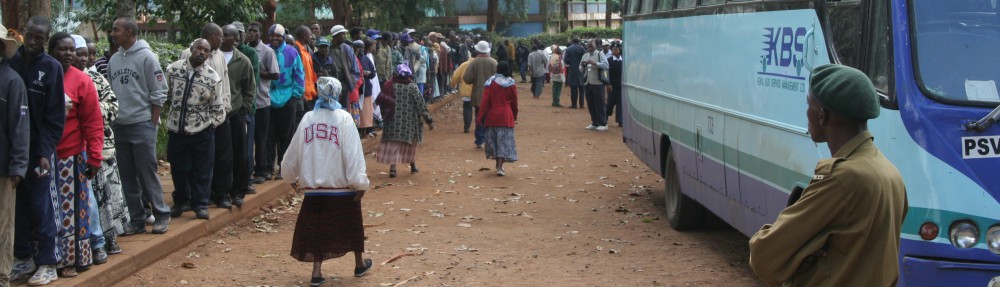
Roadside Still

Roadside Still by AfriCommons
Roadside Still, a photo by AfriCommons on Flickr.

For my friends at the African Studies Association annual conference this week . . .

The U.S. “official” infatuation with Kenya, in numbers

I’ve spent some time looking at “Official Development Assistance” (“ODA”) numbers for Africa to test my perception that the U.S. seems, for some reason that is hard to pin down, to give an inordinate amount of “development” money to Kenya.

At play Monkeys at play on UN vehicle

Sure enough. Going through the ODA summaries by country from the OECD, for each of 47 countries in continental Africa, we find plenty of verification of this. The U.S. is the leading bilateral ODA donor for 25 of the 47, including Kenya (Kenya’s number two donor is Japan). Kenya is the number three recipient of bilateral ODA from the U.S. for a 2010-2011 annual average (the most recent listing) of $642M, behind only the Democratic Republic of Congo at $1,053M and Ethipia at $791M.

On a per capita basis this is $15.53 for DRC, $15.43 for Kenya and $9.34 for Ethiopia. What about “need” based on poverty? PIn the DRC the Gross National Income (GNI) per capita is $190; in Ethiopia $400. Kenya, on the other hand, has a GNI per capita of $820, more than double that of Ethiopia and well more than four times that of the DRC.

Across the continent as a whole, Kenya ranks ninth in per capita U.S. ODA. Three countries of those getting more per capita are special cases: Liberia and South Sudan, post-conflict states where the U.S. has a special historic relationship and responsibility relating to the founding of the country itself and Libya, an immediate post-conflict situation where the U.S. government was instrumental in supporting the removal of the prior regime. All of the recipients ahead of Kenya except for the DRC have relatively small populations.

Among the five countries of the East African Community, Kenya receives both the largest amount and the most per capita in ODA from the U.S., even though its GNI per capita is by far the largest:

Country        GNI Per Capita      U.S. Bilateral ODA      Per Capita      Rank/Reference

Burundi           $250                             $48M                      $5.58        2 (1-Belgium 161M)

Kenya             $820                              $642M                   $15.43       1 (2-Japan $139M)

Tanzania         $540                             $546M                    $10.74          1 (2-UK $219M)

Rwanda           $570                             $167M                   $15.32           1 (2-UK $121M)

Uganda           $510                              $388M                   $11.24           1 (2-UK $163M)

————-
And a sampling of other countries of interest:

Somalia           —-                                 $90M                      $9.38           2 (2-UK $107M)

C.A.R.           $470                                $16M                      $3.56           3 (1-France $29M)

Malawi          $340                                $140M                    $9.69           1 (2-UK $126M)

Mali               $610                                $232M                  $14.68          1 (2-Canada $106M)

Niger             $360                                  $97M                     $6.02          1 (2-France $56M)

Chad              $690                                $124M                    $10.75       1 (2-France 45M)

Famed photojournalist Mo Dhillon responds to AU on the ICC trials: “African Unity leading Africa towards disaster”

Sir Mohinder Dhillon, renowned Kenyan photographer, photojournalist and filmmaker shared this new essay which he also submitted to the ICC judges:

“GADDAFI AND MUSEVENI”
Gaddafi and Museveni

African Unity leading Africa towards disaster.

I’d like to challenge the AU to tell me which tribunal or judiciary in Africa will ever convict a sitting Head of State. This attempt to renege on a commitment to the ICC is nothing more than a sinister plot by Africa’s dictators to save themselves from any kind of accountability. It was initiated by the late Colonel Gaddafi, who bailed the AU out of a financial crisis, thereby buying the loyalty of other African leaders whose necks were also on the line. To save himself from international justice, he wanted Africa out of the reach of the ICC. Shame on such leaders! Contrary to any suggestion of restoring national sovereignty, the aim of these people is for Africa to be out of the Rome Treaty so that they can continue with their evil intentions where money and power counts for everything and the ordinary African can rot.

Our memories in Africa are very short, particularly in the case of perpetrators of genocide, rape and murder. Those who support the AU line that accused Kenyans should be tried locally should remember that not so long ago Parliament and other local bodies preferred to hand over cases to ICC. Remember the slogan that was on the lips of all Kenyans:  “Don’t be Vague, Ask for Hague”. Kenya was given 12 months to put their act together and they did not move an inch. Kenyan authorities were going to investigate several thousand of other perpetrators but none was investigated due to lack political will despite some of perpetrators were recognizable carrying out crimes against humanity. AU is becoming laughing stock in promoting impunity.

The early history of Kenya’s ICC cases seems already to have been forgotten. After the post-election violence in 2008, the Peace Accord appointed the Waki Commission which produced 529 pages report on 16 July 2009 along with 6 boxes of documents and supporting material. A sealed envelope containing names of those considered most responsible for the violence was given to Kofi Annan as mediator.   Kenyan Government tried for one year to establish a local tribunal but parliament blocked this, leading to the involvement of the International Criminal Court.  The ICC Prosecutor, Luis Moreno Ocampo opened the envelope, inspected its contents and re-sealed it, before proceeding at Kenya Government request to carry out investigations and develop the resulting cases for ICC.

Kenya must smell the rat behind the intentions of our neighbours in Ethiopia, Uganda and Sudan, who are guilty of gross human rights violations in their own countries. Most recently, these include muzzling the media and arresting journalists and civil rights workers, but there is a long track record of crimes against humanity in each country. The AU has failed miserably to bring the perpetrators to book, as have the local judicial systems.

Until fifteen years ago, I filmed all the OAU meetings since its inception in 1963. For most of that time, the fight against apartheid in South Africa was the only factor that held this organisation together – otherwise I’m sure it would have disintegrated. It is a matter of record that crimes against humanity on the rest of the continent have far outweighed the evils of apartheid both in terms of scale and sheer lack of accountability. Why the double standard?

It is abundantly clear that most of Africa’s leaders are more concerned with protecting themselves than they are with securing justice for ordinary people. Although we in Kenya have made enormous strides in securing personal freedoms over the last twenty years, I am deeply concerned about the negative influence of our dictatorial neighbours in Uganda, Sudan and Ethiopia, where media houses are being closed down for flimsy reasons, where opposition is not tolerated and large numbers journalists and activists languish in dungeons without being charged. Kenyan genocide victims need closure just like the victims of Charles Taylor in Liberia, where the ICC was applauded for a job well done. There can never be adequate compensation for loss of life, limbs or dignity but at least some measure of justice was served.

Members of Kenya’s Government are shouting empty slogans about protecting their sovereign rights, in complete contradiction of their earlier position. I trust that the Kenyan people can see for themselves the total insincerity of those who are driven by nothing more than fear for themselves, and total disregard for the victims of violence. . . .

Here is the whole document: African Unity leading Africa towards disaster (5)


EAC: Complaining of “lack of democracy and ideological disorientation” holding back Africa, does Museveni have any self-awareness at all?

American President George W. Bush meets with P...

American President George W. Bush meets with President Yoweri Museveni of Uganda Friday, July 11, 2003 in Entebbe, Uganda. (Photo credit: Wikipedia)

From the Daily Monitor, “Museveni faults Africa” 

President Museveni has said the “lack of democracy and an Ideological disorientation” are some of the 10 bottlenecks that have kept Uganda and many African countries listed as Least Developed Countries.

The President told the East African Legislative Assembly meeting in Rwanda that the continent suffers an “ideological disorientation whereby the reactionaries fragment the African people into sectarianism of tribe, religion and gender chauvinism”.

The statement does not, however, elaborate what he meant by absence of democracy. He added that Africa continues to lag behind despite being “favoured by God and nature.”

For a different take on Museveni’s “State of the EAC Address” see this report from the EAC website.  The discussion here picks up on Museveni’s call to go beyond economic integration to “Political Federation”.

GADDAFI AND MUSEVENI
Gaddafi and Museveni

Related articles

•  Uganda: new links for ongoing themes . . . (africommons.com)

•  More on Moi, KANU and Ruto meetings with Museveni (africommons.com)

•  Uganda’s Independent features CSIS report on risk of instability with NRM decline, Museveni succession (africommons.com)

•  Another Ugandan weapons procurement scandal? (africommons.com)

•  Enough to drive one to drink . . . Museveni on Gaddafi (and Western company bribes to Gaddafi) (africommons.com)


Is Uhuru on his way to being the next East African authoritarian American darling?

Uhuru Kenya presidential campaign rally trash

Before noting the choice of speakers for the Uhuruto inauguration, the idea that governance in Kenya might be in the process of falling in line with its East African neighbors has been much on my mind since the IEBC’s decision on the election on March 9.

Museveni as the featured speaker–and what he had to say–certainly fits this theme.  Museveni can readily castigate the ICC and “the West” for meddlesome advocacy of international standards, knowing that he has a mutual “security” relationship at a deeper level with the United States.  He gets criticized by the U.S. for changing the constitution to stay in power, and for taking and keeping control of the Ugandan electoral commission–but without discernible “consequences”.

Uhuru himself in his speech said nothing about corruption–a major theme in the KANU to NARC transition and the original Kibaki inauguration, and well understood to be the Achilles Heel for Kenya’s economy.  And as I have noted before, the Jubilee platform’s only “plank” relating to governance is a proposal for active state intervention in the civil society arena.

Museveni and his NRM have been associated with the KANU of Moi and of Uhuru and Ruto over the years and at some level Kenya post-Moi has been an outlier in the East African Community of Uganda, Rwanda, Burundi and Tanzania.  As well as Museveni, one naturally thinks of Rwanda’s Paul Kagame and the recently departed Meles Zenawi in Ethiopia as authoritarian heads of state who could count on strong support in Washington at a variety of levels–both in terms of underlying security relationships and friendships with American politicians who could be counted on for advocacy in the face of international controversy.

Uhuru himself, quite the contrary to his short-lived campaign rhetoric this year as an ICC indictee, has been a favorite Kenyan politician of many in the American establishment.  He talks the talk well.  He was educated in the U.S. and has been a frequent visitor.  A “family friend” of former Assistant Secretary of State Frazer by reputation.  Rich even by American standards, and a business owner whose inherited fortune was generationally cleansed from openly kleptocratic political origins.  Before the confirmation of the ICC charges but after the 2008 post-election violence when the issues with the alleged funding of the Mungiki attacks in Naivasha and Nakuru were well known, he was a primary lobbyist for the Kenyan government in the U.S. seeking things like a Millennium Challenge Corporation Compact.  Before the 2007 election, he entertained official American visitors including Senator Obama as the “Official Leader of the Opposition”.  He was singled out for positive recognition in a report by CIPE, the Center for International Private Enterprise (the National Endowment for Democracy’s core institute under the United States Chamber of Commerce) and was spoken of in government as a Kenyan who “says the right things”.

A U.S. foreign policy establishment view on how the United States should deal with a Kenyatta administration was offered in a Foreign Affairs piece by Bronwyn Bruton of the Atlantic Council just before the election:

. . . In all likelihood, the first round of voting will lead to a runoff election on April 10 between Raila Odinga, the current prime minister of Kenya’s hastily-constructed unity government, and Uhuru Kenyatta, Kenya’s deputy Prime Minster and the son of Kenya’s first president. The tightness of the race bodes ill; it is unlikely that either side will be able to score a quick victory, and it will not take much vote rigging to influence the election’s outcome. The losing party is virtually certain, therefore, to contest the results. Some violence, in other words, seems all but assured. The question is how long it will last, whether it will spread nationwide, and how many people will be displaced, injured, or killed…

Most of the piece is behind the firewall so I won’t copy it here, but she goes on to argue that U.S. interests counsel what I would characterize as essentially a business as usual approach to Uhuru (and by implication of course Ruto) unless and until they end up eventually convicted by the ICC.  I shared this with a friend in Washington with the comment that this could be read as a Washington argument not to get too exercised if Uhuru helped himself to some extra votes to win–the risk of instability was very high and the downside to having Uhuru in office wasn’t that great.

The Carter Center has released another round of reporting on the election, “slamming” the IEBC, but concluding with a factually unsupported pronouncement that in spite of the electoral commission’s many failures their announced result happened to “reflect the will of the Kenyan people”.  This was language being tossed around in certain circles before the election with reference to Moi’s races back in the ’90s.  How to say an election is bad but the incumbent or other beneficiary of the state misconduct would have won anyway? The big difference in 2013, of course, should have been that the Kenyan voters had approved–with much U.S. support–a new constitution that was supposed to end the “first past the post” system that so benefited Moi and require a “runoff to majority”.  When you read the Carter Center report it is clear that there is no way they can offer any substantive assurance at all for the IEBC’s award of just enough to Uhuru to avoid that runoff.

But, there are interests at stake besides justice–there is also “stability”, and “peacekeeping” troops in Somalia, etc., etc.

So we shall see.  I hope for the best for Kenya, but the Uhuruto ascendancy looks to me like a big win for tribal chauvinism and a real step back in terms of democratic ideals.  Kenya is very different from either Rwanda or Ethiopia, and from Uganda, too.  Whatever excuses one makes for Kagame and Museveni in their own postwar environments, to me, ought not to apply to Kenyatta or Uhuru in Kenya.
How is IGAD’s “diplomatic observation” regarding Kenya’s election process helpful?

Africa Review reports on the statement of the Inter-Governmental Authority on Development (IGAD) from this week’s visit to Nairobi by executive secretary Mahboub Maalim (himself a Kenyan) and others from the Addis headquarters under the headline “IGAD confident of peaceful Kenya election”:

In his statement, Mr Maalim said: “Igad has come to the conclusion that Kenya’s election is not an event. It is a process and that March 4th is not the end; it is the beginning of a process that could last till June 2013. Kenyans must therefore brace themselves for the long haul.”

Mr Maalim said the Independent Electoral and Boundaries Commission (IEBC) and the judiciary are crucial for the success of the polls.

“The efficiency of the IEBC during the voter registration process must be lauded. We expect that the same efficiency will apply to the March 4 poll. This is critical if Kenya is to avoid petitions arising from IEBC system failure. The efficiency and believability of the Supreme Court in dealing with the presidential election petitions is also critical. This will determine whether or not the transition is successful,” the Igad executive secretary said.

He said IEBC should be encouraged to conduct a systems dry-run with peer reviewers to seal any loopholes that would affect its efficiency.

Dr Kimani said the recent party nominations in Kenya were inclusive, open and transparent and that it was what the rest of the region had expected.

Igad brings together six countries in the Horn of Africa – Djibouti, Ethiopia, Kenya, Somalia, Sudan and Uganda – for development and drought control in their region

“Party nominations were inclusive, open and transparent”. Wow, that is certainly a unique perspective that contradicts the reporting in the Kenyan and international press, the reporting of Kenyan civil society umbrella KPTJ, and, for example, the reporting of the Center for Multi-Party Democracy-Kenya which is a well established and leading presence in Nairobi on these matters. So who is right here? Might it be relevant that IGAD is an organization of governments that are all far more “challenged” in terms of democratic practices in general, and elections specifically, than even Kenya in the wake of power-sharing and the debacle of 2007, along with the Government of Kenya itself?

I am all for whomever exhorting peace, although I am substantially skeptical that official pronouncements of this type have actual impact on ultimate behavior. Likewise, I am all for encouragement, hope and reasoned, well-grounded optimism in the context of pushing for the best election possible from where things really stand today. But this type of statement about the primaries is a “diplomatic” position rather than an observation or representation of fact. It undermines the credibility of whatever else is said in the same statement as being connected to the facts. At best it is unhelpful–it might be dangerous.

A few links to set the scene as we approach 30 days to Kenya’s vote . . .

Jay Naidoo of The Daily Maverick writes from “the Mukuru Kwa Reuben slum, one of the largest in Nairobi” with an unknown population size: “I have a right to a toilet–it’s human dignity”.

An update on the preparation for Kenya’s citizen digital “crowdsourced” monitoring/mapping effort, using the Ushahidi software: “Uchagazi Community Next Steps”.

H/t to the UN Dispatch blog for noting another official pre-election delegation in Nairobi: “Kenya: UN official stresses need for peaceful and transparent elections”:

“Kenya’s elections will be watched closely around the world,” Under-Secretary-General for Political Affairs Jeffrey Feltman said during a visit to Nairobi, the capital.

“Let me take this opportunity to appeal to all Kenyans to exercise their democratic right and participate actively – but peacefully – in the elections,” he said. “Let me also underscore the responsibility shared by leaders at all levels to abide by legal mechanisms and to send a clear message to supporters that violence of any kind would be unacceptable.”

Mr. Feltman, who oversees UN support to elections globally in his capacity as Focal Point for UN Electoral Assistance, commended the electoral authorities for their preparations and underscored the readiness of the UN to continue providing financial and technical assistance to the electoral process.

In the category of “open government initiatives,” and “what’s good for the goose is good for the gander,” the Project on Government Oversight (US) is asking citizens to push the White House to finally fill the vacancy for the the Inspector General for the State Department:

Inspectors general are independent watchdogs within federal agencies that are essential to a well-functioning government. They conduct audits and investigations that identify wasteful government practices, fraud by individuals and government contractors, and other sorts of government misconduct. Congress and the public rely on their reports to hold agencies and individuals accountable for wrongdoing, identify a need for legislation, and evaluate the effectiveness of government programs and policies.

Unfortunately, President Obama went his entire first term without nominating an inspector general for the State Department. At over five years, the State Department opening is the longest running vacancy among federal agencies.


Wycliffe Muga in The Star on “Why we should not dismiss foreigners”, with an example from his own experience in Kenya, but perhaps a universal lesson.

In the category of “it could be worse”: “Is a military coup Museveni’s last line of defense against NRM rebels?” asks Gaaki Kigambo in The East African.


Friday Reading [updated]

Update–here is a new blog post from Progressio on the Somaliland election: “Election hots up, but remains largely peaceful.”

Somaliland election–preliminary observation report due on Monday.. Initial impressions are generally positive.

Turnout is low in Kenya’s voter registration so far.

The legal petition challenging the legal eligibility of ICC defendants Kenyatta and Ruto to seek the Kenyan presidency was suddenly dropped Thursday. The civil society petitioners’ lawyer, Ambrose Weda, “promised” an amended re-filing that would also seek an eligibility ruling on the other 3 candidates, Kalonzo, Odinga and Mudavadi:

There had been speculation that the group withdrew their petition as a result of pressure. Lawyer Ambrose Weda denied this, but in an interview with DW’s “Africalink”, political analyst Martin Oloo said he believed that they been under intense pressure and that “with the passage of time, we’ll get to know the details.”

Kenya National Commission on Human Rights has released a detailed report on the Tana River violence: well organized and planned attacks and killing. Fundamental tension over resources will remain unless/until solved. Download “28 Days of Terror in the Delta”.

Andrea Bohnstedt in The Star: “Anti-Corruption Fight in Uganda Seems Dead”.

James North in The Nation on M23, the DRC, Rwanda and the West.

U.S. Policy Toward a Post-Election Democratic Republic of Congo, Feb. 12, 2012 Testimony of Daniel Baer, Deputy Asst. Sec., Bureau of Democracy, Human Rights and Labor, before House Subcommittee on Africa, Global Health and Human Rights; Testimony of Don Yamamoto, Principal Deputy Asst. Sec, Bureau of African Affairs, Dept. of State; Testimony of Sarah Mendelson, Deputy Asst. Admin. for Democracy, Conflict and Humanitarian Affairs, USAID.

Uganda: New links for ongoing themes . . .

Uganda will review its commitment of forces to the AMISOM mission in Somalia due to being “stabbed in the back” by accusation of arming rebels in DRC.

Today, Uganda’s Media Council ordered suspension of a play entitled “State of the Nation” about corruption and poor governance, pending a “review”.

The Ugandan Speaker of Parliament, Rebecca Kadega, is attracting popular support for standing up to pressure on a recent trip to Canada on the longstanding “anti-homosexuality” bill, and rejects the notion that she should block debate on the bill to appease aid donors or avoid visa suspensions.

In the meantime, two patients from a road accident reportedly died after the ICU in Uganda’s largest hospital closed recently due to lack of equipment:

According to a research paper published by the Bio Med Central Journal, Uganda has only one ICU bed for every one million Ugandans. The paper reveals that critical care remains neglected with many patients with potentially treatable conditions unable to access services.

Ideally, with Mulago’s 1,500 bed capacity, at least 150 of them should be in a high dependency ward for people who need more intensive observation and treatment.

Other departments that have ICU beds in the hospital are the pediatric ward (4) which are not working, the Heart Institute (4) and the Cancer Institute (3) while the general ward has 12 beds with no equipment. Other public hospitals that have functioning ICUs in the country are Mbarara, Lacor, Gulu and Jinja.

h/t Rosebell’s Blog on Twitter

VOA reports that Britain has joined Ireland in an aid suspension over corruption in the Prime Minister’s office (although apparently the Irish suspension is general, whereas the UK is apparently only suspending aid to that one office):

The money was meant to have been spent on helping the needy, and to help pay for a ‘peace recovery and development program’ in northern Uganda after decades of conflict and devastation.

The Ugandan government has pledged prosecutions. Two senior officials have been charged, while 17 others have been suspended as the investigation continues.

“This report does not surprise anybody,” said Dr. Fred Golooba Mutebi, a political analyst and a visiting fellow at the University of Manchester in the United Kingdom. The only shock, he added, “is the amounts of money stolen are quite colossal.”

"Freedom of expression is your right"

“FREEDOM OF EXPRESSION IS YOUR RIGHT”