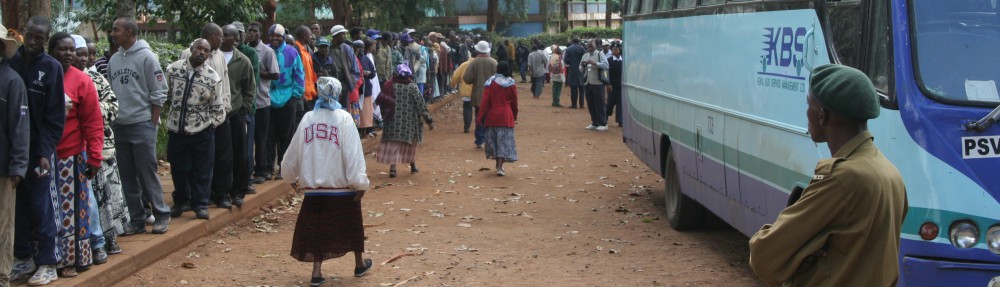
More economic news from Kenya while the campaign season continues to heat up

And in the key sector of immediate interest to the expat community, “Java House deal wins African investment award” from the Nation:

A multi-million dollar deal that saw Nairobi Java House sell a majority stake to a US private equity fund has won the Africa Investor of the year award in a ceremony that also honoured two Kenyan bank chief executives.

The transaction amount was not made public, but Mr Bryce Fort, the managing director of the equity fund, ECP, said at the time that it fell within the firm’s average deal size of about Sh5.1 billion ($60 million).

“The ECP is a strong believer in Africa’s growing middle class,” said chief executive Hurley Doddy in a video address to the Africa Investor summit after winning the award.

The Java House deal, which saw the Washington DC-based ECP acquire a majority stake in the Kenyan coffee chain, was made public early this year.

Here is the link to the story at Africa Assets.

Meanwhile, the IMF predicted 5.7% GDP growth overall for Sub-Saharan Africa in 2013 after 5% growth for 2012.

The Star reports that one group of analysts project that Kenya could near this average, reaching 5.3% growth in 2013 “but only if there is a smooth political transition with a clear winner in round one.”   The pre-election uncertainty and distraction of the campaign are weighing on the economy at present.

Upsidedown Freightcar

A key example of the progress and the frustrations in the Kenyan, and regional, economy, is found an op/ed column in the Sunday Standard from Polycarp Igathe, Chairman of the Kenya Association of Manufacturers, headlined “Inefficient railway system hurting national growth”:

Last month, I visited the port of Mombasa in the company of board members of Kenya Association of Manufacturers (KAM) and Kenya Shippers Council (KSC).

We witnessed firsthand, that at long last, chronic port congestion and inefficiencies are being tackled, bravely, by Kenya Ports (KPA), but timidly by Rift Valley Railways (RVR).

Gichiri Ndua, KPA’s Managing Director explained the gains, efforts and challenges at Kilindini port. Ship-to-shore gantry capacity has more than doubled, dredging of the port is complete and the new berth 19 is almost finalised allowing Port of Mombasa to handle a 16 per cent growth in cargo throughput. Some of the largest shipping lines are now able to call and enables Kilindini to become a transshipment port.

We confirmed that delays in cargo offtake and high cost of cargo transportation are the result of dismal failure in improving railway infrastructure in tandem with port infrastructure. Citadel Capital and Transcentury the major shareholders in RVR must simply know that they are failing the country in outstanding fashion.

Igathe goes on to write that the railroad bottleneck is a key impediment to regional growth, with Mombasa “the only port known in the world to rely 95 per cent on road freight”.  He hails reports of a new commercial contract between the Kenya Railway Corporation and China Roads and Bridges to start building a standard gauge rail line from Mombasa to Malaba as a “game changer”.  Read the whole piece for a Kenyan manufacturers perspective of what is needed for long term growth.

Friday Uganda Event in Boston; Kenya reading

Friday event in Boston: “Kony and the Lord’s Resistance Army: a State Department Perspective” at the BU Center for African Studies, 3pm

Jason Lewis-Berry, the Lead Foreign Affairs Officer in the State Department’s Bureau of Conflict and Stabilization Operations who has also served as Field Representative for Lord’s Resistance Army issues in Central Africa, will deliver this lecture @ BU. A Q&A session will follow.

“Kenya’s New Constitution: Political Musical Chairs and Inertia Taint Implementation” from the Institute for Security Studies:

27 August 2012 marked the second anniversary of the promulgation of Kenya’s new constitution. Hailed by some as one of the most progressive constitutions in Africa because of its comprehensive and liberal bill of rights, the new charter has been facing implementation challenges with suggestions that sections of the legislature and executive are bent on influencing the process for political expedience.  .  .  .

For those preparing for the Kenyan election, I recommend Muthoni Wanyeki’s recent paper “The International Criminal Court cases in Kenya: origin and impact,” also published by the ISS.  Wycliffe Muga’s column in the Star concludes “we are heading for a truly divisive election”.

The U.S. Senate Malaria Working Group, headed by Sen. Chris Coon of Delaware (Senate Foreign Affairs Africa Subcommittee chairman) and my Sen. Roger Wicker of Mississippi announced this week expansion into the Senate Caucus on Malaria and Neglected Tropical Diseases.  Hopefully, the Senate will soon be taking up confirmation of the Administration’s nomination of the Chargé d’affaires Robert Godec as the new Ambassador.

Secretary Clinton visiting South Sudan, Uganda and Kenya (including TFG meetings) on six nation Africa mission

Here is the official State Department language describing the diplomacy:

Secretary Clinton travels to South Sudan where she meets with President Kiir to reaffirm U.S. support and to encourage progress in negotiations with Sudan to reach agreement on issues related to security, oil and citizenship.

In Uganda, the Secretary meets with President Museveni to encourage strengthening of democratic institutions and human rights, while also reinforcing Uganda as a key U.S. partner in promoting regional security, particularly in regard to Somalia and in regional efforts to counter the Lord’s Resistance Army. She will also highlight U.S. support in the fight against HIV/AIDS.

The Secretary will then travel to Kenya where she plans to meet President Kibaki, Prime Minister Odinga, and other government officials to emphasize her support for transparent, credible, nonviolent national elections in 2013. To underscore U.S. support for completing the political transition in Somalia by August 20th, Secretary Clinton will also meet with President Sheikh Sharif and other signatories to the Roadmap to End the Transition.


Western storytelling, the East African “middle class” and how to account for “politics”

Here we have an interesting paradigmatic story from Der Spiegel, translated from German for their English version, “Up and Coming in Kampala; Africa’s Growing Middle Class Drives Development” by Horand Knaup and Jan Puhl:

Three good anecdotal stories here of successful start-up African businesses generating local jobs and wealth through import substitution with domestic production. They help to grow a domestic consumer market and ultimately look to export as well. One of the two in Uganda got significant assistance from the national government and the Kenyan business got financing from a German international development arm.

She earned her starting capital by importing clothes from the West, but then she began designing her own collections, and soon “Sylvia Owori” was the most popular label among women in East Africa.

Owori has her collection produced by seamstresses in villages. She has trained 200 women and sponsors the purchase of their sewing machines. “When I receive a big order, I can deliver quickly and flexibly,” she says. On the other hand, she says, the women can stand on their own feet when she doesn’t happen to have any work for them.

Her latest creation is a denim laptop bag shaped like the map of Africa. “This bag was once a pair of jeans,” she says. “You threw it into a container for old clothing and sent it to Africa. We made something new out of it and will sell it back to you.” Swedish fashion giant H&M is interested in the bag, and two other Western fashion chains have asked Owori to meet with them in London.

It’s a question of finding new ways to stimulate economic growth. The corrupt oligarchies in many African countries have made money from the export of commodities, but only a fraction of the population has benefited from the proceeds. The growth being generated by Africa’s middle class is more sustainable, say development experts. Much of it is based on the processing of African fabrics, wood and fruits, and it creates jobs.

Good examples of what is going right and working, from two of Africa’s 50+ plus countries. Well done as such.

“She is the epitome of a success story. And success stories are no longer a rarity in Africa, despite its reputation as a continent of poverty and suffering.” Right and important.

But then we get into the broad assertions and big selective extrapolations. “This growth is producing a middle class that’s growing from year to year. According to the African Development Bank, this middle class already includes 313 million people, or 34 percent of the total population.” To say that “this middle class” includes roughly a third of the population of the entire continent is to me quite misleading in the context of this story,

Continue reading →

Mudslides, Terrorism and Tourism

The death toll rose to three from the grenade attack on a nightclub north of Mombasa Sunday. In the meantime, in the Mt. Elgon region, on the Ugandan side of the border, there are 18 confirmed deaths from this season’s current mudslides, with 450 missing.

The Kenyan government protested the U.S. warning about a threat of attack in Mombasa as “economic sabotage” given the obvious potential impact on tourism, as well as a “betrayal of trust”, while insisting that it was ahead of the game and fully cooperating with U.S. agencies to stop any such planned attacks. Contrary to some initial reactions on twitter, the local bar attack was clearly not the kind of event that the American Embassy was warning about.

At the same time, Mombasa residents have accused security agencies, especially the National Intelligence Security Services (NSIS), of sleeping on the job.

“As residents of Mombasa, we are disturbed by these attacks which are occurring without any arrests. The police should work around the clock and arrest people suspected to have committed the incident,” said Mr Abdul Abdulla.

Since Kenya sent troops to Somalia last October, a series of explosions have rocked Nairobi, Mombasa and North Eastern region in what is believed to be retaliatory attacks by the Al-Shabaab.

Meanwhile, some American and British tourists on Monday down-played the travel advisory, saying the country was safe.

Mr Kevin Schmidt from California, USA, has been in the country for three weeks and said: “A lot of it is precautionary, they (US government) want to make sure everybody is informed,” he said.

“Man arrested over attack at drinking den,” Mark Agutu in the Daily Nation.

The bigger terrorism issue relates to the seizure of bomb making materials tracked to the port from Iraq and the arrest of two suspects thought to be Iranian.

“LRA nutures the next generation of child soldiers”–IRIN story from the DRC

I thought I should note a very interesting story today from IRIN, the news service of the UN Office for the Coordination of Humanitarian Affairs.

FARADJE, 26 March 2012 (IRIN) – The dilemma for Atati Faustin, 13, from Faradje in Haut-Uélé District, northeastern Democratic Republic of Congo (DRC), is that although he misses his younger brother – abducted into the ranks of the Lord’s Resistance Army (LRA) two years ago – he is also afraid of being reunited with him.

“I want my brother back,” he told IRIN, “but if I see him I would run. I am scared of him. I feel like he has died.”

Displaced with about 1,300 people from the nearby village of Kimbinzi in 2008 following repeated LRA attacks, and relocated to Ngubu, a camp for internally displaced persons (IDPs) on the outskirts of Faradje, he has not yet encountered him, but others in the community have – dishevelled, with dreadlocks, and carrying an AK47 assault rifle and a panga.

Kimbinzi is about 7km from the camp and occasionally some villagers return under a military escort provided by Armed Forces of the DRC (FARDC) to till the fields, as crops planted on land provided for them close to the River Dungu are routinely destroyed by hippos. Only young men return (during daylight hours) to Kimbinzi in a phenomenon described by relief workers as “pendulum movement” – women and children stay in the relative safety of Ngubu. .  .  .
Ugandan aid worker George Omoma has tracked the carnage left in the LRA’s wake across three countries, where children are not so much collateral damage, as the focus of LRA activity.

“Kony tells his people that it is not you [adults] that will overthrow the [Ugandan] government, it is the children. He wants to create a new generation of the LRA,” Omoma told IRIN.

Omoma is in Dungu helping to establish a rehabilitation centre for child victims of the LRA by the Catholic Church and NGOs Sponsoring Children and the San- Diego-based Invisible Children. When operations start later this year, the facility will be able to provide accommodation, counselling, training and education to hundreds of former child soldiers and abductees. .  .  .  .

Breeding child soldiers

Dominic Ongwen has risen through the ranks to become the LRA’s most senior commander in the DRC and is the armed group’s most notorious example of a kidnapped boy forced into child soldiering and who is now wanted for crimes against humanity and war crimes by the International Criminal Court.

Sam Otto Ladere has appeared on the radar with a similar personnel history to Ongwen. He commands a group of 17 fighters falling under the command of Vincent Okumu Binany in the DRC.

Matthew Brubacher, political affairs officer working with the UN Stabilization Mission in the DRC’s (MONUSCO’s) Disarmament, Demobilization, Repatriation, Reintegration and Resettlement (DDRRR) unit, and an LRA specialist based in the eastern DRC city of Goma, told IRIN Ladere was abducted at a young age from a village west of Gulu.

“Ladere is one of the up and coming commanders. He is very trusted. This was evidenced by his being placed as chief of intelligence after Maj-Gen Acellam Ceasar was suspended following the execution of Lt-Gen Vincent Otti on 2 October 2007, even though Ladere was only a captain,” he said. DDRRR is working on a radio message on their FM network to try and lure him out of the bush.

Omoma said former abductees and child soldiers had told him of Ladere’s brutality.

Kony has taken many wives. At the Juba peace talks in 2006 it was estimated he had about 80 wives and it is unknown how many children the rebel leader has fathered.

“I don’t know how many Kony kids are active in the LRA, probably quite a few. There are a few bush kids now that were born and bred in the LRA. They are pretty wild when they come out as they have never known civilization,” Brubacher said.

Certainly the idea that the LRA has been able to continue to fester and mutate and perhaps in part replicate should be given some consideration in evaluating what priority to place on military efforts against the relatively small number of active fighters that appear to remain at present.

“KONY2012”: Bigger than “Out of Africa”, and probably better

More than a week ago I promised my daughter a post about KONY2012.  Seeing as how I changed her life by moving her to Kenya for the seventh grade four years ago I allowed that this was a reasonable request, and agreed to do my best (even though I was inclined to not to write on the subject otherwise).

In the meantime, I agreed to lead a Sunday School discussion about the video for this morning, so I had to work through how to address the complexity of issues in a very brief overview for a general audience of my contemporaries who are not “East Africa junkies” who would read this blog, but who came to the issue initially primarily as parents of children impacted by an unusual and interesting cultural phenomenon in the form of this video that “went viral” in an unprecedented way.

From a Sunday School perspective, we talked briefly after watching the video about our responsibilities to be aware of things going on with “our neighbors” in the world and finding effective ways to respond. We were struck by the notion that our children were being reached and moved, and in some cases perhaps manipulated in different ways with Facebook and YouTube, etc. as opposed to what we grew up with. We touched on the issues about lobbying for a specific military response to a unique situation involving several countries. And we certainly recognized and appreciated the talent applied to making a video that had us all thinking and talking about Uganda and the DRC, Sudan and South Sudan and the Central African Republic.

Recognizing the video as aimed primarily at an American audience with ancillary worldwide distribution in our spontaneously globalized communication sphere may help to see this in a different way that I think might be constructive. It’s a viewpoint that I eventually stumbled into after reading a lot of Ugandan, aid-focused, “Africanist,” marketing, tech and media commentary–much of which is important and useful, but left me unsatisfied as well.

If we look at this as a Southern California American film about East Africa, and compare it to Out of Africa, The Constant Gardener and The Last King of Scotland, maybe we can appreciate the genius of the use of the medium in a way that has captivated so many millions of people, a way that is a little more current, and aspires to accomplish something more.

Of the cultural events in the United States in my lifetime that have some real connection to East Africa, “Obama2008” is surely the biggest, but “KONY2012” has eclipsed the big one from back in my day, the 1985 Sydney Pollack film Out of Africa starring Robert Redford and Meryl Streep. Romanticized nostalgia for a whitewashed version of European colonialism in Kenya with two of Hollywood’s biggest and most appealing stars had some real influence, and still does to this day. The image is good for American tourism to Kenya–so from a “chamber of commerce” viewpoint this has been in a way positive–there is money to be made from this nostalgia.   But it was probably a setback toward getting Americans to grant full agency to black Kenyans and indirectly contributed to the depersonalization that facilitated our support for the “one party state” of Moi, continuing right up through the problem of Kenya’s “Invisible Voters” in the 2007 election.

For Americans of a certain age,Out of Africa is right there along with Born Free and Mutual of Omaha’s Wild Kingdom in our images of East Africa.  Robert Redford alongside Ernest Hemingway.  By the mid-80s we had started to really settle on heroic images for the leadership of the civil rights movement in the United States–if Hollywood had produced a blockbuster about the Kenyan democracy movement instead of a European story set in colonial fields, some of us might have been inspired rather than just charmed and entertained.

In The Constant Gardener, a more fictionalized but topical LeCarre story, we have flawed but sensitive and aware white Europeans trying to fight the evil designs of their fellow outsiders in Kenya and the region. We even see Kibera and dance the dance and feel the vibe. But of course it is all doomed to failure.  None of that naive “new world” hope here, thank you.

In The Last King of Scotland, we move to Uganda, so in a sense we are getting warmer, and invent a white character to interact with the snippets of past history of African debauchery because that’s easier than imagining a Ugandan who could really tell us about all this, and in whom we will be as interested.

KONY2012 comes in at slightly under 30 minutes, so its quite a bit shorter than these full length feature films. But it’s more ambitious and packs a punch. It has been seen by millions and motivated thousands of those to actually read and learn something about Uganda and bordering countries today. It addresses a strange situation in which Congress passed legislation and the administration has sent U.S. troops to chase a foreign “warlord”. Most Americans were apparently completely unaware that this had even happened, and millions more now know. Sure, the video is going to strike Ugandans as patronizing (I live in Mississippi, so I know about being patronized, and how tiresome it can be, as well as the pain of an image that accentuates the worst and the past rather than the present and ignores the trajectory), but in the context of “Hollywood” film, KONY2012 can also been seen as representing some significant generational progress. We are only 18 years after apartheid and 27 years after Out of Africa. The filmmakers themselves may not be master strategists of conflict resolution and criminal justice, international relations and aid effectiveness–but there is surely here some authentic spark of passion that does recognize a common humanity with the victims of violence that when shared seems to be something more hopeful.  Something that this upcoming generation can chose to be inspired by and make use of.

And do check out the LRA Crisis Tracker alongside this academic article, “Culture, Cultivation and Colonialism in Out of Africa and Beyond.”

Economist’s Boabob Blog features UCSD work on “smart” election monitoring

More great work to fight election fraud from my former colleagues on the USAID/UCSD/IRI Kenya exit poll, Clark Gibson and James Long:

“African elections:  How to save votes”

COULD smartphones help reduce electoral fraud in Africa and in other regions? At a recent forum hosted by the Brookings Institution on the ways that wireless technologies are affecting politics in various countries, Clark Gibson, a professor at the University of California, San Diego (USCD), presented findings from experiments in Afghanistan and Uganda which suggest that they can. Local researchers were deployed to polling stations armed with digital cameras and smartphones to take photographs of the publicly posted election tallies. The research found that this alone can cut electoral fraud by up to 60%.

The experiment was first developed during the 2010 Afghan elections by James Long and Michael Callen, then UCSD graduate students, with funding from the Development Innovation Ventures section at the United States Agency for International Development. . . . The research concluded that as a result electoral rigging was cut by 25% in the polling stations in the treatment group and the theft of ballot boxes and other election materials was reduced by 60%.

Mr Gibson replicated the experiment during the Ugandan presidential election last year, using a bigger sample of 1,000 polling stations scattered all around the country.  .  .  . using a special app developed by engineers at Qualcomm, a big technology company based in San Diego, the researchers this time were able immediately to send their data back to a server at UCSD. Academics there could then check to see if the voting numbers had been falsified by looking for give away number-patterns. They found again that vote tampering and ballot-box theft were much lower among polling stations that had received warning that a photo would be taken of their tally than among those that did not.

The technology is relatively cheap—smartphones cost around $250—and allows  more locals to get involved in monitoring elections. There is a great hunger for democracy in Africa and elsewhere, says, Mr Gibson, you can tell just by looking at the queues of voters who turn out on election day. Nothing is more dispiriting than to learn that their vote has been manipulated.

Unfortunately we didn’t have funding for separate electronic verification efforts in Kenya in 2007, but this should be that much cheaper and more readily feasible in Kenya for 2012/13. Knowing what happened last time there is no excuse not to have digital image verification this time.

More Kenyan-U.S. Diplomatic History: Kenyatta’s health and succession; status of whites; military assistance

For those of us who would still like to have a better understanding of what went wrong with the last Kenyan election, and how to do better this year, it’s worth taking advantage of the passage of time (and the declassification and publication of the kind of things that we don’t have yet from 2007) to see more clearly how U.S. and Kenyan leaders have interacted over time.  And in looking at the 1970s, while Kenyatta is no longer with us, he casts a broad shadow, and Scowcroft and Moi are of course very much still around.

MEMORANDUM

  • OF CONVERSATION
  • PARTICIPANTS:
  • Brent Scowcroft
  • Ambassador Anthony D. Marshall
  • Robert S. Smith
  • SUBJECT:
  • Current Situation in Kenya

NATIONAL SECURITY COUNCIL

DATE & TIME: Wednesday – October 13, 1976 5:45 p.m.

PLACE: Scowcroft’s Office

Ambassador Marshall summarized the present security and political situation in Kenya. The GOK very much appreciated our moral support during the Uganda crisis. They believe this brought the Ugandans to the conference table. Ambassador Marshall remains pessimistic, however, about Uganda’s capacity for destabilizing Kenya. He does not expect an invasion, but he does see the continuation and increase of terrorist activities from Uganda. Nevertheless, he thinks that the ultimate threat to Kenya comes from Somalia with Soviet support. He also sees Tanzania’s economic difficulties and political policies affecting Kenya.

Ambassador Marshall believes that our interests in Kenya are to see the country remain stable. Military and economic aid and political reassurances from us can help. He sees Kenya as a buffer among the East African states and a means of slowing down Soviet penetration in East Africa. He believes that continuing stability in Kenya might even turn some of the other countries in the region to Kenya’s way of thinking. [Note: Unfortunately, African nations do not learn economic stability from one another.]

Ambassador Marshall said we have excellent bilateral relations with Kenyatta. Kenyatta is very pleased to be receiving our arms aid even though we are one of several suppliers. We have stressed the defensive purpose of our arms aid.

Ambassador Marshall turned over to General Scowcroft a letter from President Kenyatta to President Ford. It covers two principal issues. One is the possibility that the U.S. will provide a “fly past” in Kenya on December 12, Kenya’s independence day. This was discussed by Secretary Kissinger when he was in Nairobi in September. General Scowcroft knew of the proposal but did not know whether there would be an aircraft carrier available in the area at the time. If not, he said the planes could be ferried down.

The second important issue in the letter is Kenyatta’s prospective visit to the United States. Unfortunately, according to Ambassador Marshall, although Kenyatta knew about the trip in advance of Secretary Kissinger’s visit, he had not told his staff about it. The room was full of people when Secretary Kissinger brought it up and the invitation for November 10 drew a laugh from staff members who could not understand the implications of a date which followed our elections. Kenyatta himself did not understand that, in the event that President Ford was defeated, he would still be in office until late January.

General Scowcroft inquired as to Kenyatta’s health and the prospect that he could really travel to the U.S. Ambassador Marshall explained that Kenyatta has a blood clot which occasionally causes total unconsciousness for periods up to one and a half days. This has occurred three times in the past year. The rest of the time Kenyatta is in good health for a man of 84.

Ambassador Marshall noted that a move to change the constitutional provision for a 90-day Vice Presidential succession when the President dies was squashed. Nevertheless, said Marshall, we should not put all our eggs in Vice President Moi’s basket. There are other potential candidates and so far Kenyatta has not named anyone. [Note: There are indications Kenyatta does not favor Moi.] Marshall said that part elections which are expected in early 1977 (for the first time since 1966) may fill three senior vacancies and thus be a clue to the succession.

As to the post-Kenyatta era, Marshall sees the continuation of civilian government, slightly to the left of the present government. There would be tribal disturbances but the situation would remain stable. There is a good civil service and the Kenyans are interested in maintaining foreign investment and a sound economy.

General Scowcroft asked about the status of whites in Kenya and Ambassador Marshall replied that they flourish. Scowcroft was impressed.

General Scowcroft asked about the status of the MAP program and Ambassador Marshall said that it was on schedule and the Kenyans were highly satisfied. We have requested the Kenyans to accept a U.S. Defense Attache but we are not pushing it. General Scowcroft agreed that we should not push.

There was a brief discussion of the Seychelles, to which Ambassador Marshall is also accredited. The Ambassador referred to the importance of tourism to those islands. The U.S. has an Air Force tracking station there with 300 Americans. [text not declassified] We are concerned that the Prime Minister, Mancham, is flirting with the Communists.

1 Source: Ford Library, National Security Adviser, Presidential Country Files for Africa, Box 3, Kenya. Confidential. The meeting took place in Scowcroft’s office. All brackets are in the original memorandum. The letter from Kenyatta to Ford, dated September 28, is ibid.


Are we watching the early stages of a broader conflict in the Greater Horn of Africa?

Now that Kenya has initiated a full-fledged ground war in Southern Somalia, the obvious and necessary question becomes “what are the near term unintended consequences?”. It is hard to be too clear about what is “unintended” because Kenya’s intentions, on either the military or the political side, are not altogether clear in the first place, but here is one possibility that few would desire:

Simon Allison posits in South Africa’s Daily Maverick: “Kenya’s Somali raid threatens to explode into regional conflict”, noting Kenya’s confrontation with Eritrea regarding alleged arms flights to supply Al Shabaab:

. . . This begs the question: what does Eritrea have to gain by funding a Somali Islamic fundamentalist militia?

The answer lies neither in Somalia nor Eritrea, but in the country that looms large between them: Ethiopia. Ethiopia is Eritrea’s nemesis, having occupied Eritrea for decades until Eritrea achieved its modern independence with a hard-fought and vicious civil war. But Eritrea can’t relax, ever, because it has the one thing that land-locked Ethiopia wants more than anything else in this world: a port. And rapprochement is not the style of Eritrea’s slightly mad President Isaias Afwerki, whose militaristic foreign policy has left Eritrea in the international wilderness.

Instead, Afwerki has fomented instability in Somalia, hoping the chaos next door will keep Ethiopia and its military occupied. Ethiopia is deeply involved in the Somali conflict itself, and its troops make frequent cross-border raids to chase rebels who are agitating against the Ethiopian government in the ethnically Somali province of the Ogaden. As International Crisis Group’s Somalia expert Rashid Abdi explains: “Eritrea definitely has been supportive of Al Shabaab for a long time and this support is not ideological. It’s essentially meant to counter Ethiopia’s influence in Somalia.”

So while we don’t know if it really was Eritrea sending planeloads of weapons to Al Shabaab during the current conflict with Kenya, this nonetheless represents the first step in turning what is a domestic conflict into a larger, regional issue. In a way, it doesn’t really matter if Eritrea was involved or not, as long as Kenya thinks they were, they will be implicated.

Kenya has said it will pursue its claims against Eritrea, saying that it has a “series of options” to deal with them. It’s unclear what these options are, but it’s unlikely that any of them will ease tensions in the Horn of Africa. And whenever Eritrea gets involved in something, it’s not long before Ethiopia follows suit – on the opposite side, of course. So what started out as a Somali issue might just turn into something much, much bigger, not forgetting that Uganda and Burundi are already involved as they are the only countries to have contributed troops to the African Union mission in Somalia.

Kenya hoped its Somali incursion would be quick and easy. But its troops are getting bogged down in the mud and are struggling to even find the enemy. And on the diplomatic front, as the incursion starts looking more and more like an invasion, other countries are inevitably getting involved, making it even less likely that Kenya can extricate itself from Somalia quickly or easily.