
AfriCommons Christmas
Reply
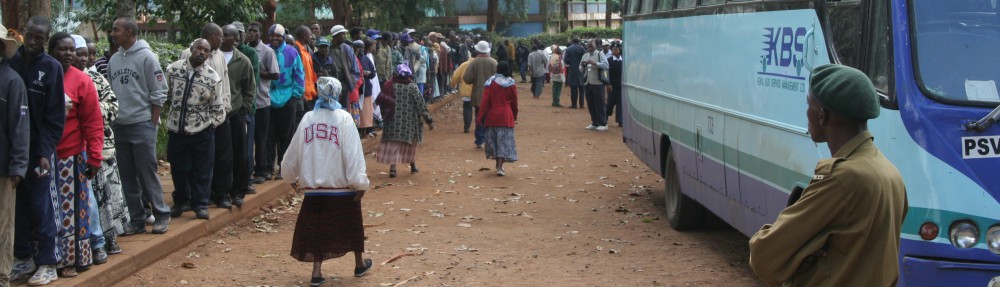
Merry Christmas for the third time from the AfriCommons Blog. Sorry for the light posting–I’ve slowed down for the holidays. I didn’t take note earlier this month of the second anniversary of the blog and have also been taking some extra time to read and take stock of where the blog should go next year with the Kenyan election campaign and so much else going on in the region at the same time.
The latest “birther” lawsuit was thrown out by a federal court today–hope that will die and that people involved in the U.S. campaigns can leave Kenya out of our races here.
I have received a couple of Christmas presents from the State Department this week: first, I finally got the first installment of cables from my outstanding FOIA request from October 2009 about the Embassy’s 2007 election observation (albeit with pretty extensive redaction on several of them).
Second, the Secretary rose to the occasion and made a strong statement criticizing the cursory approval by Kabila’s Supreme Court of his asserted re-election:
Secretary Clinton’s statement:
The United States is deeply disappointed by the Democratic Republic of the Congo Supreme Court’s decision to uphold the electoral commission’s provisional results without fully evaluating widespread reports of irregularities. We believe that the management and technical execution of these elections were seriously flawed, lacked transparency and did not measure up to the democratic gains we have seen in recent African elections. However, it is still not clear whether the irregularities were sufficient to change the outcome of the election.
We believe that a review of the electoral process by the Congolese authorities and outside experts may shed additional light on the cause of the irregularities, identify ways to provide more credible results, and offer guidance for the ongoing election results and for future elections. We strongly urge all Congolese political leaders and their supporters to act responsibly, renounce violence, and resolve any disagreements through peaceful, constructive dialogue.
We have called on Congolese authorities to investigate and prevent election related human rights violations and we urge security forces to show restraint in maintaining order. The United States continues to offer our assistance and we stand with the Congolese people in their quest for greater peace and democracy at home and throughout the region.
The U.S. appears to have paid attention and avoided the pitfall of glossing over the questions about the election.
BBC reports on remarks by the U.S. Ambassador:
But the results’ credibility has been criticised by the EU, the Carter Center and other election monitors.
The US ambassador to the country said there had been several “irregularities”.
“The United States believes that the management and technical execution of these elections were seriously flawed,” Ambassador James Entwistle said in a statement to Reuters news agency.
“[They] lacked transparency and did not measure up to the positive democratic gains we have seen in recent African elections,” he said.
Mr Entwistle said that the US and other Western donors were offering technical assistance to the Congolese to review irregularities identified by observer missions, an offer which has already been welcomed by the country’s prime minister, he said.
The country’s Supreme Court must decide by 17 December whether or not to validate provisional results.
. . . .
And the VOA reports on official comments from the State Department in Washington:
In a statement Wednesday, State Department spokeswoman Victoria Nuland said the U.S. assessment is based on reports from observation teams fielded by the U.S. and other embassies, as well as by independent election monitoring groups.
Nuland said it was not clear, however, whether the irregularities and lack of transparency were enough to change the outcome of the election.
She calls on Congolese authorities to conduct a “rapid technical review” of the electoral process which she says will help determine whether the irregularities resulted from poor organization or outright fraud. She said the U.S. is ready to give its “technical assistance,” for the review.
So what does the history of Kenya’s military and GSU from the Kenyatta era, as discussed in my last post, mean today heading into the 2012 elections? Please take time to read a presentation from Jerry Okungu from a UNDP conference in South Africa over the weekend posted at his Africa News Online blog. I worked with Jerry at IRI and I understand and appreciate his expertise on Kenyan political history. He gives the background of the role of state security forces on through the Moi era and the first Kibaki administration and the 2007 election, along with a discussion of structural changes possible under the new Kenyan constitution.
Jerry Okungu, “The Role of the Security Agencies During Elections in Kenya” at Africa News Online.
So where are we at the end of 2011?
In Kenya the situation has been like this before a new constitution came into place:
- The President is the Commander in Chief of all Armed Forces including Prisons Department
- He appoints ministers of Defense and Internal Security together with their assistants and Permanent Secretaries. They all have their offices in the Office of the President
- He appoints all army Generals and Commandants, the Police Commissioner, the Admin Police and General Service Unit Commandants
- He appoints all the eight Provincial Commissioners and 250 District Commissioners who are also Security Committee chairmen in their respective Districts and Provinces
- The President also appoints the Directors of Criminal Investigation and National Intelligence Service that also report to him directly
- The President also appoints all judges of the High Court and Court of Appeal as well as the Attorney General and the Director of Public Prosecutions
With this scenario, it was difficult to have a legal system that would go against the wishes of the President in power. It was the reason the police never investigated election related crimes and those who were taken to court were acquitted for lack of “sufficient” evidence.Because non-state actors in politics realized that they could not get protection from state owned security agents, they recruited their own for their own personal security and to encounter state brutality during election seasons. In this regard, the following private militias have sprouted on the Kenyan scene since 1992, the year Moi predicted that multi party politics would bring back ethnic violence:
- The Kalenjin Warriors of Rift Valley believed to have belonged to President Moi and his kitchen cabinet
- Mt. Elgon Land Freedom Army fighting for their land in lower parts of South Rift Valley
- The dreaded Mungiki militias of Central Province fighting an economic war against wealthy Kikuyus
- Jeshi la Mzee of Nairobi area during Moi’s time
- Kizungu Zungu and Chikokoro gangs that operated in Kisii parts of Nyanza Province
- Angola Musumbiji gangs that operated in Western Province
- Coast Republican Party, a militia separatist group that operated in the Coast region
- Baghdad Boys of Mathare slums
- Artur Brothers that were imported from Armenia to cause chaos in Kenya
Because the government was running its own set of gangs from the Police Force that from time to time carried out extra-judicial killings of innocent Kenyans, it was difficult for the government to curb the growth of other non-state gangs. Ironically when the government operatives needed to deal with the opposition leaders, they would employ the services of some of these gangs a long side the regular police.Kenyans, mainly non-state actors struggled for almost three decades to get a new constitution and to restore governance and democratic practices that would salvage their nation from the abyss of political pit-hole they had found themselves in.The 2007 post election violence left a bitter taste in the mouths of many Kenyans. The aftermath of the death of 1500 innocent Kenyans half of which perished at the hands of police brutality made Kenyans resolve that time was ripe for a new constitution and far reaching political, social and economic reforms. We had to rethink our governance practices.Because of the trauma of post election violence of 2007, it was easier for political foes to reach compromises and usher in a new constitution that was finally promulgated at a colourful ceremony in August 2010.With this new constitution came sweeping changes in our governance structure. The office of the President was stripped of powers to appoint state officers. Such powers the constitution vested in Parliament to avoid future abuse of office by the Presidency.
The constitution also merged the Regular Police with the Admin Police to form the Kenya Police Service with one Inspector General at the head and a Police Service Commission as the authority to report to. This means that future regimes would not be able to misuse the Police for their own political ambitions. A long with this the entire Police Service would be structured afresh with top officers vetted before being reemployed.In the Judiciary, the constitution created another layer of the judicial system by creating the Supreme Court of Kenya above the current Court of Appeal with the Chief Justice as the President of the Supreme Court. Also created was the post of Deputy Chief Justice and five other Supreme Court Judges. The constitution also mandated that all sitting judges and magistrates would be vetted by the Judicial Service Commission before being readmitted to the service.The vetting of judges and the Police Force was one way of saying that corruption in the Judiciary and the Police Force, especially the investigation and prosecution agencies had to be dealt with. With a more professional Judiciary and State Security Agencies in place, it was hoped that criminal activities that went unpunished would be a thing of the past in Kenya’s electoral process.The Creation of a new electoral body- The Independent Election and Boundaries CommissionPart of the reason why elections over the years were riddled with violence and corruption was because the Executive appointees to the Electoral Commission were too weak and powerless to act against the excesses of the state. They had no security of office entrenched in the constitution. They were handpicked by the Executive, hence the temptation to please the appointing authority.
So formally, the opportunity for significant change is in place with the new constitution for the next election. But implementation is very much a work in progress and the new mechanisms are untested or not yet in existence. The individual actors in the process are mostly the same people who have thrived under the Kenyatta/Moi/Kibaki rule in the old system. So tools are available for a better outcome and there is some basis for hope, but clearly no one who is not a direct actor in the Kenyan political system has a sound basis to assume that the next election will not be violent.
From 1975 intelligence briefing for President Gerald Ford’s Nation Security Adviser Brent Scowcroft:
2. Nairobi has traditionally maintained one of the smaller armies in sub-Saharan Africa, (see table). The Kenyan leaders — especially President Kenyatta — have not wanted a large standing army. Tribal considerations have been a major factor in this decision. The army has long been the only significant institution in Kenya not under direct control of the Kikuyu, Kenyatta’s tribe. Kenyatta, however, has been gradually but effectively changing the balance to favor the Kikuyu through reorganizations and promotions. Apparently as a counterweight to the army, Kenyan leaders also have made sure that the elite paramilitary General Service Unit remains heavily armed, mobile, and dominated by the Kikuyu.
3. The Kenyans have in the past been able to take some comfort in a mutual defense pact with Ethiopia and a long-standing tacit agreement with the UK that provides for British assistance on request in the event of major internal trouble or an external attack on Kenya. Nairobi now realizes that the chances of Ethiopian assistance have been diminished by Addis Ababa’s internal instability, its problems with Somalia, and by troubles with insurgencies in Eritrea and other provinces. Nairobi also believes, rightly in our view, that it can no longer count on British assistance in the event of an emergency.
[Map of the Horn of Africa]
The Kenya-Uganda Balance
4. Relations between Kenya and Uganda, never smooth since Idi Amin came to power in 1971, have reached their nadir in the last few months. In February, Amin laid claim to part of western Kenya. Nairobi responded by stimulating a series of virulent anti-Amin demonstrations and a boycott at Kenya’s harbors of goods destined for Uganda.
5. The Kenyans later eased the boycott, but imposed a number of economic restrictions on Kampala. They cut in half Uganda’s fuel allotment from the Nairobi refinery and are requiring cash payment for petroleum products and other goods. The sanctions appear to be hurting the Ugandan economy. This may have provoked the mercurial Amin into launching some cross-border forays by helicopter -borne Ugandan troops this month — allegedly in search of rustled cattle. Amin has followed this up with verbal threats against Kenya that he has linked to criticism of Secretary Kissinger’s trip to Africa and charges of collusion between Washington and Nairobi.
6. Other factors have contributed to tensions between Kenya and Uganda. Nairobi newspapers have frequently published stories of alleged atrocities by Uganda perpetrated against Kenyans. Such stories have recently gained increased credibility among Kenyans by the well publicized disappearance in Kampala a few months ago of a Kenyan student, now widely presumed to have died at the hands of Ugandan security police.
7. Kenyan leaders have long been uneasy about Amin’s erratic behavior. Their concerns have been heightened by Amin’s accumulation of Soviet weapons, by the presence of Soviet advisers in Uganda, and by Amin’s ties to radical Arab states and Somalia. Kenya is concerned that Amin might make some supportive military move if Mogadiscio instigated a renewal of insurgency in northeast Kenya — it supported such an effort in the 1960s — or ordered the Somali army into action against Ethiopia or Kenya.
8. Amin is probably planning to keep alive the threat of additional cross-border raids to keep Nairobi off balance and to emphasize for domestic consumption the “threat” to Uganda. The Kenyans are nervous over reports that Amin has been stirring up his senior officers with threats to “crush Kenyatta.” Nairobi fears that the likelihood of some erratic move by Amin — a terrorist incident, an assassination attempt against Kenyatta, or the seizure of some Kenyan territory — will increase when Amin ends his term as chairman of the Organization of African Unity in July. Our judgment is that these concerns in Nairobi are exaggerated, but we cannot completely rule out such actions because of Amin’s personality.
9. The Kenyans are being careful not to push Amin too far publicly. President Kenyatta has returned the two Ugandan helicopters and several soldiers captured during the recent incursions, although he has privately issued a stern warning to Amin. Nairobi may ease the current economic restrictions once it feels it has made its point. Amin is already complaining loudly about a fuel shortage, and the Kenyans are probably wary about giving him grounds for justifying some military move by claiming he is being economically strangled.
10. Nonetheless, Nairobi has recently begun providing limited covert support for a group of Ugandan exiles in Kenya who have been plotting the overthrow of Amin. The group does not appear well organized, and the effort could backfire on Nairobi by providing justification for Amin to take counteraction against Kenya. For example, Amin might respond to any Kenyan-supported attempt to unseat him with a greater show of force on the border. In such a case, a major border incident could arise from a miscalculation by either side.
11. Kenyan concerns about Amin are compounded by his overwhelming superiority both in weapons and number of troops. Although Kenyan units are better trained and disciplined than Ugandan forces, Kenyan leaders are uneasy over an official assessment questioning the will of the army to defend the nation’s borders. Some army officers are concerned that the attention Nairobi is paying to Uganda will divert it from what they see as the far more serious Somali threat.
12. Recognizing its military inferiority, Kenya has approached the US and other potential sources for military assistance, especially aircraft. (Kenya continues, however, to turn down Soviet offers of military assistance.) Kenya has tried to interest the British in providing troops or aircraft for a joint exercise or some other show of force, preferably near the border, but London apparently has turned Nairobi down.
. . . .
The Horn of Africa
15. Kenya’s policy toward the Horn of Africa countries continues to be marked by an alliance with Ethiopia, its partner in a 13-year-old defense pact, and by a deep distrust of Somalia, which claims about one fifth of Kenya as well as a large part of Ethiopia and all of the neighboring FTAI. Kenya supports Paris’ announced intention to grant independence to the FTAI, and has called for OAU and UN guarantees for the independence and territorial integrity of the state.
16. The likelihood of military conflict between Ethiopia and Somalia over the FTAI has sharpened Kenya’s worries about its security and the intentions of the Mogadiscio government. Kenya fears it would be drawn into such a conflict because of its defense pact with Addis Ababa.
17. Nairobi also believes that a successful Somali takeover of the FTAI would encourage Mogadiscio to reassert its claims to the northeastern part of Kenya inhabited primarily by ethnic Somalis and to press a new insurgency effort there. The Kenyans already suspect that Amin’s recent claims to parts of Kenya were made in collusion with Somali President SIAD in an effort to keep the Nairobi government off balance. We have no hard evidence to support the Kenyan suspicions, but relations between Amin and SIAD are relatively close.
Source: Ford Library, National Security Adviser, Presidential Country Files for Africa, Box 3, Kenya. Secret; Noforn; Nocontract; Orcon. Prepared jointly by the Central Intelligence Agency, The Defense Intelligence Agency, and the Bureau of Intelligence and Research. Sent to Scowcroft on May 7 by B.E. Layton, Acting National Intelligence Officer for South and Southeast Asia and Africa, Central Intelligence Agency.
Comparison Table of Military Forces
Somalia Kenya Uganda
| Air Force | |||
| Personnel | 750 | 760 | 2,000 |
| Bombers | 3 | 6 | None |
| Jet Fighters | 50 | 3 | 68 |
| SAM Battalions | 4 | None | Unknown |
| Helicopters | 12 | None | 9 |
Release from Carter Center: DRC Presidential Election Results Lack Credibility
The Carter Center finds the provisional presidential election results announced by the Independent National Election Commission (CENI) on Dec. 9 in the Democratic Republic of the Congo to lack credibility. CENI results point to the re-election of incumbent President Joseph Kabila with 49 percent of the vote followed by Etienne Tshisekedi with 32 percent and Vital Kamerhe with 7.7 percent. Voter turnout was 58 percent.
Carter Center observers reported that the quality and integrity of the vote tabulation process has varied across the country, ranging from the proper application of procedures to serious irregularities, including the loss of nearly 2,000 polling station results in Kinshasa. . . .
. . . . The Carter Center is therefore unable to provide independent verification of the accuracy of the overall results or the degree to which they reflect the will of the Congolese people.
“Congo Opposition Rejects Early Poll Results,” Financial Times [It is a bad sign that “the money quote” is anonymous]:
. . . .
According to the latest partial results, Mr Kabila is winning most support from the mining-rich Katanga province, his stronghold. Some observers have questioned the use of an unaudited voter registration system, which allotted Katanga 4.6m voters, 50 per cent more than the capital Kinshasa, home to 10m people.
A UN Security Council meeting last week noted some electoral irregularities but pressed for a peaceful conclusion to the polls.
“There is no [international] appetite to press for transparency, but just pushing to accept whatever result [the poll commission] comes up with is not going to bring peace,” one Congo expert told the FT. “We have to debunk the idea that it is peace versus transparent elections. The idea that lousy elections are going to bring peace is madness.”
Joshua Marks, of the National Endowment for Democracy, a US-funded foundation, said: “The Security Council wants to avoid violence at all costs. He added: “It’s patronising to the Congolese people. . . You’re still going to have these unresolved grievances in the country and an ever larger number of people against the Kabila regime.”
Despite mineral wealth in copper, gold and diamonds, Congo has slipped to the bottom of global development rankings under Mr Kabila’s latest term, as the country recovers from the 1998-2003 war in which an estimated 5m people died. A clutch of rebel militias still hold sway in the east.
A real election requires credible preparation by a credible election commission and credible dispute resolution mechanisms. The DRC election has already gone this far (past the actual voting) without the “international community” blowing the whistle. The Carter Center and the EU observation missions have made clear that there are serious issues with the preparation and execution of the election by the government. The actors who have supported the process to date need to stay engaged and stay committed as the process continues.
Congolese voters need hope that it makes some difference who they voted for, just like voters anywhere are entitled to expect. A pretense that the voters cannot believe in can be expected to drive violence.
Kenya’s military objectives in Somalia remain unclear, with the idea now floated that Kenya is satisfied with whatever has been done to date and has no need to seek to capture Kismayu after all. As far as Kenya itself is concerned, Somalia just isn’t legitimately the most important priority, and I agree with the perspective offered by Wycliffe Muga in Nairobi’s Star in his column a month ago: “Kismayu is the Least of our Problems”.
Here is a new article by Nairobi-based Muhyadin Amed Roble from the Jamestown Foundation’s “Terrorism Monitor”: “Will the Return of Ethiopia’s Military to Somalia Destroy al-Shabaab or Revive It?”
Just 40 days after Kenya’s military intervention against the militant al-Shabaab group began in Somalia there are indications that the Kenyan effort may become part of a joint operation with African Union and Ethiopian military forces to eradicate terrorist elements in the Horn of Africa. The African Union has backed the Kenyan invasion of southern Somalia and has also invited the Ethiopian army to join the African Union Mission in Somalia (AMISOM), currently consisting of military contingents from Uganda and Burundi.
. . . .
Knowing the results of Ethiopia’s bloody invasion of Somalia in 2006, the AU’s invitation to dispatch Ethiopia troops to Somalia will be another counterproductive and undiplomatic move according to Abdihakim Aynte, a Somali political analyst in Nairobi. “The African Union seems to ignore the last experience of Ethiopian’s business with Somalia,” Aynte told the Jamestown Foundation. [1] The U.S. State Department also seems wary of the outcome of another Ethiopian invasion. Johnnie Carson, the State Department’s top Africa policymaker, said: “Ethiopia went into Somalia some four and a half years ago and stayed for approximately two and a half to three years. That effort was not universally successful and led in fact to the rise of Shabaab after they pulled out” (McClatchy Newspapers, November 22; The Standard [Nairobi], November 22).
Ethiopia’s military intervention in Somalia will not please the current Transitional Federal Government (TFG) president Shaykh Sharif Shaykh Ahmad, a former leader of the Islamic Courts Union (ICU), ousted by the Ethiopians in 2006. Abdihakim Aynte says President Shaykh Sharif Shaykh Ahmad and the TFG do not have a choice in the matter. Somali Defense Minister Hussein Arab Isse welcomed the entrance of Ethiopian forces to eradicate al-Shabaab but warned Ethiopia against having any other objectives that damage the reputation of the country: “We welcome Ethiopian troops…and any other country that contributes forces to fight against the Shabaab militants, as long as they do not violate our sovereignty” (AFP, November 21).
. . . .
With troops from four African nations now operating on Somali soil backed by the military power of the United States, al-Shabaab is certain to try to capitalize on traditional Somali xenophobia and nationalism to preserve and even expand the radical Islamist movement.
In the meantime, it is reported that up to 6,000 Somalis have recrossed the Red Sea into Somaliland since the beginning of October, leaving Yemen due to conditions there. Somaliland’s exports of livestock to Yeman have dropped dramatically. In Somaliland, IRIN reports that the newly formed National Development Program has determined that “the weighted average national employment rate is 52.6 percent” and unemployment is higher among youth, encouraging risky attempts to migrate to Europe via Ethiopia and Sudan. The article also quotes a youth organization leader that there are approximately 104 NGOs and UN agencies working in Somaliland, but complaining of low local versus expat hiring.
Somaliland has certainly become one of best known ” little known” places in the last couple of years. At this point I do have concern that with movement toward international recognition still seeming to be stalemated by the instability and uncertainty about the nature of government in the rest of Somalia, Somaliland could deteriorate if economic progress is too slow. We shouldn’t take the status quo for granted.
Congratulations to the International Republican Institute for publishing a first-of-its-kind public opinion survey covering Hargeisa. On balance the results suggest a generalized optimism about the state of the country in Hargeisa. An interesting discussion of how to understand the results is here from the blog of Watershed Legal Services.
Chatham House has issued a report by Sally Healy entitled “Hostage to Conflict: Prospects for Building Regional Economic Cooperation in the Horn of Africa” (h/t to Ambassador David Shinn’s blog). She sees significant potential for the “close but distrustful neighbors” of the IGAD to cooperate in areas such as “transport corridors to sea ports, the management of shared water resources, common management of pastoral rangelands and improved energy security.”
On Tuesday, December the 6 the Institute for Security Studies will conduct a Pretoria seminar on “Kenya’s Military Incursion into Somalia and its Implications”.

“Tribute to Dr. Peter Oriare, Media Scholar of Great Repute”
“University of Nairobi mourns committed teacher”
My friend, Dr. Peter Oriare, was in his own way one of those who got hurt because of the election misconduct in 2007. I was very sad to hear on my return from Washington that while I was at the African Studies Association meeting, Peter died back in Nairobi. At 45 he was too young, the proud father of young children. I would greatly encourage anyone interested in Kenyan democracy to read the tribute and story linked above.
I am thankful to have known and worked with Peter. I certainly relied on him in Kenya. Along with the local staff at the International Republican Institute in Nairobi he was one of the people that made my year working in Kenya an experience that I will always treasure. When I arrived in Nairobi in June of 2007, we had funded only our baseline National Endowment for Democracy programming working with parliamentary candidates and our ongoing USAID polling program for which I was approved as Chief of Party the week before. The current polling program had been in place since an exit poll for the 2005 constitutional referendum,and had most recently included a public opinion survey from that spring which we were just then briefing to prospective presidential candidates. Peter worked with Strategic Public Relations and Research and was our primary point of contact with the firm as well as teaching and working to finish his doctorate at the University of Nairobi.
When I took over as the fourth American to lead the IRI office under that 2005 polling program, my ability to do my job depended on Peter’s expertise and continuity. Peter had worked with everyone in the IRI office and had been our primary local polling expert partner since 2000, before the IRI office opened in 2002. The polling program was touted as a major success story for both USAID and for the International Republican Institute in Kenya and Peter was the single most consistent element. Peter had a strong relationship not only with IRI and the USAID Democracy and Governance program locally but with others in the international democracy community. He led important work in media monitoring for the 2007 election that was crucial to the international understanding of the situation in Kenya.
Peter believed in transparency and he advocated internally for release of the presidential “horse race” figures from our September 2007 public opinion survey which showed Kibaki leading when most polls were showing Raila as having pulled ahead, and when our contract with USAID was amended to add the 2007 exit poll, he expected to release it as well. The established policy reason that IRI did not release the “horse race” numbers comparing the presidential candidates in our pre-election public opinion surveys–that we wanted to support democracy by informing the public, policy makers and politicians with out having a direct impact on the race itself–obviously did not come into play on the exit poll when people would have already voted when it would be released.
I pushed Peter and Strategic hard in negotiating the contract for the exit poll in the fall of 2007. We had a modest amount of additional funding from USAID, and some money from Dr. Clark Gibson at the University of California, San Diego–and we had overhead in Washington and Nairobi. Because it was obviously a close race, we needed results that were methodologically sound and statistically valid at the provincial level and not just the national level, to be able to evaluate the presidential threshold of 25% of the vote in five provinces. I needed substantially more work from Strategic than they had done in the 2002 and 2005 exit polls, which were universally accepted as successful, but in elections that were not as close. Ultimately we agreed on the additional work for very little additional money given Kenya’s inflation, and the poll was well executed as millions of Kenyas voted peacefully.
The preliminary results called in by cellphone–which were obtained by USAID and given to the Ambassador on election day–even though such reporting was entirely outside the scope of anything in the USAID agreement with IRI and I didn’t want anything to get out while the polls were still open–had Raila ahead by a margin of roughly 8 points. When the actual surveys were obtained and coded and necessary adjustments made for situations such as the seizure of some questionnaires by police–some of which were recovered and some not–the final figure was roughly 6 points. This was the number in Nairobi in mid-January, 2008 with all the surveys back and coded. That was the number on February 7 when someone “inside the Beltway” in Washington decided to throw Peter under the bus by publishing internationally a statement from IRI that poll was “invalid” after State Department and USAID officials were questioned about it by then Subcommittee Chairman Feingold at his hearing in the Senate. That was the number when I turned over the original questionnaires to my successor in Nairobi in May 2008; the number when the results were released in July at CSIS in Washington by UCSD after IRI’s six month embargo; and the number soon thereafter when the New York Times called me working on their story and asked for an interview. It was still the number when IRI released the results in August–reconfirmed by a firm in Oklahoma–the day before the UCSD testimony at the Kriegler Commission; and it is still the number today, when the poll has been used in published work from scholars in Asia and Europe, as well as in Africa and the United States.
Peter had every right to be proud of his work on this exit poll and it was rightly noted by Rosemary Okello in her tribute as a part of his positive legacy for Kenyan democracy, and for polling and scholarship everywhere.
This is what I wrote in recommending Peter on Linked-In in 2009:
Peter is a true professional, with a strong commitment to his work and high values. He is calm under pressure. He offers deep knowledge and experience and I would be very pleased to have the opportunity to work with him again in the future. July 6, 2009
Top qualities: Personable , Expert
Ken hired Peter in 2007, and hired him/her more than once.
_______________________________________________________________________

I just returned from a few days at the annual conference of the African Studies Association, held in Washington this year. This gave me the chance to hear presentations by and informally rub elbows with some of the most knowledgeable experts on Kenya and African democracy and governance from a variety of places and institutions around the world. The summary overview is that as we approach four years from the last election, there is so much that is still “up in the air” about the next one that it is impossible to know much about how it will play out.
Here is my view of where things are:
1. The election date remains in active dispute. Much Kenyan opinion holds that the new Constitution mandates an election in August of 2012 which is fast approaching. The members of the brand new electoral commission have said in the recent past that they cannot be ready by then. The Cabinet has just withdrawn a bill in Parliament to amend the Constitution to move the date [update: the Speaker has ruled that the bill may be re-filed tomorrow and be heard] and the Supreme Court has ruled that the matter must come up through normal channels through the High Court rather than be determined by an advisory opinion.
2. While it is positive that the new Independent Electoral and Boundary Commission has been formed in a process widely seen as appropriate, the time involved means that we do not yet even know the constituencies and boundaries for the new elections; further this new Commission is untested.
3. The issue of implementing the gender balance in Parliament under the new Constitution remains unsettled. A lot of seats and salaries are at stake on this issue.
4. Candidates, parties and coalitions remain very much unsettled and can be expected to remain so. There has been very little obvious progress in actually enforcing the laws governing political parties and elected officials in relation to parties. The relationship between “parties” and “coalitions” remains elusive.
5. Politics in Kenya certainly seems more openly ethnic now than at a similar time in the 2007 election cycle. One could perhaps make the argument that it is better to have it more “on the table” rather than “under the table”, but I do not necessarily buy that. Regardless, there is this time no basis for outsiders to underestimate it. How this will play out in the campaigns is unknown.
6. Like in 2007, we have high inflation rates for staples such that the wananchi are being squeezed on the basic cost of living–while the GDP growth rate in the region and in Kenya is much less robust than in 2006-07–all aside from the drought and food crisis in many regions. Whether this will get better or worse as the election approaches is unknown.
7. Corruption remains a huge issue. Overall there may have been some small progress at the margins, but in reality the accumulation of exposed cases of major graft in which no one major has been prosecuted just continues to grow. The corruption in the 2007 election specifically was swept under the rug. No one has been held accountable and the facts have remained concealed enough that any politician or spokesman can say whatever they want about what happened last time. It seems to me hard to argue that there is much deterrent in place to attempts to corrupt the 2012 elections.
8. The threat from terrorism seems to be greater and this time Kenya itself rather than Ethiopia is at war in Somalia.
No one that I heard or talked to seemed to feel that we knew much more about how the next Kenyan election might play out now than we did when I attended the same conference in New Orleans in 2009.
And yet, I picked up on what I see as disturbing reports of a repetition of the complacency that we got burned by in 2007. At the risk of sounding “preachy” I want to argue passionately that this is a mistake.
Okay, Kenya had a peaceful and well accepted referendum in 2010 when there were worries about violence. Let me explain why I don’t think at means so much in regard to 2012.
First, the referendum was not a close election–just as the 2002 NARC election was not a close election. The question in the referendum was how big the margin would be, not whether it would pass. Since the outcome of the referendum was not in play it would not have been impacted by violence or protests one way or the other. In 2007 the outcome was in play and disputed and violence served the interests of both sides to a point.
If there had been no protests regarding the election Odinga would never have become Prime Minister–and the incumbent government was clearly committed to not allowing protests, and clearly prioritized keeping power over security for the public. At the same time, if there had not been a murderous mobilization of Kalenjin militias against Kikuyu in the Rift Valley to the point of what Assistant Secretary of State Jendayi Frazer controversially labeled “ethnic cleansing” there might have been some remedial action about the subversion of the election count itself. This was the approach initially advocated by the EU and other Western countries. I would like to think that if this militia violence in the Rift Valley had been less egregious that perhaps the higher levels of the U.S. government might have come around to some form of election remediation in spite of the U.S. Ambassador’s approach. Obviously I have no way to know–but the point remains, I think, that even the violence against Kikuyu in the Rift Valley in a way indirectly helped keep for Kibaki the new five year term that the ECK awarded him.
The bottom line is that violence ended up “working” in a sense for certain political interests in 2007-08–and the price was paid only by the wananchi so far–whereas there was no political utility for such violence in 2010.
Further, the referendum was a national vote and the outcome at individual polling centres and in localities and regions did not directly matter–very unlike the simultaneous election of the President and MPs and local officials in Kenyan General Elections.
On balance, the 2010 Referendum seems to me to provide less reasonable assurance about a clean and safe General Election in 2012 than the2002 General Election and the 2005 Referendum would have provided in 2007.
There are Kenyans whose opinions I respect who think that the era of election violence is over in Kenya because of the actions of the ICC to date. Perhaps. I hope they are right, but I do not see that it makes sense to bet anyone’s life on it. Which presidential contender today is showing up in the polls as less popular because he was charged by the ICC prosecutor and named in various investigative reports about the post election violence? Who knows what will happen with the ICC process or what impact it will ultimately have?
The key for Western donors is to be prepared for contingencies rather than guessing and gambling about what might or might not happen. To have the political will to “call out” the electoral commission before the election if it abandons the practices and tools that are clearly necessary to have a transparent and reliable election. To reserve judgment on the process until it is concluded. To speak out, at least, if Kenya’s paramilitary security forces are diverted for political purposes such as sealing off Kibera and defending Uhuru Park to keep it free of protestors. To commit to transparency to assure trust. And to decide now how to respond to violence if things go wrong later.
To close this, I am going to fulfill a personal request from someone from the West who was importantly involved in trying to help the process last time by linking to an account of a Kenyan investigative journalist to the Kriegler Commission about what was happening in Kibera in the last election. I have to do this with a READER DISCRETION ADVISED WARNING–this is not “family-friendly” reading. I have no personal knowledge of any of the specifics but this does come with the personal recommendation of someone very credible who knows the source well. We all know that Kenyan politics can be murderous and there is no reason to be complacent.