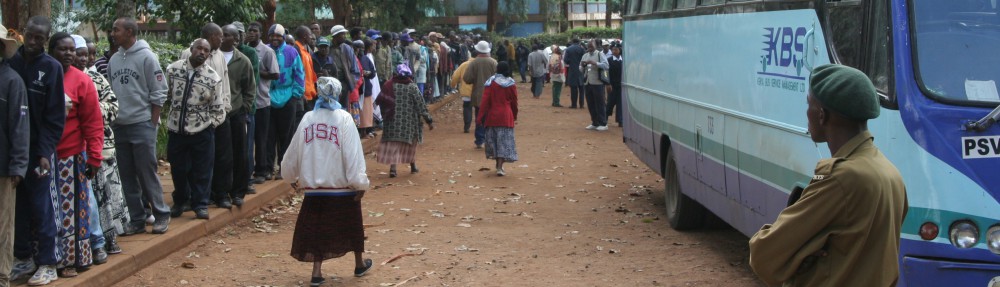
“Do not be afraid. The government will protect you.” KANU Revivalists offer alternative to democratic values in Kenya

Shortly after I arrived in Kenya in mid-2007, Kenya’s parliament passed a media regulation bill which faced a storm of international diplomatic criticism as well as domestic protest.

President Kibaki at the time backed down and sent the bill back to Parliament where it was ultimately somewhat watered down. New legislation passed last week goes much further than what was dared under the first Kibaki Administration, in spite of the new constitution. This time there doesn’t seem to be much reaction from international governments–we give our aid money quietly and tiptoe so as not to step on important toes since we have been aggressively accused of imperialism and racism for not intervening to stop the ICC prosecutions of The Now Elected for the mayhem after the 2007 election–but the international media is much more aware of these issues than they were in 2007.

And if the media bill has been put in some limbo, it has been followed by the introduction of the Jubilee bill to assert more state control over civil society and restrict and channel foreign funding to non-governmental organizations. The Uhuruto team had not shown its cards on attacking the media during the election campaign, but civil society was always a known target. See Attacks on Kenyan Civil Society prefigured in Jubilee Manifesto, my post from March this year.  More freedom for the media and for civil society means more restraints on politicians in control of government.  Restricting civil society can help maximize the opportunity to control the media, and vice versa.

Kenyans are confronted once again by the hard choice of whether they are willing to challenge their “leaders” in governmental power to maintain their individual freedoms as citizens.

Uhuru Kenyatta stayed with KANU throughout his life through the formation of TNA as a vehicle for his presidential campaign in this year’s race.  Other than running in elections himself, he has not given much indication over the years that I am aware of being concerned for opening the democratic space and by running as “Moi’s Project” as the KANU nominee in 2002 he chose the old banner.  Of course when you are one of the richest men in Africa, and your mother is one of the richest women, because of what your father took for himself and his family when he was the one-party ruler, you find yourself with plenty of freedom of speech and freedom to politically organize regardless of the details of the system that confront the small people.

In the wake of the Westgate attack, and the desire of the government to avoid scrutiny or challenge, I am reminded poignantly of what Kibaki said when he first ventured out thirteen days after he had himself sworn in for his second term:

January 9, 2008–13 days after the 2007 election (NBC News):

Kibaki made his first trip to a trouble spot, addressing more than 1,000 refugees in western Kenya, many of whom had fled blazing homes, pursued by rock-throwing mobs wielding machetes and bows and arrows.
“Do not be afraid. The government will protect you. Nobody is going to be chased from where they live,” Kibaki said at a school transformed into a camp for the displaced in the corn-farming community of Burnt Forest. “Those who have been inciting people and brought this mayhem will be brought to justice.”
He indicated he would not consider demands for a new election or vote recount.
The election “is finished, and anybody who thinks they can turn it around should know that it’s not possible and it will never be possible,” he said.

Perhaps for those Kenyans that feel sure that the government will always protect them, there is no need for these things of a free media, civil society, the questioning of elections.  Kenya could just go back to the Chinese model of the one party state.  Kenyans who prefer a freer, more empowered citizenship as a matter of values, or who don’t feel they can count on the government to always protect them will have to decide to engage to protect those rights which are of course expressed in law in the new constitution.  See “CIC (Commission for the Implementation of the Constitution) says new media law unconstitutional”, Daily Nation.

Kenyan Media

Kenyan Media

Listening . . .

Image

Waterbuck

Please excuse my lack of posting. I am taking extra time to read and listen.

In case you missed it, here is Joel Barkan’s list from Foreign Affairs, “What to Read on Kenyan Politics”.

And from AfriCOG: “Why Westgate Is About Governance But Not Security Or The ICC”.

KPTJ Statement

Sharing the statement released by KPTJ this morning:

At this time of grief, we, Kenyans for Peace with Truth and Justice, wish to express our deepest condolences to the families of those who have been lost or remain missing, and wish a swift recovery to all those who have been hurt. We applaud the contributions of our fellow Kenyans to support rescue and security work and medical care for victims, as well as the unity our nation has demonstrated throughout this crisis. We condemn this despicable attack and support all work to rescue those still trapped at Westgate, and to end the situation as soon as possible and without further loss of life.

Why Westgate? [updated 9-24]

I certainly claim no special insight into the minds of Al Shabaab, but by virtue of having been around long enough to have been marked in childhood by the memory of the “Black September” attack on the Israeli athletes at the 1972 Munich Olympics, it isn’t a surprise to read that “Westgate Shopping Mall is one of several Israeli-owned businesses in Kenya.” “Shopping mall in premier complex that is home to international brands”, Saturday Nation.

Likewise, Nairobi’s upscale malls are hubs for internationals and expats, as well as symbols of the prosperity and comfort that can be found by the affluent in Nairobi and a source of local pride. The psychological and economic impact from mass murder at such a place is entirely different than mass murder of a similar scale in some other town or village, or in the slums.

I have to say I don’t believe these people would be sated if they ruled all of Somalia without challenge.

[Update: This post was an early reaction to news of the attacks. With the crisis nearing an end after three days, we don’t seem to really know much yet about the attackers and the specifics of the operation. Variety of contradictory information and lots of opinions, some derived from some substantial amount of experience and knowledge, some from little.]

“Choosing Peace Over Democracy”

“Kenya’s 2013 Elections: Choosing Peace Over Democracy” has been published in the new Journal of Democracy by James D. Long, Karuti Kanyinga, Karen E. Ferrer and Clark Gibson.  Important and worthwhile reading for anyone interested in Kenyan politics or democratic process in Africa or the developing world more generally.

This is the first of formal publications using the exit poll and other polling data that were presented by Professors Gibson and Long at Johns Hopkins’ SAIS on May 2 and widely covered in the Kenyan media.  See my post with the video:
“Fraud and Vote Patterns in Kenya’s 2013 Election: Evidence from an Exit Poll”–Gibson and Long event in Washington Thursday.

Long and Gibson were the researchers who also carried out the 2007 IRI/USAID/UCSD Kenyan exit poll that showed an opposition victory.

Voting Procedure

Kenyan Election: KPTJ challenges IEBC and Registrar of Parties; Police remain unready; “Minefield” for Women

From the Sunday press conference of Kenyans for Peace with Truth and Justice, the released statement below warrants a careful reading.  Leading Kenyan civil society groups make it clear that:

the institutions charged with the regulation of political affairs have displayed a disturbing reluctance to enforce their respective mandates with regard to regulating political competition and ensuring adherence to electoral laws. The IEBC has displayed, within the last week, a tendency to buckle under to political pressure by repeatedly shifting timelines relating to the submission of nomination lists at the whim of the stronger political parties. This reinforces concerns around the independence of the IEBC, which were already raised in connection with the intervention by the executive in procurement of biometric voter registration (BVR) equipment.
The IEBC has also displayed a ‘hands off’ policy with regard to its regulatory mandate in respect of the nominations exercise. This is of particular concern because the IEBC will have to make bold decisions and interventions at the March 4th general elections if the country is to observe a credible, peaceful, free and fair election. Of further concern is the huge delay in rolling out civic education. This is despite the forthcoming elections being of an unprecedented nature in the history of elections in the country.

. . . .

The IEBC is required to regulate and monitor the process by which political parties nominate their candidates. The Commission only monitored that process and did not in any way regulate it. It was left to political parties to regulate themselves with disastrous consequences.
The Registrar of Political Parties has displayed an unwillingness to enforce her mandate and powers conferred upon her office by the Political Parties Act to rein in rogue political actors. . . .

KPTJ Statement on Political Party Nominations and mandate of IEBC 27.1.13

“Are Kenyan Police Ready for Elections?:  Force still under-resourced and poorly equipped as March polls approach”, from the Institute of War and Peace Reporting, iwpr.net:

As a result of the bloodshed, the government launched a programme of reforms to turn the police into a more accountable and professional force. Although the appointment of an inspector-general in December is seen as an important step forward, experts warn that the force still lacks the skills and equipment to contain outbreaks of violence around the April elections.

“Kenyans should not expect much difference in terms of capacity and professionalism from the police because they have not acquired much [since 2008],” Simiyu Werunga, a security consultant who heads the African Centre for Security and Strategic Studies, told IWPR.

“Women Navigate a Political Minefield in Kenya,” IPS, Inter Press Service:

Blatant discrimination, threats and intimidations, an uneven playing field and a largely unsympathetic public have turned electoral politics into a veritable minefield for women hoping to secure top government posts.

Despite adopting a more gender sensitive constitution back in 2010, in which Article 81(b) stipulates that not more than two-thirds of the members of elective public bodies shall be of the same gender, male-dominated parties continue to make a farce of the little political space offered to women.

“The Long Road to Internal Party Democracy” from The Star via AllAfrica.com.

Somaliland Update

Home Decoration Shop

Britain warns of “specific threat” to Westerners in Somaliland and urges its citizens to leave. This is sad; I found Somalilanders to be most welcoming and especially appreciative of the interest and attention of Western visitors. Likewise, during 2007-08, Hargeisa just felt safer than Nairobi, or Addis or Khartoum for that matter.

Former Ambassador David Shinn recently gave an interview with the Somaliland Sun that will be reassuring to Somalilanders wondering about the impact on them of the U.S. decision this month to give formal recognition to the new Somali government:

While I don’t speak for the U.S. government, I doubt that the formal recognition of the new Somali government will have any significant impact on Washington’s interaction with Somaliland. I believe the U.S. government will continue to work with Somaliland as it has in recent years. While there may not be public references to the two track policy, the separate administration in Somaliland remains a reality and I believe Washington will treat it as such. It is up to the leaders of Somalia and Somaliland to determine the nature of their relationship. I see no indication that the United States has abandoned any commitments reached in last year’s London conference. Nor do I expect this development will change in any perceptible way U.S. policy on combatting piracy in the region.

See David Shinn’s blog here.

Red Sea

[Updated] International Crisis Group releases key up-to-date guide to Kenyan election preparations

Toi Market-Nairobi

Update– the Associate Press reports “Analysts: Political Party Polls in Kenya a Failure”:

Political party primaries to select candidates for Kenya’s March national elections have been fraught with irregularities, disorganization and disgruntled losers, increasing the chances of conflict during the upcoming vote, analysts said Friday.

That’s bad news for those trying to avoid a repeat of what happened after Kenya’s 2007 elections, when a dispute over who won the presidency led to weeks of violence that left more than 1,000 people dead. The primary voting this week did little to instill confidence that officials are ready for another national vote.

.  .  .  .

Kennedy Masine, an official of the local Election Observer Group, described Thursday’s attempt to hold nominations as a “phenomenal failure.” . . .]

I’ve now finished an initial reading of the ICG report released yesterday entitled “Kenya’s 2013 Elections.”  It’s an important resource for two key reasons: 1) it is strikingly up to date for this kind of thing, with lots of new information, including footnote references for events even this week; 2) it is relatively comprehensive, covering a lot of ground in substantial detail.  It gives fair, sober assessment of the status of the major areas of reforms that were identified as needed in the wake of the disaster in 2007-08.  I hope it will be updated quickly once things shake out further with the primaries over the next few days.

In fact, you could take this report and prepare a “grade card” for implementation of the “reform agenda” over the course of the Government of National Unity.  Without being cynical or fatalistic, it would simply have to be quite low so far.  Regardless, by gathering a lot of the information that a lot of us have been thinking about in various areas in one place, the report could also be used as a road map to realistically “play to strengths” in the terms of the existing Kenyan institutions and develop last minute contingency plans and “gap fillers” in those areas where reforms and preparation are clearly going to be getting an “incomplete”, such as policing.  Surely it is clear by now that there need to be plans in place for how to provide extraneous security support beyond the Kenya Police Service in the event of a crisis triggered by major failure of the election itself.

Here is the Executive Summary with a list of recommendations.

An interesting point of reference is the NDI Kenya Pre-Election Mission of May 2012, to see what has been accomplished and not accomplished in the meantime.

Djibouti–what’s next in French Somaliland?

“Developing Djibouti: An American Imperative” by Saleem Ali of the University of Queensland at NationalGeographic.com:

A nominal democracy, the country has been relatively peaceful yet still desperately poor. I had an opportunity to visit Djibouti recently after a visit to Ethiopia for the United Nations African Development Forum. My curiosity to visit this country was sparked by an article I had read in The Washington Post regarding the expansion of US military presence in the region. Landing at Djibouti International airport, one is alarmed to find one side of the air strip almost completely populated by US Airforce presence. The country is also among the few places in the world where drone aircraft can be seen on a civilian air strip, often overwhelming civilian traffic. The presence of these prized new airforce stealth weapons in Djibouti comes from its proximity to the Arabian state of Yemen which has become an increasingly significant hotbed for Al-Qaeda.

Talking to locals, there was little resentment towards American presence but also not much to show for their positive impact on the country. Occasionally one would hear stories of US soldiers volunteering for community service or building some unusual desert residence for local villagers, but the overall development impact of US presence here of over 3000 personnel has been minimal. Unemployment is still over 40% and much of the money that comes in from foreign investment is funnelled back to the foreign-owned businesses in the city. The US government pays only $38 million per year to lease the airfield for the drone operations and the African command base here which is under further expansion.

The lack of US investment in Djibouti is a tremendous missed opportunity to develop a country which could be a low-hanging fruit for citizen diplomacy with the Muslim world. With only 900,000 people and a relatively small land-base and a highly urbanized population, developing Djibouti with aid investment would be very easy to do. . . .

While “easy” may be an exaggeration, I agree with Ali’s point that Djibouti is a place where the United States ought to be committed to “showing our stuff” in terms of development capability.  And of course, as I have written before, a key place where delivering on democracy assistance in advance of, rather than behind, a crisis, ought to be feasible.

h/t John Brown’s Public Diplomacy Press and Blog Review


Weekend Reading

“How Africa’s most threatening terrorist group lost control of Somalia” in The Atlantic.

Kenya signs deal with China to build standard gauge railroad from Mombasa that would complete with lagging Rift Valley Railroad concession. The East African

Around the Bend

Kenya teachers strike to enter its fourth week Monday.Business Daily

“For Ethiopia’s new premier, a tightrope act” Africa Review.

Hailemariam, Meles Zenawi’s deputy, was last week finally elected chairman of the Ethiopian People’s Revolutionary Democratic Front (EPRDF) after a furious behind-the-scenes battle for control of the powerful ruling party.

He was consequently due to be sworn in on September 21 as prime minister in what is the first peaceful and constitutional power transition in Ethiopia’s recent history.

The new premier would be in place until the next general election set for 2015, a tenure probably too short to consolidate any meaningful political base and influence, suggesting an authoritarian Meles-like approach to matters of government would leave him vulnerable.

His appointment is also a major milestone in Ethiopian politics as it marks the first time a minority ethnic group has ascended to power in the country’s modern history.

All Ethiopian leaders have tended to emerge from the north, particularly the Amhara and Tigray ethnic groups. Hailemariam is from the marginalised Wolyta ethnic group of the South. He is also a Pentecostal Protestant adherent, unlike his predecessors who have all been Coptic (Orthodox ) Christians.
. . . .

Hailemariam would be less impressive on the international stage such as the G8 or UN climate summits where his predecessor excelled as he spoke on behalf of the continent, but western allies mainly the US have reaffirmed their cooperation with Ethiopia.

President Barack Obama spoke with Hailemariam early this month.

But at home, the new man at the helm faces an uneasy two years ahead, with ruling party confrontations and government power squabbles, already simmering under the surface, prone to erupting into the public domain.

Political and economic competition between the old guard and the new leadership could deepen existing fault lines, and for many Ethiopia watchers, it is only a matter of time.

Any divisions in the authoritarian ruling party tends to greatly affect Ethiopia’s political sphere, and Hailemariam will need to be adept at putting together smart compromises, unlike Meles who is remembered for running a one-man show, and with an iron fist.

“In Uganda, mixed reactions to Africa’s youngest MP” VOA