Ahead of Washington Summit, Setback for Kenya’s Attorney General in pre-trial defense of President Kenyatta at ICC


Counting-the original tally

Counting-the original tally; December 27, 2007

“ICC acts tough on Uhuru’s assets, phone records” Daily Nation, July 30.

The International Criminal Court has directed that the Kenyan government be compelled to provide the property and financial records associated with President Uhuru Kenyatta if the government was not ready to fully cooperate.

In a ruling on Tuesday, the judges further unanimously endorsed the prosecution’s revised request that Attorney-General Githu Muigai had contested during the status conference on July 9.

The AG seems to have lost his argument, as the Trial Chamber V (B) ruled that the prosecution’s request was right within the provisions of the Rome Statute of cooperation.

.  .  .  .

The judges further directed the prosecution to “pursue all possible means to get Mr Kenyatta’s telephone records.

. . . .

Of the items that Ms Bensouda had requested she was only able to obtain the details of four the vehicles Mr Kenyatta owned or regularly used between November 1, 2007 and April 1, 2008. These were obtained with the consent of the accused.

In fact, Lands secretary Charity Ngilu, in a letter that was read to the court, said that “doing the best with the resources and time available to us, we have not located any land, title or property registered under the name of Uhuru Muigai Kenyatta.”

. . . .

. . . .

The Chamber also trashed arguments by the AG that the “work of prosecution investigators was being outsourced to the Kenyan government”. The judges, Kuniko Ozaki, Geoffrey Henderson and Robert Fremr, also validated the extensive requests by ICC prosecutors.

“It is a reasonable investigative premise that an accused with access to substantial resources may choose to act through various intermediary entities, as this would in particular, reduce the traceability of transactions intended to further a criminal purpose,” they said.

Githu had dismissed the request by Prosecution Chief Fatou Bensouda as irrelevant to the charges and too broad. The wide-ranging requests, which were made public for the first time late Tuesday seeks disclosure of the President’s records for about three years beginning June 1, 2007 to December 15, 2010.

“Investigations inquiries may not be confined merely to the immediate period of the violence,” the judges ruled. “In the context of certain records, a longer time period may also be justified for comparison purposes where pattern of activity may be significant in revealing unusual communication or transactions.”

This is the second time the ICC Judges are asking the Kenyan authorities to use compulsion to comply with its cooperation obligations to the court. The judges have threatened to refer Kenya to the Assembly of State Parties if it declines to disclose the records.

Already, a separate chamber has issued orders to the govern- ment to compel nine witnesses to testify against Deputy President William Ruto and his co-accused, journalist Joshua Sang. Uhuru’s trial is set to begin on October 7.

. . . .

If you are in Washington for the Africa Summit or otherwise on August 7 you can have dinner with H.E. Kenyatta at the Grand Hyatt from 7-9pm, sponsored by the Corporate Council on Africa, for $200 if you are not a member of the Council, or $100 if your are.  Members (only) may wish to join H.E. Teodoro Obiang of Equitorial Guinea, starting at 6pm that night at the St. Regis.  Perhaps with a good driver you can catch both.  To register follow the links here; the Council is also hosting several less controversial events surrounding the Summit.


Happy Saba Saba Day–and how is Kenya?

Happy Saba Saba Day–and how is Kenya?. (from July 7, 2012–would appreciate your comments here or by e-mail about what has and has not changed)

New Congressional Research Service report on the U.S. response to the Lord’s Resistance Army

The Lord’s Resistance Army: The U.S. Response was submitted by CRS on May 15 and has been published by the Federation of American Scientists.

The LRA is assessed to remain in much diminished capacity in a territory covering parts of Northern Democratic Republic of Congo, South Sudan, Sudan and the Central African Republic, but still resilient in these remote areas.

The most recent concerns are the deterioration of the overall stability and governance of the Central African Republic and South Sudan–with related questions of U.S. and regional priorities.  Likewise there are questions regarding the relationship of continued U.S. support for the Ugandan military to the intention to “review” overall U.S. relations in the wake of Uganda’s new laws targeting homosexuals and more broadly to U.S. support for democracy and human rights within Uganda. In early 2013 AFRICOM’s commander identified the anti-LRA operations, known as “Observant Compass”, as the command’s third highest operational priority after the anti-terrorism efforts in Somalia and Northwest Africa, but obviously a lot of things have been happening since then.

Canadian High Commissioner misses the point in warning Kenyan politicians about ICC pullout

A diplomat has warned that the move last week by law makers to have Kenya pull out of the Rome Statute could jeopardise future search for international justice for Kenyans.

Canadian High Commissioner in Nairobi David Angell said pulling out of the Rome Statute, that established the International Criminal Court (ICC), would deal a blow to any future victims of violence that Kenyan judicial system would not handle.

“Canadian envoy warns in Kenyan ICC pull-out” Daily Nation

What search for international justice? Kenya’s last Parliament did not follow suspect William Ruto’s “Don’t be vague, go to The Hague” lead out of a preference for “international” justice over trying the suspects locally–rather it was an excuse for not prosecuting anyone themselves. Likewise the last Parliament did not then turn around and vote in December 2010 to withdraw from the ICC as soon as the charges came down against Ruto, Uhuru Kenyatta, Sang and the three others in consideration of the interests of “justice”. If the members of Kenyatta and Ruto’s Jubilee coalition who voted again to withdraw from the ICC on the eve of Ruto’s trial were in the least concerned about a “search for international justice” for victims of election violence–past or present–they would not have done so.

Kenyatta and Ruto as KANU leaders were on the side of election violence in Kenya in 1992 and 1997 and they certainly have not done anything to express remorse or “search for justice”–international or otherwise–for the victims. The very idea that there should be such a search for justice for victims of electoral violence is an affront to the political order in Kenya and on this Kenyatta and Ruto can easily circle the parliamentary wagons against the threat to their private sovereignty and that of their cohort.

The High Commissioner ought to appreciate that he is speaking to an audience which has, over many years, shown that it takes these thing deadly seriously. If the Canadians want to step into the current diplomatic vacuum in Nairobi to address the situation, I certainly applaud the intention, but they if they want to have influence they need to speak of things that their audience cares about.

Two “must reads” from Kenya ahead of the opening of the PEV trials at the ICC

3451378449_800db9e485_o
“Why Uhuru and Ruto must attend trials in The Netherlands” by George Kegoro in the Daily Nation.

.  .  .  .
I have found possible answers to this question in the record of the first presidential debate that was organised by the Kenyan media in the run-up to the March elections. The moderator, NTV’s Linus Kaikai, explored the question of the trials with Mr Kenyatta against the fact that he was seeking to become president of Kenya. Specifically Mr Kaikai wanted to know how Mr Kenyatta would juggle between attending his trial and the duties of presidency if he was elected to office.

On the night, Mr Kenyatta provided well-considered answers to questions surrounding their cases and the presidential bid. Referring to himself and his running mate Mr Ruto, Mr Kenyatta indicated that “it is our intention to follow through [the cases] and ensure that we clear our names”. He added that he considered accountability before the ICC as a necessary step towards ensuring that the kind of problems that Kenya faced in 2007 would not recur.

In his own words: “At the same time, we are offering ourselves for leadership in this country, a position that we believe and want to pass on to Kenyans, an agenda that will first and foremost ensure that the kind of problems of 2007 are put to an end.”

Asked whether the cases would affect his capacity to run the country, he said, “many Kenyans are faced with personal challenges and I consider this as a personal challenge”.

He said he considered that since personal challenges did not affect the capacity of other people to continue with their day-to-day jobs, they should not prevent him from doing so as well.

On that night, Mr Kenyatta concluded: “I will be able to deal with the issue of clearing my name while at the same time ensuring the business of government is implemented”.

Earlier, during the same debate, in answer to a question about his understanding of the problem of tribalism and how he would be different from Kenya’s first three presidents, Mr Kenyatta answered that “we have a new Constitution now” and added that “my job as president is to ensure that the Constitution is implemented”.
.  .  .  .

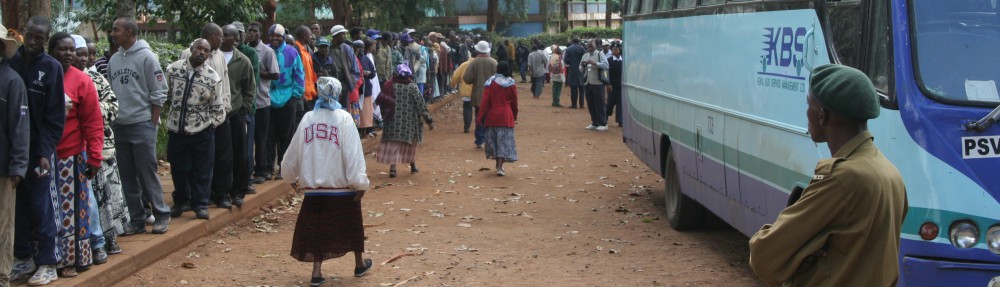
Kenya Bus Service (KBS) and Security at Polling Place

“The Eagle Has Landed: Kenya and the ICC” by John Githongo in The Star.

. . . .

. . . History is being made.

The ICC has redefined Kenya’s foreign policy totally and turned domestic politics inside out. Immediately after the post-election violence in 2008, Kenyans were clamouring for the ICC to intervene given the horrors that had just taken place.

Accountability, justice, impunity, reconciliation and other such words were the primary fodder of political discourse as we headed into the referendum on the constitution in 2010. Indeed, it can be argued that even among those most strongly opposed to the new constitutional dispensation, the dark looming cloud of the ICC and all its implications, especially the public mood that accompanied it through 2008 into 2010, all served to soften them up to demonstrate their pro-change, reformist credentials at a time when the country’s leadership and the messy albeit negotiated coalition arrangement was particularly unsatisfactory to the population.

If it hadn’t been for the ICC, perhaps more of the so-called ‘watermelons’ who pretended to support the new constitution while secretly being opposed to it, would have come out into the open with their true position.

.  .  .  .

. . . Parts of the Kenyan population are in just such a trap: caught between our preaching about and, yes, belief in, good governance and accountability; and its realities when brought to bear in our tribalised, politicised and fragmented political economy. Grimly put – ‘it hurts like hell when it is my tribesman who is being held accountable’. It hurts so much it leads to some of the most gibbering rationalisations of absurdity possible.

Continue reading

I am concerned that a move by the ICC to try Uhuru, Ruto and Sang “locally” would needlessly cost additional lives

3451378449_800db9e485_o

The Kenyan government, after years of lack of success in its various diplomatic efforts to block the ICC prosecutions of key figures in the political killings involved with the 2007-08 elections, achieved a potential breakthrough at the most recent AU meeting in Addis.  By getting a section of African strongmen and politicians to agree that the ICC shoe that they had promised to wear was pinching too tightly when it was not deferring to them as Heads of State as opposed to only pursuing lessor suspects out of power, the Government of Kenya raised the stakes for those nations that advocate a law-based international order and for the ICC as the only institution that remains with any potential to substantively express any tangible disapproval of the post-election murder and mayhem in Kenya in 2007-08.

It is in this context that the ICC will have to decide whether or not to accept a panel recommendation to move the trials from The Hague to Kenya or Tanzania.

Let me say that I am no fan of the decision to locate the ICC in The Hague in the first place.  Nothing against the Dutch and I do understand that The Hague has symbolism as a seat of the international law of nations.  Of course the criminal trials of individuals is something quite different and if anything in some ways undercut by the association.  We are confronted now with a situation in which the indictees have taken power in a member state–in a campaign initiated in the context of their defense to the ICC charges–and wish to avoid trial by mutating the individual criminal charges into a matter of the international relations of sovereign states.

So by all means move the Court to Botswana or Belize or some other more suitable location when it becomes logistically rational to do so, but these trials are supposed to be about the loss of life and limb in the “extra-electoral” context of the Kenyan fight for political power and it makes no sense to physically conduct the trial in such a way as to put more lives in the same type of jeopardy.

First, as a general proposition, witnesses against the President and Deputy President will never be able to live in safety in Kenya for any time in the foreseeable future after being identified and choosing to testify (they may wish to accept the danger of living in Kenya after testifying but this should not be asked or expected of them); this is the cold reality that should be readily evident to anyone who has paid attention to politics in Kenya over the years.  If it is understood that witnesses cannot testify in Kenya then why split up the trials over more than one location?  This process has already taken too long to no one’s benefit and supposedly the ICC has problems with resources and funding and a big backlog of cases already.

Second, estimates of the loss of life related to the most recent Kenyan elections with all priority on “peace” or stability over all else were still more than 500 people.  The police made extra-legal pronouncements restricting lawful civic expression and assembly; the country was basically shut down, the military was deployed and people were shot for breaking no law.  A trial in Kenya would be extremely expensive and quite dangerous by any informed reckoning.  The suspects on trial would be in charge of the “security” forces.  How many innocent lives will be lost for this?  No one can know ahead of time but it is grossly irresponsible not to count on some people who have no role in the trials dying for holding them in Kenya.

The whole point of the ICC is that it is “international”.  Thirty three other nations in Africa beside Kenya are members.  The reason for these cases being at the ICC was the tactical decision to vote in the “duly elected” Kenyan Parliament to “don’t be vague, go to The Hague.”  If “The Hague” no longer has the stomach for this, they should declare now that the task is too hard and walk away and make clear that Kenya, in spite of the work of the Waki Commission arising out of the AU-sponsored 2008 post-election settlement and the vote of its own parliament, is a zone of impunity, at least for suspects who arise above a political ceiling on potential accountability.  Otherwise, these trials need to be brought to fruition and be heard and appealed and done with purposeful speed and as few diversions as feasible.

We all know that the crimes alleged happened.  We saw them and heard them and see and feel their effects today.  Those of us who lived through this time in Kenya heard various bits and pieces of the details as these things were happening.  If the suspects or any of them are tried and acquitted then anyone who believes that they are in fact innocent of the roles alleged can celebrate that and all of us can finally mourn justice for these crimes along with the dead.

Famed photojournalist Mo Dhillon responds to AU on the ICC trials: “African Unity leading Africa towards disaster”

Sir Mohinder Dhillon, renowned Kenyan photographer, photojournalist and filmmaker shared this new essay which he also submitted to the ICC judges:

“GADDAFI AND MUSEVENI”
Gaddafi and Museveni

African Unity leading Africa towards disaster.

I’d like to challenge the AU to tell me which tribunal or judiciary in Africa will ever convict a sitting Head of State. This attempt to renege on a commitment to the ICC is nothing more than a sinister plot by Africa’s dictators to save themselves from any kind of accountability. It was initiated by the late Colonel Gaddafi, who bailed the AU out of a financial crisis, thereby buying the loyalty of other African leaders whose necks were also on the line. To save himself from international justice, he wanted Africa out of the reach of the ICC. Shame on such leaders! Contrary to any suggestion of restoring national sovereignty, the aim of these people is for Africa to be out of the Rome Treaty so that they can continue with their evil intentions where money and power counts for everything and the ordinary African can rot.

Our memories in Africa are very short, particularly in the case of perpetrators of genocide, rape and murder. Those who support the AU line that accused Kenyans should be tried locally should remember that not so long ago Parliament and other local bodies preferred to hand over cases to ICC. Remember the slogan that was on the lips of all Kenyans:  “Don’t be Vague, Ask for Hague”. Kenya was given 12 months to put their act together and they did not move an inch. Kenyan authorities were going to investigate several thousand of other perpetrators but none was investigated due to lack political will despite some of perpetrators were recognizable carrying out crimes against humanity. AU is becoming laughing stock in promoting impunity.

The early history of Kenya’s ICC cases seems already to have been forgotten. After the post-election violence in 2008, the Peace Accord appointed the Waki Commission which produced 529 pages report on 16 July 2009 along with 6 boxes of documents and supporting material. A sealed envelope containing names of those considered most responsible for the violence was given to Kofi Annan as mediator.   Kenyan Government tried for one year to establish a local tribunal but parliament blocked this, leading to the involvement of the International Criminal Court.  The ICC Prosecutor, Luis Moreno Ocampo opened the envelope, inspected its contents and re-sealed it, before proceeding at Kenya Government request to carry out investigations and develop the resulting cases for ICC.

Kenya must smell the rat behind the intentions of our neighbours in Ethiopia, Uganda and Sudan, who are guilty of gross human rights violations in their own countries. Most recently, these include muzzling the media and arresting journalists and civil rights workers, but there is a long track record of crimes against humanity in each country. The AU has failed miserably to bring the perpetrators to book, as have the local judicial systems.

Until fifteen years ago, I filmed all the OAU meetings since its inception in 1963. For most of that time, the fight against apartheid in South Africa was the only factor that held this organisation together – otherwise I’m sure it would have disintegrated. It is a matter of record that crimes against humanity on the rest of the continent have far outweighed the evils of apartheid both in terms of scale and sheer lack of accountability. Why the double standard?

It is abundantly clear that most of Africa’s leaders are more concerned with protecting themselves than they are with securing justice for ordinary people. Although we in Kenya have made enormous strides in securing personal freedoms over the last twenty years, I am deeply concerned about the negative influence of our dictatorial neighbours in Uganda, Sudan and Ethiopia, where media houses are being closed down for flimsy reasons, where opposition is not tolerated and large numbers journalists and activists languish in dungeons without being charged. Kenyan genocide victims need closure just like the victims of Charles Taylor in Liberia, where the ICC was applauded for a job well done. There can never be adequate compensation for loss of life, limbs or dignity but at least some measure of justice was served.

Members of Kenya’s Government are shouting empty slogans about protecting their sovereign rights, in complete contradiction of their earlier position. I trust that the Kenyan people can see for themselves the total insincerity of those who are driven by nothing more than fear for themselves, and total disregard for the victims of violence. . . .

Here is the whole document: African Unity leading Africa towards disaster (5)


“The West” is not a Country either–the U.S. and U.K. do not have the same interests in Kenya

The Star reports that:

President Uhuru Kenyatta is set to hold talks with UK’s Prime Minister David Cameron during his three day visit, the first to a western capital since his election.

Human rights activists in the UK are reportedly organising to hold demonstrations to protest what they say is a ‘hypocritical manner’ manner in which the British government has made a U-turn against in its stand towards the Kenyan government.

In the U.K., unlike in the U.S., the Kenyan election stirred a significant discussion in the national legislature, in this case the House of Commons. Here is the link to the Hansard or transcript from March 20.

The biggest difference in interests is that Kenya, a British colony within the lifetimes of current political leaders, is important to the British economy. Kenya is not very important to the U.S. economy. It might be someday, and the U.S. would notionally like to be more engaged economically in East Africa, and not only because the Chinese are; nonetheless, as of today the level of trade and investment is not a higher order immediate interest for the United States.

Further, in the global system that the U.S. has helped create, the U.S. does not really have the same relationships to even the largest companies that may be headquartered in the U.S. as the British and some other European nations still have with their business champions. Not to say that the State Department doesn’t want to sell Boeing v. Airbus, but there is no American equivalent of BAE, for example. Further, it is British rather than American companies that are the key players in Kenya in banking and finance, tea, horticulture, tobacco, printing, public relations consulting, etc.

As of the last few years, roughly 60% of the roughly 5,000 Americans living in Kenya, according to the State Department, were connected to missionary work. The British, not as much as far as I know. Moreover, there are perhaps five times as many British passport holders in Kenya as Americans.

The United States has a reported official established presence of more than two dozen federal agencies in Kenya, so we do have interests, but they are heavily weighted toward “global” security matters, along with international crime/drugs, etc., and what we might call diplomatic and security logistics. In other words, it is convenient for people to locate in and transit out of Nairobi to support a variety of functions that don’t relate uniquely to Kenya. Its an easier place to fly in and out of and has lifestyle appeal, along with being a locus of the same type of thing for people in other agencies, from other governments and international organizations. It is not that this geographic interest doesn’t matter, its just that it really is not of first order importance. A lot of the aid programs that we conduct in Kenya could easily be moved to other countries that are even more in need if less convenient, for instance.

When al Qaeda wanted to attack Americans and U.S. interests in East Africa, they bombed our Embassies in Kenya and Tanzania–not some critical infrastructure or something or someplace else that the Embassies are there to protect.

Kenya is a tourist destination with direct flights of modest duration from the U.K., but still no U.S. direct flights. In the U.S., Kenya is on the tourism “map” along with other various other locations in Africa, but at a much lower relative level; the British are Kenya’s greatest source of tourists. The British newspapers cover Kenya in a completely different way, and to a much greater extent, than American papers.

I have referred to Kenya as Americans’ favorite African country, but this is within the context of the whole “Africa is a Country” perception problem. It was one of the British princes who had the bad form to be quoted to the effect that “Americans don’t do geography”. The British still know their way around their former empire and distinguish Kenya from its neighbors much more readily than do Americans.

Certainly the British MPs wax eloquent about the key importance of training the British military in Kenya, noting that this was said to have played a major role in allowing Britain to mount its Falklands Islands operations some thirty years ago. Of course, realistically, the UK military in this century is primarily derivative and it is hard to see that the world would be so much different if the British had to train in one of the other former colonies–the U.S. for instance–instead of in Kenya. Military training in Kenya is surely good for British political and military morale, but i think it is the economic issues that really make Kenya uniquely important for the UK, whereas for the U.S. the scales tip overwhelming to the “security” direction.

Obviously the International Criminal Court is another area of difference. The British are members, along with other Western European nations, whereas the U.S. is with the Chinese and Russians in standing outside (whether we are nominally favorable or nominally derogatory seems to depend on which of our parties is in power but we seem to have a fixed commitment to stay out). In this sense, the election of Uhuru Kenyatta and William Ruto is in one particular respect inconvenient for the British in a way that is not as challenging for the United States, but given the ordinary primacy of the specific over the general, and the immediate dollar or pound over longer term security in democratic politics, it is not really surprising that the UK has been more aggressive and quicker in seeking publicly to “get right” with Uhuru Kenyatta following his elevation to the Kenyan Presidency than has the United States.

At Easter, chicks come home to roost for U.S. for helping to underwrite impunity in Kenya; but “we” do not need Uhuruto

The United States looked the other way on a stolen 2007 election in Kenya.

Even though our Ambassador himself saw the changed tally forms at the Electoral Commission in Nairobi. We supported a “settlement” that created a temporary prime minister spot, without defined authority, for the apparent winner (not only did the exit poll done at the instance of the Ambassador and funded by USAID show a substantial win for the opposition candidate Odinga, but a separate State Department analysis in January concluded “advantage Raila.”).  “We” nonetheless called on Kenyans to accept the “results”. While we withdrew our congratulations to Kibaki and later asserted that we did not know who won, we were not willing to be publicly honest about what “we” had seen at the ECK as well as what else we did know.

To help pressure for a settlement, we eventually issued “visa ban” letters to three members of the Electoral Commission on the basis of evidence of bribery–but we never revealed this fact or the evidence–it only came to light through stolen cables published in the Daily Nation years later.

We rejected accountability for election theft–thus supporting impunity in this regard.  We supported, in concept, justice for the the post-election killings and mayhem. We had a hybrid position; let’s call it “limited, modified impunity”. Of course, the reality is that our supposed solution of “local tribunals” in Kenya for the post-election violence was always a complete pipe dream under the “power sharing” government we helped broker because that government was never going to implement any such thing.

Thus the role of the International Criminal Court as a last resort due to the initiative of the commission led by Justice Waki to provide the names to the ICC as a fallback.  We should pat ourselves on the back, I suppose, for helping to pay for the commission at least. Likewise, we have over the subsequent years now declined to go along with the aggressive activities of the Government of Kenya in requesting action from the UN Security Council to squelch the ICC’s prosecution, so we have at least refused to stand in the way of the ICC.  At the same time, we haven’t seemed to accomplish anything very noticeable on the protection of witnesses and the other core issues that enshrine impunity in Kenya.

Now, just like in 2007, we have helped pay for another flawed election, this time one which has ended up with a victory for the ticket of “Uhuruto” composed of the two leading politicians charged by the ICC for allegedly having key responsibility for the instrumental political killings of 2008. While it appears plausibly that Uhuruto on March 4 had a higher percentage of support than did Kibaki in 2007, it is also clear that there were substantial irregularities in the handling of the election, over a period of many months, by the “new and improved” IEBC–which was in fact caught even within the Kenya government itself, engaging in unlawful procurement corruption in regard to key technology–technology which was supposed to provide safeguards against the shambolic 2007 tallying process, but failed to be deployed or work.

So after an extraordinary sum of perhaps $240M was spent on an election with only somewhere around 14M registered voters (not sure exactly how many since the register was a series of 33,400 separate paper print outs which were reported by the IEBC to be unavailable for review in the Supreme Court)–we ended up with the same manual count fiasco as in 2007.  More system purchases were more opportunities to “eat”, not more reliability.

The IEBC was perceived as being corrupted on both sides instead of stacked completely only on one side like the ECK last time–but there was no one individual trusted like Kivuitu to let everyone down this time. In one respect that helped diffuse the prospect of violence because the voters this time were much more subdued and had lower expectations–and knew what could happen. And there were some other things different this time based on lower expectations from the “international community”–the observer groups spoke out early to bless the IEBC before it was anywhere close to completing its tally and gave it some cover for whatever it would chose to do. Last time, only IRI really did that–and it was rightly criticized for doing so as the count became problematic.  This time, private conversation before the election about what to say hearkened back to what observers had said in the first full blown observations of Kenya’s first multi-party elections in 1992 under Moi–the terminology “reflects the will of the Kenyan people” as a way to say the process run by the Government of Kenya could not stand scrutiny but the official candidate had a plurality anyway. The difference being that this time Kenyans had passed a new Constitution that was supposed to end the old first-past-the-post system in favor of a runoff-to-majority that meant that the opposition did not have to unite behind one candidate ahead of time to have any chance against a minority candidate supported by the State.

The U.S. knew, and Kibaki and his supporters, including Uhuru Kenyatta, knew that in 2007 we gave the Government of Kenya a pass on election rigging.  This time we didn’t step in and blow the whistle on procurement corruption or otherwise as the process moved towards its unsuccessful conclusion–and we gave the powers that be in Kenya no real reason so far as I know to believe that we had really changed the terms of the deal from 2007.

Now we have another incoherent vote count, but everyone is relieved that major violence did not erupt.  The new Electoral Commission argued to the Supreme Court that the Court could not set aside the IEBC’s pronounced premature results on the basis of the irregularities that had been revealed so far, or the known uncertainties, because to do so would create a constitutional crisis–the only way to have another election would be to use the same flawed register and the same flawed Electoral Commission itself.  In other words, the Court did not, according to the IEBC, really have the power to challenge its work and its decision which was now fait accompli.  The Court announced its ruling–at the last allowable moment (a few hours later than the two weeks permitted if it were as strict with itself as it was with those before it)–yet could not muster any explanation or reasoning whatsoever.  It declared itself to have the power, and to be exercising it, to ratify the IEBC’s result, but either couldn’t agree on why or was not comfortable saying until a future date–after the swearing in.

The bottom line here is that the United States has been helping to underwrite failure in Kenya for too long.  We got taken for a ride–again.  We ought to have more self respect.

The British government has groveled to “get right” with an incoming Uhuruto administration, but we simply do not need to do so.

We provide a disproportionate amount of aid to Kenya–officially roughly a Billion U.S. Dollars each year–unofficiallly I am sure there is more; not to mention extensive private aid that also helps alleviate the suffering of Kenyans left adrift by the corruption and bad priorities of their governments.  As far as I can see, we spend a lot of money in Kenya for sentimental rather than legitimate programmatic reasons.  And the restaurants and resorts are more upscale and Kenya is more oriented for tourism accompanying official travel and postings.  But a lot of the tourist infrastructure is owned by the Kenyatta and Moi families themselves.  We ought to grow up and take our responsibilities more seriously.

What has all this spending been adding up to aside from bad elections?  Kenya’s Human Development Index score for 2000 was .513 for a “Medium Human Development” ranking of 134th among the scored countries.  The 2012 score was .519, for a rank of 145th.  Among the 45 “Low Human Development” countries Kenya stands out, along with Zimbabwe for having by far the highest “Mean Years of Schooling”.  Yes, from 2000 to 2012 Kenya’s GDP per capita increased by roughly fifty percent–it just didn’t result in much relative overall human development progress for the country as a whole.

The Cold War has been over for almost 25 years.  What we have been doing has not been working very well and we can do better.

More links for Kenya’s Election; Chief Justice’s “bombshell” press conference; Debate loses a “horse”

Kenya Voting: "Curriculum Cooking"

AllAfrica.com has put together a special feature page on the Kenyan elections that is a good source for the latest stories from the main Kenyan media sources:  “Kenya Decides: 2013 Elections”. (h/t @GeorgetownDG)

On Thursday, February 28, the Institute for Security Studies Nairobi office will host a “Seminar on Kenya’s 2013 Elections: issues, actors and scenarios.”  Register on-line through the link.

IRIN has published on on-line “multimedia documentary” entitled “No Ordinary Elections” which does a nice job of informing an international audience of the basic context of the upcoming Kenyan election and includes good interviews discussing humanitarian concerns and preparations in general terms.  A work of art in internet publishing.

In the latest developments, there is a lot of buzz in the human rights community regarding the announcement by Chief Justice Mutunga at a press conference today that he had received a letter threatening judges and others regarding any ruling against the candidacy of Uhuru Kenyatta purporting to be from a Mungiki-associated group, Further, as reported in the Star story “Chief Justice Raises Concern Over Threats to Judges”:

The CJ also revealed that he was asked by an immigration officer at the JKIA to seek travel clearance from the Head of Civil Service Francis Kimemia a day after the letter was posted.

“I was stopped at the Jomo Kenyatta International Airport (JKIA) by an Immigration Officer, who insisted that I could not travel because I had not been cleared by Mr. Francis Kimemia, the Permanent Secretary, Head of the Public Service, and Secretary to the Cabinet.” Mutunga said.

The CJ further asked Inspector General of police David Kimaiyo to take the necessary steps to protect judges from threats and intimidation so as not to give constitutional rulings. “The Judiciary will not flinch from interpreting the constitution as required. The constitution must be guarded jealously,” He said.

From The Standard: CJ Mutunga bombshell”.

From the Daily Nation: “Chief Justice Speaks Out on Threatening Letter.”

Obviously a lot of difference among the media houses in how to report this.  Thus the need to read widely to put together the pieces in getting the facts and understand the interests.

While I would completely reserve judgement as to exactly what to make of the threatening letter, the “immigration” harassment is disturbing in light of Kenya’s short but unduly “colorful” history involving politics at these highest levels.  Certainly the President himself should address this if he wants to reassure the country at a time in which no one needs any more tension than can be helped.

This has overshadowed the other big political story of the day, that Uhuru Kenyatta’s campaign has announced that he will drop out of the second presidential debate scheduled for Monday, complaining of the allegedly unfair amount of emphasis on the charges he faces from the International Criminal Court and “ganging up” by the other candidates on this point.

My sense of the political strategy here would be that Kenyatta feels he is in solid position to make a runoff, and not in striking distance to win in the first round, so there is nothing major to be gained from another debate, while there are risks from undesired questions and unscripted situations.  He has plenty of money and media access as a top candidate so he probably doesn’t feel a need to share the stage to  communicate whatever he wants to say in the last days of the campaign.  Likewise, part of his approach since the ICC charges have been confirmed has been to portray himself as a victim of other politicians and interests, so claiming that he was treated unfairly in the debate fits with that theme, too.