Ocampo, the Donors and “The Presumption of Arrogance”; a story of babes in the woods of Mt. Kenya?

Let me be clear that I have always supported the pursuit of the ICC cases for the 2007-08 post election killings in Kenya.  Not because the ICC was necessarily a good option but because it was that or nothing.  My country, the United States, officially as a matter of foreign policy articulated by the State Department, always supported prosecution of the post election violence by a “local tribunal” in Kenya.  Which is quite exactly like being in favor of Santa Claus bringing a cure for Ebola in Sierra Leone.  In no way am I against either, but there are obviously more challenging questions begged by the devastating facts presented in these situations. (See “Christmas Shopping–For Sale: Brooklyn Bridge, Ocean Front Property in Arizona, Local Tribunal in Kenya”)

In the context of the “don’t be vague, go to The Hague” vote by Kenya’s Parliament, our U.S. position has been inevitably opaque.  We are not and have never been a member state of the International Criminal Court.  As a general proposition under U.S. law our officials are not to be involved in supporting ICC prosecutions, subject to certain potential exceptions.  Nonetheless, as permanent members of the United Nations Security Council the diplomatic strategy of the Kenyan government in the second Kibaki administration put us to a decision as to whether or not to support Security Council intervention to interrupt the ICC prosecutions in the two Kenyan cases.  We declined to do so, to our credit in my opinion.

How to understand what has happened with the pre-trial decisions by Prosecutor Bensouda to drop the charges against the two defendants in the Government/PNU case, Muthaura (on 11 March 2013) and Kenyatta (on 5 December 2014), while the trial in the Opposition/ODM case proceeds?

Almost seven years after the post election violence we are left with complete impunity on the side of those who initiated the conflict by stealing the election and employed two of the three types of large scale killings at issue in the charges of “crimes against humanity”.  ICC Prosecutor Ocampo’s Government/PNU case originally included Kibaki’s Commissioner of Police, Major General Hussein Ali, but the Pre-Trial Chamber declined to confirm the charges against Ali, as it declined to confirm the charges against Henry Kosgey on the Opposition/ODM side.  The greatest cause of death as identified by the Waki Commission report was gunshot wound – understood to be primarily administered by the General Service Unit, Administrative Police and Kenya Police Service forces under Ali’s command.  The “body count” of those who were identifiable by tribe as reported by the Waki Commission was greatest among the Luo–those targeted primarily by the Government side rather than by the militias associated with the Opposition.

So whatever happens with the Ruto and Sang case, the winners of the post election conflict–those on the side of those who stole the election in the first place and who killed to keep and enforce power–remain comfortably immune from any negative consequences, as well as with the benefit of what they have “eaten”.  No more than two individuals face any charges of the many people involved in raising and facilitating the ethnic militias in the Rift Valley that killed innocent Kikuyu in revenge for Kibaki’s election theft and to some extent for leverage in a post election political dispensation, as well as to remove future Kikuyu votes and occupy land as in 1992 and 1997 (when Kenyatta and Ruto were partnered in KANU as now in Jubilee).

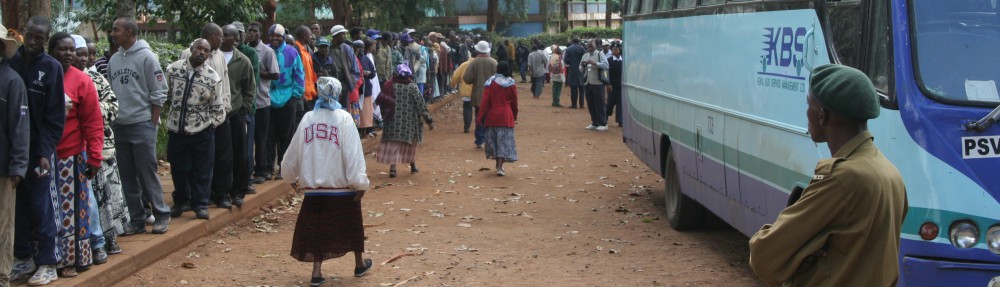
Post-election IDP camp at Naivasha, Kenya, 2008

Post-election IDP camp at Naivasha, Kenya, 2008

I do not necessarily blame Ocampo for having tried and failed. He took on what was perhaps inevitably a nearly impossible task given his lack of actual power. I do very much fault him for raising expectations and seeming to believe as well as play to his own press, and then quitting before the end. I am inclined to think that he simply had no realistic understanding of what he was getting into in going after Kibaki’s closest lieutenants on their own turf and was tone deaf to learning.  He seems to have believed that the perceived global stature of the International Criminal Court and his office meant a lot more than it actually did in the warrens of power in Nairobi, no matter how many painted his face on the side of a matatu or a duka. It is hard to imagine how he could have failed to seriously pursue Kenyatta’s telephone and bank records before he left the prosecutor’s office in July 2012. Or how he could have seriously convinced himself that he or his successor would somehow get the records through some notion of “cooperation” from the second Kibaki Administration in which Kenyatta was a key Minister throughout, from his initial appointment during the post election violence on January 8, 2008, as well as the Deputy Prime Minister from April 2008.  Did he pursue evidentiary assistance formally from the United States under those potential legal exceptions I mentioned?

For details on the cases, as I wrote in a post in October ahead of the ICC Status Conference, “Susanne Mueller’s article from the Journal of East African Studies earlier this year, “Kenya and the International Criminal Court (ICC): politics, the election and the law”, perhaps gives the clearest account of how the game has been played so far.”

I do not doubt that Ocampo showed personal courage in the prosecutions of Argentina’s ex-generals and compatriots in establishing the credential that led to his appointment as the ICC’s first prosecutor. Nonetheless, the key distinction in that case was a change in government that made such prosecutions feasible. That did not happen in Kenya because the stolen election was allowed to stand, with an eventual settlement that if anything made the situation harder by adding the perpetrators on the Opposition side into that Government as more junior parties, helping to maintain unity for impunity.

As for my country, we tried to have it both ways by supporting impunity for the theft of the election–having at the very best “actively looked the other way” while it was happening– then notionally supporting “justice” for the killings that followed. Not an idea that was ever likely to fit down a real chimney in Kenya.

And yes, I do have more stories for “the war for history” series.  For instance, yes, the State Department did know before the vote in 2007 that the Kibaki Administration had dispatched the Administrative Police to opposition strongholds in support of the Kibaki re-election effort.  Of course if the “AP” hadn’t gotten caught by those Kenyan television journalists it wouldn’t have been such a problem; certainly we Americans did not say anything publicly.  Now that Kenyatta’s grasp on power is that much firmer with the ICC case over, I don’t doubt that he will further ramp up his efforts to formally and informally undermine the new Constitution and shift power back to the Presidency and away from the media, civil society and the citizenry at large to avoid such inconveniences going forward.

This week I got an email from the State Department’s Bureau of Democracy, Human Rights and Labor with a Request for Proposals for “Countering Closing Civic Space in Kenya and Uganda”.  It’s a nice idea to support those trying to hold on to the freedoms they have won, and the amount of money–as much as $841,000.00 for a regional program for the two countries–would not have been trivial if it weren’t for the many millions we spent on the Kenyan IEBC during its 2012-13 “#Chickengate” binge, and on helping to sell its incomplete at best results to the public in the last election, for instance, among many other examples of the things we keep doing to contradict ourselves on support for rights, reform and democracy.  And of course our much deeper overall long term “partnerships” with the Museveni and Kenyatta governments.

I may be the one showing naivete now, but I do actually believe that by and large most people in my government, as with the other Donors, do wish for better for Kenyans in terms of justice versus impunity, and for the protection of rights and the establishment of a meaningful democracy where voters have agency.  All other things being equal, they would like Kenya to be a country in which powerful killers go to jail and votes count.  It’s just that they can’t bring themselves to make the hard choices or take the risks required.

Democracy Reading–Waltzing with a Dictator; history and lessons for today

Raymond Bonner’s Waltzing with a Dictator: the Marcoses and the Making of American Policy (©1987, 1988) is long out of print, but used copies are readily available.

This is well worth a read by those interested in American foreign policy and its relationship with authoritarian governments and democratic transitions anywhere, and in international election observation.  One lesson here for Americans, and for those seeking American support for reform, is to appreciate the power of illicit wealth in the hands of foreign authoritarians to help charm key people in power in both Democratic and Republican administrations in the United States.  Nonetheless, in a pinch in the Philippines, we eventually helped with the restoration of democracy irrespective of Cold War interests that had been previously asserted to justify support for the Marcos dictatorship.

The 1986 election in which Ferdinand Marcos was ousted by Corazon  Aquino was a pioneering effort in international election observation and internationally supported domestic observation to combat state-supported election fraud.  Aquino’s accession to the presidency as summarized in her Wikipedia entry:

A self-proclaimed “plain housewife“,[1] she was married to Senator Benigno Aquino, Jr., the staunchest critic of President Marcos. She emerged as leader of the opposition after her husband was assassinated on August 21, 1983 upon returning to the Philippines from exile in the United States. In late 1985, Marcos called for snap elections, and Aquino ran for president with former senator Salvador Laurel as her Vice-President. After the elections were held on February 7, 1986, the Batasang Pambansa proclaimed Marcos and his running mate, Arturo Tolentino, as the winners amidst allegations of electoral fraud, with Aquino calling for massive civil disobedience actions. Defections from the Armed Forces and the support of the local Catholic Church led to the People Power Revolution that ousted Marcos and secured Aquino’s accession on February 25, 1986.

Of particular current interest from the Bonner book is the role of Republican Senators Thad Cochran of Mississippi and Richard Lugar of Indiana as election observers who held the line against election fraud and provided key support for “moderates” back in Washington in the Reagan White House against the pro-Marcos “hardliners”.  After seeing blatant election misconduct by the regime, Cochran sent a message by donning his yellow golf pants during the observation–yellow being Aquino’s campaign color.  Lugar was defeated in the 2012 Republican primary by a hardline “tea party” challenger, and Cochran has just been certified as the narrow winner of a primary runoff against a “tea party” challenger in Mississippi.  Within the Carter White House in 1977-81 there was similarly a divide between hawkish pro-Marcos Democrats, people we might think of now as more or less “neocons”, and early human rights advocates.

“The West” is not a Country either–the U.S. and U.K. do not have the same interests in Kenya

The Star reports that:

President Uhuru Kenyatta is set to hold talks with UK’s Prime Minister David Cameron during his three day visit, the first to a western capital since his election.

Human rights activists in the UK are reportedly organising to hold demonstrations to protest what they say is a ‘hypocritical manner’ manner in which the British government has made a U-turn against in its stand towards the Kenyan government.

In the U.K., unlike in the U.S., the Kenyan election stirred a significant discussion in the national legislature, in this case the House of Commons. Here is the link to the Hansard or transcript from March 20.

The biggest difference in interests is that Kenya, a British colony within the lifetimes of current political leaders, is important to the British economy. Kenya is not very important to the U.S. economy. It might be someday, and the U.S. would notionally like to be more engaged economically in East Africa, and not only because the Chinese are; nonetheless, as of today the level of trade and investment is not a higher order immediate interest for the United States.

Further, in the global system that the U.S. has helped create, the U.S. does not really have the same relationships to even the largest companies that may be headquartered in the U.S. as the British and some other European nations still have with their business champions. Not to say that the State Department doesn’t want to sell Boeing v. Airbus, but there is no American equivalent of BAE, for example. Further, it is British rather than American companies that are the key players in Kenya in banking and finance, tea, horticulture, tobacco, printing, public relations consulting, etc.

As of the last few years, roughly 60% of the roughly 5,000 Americans living in Kenya, according to the State Department, were connected to missionary work. The British, not as much as far as I know. Moreover, there are perhaps five times as many British passport holders in Kenya as Americans.

The United States has a reported official established presence of more than two dozen federal agencies in Kenya, so we do have interests, but they are heavily weighted toward “global” security matters, along with international crime/drugs, etc., and what we might call diplomatic and security logistics. In other words, it is convenient for people to locate in and transit out of Nairobi to support a variety of functions that don’t relate uniquely to Kenya. Its an easier place to fly in and out of and has lifestyle appeal, along with being a locus of the same type of thing for people in other agencies, from other governments and international organizations. It is not that this geographic interest doesn’t matter, its just that it really is not of first order importance. A lot of the aid programs that we conduct in Kenya could easily be moved to other countries that are even more in need if less convenient, for instance.

When al Qaeda wanted to attack Americans and U.S. interests in East Africa, they bombed our Embassies in Kenya and Tanzania–not some critical infrastructure or something or someplace else that the Embassies are there to protect.

Kenya is a tourist destination with direct flights of modest duration from the U.K., but still no U.S. direct flights. In the U.S., Kenya is on the tourism “map” along with other various other locations in Africa, but at a much lower relative level; the British are Kenya’s greatest source of tourists. The British newspapers cover Kenya in a completely different way, and to a much greater extent, than American papers.

I have referred to Kenya as Americans’ favorite African country, but this is within the context of the whole “Africa is a Country” perception problem. It was one of the British princes who had the bad form to be quoted to the effect that “Americans don’t do geography”. The British still know their way around their former empire and distinguish Kenya from its neighbors much more readily than do Americans.

Certainly the British MPs wax eloquent about the key importance of training the British military in Kenya, noting that this was said to have played a major role in allowing Britain to mount its Falklands Islands operations some thirty years ago. Of course, realistically, the UK military in this century is primarily derivative and it is hard to see that the world would be so much different if the British had to train in one of the other former colonies–the U.S. for instance–instead of in Kenya. Military training in Kenya is surely good for British political and military morale, but i think it is the economic issues that really make Kenya uniquely important for the UK, whereas for the U.S. the scales tip overwhelming to the “security” direction.

Obviously the International Criminal Court is another area of difference. The British are members, along with other Western European nations, whereas the U.S. is with the Chinese and Russians in standing outside (whether we are nominally favorable or nominally derogatory seems to depend on which of our parties is in power but we seem to have a fixed commitment to stay out). In this sense, the election of Uhuru Kenyatta and William Ruto is in one particular respect inconvenient for the British in a way that is not as challenging for the United States, but given the ordinary primacy of the specific over the general, and the immediate dollar or pound over longer term security in democratic politics, it is not really surprising that the UK has been more aggressive and quicker in seeking publicly to “get right” with Uhuru Kenyatta following his elevation to the Kenyan Presidency than has the United States.

March 24: International Day for the “Right to the Truth” and the Kenyan TJRC

The International Center for Transitional Justice asks “Can We Handle the Truth?” concerning gross violations of human rights.

The ICTJ has been working in Kenya since 2008, focusing in particular on the effort to deliver a successful post-election Truth, Justice and Reconciliation Commission process.

Supporting the search for truth, to lead to justice and reconciliation, is obviously a tough job in Kenya, and in the case of the supporting the TJRC made that much harder by the bizarre situation presented by the Kiplagat appointment to the chairmanship. The latest news from this week is Kiplagat’s last minute refusal through his lawyers to honor his summons to testify before the Commission:

The Truth Justice and Reconciliation Commission issued Ambassador Bethuel Kiplagat with a summons to appear before the Commission on Thursday 22 March 2012 . On the eve of the Hearing, the Commission received a letter from Ambassador Kiplagat’s lawyers stating that he would not honour the summons.

The Commission is now in the final stage of its Hearings. This stage includes giving a Hearing to persons adversely mentioned by Kenyans through our public Hearings and statement taking. This is an important stage which ensures fairness in compiling an accurate and complete historical record of the truth about the gross violations of human rights in Kenya

The Commission recognises that its ultimate aim is to draw Kenyans towards the path of reconciliation and healing. An overwhelming number of Kenyans have expressed the view that this destination can only be achieved through Truth and Justice

It is in pursuit of the truth that Ambassador Kiplagat, like any other witness, was to appear today before the Commission.
The Commission is surprised and taken aback at the reasons advanced by Ambassador Kiplagat’s lawyers for his non appearance here today. The High Court case clearly did not address the issue of illegal or irregular allocation of land. The High Court case only dealt with the legality of the process followed in appointing the commissioners

We are dismayed that although Ambassador Kiplagat has claimed widely in the media that he has returned to the Commission in a spirit of reconciliation and a desire to further the work of the Commission, he is instead addressing the Commission through his lawyers and refusing to cooperate with the critical national process of truth telling

We note that it is the Commission, and not individual Commissioners, that has summoned Ambassador Kiplagat to testify. The law is clear that the decision to summon a witness lies with the Commission and not with any other person or institution, and that any witness who does not comply is in breach of the law since Commission summonses are backed by the force of law as laid out in Section 7 of theTJR Act

The Commission is unwilling to squander any more valuable time and resources on theatrical tantrums meant to distract it from achieving its mandate. We are cognisant that there are Kenyans in this room who have travelled from Kitale and other distant destinations, in order to attend these proceedings which are adjourned to 29th March when the other witnesses expected today and who sought more time shall be in a position to attend.

We thank you for your patience and your attention.

New Mo Ibrahim Foundation rankings for African Governments

Here are the 2010 Ibrahim Index rankings for the East African Community members, plus Ethiopia and Sudan, out of 53 African countries. Overall ranking to left, "Participation and Human Rights" in parenthesis to the right:

15 Tanzania (56.37)
24 Uganda (50.84)
27 Kenya (55.47)
31 Rwanda (37.94)
32 Burundi (48.63)

34 Ethiopia (34.58)
48 Sudan (23.08)

Kenyan Justice Minister claims he did not know of renditions to Uganda, calls it “a failure of institutions”

Another surprising statement from Mutula Kilonzo:

NAIROBI (Reuters) – Kenya’s justice minister said the rendition of Kenyans to Uganda to face charges of involvement in bomb attacks in Kampala should not have occurred and that parts of the judicial system had failed.
Mutula Kilonzo comment’s to Reuters in an interview late on Wednesday supported the view of two high court judges who have criticised the transfer of several suspects to Uganda.

"It is a failure of institutions because it should not happen. The judge in many respects is dead right because if you believe a Kenyan citizen has committed an offence, put him through the process," Kilonzo said late on Wednesday.

Judge Mohamed Wasarme said on Tuesday the transfers flouted the rights of the Kenyan citizens.

On Thursday a high court judge labelled the arrest, detention and removal of one of the Kenyan suspects as illegal.

A total of 38 people, including Ugandans, Kenyans and Somalis, have been charged with terrorism over the twin bomb blasts in the Ugandan capital that ripped through crowds watching the World Cup final in July.

The Kenya Human Rights Commission, a civil society group, says 13 Kenyans were illegally transferred to Uganda.
. . . .
Reprieve, a UK-based legal rights group, said worrying new patterns of counter-terrorism were emerging in east Africa.
"If it’s true Kilonzo was unaware of the renditions, then what we’re talking about is a rogue police force … that operates outside all chains of command," said Clara Gutteridge, a deputy legal director at Reprieve.

Earlier in the week we have seen Kilonzo back down on last week’s statement that the ICC was no longer needed to prosecute Kenya’s Post Election Violence since Kenya had passed a new constitution that would reform the police and courts. Hmm. . .

Unintended Consequence of al-Bashir Invite–more leverage for ICC on Kenya Post-Election Violence?

From Tom Maliti, Associated Press

NAIROBI, Kenya – Kenya on Friday allowed the International Criminal Court to open an office in the country, a development that comes after Kenya’s commitment to the court came into question when the nation hosted Sudan’s indicted leader last week.
ICC Prosecutor Luis Moreno Ocampo is investigating top Kenyan leaders and businesspeople for their roles in the country’s December 2007 to February 2008 post-election violence that killed more than 1,000 people.

On Friday, Kenya granted the ICC immunity from legal challenges, tax exemptions and other privileges in a letter signed by Foreign Affairs Minister Moses Wetangula.

The move comes only a week after Kenya hosted Sudanese President Omar al-Bashir during a ceremony for Kenya’s new constitution.

. . . .

Kenyan Cabinet leaders, including Wetangula, met with ICC Registrar Silvana Arbia on Friday.
"We have agreed to comply with every aspect of the (ICC) request for the privileges and immunity which their officers require to be able to undertake their work," said Minister of State for Internal Security George Saitoti, who chairs the Cabinet subcommittee on the ICC.

"I trust that the government of Kenya will fully respect its obligations under the Rome Statute," which established the ICC, Arbia said after receiving the letter.

The ICC registrar has been in Kenya since Wednesday to seek government assurances it will cooperate with the court and educate the public about how it operates.

For a cautionary, but realistic view of where Kenya is a the moment, see the latest post from "Maina’s Blog", wherein Maina Kiai stresses the ICC status and throws cold water on the Truth, Justice and Reconciliation Commission:

Impunity and lack of accountability also needs to be addressed via the Truth, Justice and Reconciliation Commission, which is unfortunately now turning into a bigger farce than could have been anticipated! How a potential witness—in a negative way–can Chair the TJRC beats comprehension! How someone who is supposed to lead reconciliation can be so arrogantly obstinate boggles the mind. If Bethuel Kiplagat does not get what conflict of interest is, his competence and integrity as Chair are marred ab initio. Worse, he has now gone out and hired other potential witnesses as staff for the TJRC! Which means that these survivors—and a large majority have been on the margins of society precisely because of the violations they suffered–who are now staff will not be testifying at the TJRC as that would be another conflict of interest! What better way to destroy an institution, and weaken it before it starts than this?

Today-Supreme Court hears oral argument in Samantar v. Yousuf–Somalia and Somaliland Torture Case (Updated)

NPR’s story from before the argument this morning.

For a recap of the today’s argument and other details see SCOTUSWiki on Samantar v. Yousuf

This site includes links to the various briefs, including the Amicus Brief filed by Foreign Minister Duale for the Republic of Somaliland in favor of Yousuf (the victims), and other supporting amicus briefs from three Democratic Members of Congress, Senators Spector and Feingold and Representative Lee, and from a group of former US diplomats including Princeton Lyman. The US Government also supported affirming the Fourth Circuit’s ruling overturning the District Court’s dismissal of the case on sovereign immunity grounds.

The Summary of Argument from the Somaliland brief:

TORTURE, EXTRAJUDICIAL KILLINGS AND THE ARBITRARY DETENTION OF SOMALI CITIZENS WERE ALL EXPRESSLY FORBIDDENBY THE CONSTITUTION THAT CREATED THE GOVERNMENT OF THE DEMOCRATIC REPUBLIC OF SOMALIA. SUCH ACTS THEREFORE COULD NOT POSSIBLY HAVE BEEN PERPETRATED UNDER ANY LEGITIMATE AUTHORITY GRANTED TO THE SOVEREIGN GOVERNMENT OF SOMALIA OR ITS PUBLIC OFFICIALS. UNDER THESE CIRCUMSTANCES, THE DOCTRINE OF SOVEREIGN IMMUNITY DOES NOT APPLY.

THE UNITED STATES CONGRESS HAS ENACTED STATUTES PROVIDING THE VICTIMS OF HUMAN-RIGHTS ABUSES A REMEDY WHEN THE PERPETRATORS OF THOSE ABUSES ARE FOUND WITHIN THE CONFINES OF THIS COUNTRY’S BORDERS. IT IS ESSENTIAL THAT THE JUDICIAL PROCESS ENVISIONED BY THE UNITED STATES CONGRESS BE PERMITTED TO GO FORWARD SO THE EFFORTS TO ACHIEVE PEACE AND RECONCILIATION IN SOMALILAND AND THROUGHOUT THE REGION CAN BE REALIZED. MORE IMPORTANTLY, IT IS ESSENTIAL THAT THE RULE OF LAW BE APPLIED TO THE PERPETRATORS OF INTERNATIONAL HUMAN-RIGHTS ABUSES WHEN THEY ARE FOUND WITHIN THE BORDERS OF THE UNITED STATES.

Amicus briefs supporting Samantar were filed by three former Republican Attorneys General, Meese, Barr and Thornburg, and by the Kingdom of Saudi Arabia.

Human Rights Watch–New World Report/Kenya Chapter

From the new Human Rights Watch World Report. Note: “The police regularly targeted civilians for killings and other violence in 2009, as in previous years.” http://www.hrw.org/en/world-report-2010/kenya

The Uganda chapter is here, and the Ethiopia chapter is here.

Christmas Eve Arrests for Human Rights Marchers

Bunge La Mwananchi reports that 22 members of BLM and Kenyans for Justice and Development have been arrested and taken into police custody for the offense of engaging in a peaceful procession against impunity, noticed to police in advance by letter.  I guess it can be said that there is no impunity for political expression.