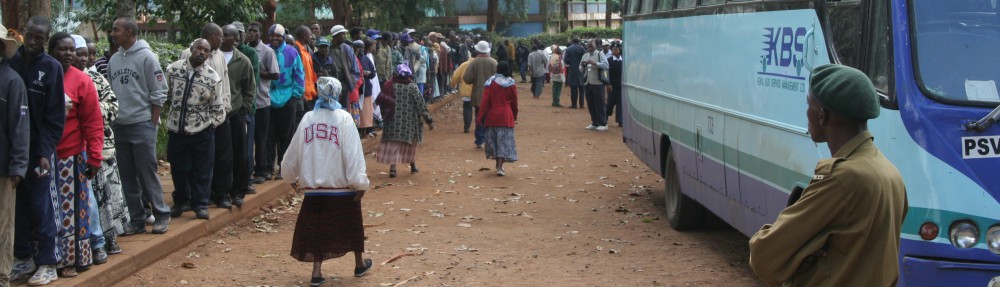
Carter Center calls it as they see it in DRC

Release from Carter Center: DRC Presidential Election Results Lack Credibility

The Carter Center finds the provisional presidential election results announced by the Independent National Election Commission (CENI) on Dec. 9 in the Democratic Republic of the Congo to lack credibility. CENI results point to the re-election of incumbent President Joseph Kabila with 49 percent of the vote followed by Etienne Tshisekedi with 32 percent and Vital Kamerhe with 7.7 percent.  Voter turnout was 58 percent.

Carter Center observers reported that the quality and integrity of the vote tabulation process has varied across the country, ranging from the proper application of procedures to serious irregularities, including the loss of nearly 2,000 polling station results in Kinshasa.  .  .  .

.  .  .  .  The Carter Center is therefore unable to provide independent verification of the accuracy of the overall results or the degree to which they reflect the will of the Congolese people.

DRC: “We have to debunk the idea that it is peace versus transparent elections. The idea that lousy elections are going to bring peace is madness.”

“Congo Opposition Rejects Early Poll Results,” Financial Times [It is a bad sign that “the money quote” is anonymous]:

.  .  .  .

According to the latest partial results, Mr Kabila is winning most support from the mining-rich Katanga province, his stronghold. Some observers have questioned the use of an unaudited voter registration system, which allotted Katanga 4.6m voters, 50 per cent more than the capital Kinshasa, home to 10m people.

A UN Security Council meeting last week noted some electoral irregularities but pressed for a peaceful conclusion to the polls.

“There is no [international] appetite to press for transparency, but just pushing to accept whatever result [the poll commission] comes up with is not going to bring peace,” one Congo expert told the FT. “We have to debunk the idea that it is peace versus transparent elections. The idea that lousy elections are going to bring peace is madness.”

Joshua Marks, of the National Endowment for Democracy, a US-funded foundation, said: “The Security Council wants to avoid violence at all costs. He added: “It’s patronising to the Congolese people. . . You’re still going to have these unresolved grievances in the country and an ever larger number of people against the Kabila regime.”

Despite mineral wealth in copper, gold and diamonds, Congo has slipped to the bottom of global development rankings under Mr Kabila’s latest term, as the country recovers from the 1998-2003 war in which an estimated 5m people died. A clutch of rebel militias still hold sway in the east.

A real election requires credible preparation by a credible election commission and credible dispute resolution mechanisms.  The DRC election has already gone this far (past the actual voting) without the “international community” blowing the whistle.  The Carter Center and the EU observation missions have made clear that there are serious issues with the preparation and execution of the election by the government.   The actors who have supported the process to date need to stay engaged and stay committed as the process continues.

Congolese voters need hope that it makes some difference who they voted for, just like voters anywhere are entitled to expect.  A pretense that the voters cannot believe in can be expected to drive violence.

Here is the Nov. 28 preliminary post-election statement from the Carter Center election observation mission.

AFRICOM and the “Whale of Government” Approach? [Updated]

Ok, maybe it’s tilapia instead of whale, but I thought this blog post from AFRICOM public affairs was worth a look:

By Dace Mahanay, Bush School of Government and Public Service at Texas A&M University graduate student

Note: Dace Mahanay is currently interning with the Borlaug Institute on an AFRICOM agriculture project in Kisangani, DRC. He is sending periodic blogs detailing the project’s progress.

At Camp Base, just outside of Kisangani in the Democratic Republic of the Congo, the Norman Borlaug Institute for International Agriculture continues to work with Agriculture Company (AgCo), a company of Congolese soldiers (Forces Armes de la Republique Democratique du Congo, widely known as FARDC), in an effort to provide sustainable methods of food production for the training center and U.S.-trained light infantry battalion. From fish farming to the cultivation of cassava, the needs of soldiers are being met in a sustainable way that is positive for the future of Camp Base and the community of Kisangani as a whole.

The last few weeks have been an exciting time for the agricultural project. A fish farming expert from the U.S. visited the project and provided valuable recommendations for increased production of tilapia and African catfish. The first batch of harvestable tilapia will be ready in the next couple of months and will be an excellent source of protein for FARDC soldiers.

The President’s new development policy invokes a “whole of government” approach, and I did learn last week about some encouraging specifics in coordination, such as the fact that the MCC has, for the first time, executed an actual Memorandum of Understanding with USAID. Nonetheless, if AFRICOM as a military combatant command, is going to be leading agricultural projects in places where we are not openly militarily engaged except in “permanent” and ongoing training and related activities, what are the lines between civilian and military? Between defense/security/diplomacy and development/agriculture assistance?

It sounds like a great program from an agricultural standpoint. Also sounds like it gets into areas that could involve unintended consequences if all the local circumstances are not well understood.

Update: Here is a story raising the issue of reports of rape and murder by the Congolese army:

Government troops are raping, killing and robbing civilians in the same area of eastern Democratic Republic of Congo where militias carried out mass rapes more than two months ago, a top United Nations envoy said.

Margot Wallstrom, who is responsible for UN efforts to combat sexual violence in conflict, told the Security Council that UN peacekeepers have received reports of rapes, killings and looting by government soldiers.

“The possibility that the same communities who were brutalised in July and August by FDLR and Mai Mai elements are now also suffering [at the hands of the army] is unimaginable and unacceptable,” she said, referring to the Rwandan-led rebels from the Democratic Front for the Liberation of Rwanda.

Friday Reading

Texas in Africa has the run down on today’s release of the UN human rights mapping report on the DRC.

Of special interest for East Africa is how this plays out in regard to Museveni now, aside from Rwanda and Burundi. Museveni has recently spoken of withdrawing from support of AMISOM in reaction to the criticism–while his offer to of tens of thousands of additional troops has remained outstanding. Kenya has been calling for more troops for AMISOM for months, and has made noise about changing the arrangements to send its own forces. Kenya’s Foreign Minister Wetangula has said that the international community should stop wasting vast amounts on the anti-piracy maritime efforts and spend the money for "national building" with the TFG, which includes the ramping up of AMISOM. Kenya watchers will remember that Wetangula was one of Kibaki’s core appointments of the key ministries following the 2007 elections prior to the Kofi Annan-led mediation between PNU and ODM. PNU has had some ties with Museveni’s NRM.

In Kenya, the human rights community is deeply offended by the renditions of alleged terrorism suspects to Uganda without due process, while the government has leaked a report showing planned attacks in Nairobi in conjunction with the Kampala bombing during the World Cup. At a time when Kenya needs to focus on the hard work of implementation of the new constitution, the neighborhood keeps getting messier.

On a lighter note, check out the backpackers guide to Somaliland on the Medeshivalley.com blog.

U.S. AFRICOM Troops to Congo? To attack the LRA?

Wired has a piece on their Danger Room blog suggesting “why the US should send troops (and spooks)” to the Democratic Republic of the Congo, to pursue the Lords Resistance Army, on the theory that what is missing is military capability and we are the ones that have it:

Africom is not designed to mount Afghanistan-size wars. It’s all about brief, targeted intervention, influence and the Pentagon’s new favorite word, “partnership.” “Admittedly, this is an indirect and long-term approach,” Maj. Gen. William Garrett, then-commander of Africom’s land troops, told me earlier this year. Recently, U.S. Special Forces helped form a new “model” Congolese army battalion. And earlier this month in Kinshasa, Congo’s sprawling capital, a hundred U.S. Army doctors and medics teamed up with 250 Congolese personnel for a couple weeks of training. “The U.S. has determined it wants to be more involved in Africa,” explained Army Lt. Col. Todd Johnston, the exercise commander.

So why not get involved where it can really help? That’s what advocates of U.S. action in Congo are asking. After all, this is a mineral-rich country that takes millions and millions in foreign donations, mostly from America. So find the LRA, and kill or capture the chiefs before they make an already desperate country even worse.

But do it the Africom way. No massive troop deployment. No occupation. No drawn-out conflict. No headline news in the U.S. Just a few spooks, a few commandos, some airplanes and choppers and the permission of Congolese president Joseph Kabila. By American military standards, it wouldn’t take much. But it would make life a lot safer for millions of people in Central Africa — and might help reduce the cost to the world of keeping Congo on life support. Plus, it could show the way forward for a smarter, less expensive American way of war.

There are just two problems. First, the U.S. military has tried taking out the LRA before, albeit indirectly — and failed. Last year, Ugandan and U.N. forces acting on U.S.-provided intelligence launched an offensive aimed at taking out LRA leadership. But the rebels escaped … and killed hundreds of civilians as they hacked their way deeper into the forest.

Second, despite a growing body of legislation meant to define America’s role in Congo’s conflicts, at the moment there’s no clear U.S. policy regarding Congo and no prospect of one emerging anytime soon. The U.S. military might be the best solution to Congo’s LRA problem, but it’s a solution lacking one key component: political will.

It’s a bit hard for me to understand how you can present an argument for sending US troops into the Congo, with the permission of President Joseph Kabila, to hunt down the LRA, without any serious discussion of the ramifications of this in relation to all of the other conflicts and issues in Eastern Congo involving foreign-supported militias, ethnic groups, etc. Or how you address the issues involving the fact that the LRA ranges across four different countries and originates in Uganda rather than the DRC. If you don’t cross borders, you fail and you have to stay indefinitely in the DRC to have any hope of keeping the LRA elsewhere–do you follow them into Sudan, for instance, based on permission from Joseph Kabila? Do we have US troops fighting in Uganda during the February elections?

Conceptually, I fully appreciate the impulse to act directly instead of just through training others to try to put a stop to the LRA–however, I just don’t buy this as a legitimate assessment. Part of the reason is that reading carefully, you see that what Axe is describing is not just  a lack of capability by the DRC, but also a lack of will. This makes the whole thing a bit disingenuous.

Robert Kaplan waxed poetic in the Atlantic back in 2007 at the inception of AFRICOM about the nature of the combatant command as a new “under one roof” State Department, USAID and military entity for “nation building”. Based on the GAO report issued in July on the status of AFRICOM (h/t Dr. Carl LeVan) any such ambitions are at an embryonic stage as AFRICOM has yet to formalize its own basic planning documents and at least at that time still had not really worked out how to handle the role of the Combined Joint Task Force–Horn of Africa in Djibouti, which is the actual on-continent U.S. base. Likewise, AFRICOM as of July had only 29 people at headquarters from State and USAID and did not use any methodology to actually measure or evaluate its various programs in civil affairs, rule of law, etc., etc., which might or might not complement other things done by others from the U.S. government.

Does this piece in Wired represent the “tip of the spear” in the search for an alternative role for AFRICOM–more “rapid strike force” and less “nation building”?

When someone floats an idea and says “plus, it could show the way forward for a smarter, less expensive American way of war”, start by being afraid for your children and your wallet. And suggest that they may want to experiment on this in Afghanistan and/or Iraq first.