“Do not be afraid. The government will protect you.” KANU Revivalists offer alternative to democratic values in Kenya

Shortly after I arrived in Kenya in mid-2007, Kenya’s parliament passed a media regulation bill which faced a storm of international diplomatic criticism as well as domestic protest.

President Kibaki at the time backed down and sent the bill back to Parliament where it was ultimately somewhat watered down. New legislation passed last week goes much further than what was dared under the first Kibaki Administration, in spite of the new constitution. This time there doesn’t seem to be much reaction from international governments–we give our aid money quietly and tiptoe so as not to step on important toes since we have been aggressively accused of imperialism and racism for not intervening to stop the ICC prosecutions of The Now Elected for the mayhem after the 2007 election–but the international media is much more aware of these issues than they were in 2007.

And if the media bill has been put in some limbo, it has been followed by the introduction of the Jubilee bill to assert more state control over civil society and restrict and channel foreign funding to non-governmental organizations. The Uhuruto team had not shown its cards on attacking the media during the election campaign, but civil society was always a known target. See Attacks on Kenyan Civil Society prefigured in Jubilee Manifesto, my post from March this year.  More freedom for the media and for civil society means more restraints on politicians in control of government.  Restricting civil society can help maximize the opportunity to control the media, and vice versa.

Kenyans are confronted once again by the hard choice of whether they are willing to challenge their “leaders” in governmental power to maintain their individual freedoms as citizens.

Uhuru Kenyatta stayed with KANU throughout his life through the formation of TNA as a vehicle for his presidential campaign in this year’s race.  Other than running in elections himself, he has not given much indication over the years that I am aware of being concerned for opening the democratic space and by running as “Moi’s Project” as the KANU nominee in 2002 he chose the old banner.  Of course when you are one of the richest men in Africa, and your mother is one of the richest women, because of what your father took for himself and his family when he was the one-party ruler, you find yourself with plenty of freedom of speech and freedom to politically organize regardless of the details of the system that confront the small people.

In the wake of the Westgate attack, and the desire of the government to avoid scrutiny or challenge, I am reminded poignantly of what Kibaki said when he first ventured out thirteen days after he had himself sworn in for his second term:

January 9, 2008–13 days after the 2007 election (NBC News):

Kibaki made his first trip to a trouble spot, addressing more than 1,000 refugees in western Kenya, many of whom had fled blazing homes, pursued by rock-throwing mobs wielding machetes and bows and arrows.
“Do not be afraid. The government will protect you. Nobody is going to be chased from where they live,” Kibaki said at a school transformed into a camp for the displaced in the corn-farming community of Burnt Forest. “Those who have been inciting people and brought this mayhem will be brought to justice.”
He indicated he would not consider demands for a new election or vote recount.
The election “is finished, and anybody who thinks they can turn it around should know that it’s not possible and it will never be possible,” he said.

Perhaps for those Kenyans that feel sure that the government will always protect them, there is no need for these things of a free media, civil society, the questioning of elections.  Kenya could just go back to the Chinese model of the one party state.  Kenyans who prefer a freer, more empowered citizenship as a matter of values, or who don’t feel they can count on the government to always protect them will have to decide to engage to protect those rights which are of course expressed in law in the new constitution.  See “CIC (Commission for the Implementation of the Constitution) says new media law unconstitutional”, Daily Nation.

Kenyan Media

Kenyan Media

Two “must reads” from Kenya ahead of the opening of the PEV trials at the ICC

3451378449_800db9e485_o
“Why Uhuru and Ruto must attend trials in The Netherlands” by George Kegoro in the Daily Nation.

.  .  .  .
I have found possible answers to this question in the record of the first presidential debate that was organised by the Kenyan media in the run-up to the March elections. The moderator, NTV’s Linus Kaikai, explored the question of the trials with Mr Kenyatta against the fact that he was seeking to become president of Kenya. Specifically Mr Kaikai wanted to know how Mr Kenyatta would juggle between attending his trial and the duties of presidency if he was elected to office.

On the night, Mr Kenyatta provided well-considered answers to questions surrounding their cases and the presidential bid. Referring to himself and his running mate Mr Ruto, Mr Kenyatta indicated that “it is our intention to follow through [the cases] and ensure that we clear our names”. He added that he considered accountability before the ICC as a necessary step towards ensuring that the kind of problems that Kenya faced in 2007 would not recur.

In his own words: “At the same time, we are offering ourselves for leadership in this country, a position that we believe and want to pass on to Kenyans, an agenda that will first and foremost ensure that the kind of problems of 2007 are put to an end.”

Asked whether the cases would affect his capacity to run the country, he said, “many Kenyans are faced with personal challenges and I consider this as a personal challenge”.

He said he considered that since personal challenges did not affect the capacity of other people to continue with their day-to-day jobs, they should not prevent him from doing so as well.

On that night, Mr Kenyatta concluded: “I will be able to deal with the issue of clearing my name while at the same time ensuring the business of government is implemented”.

Earlier, during the same debate, in answer to a question about his understanding of the problem of tribalism and how he would be different from Kenya’s first three presidents, Mr Kenyatta answered that “we have a new Constitution now” and added that “my job as president is to ensure that the Constitution is implemented”.
.  .  .  .

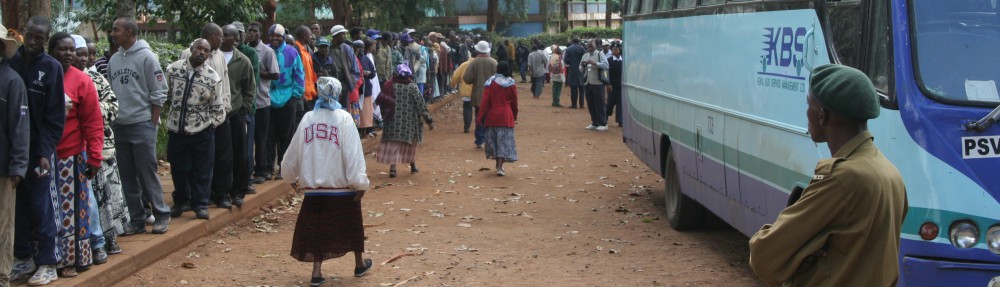
Kenya Bus Service (KBS) and Security at Polling Place

“The Eagle Has Landed: Kenya and the ICC” by John Githongo in The Star.

. . . .

. . . History is being made.

The ICC has redefined Kenya’s foreign policy totally and turned domestic politics inside out. Immediately after the post-election violence in 2008, Kenyans were clamouring for the ICC to intervene given the horrors that had just taken place.

Accountability, justice, impunity, reconciliation and other such words were the primary fodder of political discourse as we headed into the referendum on the constitution in 2010. Indeed, it can be argued that even among those most strongly opposed to the new constitutional dispensation, the dark looming cloud of the ICC and all its implications, especially the public mood that accompanied it through 2008 into 2010, all served to soften them up to demonstrate their pro-change, reformist credentials at a time when the country’s leadership and the messy albeit negotiated coalition arrangement was particularly unsatisfactory to the population.

If it hadn’t been for the ICC, perhaps more of the so-called ‘watermelons’ who pretended to support the new constitution while secretly being opposed to it, would have come out into the open with their true position.

.  .  .  .

. . . Parts of the Kenyan population are in just such a trap: caught between our preaching about and, yes, belief in, good governance and accountability; and its realities when brought to bear in our tribalised, politicised and fragmented political economy. Grimly put – ‘it hurts like hell when it is my tribesman who is being held accountable’. It hurts so much it leads to some of the most gibbering rationalisations of absurdity possible.

Continue reading

Attacks on Kenyan Civil Society prefigured in Jubilee “manifesto”

The Jubilee (UhuRuto) Coalition manifesto contains a section entitled “Good Governance” which strikingly in a country with so many governance challenges, contains only one section, on “the challenge” of “managing our relationship” with civil society:

THE CHALLENGE

The influence of Civil Society has expanded over the years to the point where the various Civil Society groups play an important role in the country’s political and economic development. In the years following the signing of the National Accord, the sector has grown in stature, influencing government decisions, political culture, and key appointments. We must identify new and innovative ways of working with the sector so that the country can fully benefit from its expertise and experience.

THE OPPORTUNITY

We believe that NGOs have a valuable role to play in monitoring government and helping to strengthen the social infrastructure in our country. We shall manage our relationship with the NGO sector in accordance with internationally recognized best practices.

SOLUTIONS

The Coalition government will:

  • Introduce a Charities Act to regulate political campaigning by NGOs, to ensure that they only campaign on issues that promote their core remit and do not engage in party politics. This will also establish full transparency in funding both for NGOs and individual projects.
  • Establish a Charities Agency to provide an annual budgetary allocation to the NGO sector.
  • Promote accountability and coordination between the NGO sector and national and county governments.
  • Develop strong partnership with the NGO sector that enhances the country’s development agenda and promotes the interests of the people of Kenya.

So what does this mean?  Clearly, what is proposed is substantial “regulation” and government involvement in the workings of civil society.  This was understood by many in civil society before the election to refer to “Ethiopian” style control–you could also look at Rwanda and Uganda for other regimes in the EAC.

Since the election, we have seen some nasty, conspiratorialist, attacks on civil society for not getting in line with the IEBC’s announced result. See “Kenyans fundamental rights under attack” from Mugambi Kiai in the Nation, responding.


“Peace,” “Truth” and American commentary in the wake of the election

“Peace versus Truth: A Story of Unnecessary Trade-Offs”.

“Indictee for President!”  Michella Wrong writes in the New York Times Latitude blog on how “being prosecuted by the ICC helped Uhuru Kenyatta’s chances in the Kenyan election.”  I would go a little further back and identify the ICC indictment as the impetus for Uhuru’s launching of his TNA party and his run for President in the first place, through his emergence as the dominant Kikuyu candidate.  In other words, absent the ICC factor, I doubt Kenyatta would have run, or at least run seriously, and if he had, I doubt he would have gotten very far early on.

Here is Jendayi Frazer’s solo interview on PBS NewsHour last night: “Western Allies Have ‘Muted’ Response to Kenya’s Presidential Election”:  

GWEN IFILL: After all the violence in 2007 and 2008 after the last presidential election, we were all bracing to see if the same thing would happen this time. And so far it has not. Why do you think that is?

JENDAYI FRAZER: Right.

Well, I think the Kenyans learned lessons from 2007. And the civil society very much was guarding their country and guarding against future violence.

They also had this election under entirely new institutions. There’s a brand-new constitution. There’s a de-evolution of power from the center, from the presidency, to governors of 47 counties. There’s county assemblies. And so I think the diffusion of power, the expectations about their new institutions and the lessons learned from 2007 account for the lack of violence this time.

Frazer is right in identifying why the situation in 2013 was different and “the same thing” that happened in 2007-08 was not going to happen this year.  There is an irony, however, for her to invoke the work of Kenyan civil society, and the reforms of the new Constitution, in the context of her advocacy now in regard to this election when William Ruto was the leader of the “reds” who campaigned against the Constitution and  Uhuru Kenyatta was seen as a “watermelon”, nominally “green” or pro-Constitution on the surface, but “red” in substance.  The “Uhuruto” Jubillee Coalition took the position pre-election that it wished to restrict civil society if it took power.

Otherwise, there is much that is very telling in this solo interview about how the American media covers politics in the “developing world” and Africa in particular, and much that is telling about America’s official and unofficial interaction with foreign politicians and leaders.

It should be noted that for someone that served only a short time in the State Department, Frazier has positioned herself as a dominant figure in the Washington media in commenting on this election.  A plausible reason for this relates to the fact that she has deeper roots in the Kenyan scene than her service as Ambassador to South Africa and then Assistant Secretary of State for African Affairs in the Bush Administration.  These roots, however, are not discussed publicly in the context of her commentary on this Kenyan election.  By reputation in Kenya, Frazer is identified widely but privately as a close family friend of the Kenyattas,  Read the following exchange in this context:

GWEN IFILL: Uhuru Kenyatta, you have met him. You know something of him. What do we know about him, other than he’s the son of a very famous leader of the country, a very wealthy man and now is under this cloud?

JENDAYI FRAZER: Well, he’s also very much a person who respects the West. He was educated in the United States. He’s been pro-Western in his outlook.

He’s been the minister of finance before and the deputy prime minister. He’s always had strong relations with the United States. Now, the case against him is problematic. And as it was stated, it’s falling apart. The co-conspirators have all — that were charged with him are charged with attending a particular meeting at statehouse and in that meeting planning reprisals against the violence that was being meted out against the Kikuyus.

But the key eyewitness has now said that he lied and he’s been changing his testimony and has — and even said that he’s taken bribes. And so the case is falling apart.

There is much that is unsaid that may be of vital import.  One question is simply whether Dr. Frazer, especially as a private citizen engaging with this is in a position to be objective about Kenyatta personally beyond describing the basic relationship to the U.S.  Second, and relatedly, there is much more involved here than just the actual status of ICC prosecution’s case: there is also the bigger moral question of whether or not Kenyatta, and his running mate Ruto, are in fact innocent of being directly involved in deliberate killing of innocent Kenyans on the basis of their ethnicity for instrumental political reasons.

From a standpoint of pragmatic realpolitik, as well as for Western private and business interests, it might be convenient now for the ICC cases, especially the case against Kenyatta, to “go away” to protect the ability to do “business as usual”.  Frazer is right that Kenyatta has had ties in the U.S.–he would have been a favorite of some others in the U.S. but for the post-election violence in 2008.  But I do not believe that there are very many Kenyans at all–whether Kenyatta voters or not–who do believe that both Kenyatta and Ruto did not in fact do in essence, if not in exact detail that can be proven in court now, what they are accused of doing in terms of engaging in leadership of “militia” killings.  Kenyatta’s appeal in fact relates to the notion that the use of the Mungiki to kill in the eastern Rift Valley was in some notion “defensive” of Kikuyu killed by members of other tribes in other places further west in the Rift Valley (what Ruto is accused of being involved in).

Part of what is happening here is that by attacking the shortcomings of the ICC and the Western media among others, some are seeking to relieve themselves of some of the moral tension associated with the haunting question of whether “peace” is being bought by the (possible) election of “killers”.

In this context, here is a link to Dr. Frazer’s aggressive interview with Michelle Martin on NPR’s “Tell Me More” this afternoon.

Kenyan High Court, while finding no jurisdiction to examine IEBC’s process because it touches on the election of a President, states that civil society case raises issue that should be examined in appropriate forum

My personal heroes with Kenyan civil society, the African Centre for Open Governance, went to the Kenyan High Court this morning with a petition seeking equitable relief to direct the IEBC to follow the election law, focusing on the verification of actual voting by polling station as discussed in my previous post.

The court ordered argument on jurisdiction alone at 11:00am in front of a three judge panel appointed by the Supreme Court, with ruling to be announced at 3:00. The ruling was not announced until 4:30. The court ruled essentially that any challenge to IEBC procedure related to the presidential election such that it could only be brought in the Supreme Court of Kenya. IEBC’s lawyer also argued that the Supreme Court could only hear the case after the IEBC declares an election result, although that would presumably be a decision for the Supreme Court itself. Thus the High Court “struck off” the case, finding no jurisdiction to act.

However, the Court did state that they had reviewed the affidavits and other evidence presented in support of the petition and found that they raised issues that were “not idle” and should be pursued in the appropriate forum. And ruled that each side to bear its own costs.

Things remain with the IEBC the time being.

Constitutional Debate on Constituency Development Funds in Tanzania

Bora Kujenga Daraja (better to build a bridge) discusses the filing by a group of civil society organizations of a lawsuit challenging the constitutionality of new legislation in Tanzania creating Constituency Development Catalyst Funds, or Mfuka wa Majimbo. [h/t to Global Integrity  on Twitter]

Here is an introduction to the Daraja organization that sponsors this blog from their website:

Daraja is a new organisation that aims to make positive changes to life in rural Tanzania by bringing people and government closer together. Our name reflects our approach – Daraja comes from the Swahili word for bridge.

In rural Tanzania, local government has a responsibility to listen to the community and to deliver public services that meet local needs. We want to make sure local government fills that role. We want to make the system work.

The argument in the lawsuit is that the legislation violates the Tanzanian constitution by inappropriately crossing the separation of powers by giving legislators executive authority, rather than legislative oversight, over these funds:

A few days ago, a group of seven civil society organisations, including Policy Forum and the Legal and Human Rights Centre (LHRC) filed a case with the High Court of Tanzania, arguing that the act establishing the Constituency Development Catalyst Fund, or Mfuka wa Majimbo, is unconstitutional. In doing so, they are following the lead of other organisations raising challenges to similar constituency-based development funds in other countries.

But this move is far from being universally popular. MPs from all major parties supported the CDCF bill. One MP – Dr Faustine from Kinondoni – used his personal blog to criticise the CSOs’ case, arguing that the CDCF has been a very effective way of quickly solving problems in his constituency. . . .

And this view can perhaps claim some academic support from a surprising source: the DFID-funded African Power and Politics Programme (APPP), who have been looking into the idea that governance reforms should build on what exists and should be rooted in their socio-cultural context. Perhaps it’s better to give MPs a means of fulfilling constituents’ expectations and to find ways of ensuring it’s well managed, accountable and more than just a slush fund, rather than to insist on western governance niceties in a very different context. “Going with the grain” is the slogan of this approach.

I have a lot of sympathy for going with the grain. But surely it applies more to governance reforms at the administrative level – focussing on things like budgeting and financial management systems – than to such a fundamental distinction as that between the executive and the legislature. After all, the constitution is supposed to prevent misuse of power by the government and MPs, which is exactly what these CSOs are trying to use it for.

And let’s not forget, MPs are hardly powerless to “bring development” to their constituencies. They have the most influential seat on the council, which sets the budget for local development projects. And if that system is too slow and bureaucratic for them to use in response to local demands, MPs are better placed than almost anyone else to make the system work better, since they also have a roll in setting the national budget and national laws and policies.

For civil society there’s also a rigourous debate about tactics going on here – also a question of following formal processes or going with the grain. Launch a legal challenge to bring the law down, or focus on monitoring how the CDCF works in practice. In Kenya, for example, such monitoring has uncovered widespread abuses and I hear this has led to some MPs concluding that this type of fund is more trouble than it’s worth. It doesn’t have to either/or, of course; it could be both legal challenge and monitoring, but that takes twice as much effort.

Friday links

“Are the private sector and civil society natural enemies?”–insightful piece from the Nation Groups’s Pan-African Media Conference by Muthoni Wankeki in Pambazuka.

Meanwhile, a new survey reported in Business Daily indicates that Kenyan business leaders are worried about a repeat of election violence.

“In Defense of the Voice of America” by Alemayehu Mariam in Pambazuka, reprinted from Huffington Post.

Human Rights Watch reports on pre-election environment in Sudan and Ethiopia, says April and May elections unlikely to be “free and fair”. Ethiopia: Repression Rising Ahead of May Elections. Sudan: Government Repression Threatens Fair Elections. Daily Nation story here.

And for the first time a senior SPLM leader has called for Bashir to face the ICC charges against him in The Hague.