
From a different mall at a happier time, but this reminded me of those missing from the Westgate attacks.
“Missing Victims Didn’t Just Disappear” Jenny Luesby in The Standard.
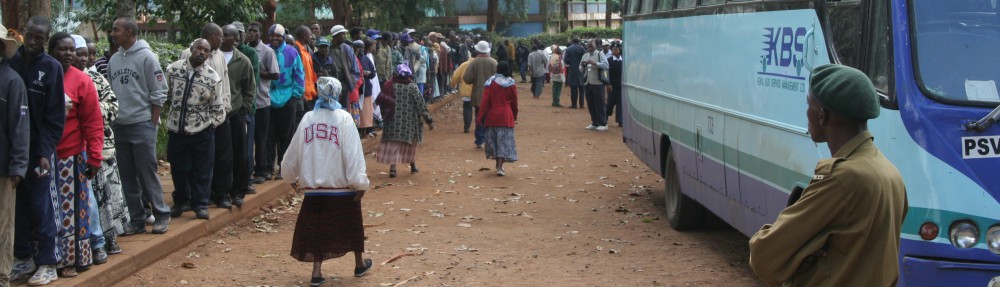
From a different mall at a happier time, but this reminded me of those missing from the Westgate attacks.
“Missing Victims Didn’t Just Disappear” Jenny Luesby in The Standard.
A piece that you might have missed on the Westgate attack that touches more of the bases than most: The Real Reason al-Shabab Attacked a Mall in Kenya by Bronwyn Bruton at DefenseOne.com.
Also: “Terror Strikes Nairobi, Crossing Borders” from Lauren Hutton at the Netherlands Institute of International Affairs (Clingendael).
And if you missed a wise perspective on the human context, here is Karen Rothmyer in The Nation: “Reflections on the Kenya Terror Attack”
Other lessons so far: from Abdul Haji, son of the Garissa Senator and former Defense Minister, who drove from another shopping mall (Yaya Centre) and helped rescue many at Westgate after a cell call from his brother who was stranded by the attackers, we learn that real heroes drink Dormans (and pack a pistol), and leave notes for the owners of cars they back into while rushing to rescue their brothers. The story of the Haji-on-the-spot collaboration with the Kenyan Red Cross, a handful of plainclothes police and a kitted out group of what we might call “neighborhood watchmen” is just so deeply “Kenyan”.
Ambassador David Shinn appropriately noted on his blog that his biggest surprise about the Westgate attack is that it hadn’t happened sooner. People I touch base with expect more, and we have additional attacks in Mandera and Wajir. In order to stay safe and protect each other, it seems to me that Kenyans need to calmly but firmly and persistently press to get as much truthful information as possible about what happened at Westgate and take responsibility for their neighborhoods and surroundings.
The #WeAreOne_dering hashtag on Twitter has brought people from all over the world into the conversation about what really has really happened with this attack.
The United States, in particular, has spent millions on an ongoing basis, through the State Department and the Defense Department directly and indirectly on “capacity building”, training, etc. for Kenyan security. Given the meager preparation for and response to an attack like Westgate, we need to quickly recalibrate to account for the present reality and the immediate threat.
Here is my post from 2009 “Corruption and Terrorism/Security”. And from 2010 “U.S.-Kenya Relations: A counterterrorism versus reform tradeoff?”
And to address the religious dimension, here is an important post from African Arguments via allAfrica.com: “Somalia: To Beat Al Shabaab Kenya Must Expel its Religious Leader “Sheikh Hassaan” From Nairobi”. And the National Council of Churches of Kenya has posted this flyer from the Inter-Religious Council of Kenya announcing a “We Are One in Prayer” event on October 1.
Sharing the statement released by KPTJ this morning:
At this time of grief, we, Kenyans for Peace with Truth and Justice, wish to express our deepest condolences to the families of those who have been lost or remain missing, and wish a swift recovery to all those who have been hurt. We applaud the contributions of our fellow Kenyans to support rescue and security work and medical care for victims, as well as the unity our nation has demonstrated throughout this crisis. We condemn this despicable attack and support all work to rescue those still trapped at Westgate, and to end the situation as soon as possible and without further loss of life.
Simon Allison in The Daily Maverick has a piece today entitled “Nairobi attack: Why Kenya and why now?” that strikes me as solid and recommended priority reading.
As far as where things are in Somalia this is probably a good time to read, if you missed it, Matt Bryden’s report “Somalia Redux?: Assessing the new Somali federal government” for the Center for Strategic and International Affairs, which provides a sobering corrective to any notions that recent progress in Somalia is more than a set of limited early steps toward any long term formation of a stable state.
Add this on the Kenyan security situation: “Kenya mall al-shabaab attacks reveal security cracks” Africa Report.

Khat Shop Hargiesa
The Somaliland Sun reports that the Government of Somaliland has informed the visiting head of the new United Nations Mission to Somalia (UNSOM) that Somaliland will not host a UNSOM office. Somaliland wishes to continue hosting and receiving aid through various individual UN agencies and organizations but considers the overall UNSOM mission in support of the Federal Government of Somalia incompatible with Somaliland’s independent status.
In the meantime, the questions of governance for Kismayo and the “Jubaland” region remain an immediate challenge as does the unsettled Somaliland-Puntland border. Somaliland has indicated a desire to strengthen relations with Kenya, which shares a common interest in some degree of regional autonomy for Jubaland on the Kenyan border.
Of note on Kenya:
Wachira Maina–“ICC: Kenya’s is a lose-lose strategy even if African Union has its way” in The East African.
Dr. Stephanie Burchard, “How Fraud Might (Indirectly) Promote Democracy in Africa” in the Institute for Defense Analyses’ Africa Watch, discussing the judicial review of Ghana’s presidential election in contrast to the procedure in Kenya.
David Anderson on the Mau Mau case, “Atoning for the Sins of Empire” in the New York Times.
Wycliffe Muga on “A Brief History of Election Rigging” in The Star.
Jaindi Kisero on “There is more to the Kenya Pipeline Company saga than nepotism; is it someone’s turn to eat?” in the Daily Nation.
Paul Wafula on “Hidden pain in financing Jubilee’s bag of goodies” in The Standard.
George Kegoro, “There’s need for an independent team to probe conduct of election” in the Daily Nation.
I have previously praised the grassroots observation approach and thoroughness of the AGLI in observing the referendum vote in 2010.
Here is their report on the March 4 general Kenya elections. Basically they found widespread problems in the areas they observed and reported on in detail. They did not aspire to cover the whole country and thus make no claims as to the total impact of the problems, but show clearly that there were multiple avenues and opportunities for widespread fraud.
In particular, they observed extra presidential ballots being given out by a polling clerk in one station. The observer reported the matter and the clerk was arrested, but the polling station ended up with roughly 100 extra votes for president over the votes for the other races, and this was apparently reported on and included in the national totals. This type of conduct would be one explanation for the huge overvote in the presidential race. I have not seen other explanations . . .
The AGLI recommends a post election audit by the IEBC and an outside group now that the Supreme Court has ruled without delving into the details so that the process can be improved.
This is a quote from an e-mail I sent to an expert back in the U.S. on my way home from Kenya, where I am now. As far as a candid summary of what I think happened in the Kenya elections:
Overall situation with observers was that they were extremely reticent to say anything of substance because of the fear of violence and the fact that IEBC process was ongoing. Further, because of Jubilee attacks on the British High Commission and the West more generally (in my opinion at least) there was an extra level of reticence to say anything that would confront the Government of Kenya election process. We ended up with little impact, if not window dressing, as far as I can see. Someday they will write final reports that might, I hope, involve a deeper look into the original vote count and subsequent events, as well as the prior problems that led to a small voter registration pool, etc.
See Robyn Dixon’s piece in the Los Angeles Times , “Kenya election over, dispute over outcome heads to Supreme Court”::
The narrow margin and repeated failures of the election commission raise the possibility that the Supreme Court could call for an audit of the election result, analysts said.
Kenyatta got 50.07% of the vote, crossing the line with a margin of some 8,000 votes out of more than 12 million cast.
Despite the failures, Kenya’s news media were muted in their reportage of the commission problems. Even international observers have tip-toed around the subject.
However, respected Kenyan anti-corruption crusader John Githongo called the election a failure Sunday. Githongo, an election monitor, said for months a group of community organizations had tried in vain to warn the election commission of problems in its systems and approach.“In my personal opinion, it’s a failed election,” Githongo said in an interview with The Times. “I think the IEBC performance was catastrophic. I was part of a group of organizations that repeatedly warned them that these problems were there and on the way.”
Commission Chairman Issack Hassan denied the problems and failed to turn up for meetings with the organizations, according to Githongo.
Githongo said Kenyans were so keen to avoid a repeat of the violence that followed the disputed 2007 poll that many, especially in the Kenyan media, kept silent about the obvious problems in the election commission.
. . . .
Githongo’s criticisms come after reports that Safaricom, the mobile phone provider involved in the electronic system that was supposed to transmit results to the central tallying point, also warned the commission of looming failures in the weeks before the election, and was also ignored.
Patrick Smith, editor of the journal Africa Confidential, said Western officials privately condemned the commission’s appalling performance but said nothing publicly “for fear of being seen as interfering in the election”.
. . . .
A simple question of what Kenyans chose to expect of and hope for themselves really, for them to answer.
Everyone is tired, no question. Most Kenyans are poor, and the breakdown of the IEBC process caused loss in the economy which hurts poor Kenyans the most. At the same time, the short term value of sweeping another electoral commission fiasco under the rug would be balanced by a huge cost in terms of the dreams of democracy that seemed to have been achieved in the 2002 vote.
The situation regarding the vote is less clear than in 2007, but the meaningful ability to go to court exists this time, unlike in 2007. Should the legal process be shelved now that it is finally available–and if so, will it be available again?
The voting was over by Tuesday, March 5. The IEBC (the Kenyan replacement for the previous discredited Electoral Commission of Kenya or “ECK”) then has seven days to announce final results from the votes, which are cast by paper ballot and counted (only) at the individual polling stations around the country. The results at each of the more than 30,000 polling stations around the country are set out on multiple original official forms which are signed by the election official and the political party agents. One original is then posted on the door of the polling station where the counting has been done. This way the public can see the results while the armed guards at the door keep the public out of the room where the physical ballots are secured back in the sealed ballot box after counting.
Since the digital transmission of results failed for reasons that remain unexplained factually but much pontificated about, we are left with less information early than we would have hoped. But, as long as the forms remain available for each polling station, and are open to the public, we ought to be able to nail down how people voted–at least as the votes were counted.
Unfortunately, there is much pressure to rush and do something less than verification based on the actual documented count of the votes.
In 2007, the actual voting results were ultimately never released or disclosed, and while many court petitions were successfully adjudicated in parliamentary and local races, the Kreigler Commission appointed under the post election settlement to investigate the failed election passed on any further effort to actually determine the presidential votes as counted and announced at the polling stations. While there are alleged “official results” published by the ECK, they are only alleged aggregated numbers by parliamentary constituency, not by actual unit of voting and counting.
For my American readers, imagine results for the presidential election that are announced only in aggregate by Congressional District.
See my previous post for the results at the polling station where I observed. This information should be available for each polling station, and should then add up to what is reported as a matter derivatively on up the chain.
Okay, congratulations are in order for a great job by presiding officers and polling clerks, and incredibly patient voters at the polling centre where I spent the late afternoon and on until finishing the presidential count and posting the signed off results on the door to be photographed at the stream I was covering.
Everyone got better at adapting to the absence of the technology and the cumbersome process and voters moved much faster through the remaining lines in late afternoon and early evening. Having stood in the hot son all day in huge lines surely motivated everyone to get done, but essentially no grousing was to be heard where I was at that point.
Turnout at the stream I closed was 626 valid votes cast for president from 755 registered voters. So over 80%. The boxes were jammed full of ballots but the system worked. Totals for president were Odinga 433, Kenyatta 170, Mudavadi 8, Kenneth 7 and the rest less. Dida was the only presidential candidate in that stream to get 0.
Will post “snaps” soon.