“[T]o dance on the graves . . .”–KPTJ letter to UK Serious Fraud Office on #Chickengate convictions

By NJONJO MUE, as printed at Business Daily, “Smith & Ouzman director’s crime goes beyond ‘chicken’ offer to IEBC officials”:

Mr Mue is programme adviser at Kenyans for Peace with Truth and Justice.

Kenyans for Peace with Truth and Justice (KPTJ), a coalition of more than 30 legal, human rights and governance civil society groups would like to commend UK’s Serious Fraud Office (SFO) for the successful prosecution of Smith & Ouzman, and two of its directors for overseas corruption, including the bribery of Kenyan election officials to obtain contracts for printing of poll materials.

We write this letter to give our perspective on the impact of corruption on elections. We do this in the hope that you will bring these matters to the attention of the court so that they may inform its deliberations on the sentencing of the directors and the company and the subsequent confiscation hearing.

We would also like to strongly suggest that the SFO call expert witness on this point so that the court can be fully informed about it. We would be happy to provide relevant names of experts in this area should the SFO need such assistance.

KPTJ was formed in the wake of the widespread violence that engulfed Kenya following the disputed 2007 presidential elections.

More than 1,100 people were killed, over half a million displaced from their homes, hundreds of women and men sexually assaulted as well as property worth billions of shillings destroyed in the chaos.

Kenya was saved from a full-scale civil war only by international mediation efforts led by former UN secretary-general Kofi Annan.

The mediation agreed on a raft of measures to address both the immediate crisis and the long-term underlying issues to bring permanent stability to the country, including constitutional and institutional reforms.

A commission of inquiry appointed to review the elections recommended a complete overhaul of the electoral process, including the disbandment of the then Electoral Commission of Kenya (ECK) and a fresh registration of voters.

The ECK was replaced by the Interim Independent Election Commission, the body whose officials Smith & Ouzman subsequently bribed to obtain business from.

The above background is important in order to demonstrate a number of key points.

First, both Kenyans and the international community invested a lot of time, money and hard work to ensure that the devastating political violence of 2008 would never occur again.

This was done through reforming the election management body and the appointment of new commissioners, among other measures.

For Smith & Ouzman to casually bribe  the new poll officials and justify it by claiming that they were just doing  business the “African way” is not just an insult to Kenyans and Africans, it is to dance on the graves of those who paid the ultimate price due to the failed elections.

Second, Kenya has frequently paid a high price in terms of lives lost and property destroyed as a result of disputed elections, the post-election violence being only the most extreme example.

Political violence in turn is often the direct consequence of having elections managed by officials of questionable integrity who cannot be trusted to deliver a free and fair election.

When Smith & Ouzman bribes poll officials to obtain contracts for printing election materials, the country not only incurs financial loss due to the inflated price, but also it ultimately pays a much higher price in terms of the loss of integrity of the electoral body and the subsequent instability and political uncertainty that the loss brings.

As far as financial consequences are concerned, it is notable that Kenya’s elections have been said to be among the world’s most expensive per capita, in spite of their generally poor quality.

Third, an election body, like a bank, survives on public trust and derives legitimacy and credibility not from the technical sophistication of their poll materials, tools and procedures, but from public faith in its impartiality, competence and integrity.

The bribery claims against Kenyan poll officials has resulted in loss of public faith in the agency and may lead to disputed elections and violence in future.
Continue reading →

Tonight in Washington–important African Politics event

Wednesday, January 14 from 6 – 8 pm

American University
School of International Studies

Celebrating the launch of Dr. Carl LeVan’s new book, Dictators and Democracy in African Development: The Political Economy of Good Governance in Nigeria. Click here to RSVP for this social event being hosted by the Comparative and Regional Studies Program.

Special guests include: Congressman John Conyers,
and former U.S. Ambassadors to Nigeria:
Princeton Lyman
John Campbell
Robin Sanders
Howard Jeter

What are the conditions for good governance in Africa, and why do many democracies struggle with persistent poverty? Drawing on a study of Nigeria since independence, I challenge conventional explanations for government performance such as regime type and oil wealth. Using veto players theory and original data from extensive field research, I link the political structure of the policy process to divergent outcomes across two broad categories of public policy. This generates a dilemma with important implications for African countries struggling with institutional trade-offs presented by different regimes.

Carl has been a good friend to me and the blog as a teacher of African Politics and been very kind to help me learn. Anyone interested in events in Nigeria and the upcoming elections would do well to meet Carl and read his timely new book.

Check out his homepage and Development for Security blog here.

So what matters in Kenya? David Ndii reminds us that most Kenyans do not have enough food . . .

Not to distract from the “news”, the big events like a second Nairobi Carrefour coming to Karen and competing with Nakumatt. . . but for anyone who is interested in Kenya and
has not actually lived there in recent years, I highly recommend David Ndii’s latest Friday column from Daily Nation, “On hunger, and a nation in need of a conscience“:

Hunger stalks this land. One third of the respondents to Ipsos Synovate’s latest opinion poll answered yes to the question whether they or other members of their households ever sleep hungry.

The facts are much worse that the poll’s finding.

The most comprehensive information on our food situation is in a report published by the Kenya National Bureau of Statistics in 2008 titled Food Insecurity Assessment in Kenya.

It shows that over half of Kenyans, 51 percent, consume less than what they require on a daily basis. They consume an average of 1,261 calories per day, against a requirement of 1,683 calories — a shortfall of 422 calories or 25 percent of the daily requirement.

Simply put, half of the country suffers from chronic hunger. . . .

US Military may be uniquely situated to help in ebola crisis [updated]

[Sept. 19:  For a contra view see this column from @MeanCharlotte in the Los Angeles Times, reflective of views on the right that the military, at least under this president, is not the right tool for “wars” that are metaphorical rather than involving combat (“Ebola isn’t the Islamic State.  It’s a virus.”). Likewise, some of those on the left, particularly in Africa, who are suspicious of AFRICOM in concept, are leery of hidden motives. Many envision a deployment heavy on combat-ready “warfighters” to conduct a mission skewed toward policing or physical security in a way that I don’t expect to be what is planned or what will transpire.  Not disputing the basis for wariness based on experience with recent wars and some relief and development efforts, I “stick to my guns” (metaphorically) in seeing this crisis and the balance of options available differently.]

Regarding the AFRICOM deployment to lead/assist the U.S. response to the ebola crisis in West Africa, here is a link to a fact sheet describing the basic work of the U.S. Army Medical Research Institute of Infectious Diseases at Ft. Detrick, Maryland.  The Institute was established in 1969 and has as a primary function ongoing work on botulism, plague, anthrax and ebola, among other threats to military personnel and to public health.  They do pioneering work on vaccines in these areas, for instance.

The U.S. military is not necessarily well suited for all the various tasks that it gets assigned because no one else in the U.S. government is staffed or funded or otherwise able to do them.  Addressing an infectious epidemic on a crisis basis is much more suited to military leadership, and our specifically planned for and developed capacities, than general “development” or disaster relief work, I believe.

The U.S. military has a huge medical capacity in its own right to serve the military itself, in peacetime and as deployed around the world, along with civilian dependents and others, separately from combat-specific capacity.  We have a volunteer military, but once you volunteer you are subject to being assigned on a “command and control” basis that makes the military more flexible in a crisis than a civilian governmental or private entity.  I am one of those people who have concerns that we should have more capacity in other parts of our government, including civilian development and diplomacy functions, but such concerns should not makes us unduly reticent to use the resources that are available to help address an immediate human crisis as best we can.

Likewise, I am not an advocate of promiscuous use of the military either for war or as a substitute development agency–see my post from  2010:  “Provocative Question: To Eliminate Redundancy, Should We Move USAID From DOS to DOD?” –so I understand the general concern or skepticism, but in this specific instance we in the United States, and people at risk in West Africa, need to make use of the resources developed and available through the military.

[Update: See this from Foreign Policy: “Can the U.S. Army Degrade and Destroy Ebola?” from an expert who had an opportunity to have input on the planning.]

Catching up on some prior must reads:

“John Githongo: corruption in Kenya is poisoning politics” from The Guardian, July 3.

“After Westgate: opportunities and challenges in the war against Al-Shabaab”, a Chatam House paper by Paul D. Williams, July.

.  .  .  As Al-Shabaab loses territory and its popularity among Somalis continues to dwindle, other clan- and region-based actors will become more salient as national debates over federalism, the decentralization of governance mechanisms beyond Mogadishu and the place of clannism will occupy centre stage. As a consequence, AMISOM’s principal roles should gradually shift from degrading Al-Shabaab towards a broader stabilization agenda: encouraging a national consensus over how to build effective governance structures; developing an effective set of Somali National Security Forces; and ensuring that the Federal Government delivers services and effective governance to its citizens, especially beyond Mogadishu in the settlements recently captured from Al-Shabaab. As it stands, however, AMISOM is not prepared to carry out these activities. More worryingly, nor is the Somali Federal Government.

How will the U.S. handle its involvement with a possible Kenyan referendum?

We have the examples of Kenya’s constitutional referenda of 2005 and 2010 for some lessons.

In the fall of 2005, the Government of Kenya, on behalf of the “Wako Draft” constitution being brought to a referendum vote–the “Banana campaign”– loudly claimed that the U.S. was interfering in the referendum in opposition to President Kibaki’s position.  In 2010, Americans campaigning against the “Committee of Experts as Amended” Draft complained that the U.S. was interfering in the referendum by supporting the “Yes” campaign.

I am not aware that there was any substance to the allegations in 2005.  For one thing, it was not clear to me by the time I was on the scene in Kenya in mid-2007 that people at the State Department were necessarily glad that the referendum had failed.  One American official suggested to me that the Wako Draft had not been that bad and certainly better than the old constitution that everyone was left to deal with.  My inclination is that the campaign rhetoric from some of Kibaki’s ministers was just that–campaign rhetoric using the American “bogeyman” as a foil to rally solidarity from Kibaki’s political base (in other words, a somewhat milder version of what the Uhruruto campaign did with more success in 2013, less the ICC “bogeyman”).  Admittedly, I was not involved in 2005 and have made no independent investigation of the matter so I am not purporting to offer any definitive opinion. The International Republican Institute exit poll funded by USAID was consistent with the big victory for the “Orange” side officially reported by the Electoral Commission of Kenya following the vote in November 2005.

In 2010, things were different.  Congressman Christopher Smith of New Jersey, Chairman of the relevant subcommittee covering Africa of the House Committee on Foreign Affairs pressed the issue and it was eventually reported in the Daily Nation that Smith had received a report from the USAID Inspector General that “found that US funding did go specifically to encourage “Yes” vote on referendum.”  In that situation, however, the Government of Kenya was not complaining because Kibaki himself, along with former “Orange” leader Raila Odinga as Prime Minister, was supporting the Amended Draft.  The Amended Draft was jiggered to accommodate the negotiated interests of most political leaders in the “government of national unity” around both Kibaki and ODM.  There was some organized opposition led by William Ruto which outpolled the Draft in the Rift Valley, but only there.  At the time, Ruto was on the outs with both the President’s faction and with ODM, among other things from pressure tied to allegations about participation in post election violence and certain pending corruption allegations, so no one outside his immediate base was too concerned about his position.

Process purists like myself thought it was wrong for the U.S. to let our funding cross into the campaign itself, beyond simply assisting the process–and to deny it if we did do it.  Americans who opposed the Kenyan Draft because of their concerns about the impact of language on the two “contentious issues”–the Khadi’s Courts and abortion–did not like to have their tax dollars used against them in the campaign.  Kenyans who opposed the Draft may have had comparable feelings in regard to U.S. “democracy assistance” spending, but I didn’t pick up on much complaint–given that their own government was campaigning against them, the U.S. funding as a distinct issue would not be the first and most obvious issue about neutrality, even though the sums of money involved were quite huge for Kenya.

The other key aspect to the context of 2010 is that there was great pent up public demand for a reformed constitution that had been promised for years. The ” yes” side won in a landslide and surveys afterward showed that Kenyans were approaching unanimity in being glad that the constitution had passed. In this environment, the process details about funding do not seem to have so much actual or perceived political significance.

As far as a 2015 referendum triggered by the current petition drive, I have no idea what approach people in our various foreign policy organizations would take on substance.  In general, I doubt people in the U.S. government would care very much directly one way or the other regarding constitutional amendments now unless something unexpected showed up in a draft late in the game.

I haven’t heard or read anything about “the reform agenda” from Washington in a long time even though it was for some years a constant refrain from the State Department.  “Reform” seems to have happened in 2010 and have borne fruit with the IEBC’s decision on the 2013 election being accepted by the opposition,  challenged only in court.  The lion’s share of “reform agenda” that was envisioned in the 2008 post election settlement has not come to pass–for instance the Truth, Justice and Reconciliation Commission seems to have become just one more Kenyan Commission  producing a report to be somewhat censored then shelved for the edification of future scholars who might want to know more about what has gone wrong over the years.  Likewise, there is nearly universal impunity now settled for all the acts of post election violence, subject only to the three last cases lingering at the ICC–so one way or the other, most people involved will have gone scot free. The biggest substantive recommendation of the Kreigler Commission, which found the whole election in 2007 to have been a bust, was to deploy electronic reporting of the vote tallies from the polling station to Nairobi as opposed to depending on physical carriage of the paper forms.  That single most crucial upgrade was a complete failure in the 2013 election–in circumstances that were left murky–and the IEBC turned out not even to even have a working process to handle the reporting on paper.  Nonetheless, if “we” the United States were going to get too exercised about any of this, surely we would have done so in 2013 when we were faced with the embarrassment of having a relationship with an elected government led by ICC suspects.  Instead we bent over backwards to find ways to praise another poor election process because it wasn’t openly stolen at the the presidential level this time and murder and mayhem didn’t follow.  Now everyone seems to have pretty much gotten used to that formerly unprecedented situation of close diplomatic interaction with ICC suspects.  Bottom line is that I doubt that my government will want to play heavily pro or con in a Kenya referendum in the near future.

Nonetheless, I think we can count on the U.S. being very much involved even assuming we are not much concerned about the outcome.  A State Department report has estimated that international support for the 2013 election was approximately $60M, with more than $37M in “medium term” USAID funding.  We have had IFES embedded with the ECK/IEBC for every vote starting with 2001 for the 2002 election; we have funded polling and election observation each time, along with a gamut of other activities.  One way or the other, I am sure we will be “all up in it”.  On balance, the Government of Kenya has liked it that way–for whatever reason–because that has been the choice that they have made, year in and year out, in accepting our money.  Even if they point and holler during the campaign.

“We see Africa’s potential”

"We see Africa's potential"

“We see Africa’s potential”

This week’s Africa Summit in Washington suggests hope for a deeper, broader engagement between the United States and many African countries. This is a policy area where there seems to be substantial room for negotiated agreement and cooperation between Republicans and Democrats. While there are things that I wish we would do differently, I am glad to see the effort and attention and I will watch with interest.

Uganda: “bursting at the seams” says State OIG inspection

The State Department Office of the Inspector General released this afternoon its latest regular inspection report for the U.S. Embassy in Uganda. The Kampala mission, the second largest in Sub-Saharan Africa, gets good marks, but is facing critical physical space problems from ongoing and expected growth–“bursting at the seams”. More of general interest, how does the IG summarize the context of the mission of the United States in Uganda? Here you are:

Uganda has experienced nearly three decades of domestic stability, except in northern areas. President Museveni’s National Resistance Movement took power in 1986. Irregularities marred his reelection in 2011, and he is expected to run again in 2016. Uganda has never experienced a peaceful transition of political power, and civil society does not effectively hold government accountable. Uganda’s record on democracy, human rights, and anticorruption is poor, but it has become an important force for regional stability in East Africa. It contributes to the African Union Mission in Somalia, leads regional efforts against the Lord’s Resistance Army, and has mediated talks between the Democratic Republic of the Congo and the M23 rebels.
The passage of Uganda’s Anti-Homosexuality Act in early 2014 prompted Washington to reassess the bilateral relationship, including U.S. foreign assistance, which was taking place during the inspection. Bilateral security cooperation has included peacekeeping training for Ugandan forces in Somalia and Ugandan support for the 2013 evacuation of U.S. diplomats from South Sudan.
Economic growth over the past decade has averaged 6 to 7 percent, with inflation in the single digits, and the percentage of the population in poverty dropped by half. Uganda’s population is projected to grow from 35 million to more than 60 million over the next 20 years, threatening to erode and even reverse development progress. The economy provides one job for every 40 new entrants to the job market. By the end of this decade, Uganda may be an oil- producing country, which would significantly raise government revenue but could also exacerbate corruption. U.S. exports to Uganda in 2012 totaled $100 million, half of which consisted of aircraft and machinery.
HIV/AIDS prevalence rates declined in the early 1990s to less than 7 percent, one of the lowest rates in Africa, but has begun to rise again. The U.S. Agency for International Development’s (USAID) FY 2013 assistance budget for Uganda was $67.5 million for development, $11 million for Food for Peace, and $84.95 million for the Global Health Initiative. The Department of State (Department) also provided $316.14 million for the Global Health Initiative, $190,000 in foreign military financing, and $522,000 in international military engagement and training. International narcotics control and law enforcement funding of $600,000 went directly to Uganda.
With 712 employees, the embassy is the second largest in Sub-Saharan Africa and includes 147 U.S. direct hires compared to 91 in 2007. Other departments and agencies represented in the embassy include USAID, the U.S. Department of Defense (DOD), the Centers for Disease Control and Prevention (CDC), the Federal Aviation Administration, the U.S. Department of the Treasury, and the Peace Corps. The embassy chancery accommodates all employees and has annexes in Gulu (CDC) and Entebbe (CDC and DOD), which are 7 hours away and 90 minutes away, respectively, by vehicle. In addition, the general services office and warehouse facility is located 6 kilometers from the embassy compound, and it has more desks than some smaller embassies in Africa.

Uhuru Kenyatta, Jendayi Frazer and Paul Kagame walk into a commodity exchange in Kigali . . .

Swiss trader looks up and says, “You must be here to save Kenya’s small family farmers!”

Post-election IDP camp at Naivasha, Kenya, 2008

Post-election IDP camp at Naivasha, Kenya, 2008

“Could Rwanda’s Kagame get thrown out of the ‘smoke filled room’?” AfriCommons, 13 March 2014

“East Africa Exchange Formally Launched” BizTech Africa, 4 July 2014

“Carter Center release; Initial observations on the ‘Frazer v. Carson’ controversy”  AfriCommons, 21 Feb. 2013

“Beth Mugo Admits Kenyatta Family Owns Huge Tracts of Land, But Defends Uhuru” Mwakilishi, 12 Feb. 2013

“How Kosgei pulled strings to block U.S. from endorsing Kibaki presidency” Daily Nation, 13 July 2012

“Kenyan PM Odinga Speaks Out on Election, ‘Dubious’ Role of Jendayi Frazer and Ambassador” AfriCommons, 4 March 2010

Part Ten–FOIA Documents from Kenya’s 2007 election–Ranneberger at ECK: “[Much caan happen between the casting of votes and the final tabulation of ballots and it did” AfriCommons, 30 April 2012

“Africa Bureau under Frazer coordinated “recharacterization” of 2007 exit poll showing Odinga win (New Documents–FOIA Series No. 12)” AfriCommons, 18 March 2013

Saba Saba; Sawa, Sawa: the sky did not fall

IMG_7705

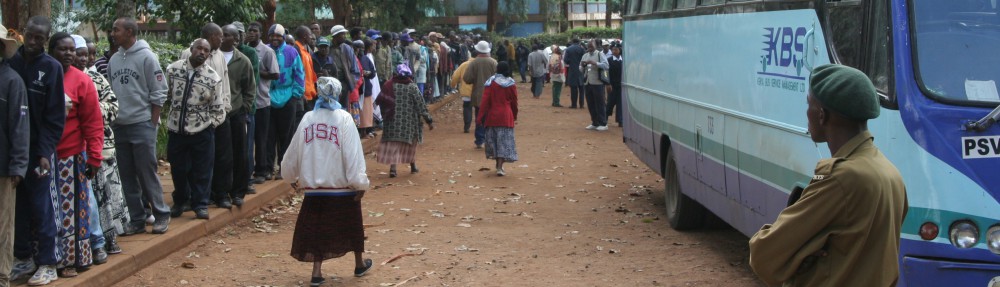
As I noted, rallies will come and rallies will go.  The challenge of governmental dysfunction, propped up by tribalism, remains.  This photograph is from the day before the 2013 election at the public primary school in Nairobi’s posh Westlands neighborhood.  I suspect the scene was much the same yesterday and is much the same today.

Happy Saba Saba Day–and how is Kenya?

Happy Saba Saba Day–and how is Kenya?. (from July 7, 2012–would appreciate your comments here or by e-mail about what has and has not changed)