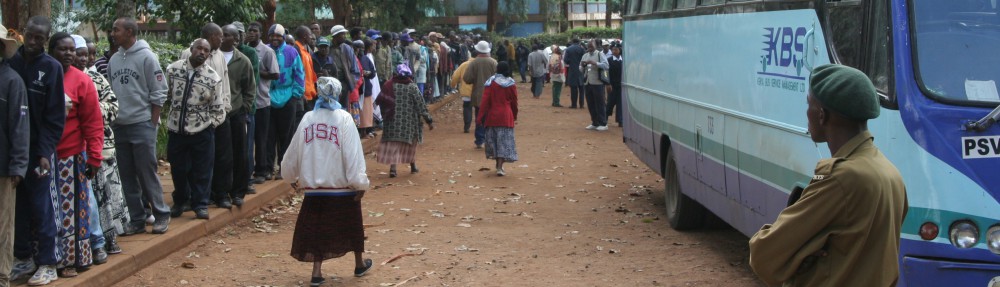
More links for Kenya’s Election; Chief Justice’s “bombshell” press conference; Debate loses a “horse”

Kenya Voting: "Curriculum Cooking"

AllAfrica.com has put together a special feature page on the Kenyan elections that is a good source for the latest stories from the main Kenyan media sources:  “Kenya Decides: 2013 Elections”. (h/t @GeorgetownDG)

On Thursday, February 28, the Institute for Security Studies Nairobi office will host a “Seminar on Kenya’s 2013 Elections: issues, actors and scenarios.”  Register on-line through the link.

IRIN has published on on-line “multimedia documentary” entitled “No Ordinary Elections” which does a nice job of informing an international audience of the basic context of the upcoming Kenyan election and includes good interviews discussing humanitarian concerns and preparations in general terms.  A work of art in internet publishing.

In the latest developments, there is a lot of buzz in the human rights community regarding the announcement by Chief Justice Mutunga at a press conference today that he had received a letter threatening judges and others regarding any ruling against the candidacy of Uhuru Kenyatta purporting to be from a Mungiki-associated group, Further, as reported in the Star story “Chief Justice Raises Concern Over Threats to Judges”:

The CJ also revealed that he was asked by an immigration officer at the JKIA to seek travel clearance from the Head of Civil Service Francis Kimemia a day after the letter was posted.

“I was stopped at the Jomo Kenyatta International Airport (JKIA) by an Immigration Officer, who insisted that I could not travel because I had not been cleared by Mr. Francis Kimemia, the Permanent Secretary, Head of the Public Service, and Secretary to the Cabinet.” Mutunga said.

The CJ further asked Inspector General of police David Kimaiyo to take the necessary steps to protect judges from threats and intimidation so as not to give constitutional rulings. “The Judiciary will not flinch from interpreting the constitution as required. The constitution must be guarded jealously,” He said.

From The Standard: “CJ Mutunga bombshell”.

From the Daily Nation: “Chief Justice Speaks Out on Threatening Letter.”

Obviously a lot of difference among the media houses in how to report this.  Thus the need to read widely to put together the pieces in getting the facts and understand the interests.

While I would completely reserve judgement as to exactly what to make of the threatening letter, the “immigration” harassment is disturbing in light of Kenya’s short but unduly “colorful” history involving politics at these highest levels.  Certainly the President himself should address this if he wants to reassure the country at a time in which no one needs any more tension than can be helped.

This has overshadowed the other big political story of the day, that Uhuru Kenyatta’s campaign has announced that he will drop out of the second presidential debate scheduled for Monday, complaining of the allegedly unfair amount of emphasis on the charges he faces from the International Criminal Court and “ganging up” by the other candidates on this point.

My sense of the political strategy here would be that Kenyatta feels he is in solid position to make a runoff, and not in striking distance to win in the first round, so there is nothing major to be gained from another debate, while there are risks from undesired questions and unscripted situations.  He has plenty of money and media access as a top candidate so he probably doesn’t feel a need to share the stage to  communicate whatever he wants to say in the last days of the campaign.  Likewise, part of his approach since the ICC charges have been confirmed has been to portray himself as a victim of other politicians and interests, so claiming that he was treated unfairly in the debate fits with that theme, too.

My piece on police reform in The Star: “Could Kimaiyo be Kenya’s Kivuitu of 2013?”

“Could Kimaiyo be Kenya’s Kivuitu of 2013?”

.  .  .  .

. . . [H]e is in a new position set down on top of an old and dysfunctional organisation that he has inherited and that he does not have time to change before the election.

The news already reports a rift over appointment authority between Kimaiyo and the chair of the new National Police Service Commission—the kind of kinks in a new system that should be expected and that inevitably take time.

Ultimately, Kimaiyo even on paper, is only one member of the National Security Council. Even though he has some additional theoretical authority, he is to implement rather than set the government’s security policy.

Like Samuel Kivuitu in the weeks before the election in 2007, he has respect and credibility from his past, but he is one man only, one vote on security policy, and not fully in control of what will happen even within the police service at this point. This should be a sobering thought in light of what we all saw play out in the last election.

Follow the link to read the whole piece from the Star.

FYI, this was submitted for publication before the back and forth in the campaigns about alleged involvement of civil servants in politics.

Please also read this from Pheroze Nowrojee in the Star, “Of Civil Servants and our Politics”:

The Inspector-General of Police, David Kimaiyo issued a public statement that politicians should not discuss land ownership in their campaigns. He did not suggest that there was any breach of the law by any politician. Yet he called for a gag. He was stepping into the political arena. He was abridging the Bill of Rights. Kimaiyo too was way out of line.

Kenya’s National Council of Churches (NCCK) sticks up for EU envoys; TJRC slammed; and an optimistic view for March 4

The Star: “NCCK Warns Uhuru, Ruto over the Hague”:

“It will not be easy running a government while away as compared to from State House, but we ask Kenyans to exercise their discretion and vote as they want,” said NCCK Secretary General Rev Canon Peter Karanja yesterday after a two-day meeting at the Jumuia Conference and Retreat Centre in Limuru.

The High Court is due to rule tomorrow if Uhuru and Ruto are eligible to contest the presidency on grounds of integrity. “We ask for the law to be followed as we await the court ruling on Friday,” he said.

The press conference was attended by the NCCK chairperson Rev Canon Rosemary Mbogoh, deputy secretary Oliver Kisaka and Zion Harvest Mission Bishop Nicolas Oloo.

The council condemned the recent criticism of diplomats who stated last week that there will be “consequences” if Kenyans elect Uhuru and Ruto as president and deputy president.

“NCCK appreciates the interests of the foreign missions, European Union and African Union, because they helped us when the country went haywire and it is not fair to ridicule them,” he said.

The NCCK statement warned against tribal balkanization, called for more voter education by the IEBC, urged politicians to focus on issues, and asked President Kibaki to gazette the new National Land Commission.

CapitalFM: “KNHCR slams Truth Commission as Sham”.  The official Kenya National Human Rights Commission denounced the failure of the Truth and Reconciliation Commission established as part of the settlement following 2008’s post-election violence to produce and release a report ahead of the March 4 election.  The report was due by 2011.

Wycliffe Muga’s column in The Star this week, “Why There Will be No Violence,” explains his optimism:

. . . .

Actually, I am pretty sure that it won’t happen again. This election is going to be totally different from the 2007 one in three crucial respects:

First, we have an electoral body which only came into being through a process involving a broad consensus. Thus the IEBC, despite all its organisational weaknesses, is thus totally unlike the old ECK which President Kibaki openly stuffed with his cronies just before the election.

Then we have a new judiciary, the members of which have been subjected to public vetting, often of a very humiliating kind. And although there are those among us who still regard the Chief Justice Willy Mutunga as an ear-stud-wearing poseur, who has yet to prove his mettle, nonetheless no loser in any election can convincingly argue that “there is no point” in seeking justice from this judiciary.

Finally, we now have the ICC entrenched in our national life in a way which was inconceivable before the post-election violence came upon us. Those of us who knew anything of the ICC prior to this, tended to think that it was set up to try Serb militia chiefs; Congolese and Liberian warlords; and the likes of Joseph Kony.

Now we know better. And, more significantly, our top politicians know better. They know that the moment they send out any street gangs or private militias to do their dirty work, they have effectively supplied the ICC with the witnesses who will one day – from the safety of Europe – turn up in fine suits to offer evidence against them.

. . . .


A few thoughts on Kenya’s presidential debate

Even though I’m committed to not attempting to “cover” the Kenyan presidential campaign remotely, yesterday’s debate was one of those big moments in various respects that begs some comment from anyone writing about Kenyan politics and governance.

As far as the election itself, I don’t expect a major impact from the debate or anything specific said. Most voters have made up their minds during the course of the two and a half years that the campaign has been the primary focus of Kenya’s pols. The biggest election variable I would expect would be turnout and neither of the two contenders who could actually win at the end of the day stumbled badly enough or scored enough points in this debate to have a dramatic effect.

Several things stand out for me, however. First is national pride. There is a sense of “joining the big leagues” and capturing an international stage as a modern democracy that Kenyans take pride in here. Sports has been the most similar national rallying point otherwise, and the London Olympics was a disappointment so it is good to see Kenyans have a point of positive recognition as Kenyans. Unfortunately, it comes so late in the campaign that the opportunity for this positive spirit to make a major difference in the preparation for voting and the more general groundwork for the election is limited. Tensions are already high because the realization is sinking in that the election is a big challenge and there will be some problems.

From talking to friends in Kenya and following things I do believe that there is some real value to the determination of many Kenyans to try to prevent the country from being perceived to make a negative spectacle of itself through violence and it makes sense to me to hope for some incremental benefit to this sort of positive pre-election publicity. Nonetheless, the overall amount of election-connected violence in the year before the vote was lower in 2007 in some respects, and people voted very peacefully and in large numbers. When violence occurred after the vote, the vast majority of Kenyans, especially those who actually voted, did not participate. So I don’t think you can measure the risk of violence by the overall sentiments of the population. Energy is much more wisely spent on preparation than prognostication.

A related point to me is that this debate simply shows the world the level of technological and economic development that exits in Nairobi, particularly in the media. The country was very much ready for this in 2007, and in some ways it seems more surprising that this didn’t happen in 2007 than that it did in 2013. More than anything it reflects, to me, the different dynamics of not having an incumbent seeking or planning to stay in office.

The second major impression for me was how the debate showed the disfunction of Kenya’s political parties at a national level. Without established major parties of some coherence other than as platforms for individuals, we end up with six candidates, then eight by court order at the last minute, and almost all the post-debate discussion centered on the contest for power among the individuals or the event of having the debate itself, rather than on anything of real substance about what one candidate believably could accomplish versus another. Congratulations are due more to Kenya’s media than to the political process or the candidates or parties it seems to me.

Some of the other things commented on widely were less significant to me, perhaps because my expectations of what could be possible in Kenya are higher. Martha Karua on stage was not a big moment in my book. She will rank significantly less of a factor in 2013 than Charity Ngilu did in 1997. Karua’s big moment in national leadership was her role as Kibaki’s lion(ess) facing off with Ruto at the Kenyatta International Conference Center December 28-30, 2007, and facing off with both the ODM side and Kofi Annan in the (generally unsuccessful) mediation afterwards prior to the February 28 post-election settlement signed by Kibaki and Raila. She is a strong capable female lawyer, but she doesn’t have an obvious constituency as a candidate for president of Kenya at this point and I don’t see her presence at the debate or her fortunes in this election as a proxy for the general status of women in politics in Kenya.

More striking is the idea of someone facing ICC trial for “crimes against humanity” this spring on stage on an equal footing and an understood stature as one of the two candidates who could become president. That to me is the greatest novelty of this debate.

[Update: See “What we learned from Kenya’s first ever televised presidential debate” at Africa is a County, especially for a fun list of tweets from watching the debate in livestream.]

President Obama releases message to Kenyans on election

President Obama’s Message to the People of Kenya
February 5, 2013

Habari yako. Over the years, I have been greatly moved by the warmth
and spirit – the strength and resolve – of the Kenyan people. And I’ve
been grateful for my connection to Kenya, and the way you’ve welcomed
me and my family to your beautiful country – from my father’s village
in Alego, to bustling Nairobi.

In my visits, I’ve seen your progress. Kenya has lifted people from
poverty, built an emerging democracy and civil society, and sustained
a spirit of hope in the face of great difficulty. After the turmoil of
five years ago, you’ve worked to rebuild communities, reform
institutions and pass a new constitution.

Now, Kenya must take the next step in March, with the first national
elections under your new constitution.

We all know what makes for successful elections. Kenya must reject
intimidation and violence, and allow a free and fair vote. Kenyans
must resolve disputes in the courts, not in the streets. Above all,
the people of Kenya must come together, before and after the election,
to carry on the work of building your country.

The choice of who will lead Kenya is up to the Kenyan people. The
United States does not endorse any candidate for office, but we do
support an election that is peaceful and reflects the will of the
people.

This election can be another milestone toward a truly democratic Kenya
defined by the rule of law and strong institutions. If you take that
step, and reject a path of violence and division, then Kenya can move
forward towards prosperity and opportunity that unleashes the
extraordinary talents of your people – especially young people. If you
continue to move forward, you can build a just Kenya that rejects
corruption, and respects the rights and dignity of all Kenyans.

This is a moment for the people of Kenya to come together, instead of
tearing apart. If you do, you can show the world that you are not just
a member of a tribe or ethnic group, but citizens of a great and proud
nation. I can’t imagine a better way to mark the 50th anniversary of
Kenyan independence. And I say to all of you who are willing to walk
this path of progress-you will continue to have a strong friend and
partner in the United States of America. Kwaheri


How is IGAD’s “diplomatic observation” regarding Kenya’s election process helpful?

Africa Review reports on the statement of the Inter-Governmental Authority on Development (IGAD) from this week’s visit to Nairobi by executive secretary Mahboub Maalim (himself a Kenyan) and others from the Addis headquarters under the headline “IGAD confident of peaceful Kenya election”:

In his statement, Mr Maalim said: “Igad has come to the conclusion that Kenya’s election is not an event. It is a process and that March 4th is not the end; it is the beginning of a process that could last till June 2013. Kenyans must therefore brace themselves for the long haul.”

Mr Maalim said the Independent Electoral and Boundaries Commission (IEBC) and the judiciary are crucial for the success of the polls.

“The efficiency of the IEBC during the voter registration process must be lauded. We expect that the same efficiency will apply to the March 4 poll. This is critical if Kenya is to avoid petitions arising from IEBC system failure. The efficiency and believability of the Supreme Court in dealing with the presidential election petitions is also critical. This will determine whether or not the transition is successful,” the Igad executive secretary said.

He said IEBC should be encouraged to conduct a systems dry-run with peer reviewers to seal any loopholes that would affect its efficiency.

Dr Kimani said the recent party nominations in Kenya were inclusive, open and transparent and that it was what the rest of the region had expected.

Igad brings together six countries in the Horn of Africa – Djibouti, Ethiopia, Kenya, Somalia, Sudan and Uganda – for development and drought control in their region

“Party nominations were inclusive, open and transparent”. Wow, that is certainly a unique perspective that contradicts the reporting in the Kenyan and international press, the reporting of Kenyan civil society umbrella KPTJ, and, for example, the reporting of the Center for Multi-Party Democracy-Kenya which is a well established and leading presence in Nairobi on these matters. So who is right here? Might it be relevant that IGAD is an organization of governments that are all far more “challenged” in terms of democratic practices in general, and elections specifically, than even Kenya in the wake of power-sharing and the debacle of 2007, along with the Government of Kenya itself?

I am all for whomever exhorting peace, although I am substantially skeptical that official pronouncements of this type have actual impact on ultimate behavior. Likewise, I am all for encouragement, hope and reasoned, well-grounded optimism in the context of pushing for the best election possible from where things really stand today. But this type of statement about the primaries is a “diplomatic” position rather than an observation or representation of fact. It undermines the credibility of whatever else is said in the same statement as being connected to the facts. At best it is unhelpful–it might be dangerous.

A few links to set the scene as we approach 30 days to Kenya’s vote . . .

Jay Naidoo of The Daily Maverick writes from “the Mukuru Kwa Reuben slum, one of the largest in Nairobi” with an unknown population size: “I have a right to a toilet–it’s human dignity”.

An update on the preparation for Kenya’s citizen digital “crowdsourced” monitoring/mapping effort, using the Ushahidi software: “Uchagazi Community Next Steps”.

H/t to the UN Dispatch blog for noting another official pre-election delegation in Nairobi: “Kenya: UN official stresses need for peaceful and transparent elections”:

“Kenya’s elections will be watched closely around the world,” Under-Secretary-General for Political Affairs Jeffrey Feltman said during a visit to Nairobi, the capital.

“Let me take this opportunity to appeal to all Kenyans to exercise their democratic right and participate actively – but peacefully – in the elections,” he said. “Let me also underscore the responsibility shared by leaders at all levels to abide by legal mechanisms and to send a clear message to supporters that violence of any kind would be unacceptable.”

Mr. Feltman, who oversees UN support to elections globally in his capacity as Focal Point for UN Electoral Assistance, commended the electoral authorities for their preparations and underscored the readiness of the UN to continue providing financial and technical assistance to the electoral process.

In the category of “open government initiatives,” and “what’s good for the goose is good for the gander,” the Project on Government Oversight (US) is asking citizens to push the White House to finally fill the vacancy for the the Inspector General for the State Department:

Inspectors general are independent watchdogs within federal agencies that are essential to a well-functioning government. They conduct audits and investigations that identify wasteful government practices, fraud by individuals and government contractors, and other sorts of government misconduct. Congress and the public rely on their reports to hold agencies and individuals accountable for wrongdoing, identify a need for legislation, and evaluate the effectiveness of government programs and policies.

Unfortunately, President Obama went his entire first term without nominating an inspector general for the State Department. At over five years, the State Department opening is the longest running vacancy among federal agencies.


Wycliffe Muga in The Star on “Why we should not dismiss foreigners”, with an example from his own experience in Kenya, but perhaps a universal lesson.

In the category of “it could be worse”: “Is a military coup Museveni’s last line of defense against NRM rebels?” asks Gaaki Kigambo in The East African.


Somaliland Update

Home Decoration Shop

Britain warns of “specific threat” to Westerners in Somaliland and urges its citizens to leave. This is sad; I found Somalilanders to be most welcoming and especially appreciative of the interest and attention of Western visitors. Likewise, during 2007-08, Hargeisa just felt safer than Nairobi, or Addis or Khartoum for that matter.

Former Ambassador David Shinn recently gave an interview with the Somaliland Sun that will be reassuring to Somalilanders wondering about the impact on them of the U.S. decision this month to give formal recognition to the new Somali government:

While I don’t speak for the U.S. government, I doubt that the formal recognition of the new Somali government will have any significant impact on Washington’s interaction with Somaliland. I believe the U.S. government will continue to work with Somaliland as it has in recent years. While there may not be public references to the two track policy, the separate administration in Somaliland remains a reality and I believe Washington will treat it as such. It is up to the leaders of Somalia and Somaliland to determine the nature of their relationship. I see no indication that the United States has abandoned any commitments reached in last year’s London conference. Nor do I expect this development will change in any perceptible way U.S. policy on combatting piracy in the region.

See David Shinn’s blog here.

Red Sea

[Updated] International Crisis Group releases key up-to-date guide to Kenyan election preparations

Toi Market-Nairobi

Update– the Associate Press reports “Analysts: Political Party Polls in Kenya a Failure”:

Political party primaries to select candidates for Kenya’s March national elections have been fraught with irregularities, disorganization and disgruntled losers, increasing the chances of conflict during the upcoming vote, analysts said Friday.

That’s bad news for those trying to avoid a repeat of what happened after Kenya’s 2007 elections, when a dispute over who won the presidency led to weeks of violence that left more than 1,000 people dead. The primary voting this week did little to instill confidence that officials are ready for another national vote.

.  .  .  .

Kennedy Masine, an official of the local Election Observer Group, described Thursday’s attempt to hold nominations as a “phenomenal failure.” . . .]

I’ve now finished an initial reading of the ICG report released yesterday entitled “Kenya’s 2013 Elections.”  It’s an important resource for two key reasons: 1) it is strikingly up to date for this kind of thing, with lots of new information, including footnote references for events even this week; 2) it is relatively comprehensive, covering a lot of ground in substantial detail.  It gives fair, sober assessment of the status of the major areas of reforms that were identified as needed in the wake of the disaster in 2007-08.  I hope it will be updated quickly once things shake out further with the primaries over the next few days.

In fact, you could take this report and prepare a “grade card” for implementation of the “reform agenda” over the course of the Government of National Unity.  Without being cynical or fatalistic, it would simply have to be quite low so far.  Regardless, by gathering a lot of the information that a lot of us have been thinking about in various areas in one place, the report could also be used as a road map to realistically “play to strengths” in the terms of the existing Kenyan institutions and develop last minute contingency plans and “gap fillers” in those areas where reforms and preparation are clearly going to be getting an “incomplete”, such as policing.  Surely it is clear by now that there need to be plans in place for how to provide extraneous security support beyond the Kenya Police Service in the event of a crisis triggered by major failure of the election itself.

Here is the Executive Summary with a list of recommendations.

An interesting point of reference is the NDI Kenya Pre-Election Mission of May 2012, to see what has been accomplished and not accomplished in the meantime.

Fiasco

“If how we did nominations is how we shall hold elections, God save Kenya,” Mituma Mathiu in the Daily Nation:

The political party nominations are a complete, utter fiasco, and they tell us a great deal about Kenya’s political culture.

First, and this is what puts the lives of all us in danger, is that politicians are a law unto themselves. . . .