New U.S. Charg’e arrives in Kenya

“The US embassy in Nairobi is pleased to announce the arrival of Ambassador Robert F Godec, who assumed duty as Charg’e d ‘Affaires of the US Mission in Kenya beginning August 27, 2012.  Though not new to Kenya, Godec served in the U.S Embassy in the late 1990s in a different position. Having served as the U.S Ambassador for three years from 2006 in Tunisia, he currently serves as the Principle Deputy Coordinator in the Bureau of Counterterrorism at the U.S Department of State.

Ambassador Godec takes his new task having had great experience after serving in U.S government as a Deputy Coordinator for Iraq, Acting Deputy Chief of Mission and Minister Counselor for Economic Affairs at the U.S Embassy Pretoria, South Africa and also as the Secretary in the Bureau of Near Eastern Affairs.”

“Peacebuilding Update” amid tensions in Kenya

I previously highlighted the work of the Quakers, through the Friends Church Peace Teams, in running a successful grassroots election monitoring effort in Western Kenya during the 2010 constitutional referendum.  Here is the latest information from the U.S. Friends Committee on National Legislation on the ongoing work in Kenya:

The Friends Church Peace Team reported on its continuing work toward a grassroots election monitoring system, which will allow Alternatives to Violence facilitators and others in Kenyan Friends’ peacebuilding networks to send text message updates on any incidences of violence in their communities.

Change Agents for Peace International (CAPI), based in Nairobi, is responding to rising tension between Christians and Muslims in the city’s informal settlements. July’s attacks on churches in a town near Kenya’s border with Somalia have heightened divisions, and CAPI has worked to facilitate interfaith dialogue since.

Updates from Kenya

Last week, at least 48 Kenyans were killed in an attack on Reketa village in Tana River, southeastern Kenya. The violence was part of ethnic clashes between two tribes, and local residents have cited the approaching elections as a source of rising aggression. The deadly conflict underscores the immediate need for community-based violence prevention and peacebuilding, which will only increase as the polls draw nearer.

Unfortunately, Reketa is not the only area experiencing growing tension. Another is Kenya’s coast, where the recent death of a Muslim cleric has led to protests and conflicts with police. Tensions have also risen arounda growing secessionist movement, known as the Mombasa Republican Council, which seeks to address the decades of marginalization and inequity experienced by those living on the coast. The Kenyan government recently decided to lift its ban on the group, and some feel this will allow more space for non-violent paths forward. In the meantime, however, others are increasingly concerned about the impact the divide may have during the next polls.

While in Kenya earlier this month, Secretary of State Hillary Clinton highlighted U.S. support for a peaceful, fair election. The visit was an important one, particularly as Kenyan experts have emphasized the need for vocal diplomatic engagement from the international community. The visit was also an important follow-up tothe resignation of U.S. Ambassador to Kenya, Gen. Scott Gration, in late June. While the appointment of a new ambassador will likely be slow going, FCNL has joined others in advocating that the position be filled by someone with deep conflict prevention.


Having spent my time in Kenya on leave from a job in the U.S. defense industry and having retired from that role to be an independent lawyer only very recently, I have been pleased to get acquainted with the FCNL work and the Quaker perspective in Kenya, having been aware of the Quakers as a significant presence in the towns and villages of Western Province from my work there.

Growing up in the United States during the Cold War and the post-Vietnam period, I think we had a better ability then to express an appreciation for the value of peace as a goal and ideal than we have now after almost eleven years during which we have been continuously at war.  Partly it was the gravity of the nuclear standoff and “mutual assured destruction”; partly the proximity of the draft in a more egalitarian era in which we did not compartmentalize overseas “warfighting” in the way that we do now in this century, and in part just the tremendous cost in lives in Vietnam in recent memory.  I very much believe that the more recent reticence to speak of “peace” has had a lot to do with the success of people who were promoting the Iraq war in domestic American politics to mobilize key Christian spokespeople and constituencies to support, ironically, a war of choice–that was a distorting misadventure and I hope that we can put it behind us now that that war is finally over.

Regardless, we shouldn’t be squeamish about being explicitly for peace even if we don’t know or agree on the details of how to get it or keep it.  I do have to note that even the Romney campaign of late has revived the Ronald Reagan “peace through strength” slogan.  While the jury is probably very much out on how much similarity there is to what that would mean to a Romney Secretary of State or Defense next year versus what it would have meant to George Schultz in 1984, at least the word itself is being dusted off.

Key current events and questions in the Kenyan Presidential election

Waiting for the Hurricane Isaac to visit us here on the Gulf Coast I have been drafting a long post/essay on the potential impact on the Kenyan election of the outcome of the U.S. elections and corresponding with a friend who is getting ready to go to Kenya.

Before polishing that up, I wanted to catch up on the Kenyan presidential race itself.

Under the new Constitution we are seeing the first Kenyan election under a “run-off for majority” rather than a “first past the post” system. Under this new system, any candidate who dominates the Kikuyu vote is almost guaranteed a spot in a run-off as long as there is more than one other candidate of any significance at all in the first round.

For months the polls have continued to reflect a race dominated by Raila Odinga and Uhuru Kenyatta. Odinga has a significant lead but less than an outright majority and Kenyatta has a large margin for second place, or the spot in a runoff as the prevailing Kikuyu, anti-Odinga or non-Luo alternative. Among claimants to be the choice of the Kikuyu/Central Province “old guard” establishment, Kenyatta alone shows strongly in the public opinion polls. In this regard the race has remained relatively stable for weeks.

Deputy Prime Minister Musalia Mudavadi and Vice President Kalonzo Musyoka both have significant support, but do not rival Uhuru in the polling. MP William Ruto running as a fellow ICC “victim” and champion of Kalenjin Rift Valley interests is not getting much national traction and none of the alternative Kikuyu candidates has shown themselves as a threat in the polls so far.

Details of “parties” and alliances and alignments shift weekly if not daily, but the main specific potential “game changer” of the past few months seems to have remained the untimely death in a helicopter crash of Internal Security Minister George Saitoti. Saitoti, on one hand, could be seen as one more candidate among the pack with Kalonzo and Mudavadi–I would see him, however, as a much stronger contender against Uhuru specifically. If I had been advising Uhuru’s campaign (for the record I don’t know who he is using in this capacity outside Kenya this time) I would have been much more focused on Saitoti than the others.

Saitoti was a Kikuyu-speaker of mixed ethnicity representing a near-Nairobi Rift Valley district, with a strong background in the Moi administration, within which he had gotten rich. As Kibaki‘s Internal Security Minister he had a more substantive portfolio and was more of an insider than the Vice President. Kalonzo had run separately in 2007 under the ODM-Kenya splinter and did not publicly endorse Kibaki until after the election. He provided crucial service in the pinch to the Kibaki campaign in that role, but assuming the truth to what then-MP and Kalonzo associate Joe Khamisi wrote in his book The Politics of Betrayal–that Kalonzo cut a pre-election deal with Kibaki through Stanley Murage–it’s hard to see that he would have earned himself a lot of respect. And of course Mudavadi had been against Kibaki (and thus for Uhuru with Moi) in 2002, and then been a member of Raila’s Pentagon against Kibaki in 2007. So its difficult to see that simply abandoning Raila and ODM in 2012 would be enough to give Mudavadi a serious claim on Kibaki’s affections to the point of the President throwing him Uhuru’s base with Uhuru still in the race.

Saitoti, running under the same PNU (“Party of National Unity“) label under which Kibaki claimed re-election, seems to me to have been in a different category of potential even if he had not yet moved out in the polls. Another interesting factor for Saitoti would have been his role as Minister of Internal Security in dealing with the major outside players such as the Western powers and Museveni. PNU was a bit illusive in 2007 as some hybrid of “party”, “coalition” and “committee to re-elect the president”, but nonetheless elected a section of MPs in its own name. With Saitoti dead there have been purported “PNU” endorsements of Uhuru already.

Obviously the prospect of electing a new president of Kenya on the eve of his trial for crimes against humanity by the ICC is disturbing/offensive to Kenya’s ally the United States and the European powers and many of Kenya’s other friends. An article in the Daily Nation yesterday highlights the seemingly difficult spot that Kibaki is in with the competing claims to his support in the context of the ICC indictment against Uhuru.

Kibaki plays his cards close and I doubt most of us will ever know much of what he ends up doing in regard to the 2013 election. I would encourage interested observers to make sure to remember that the Kenyan administration hosted Sudan’s Omar al-Bashir–under indictment from the ICC and with well-established pariah status to celebrate the new Kenyan Constitution and inaugurate the “new era” two years ago.

As for Kalonzo and Mudavadi, assuming that Uhuru stays in the race they are potentially in a position of serving as important “placeholders” to assure Uhuru a spot in a run-off against Raila. But then in the run-off, would they stay lock-step in the anti-Raila position, or could they be peeled away? Obviously it would be very hard personally for Kalonzo to support Raila after 2007 but Mudavadi has supported Raila once. Would their first round voters follow them in a run-off regardless?

And of course the biggest question of all. The stakes are higher in the presidential race than in 2007. Will the IEBC come through with a credibly complete and accurate count of the votes and what will happen if not?

Another Katrina anniversary, Isaac and Kenya

Sometime tomorrow I will bring in the bottles off the bottle tree.  Not sure yet what else will be involved in final preparations for Hurricane Isaac here on the Mississippi Gulf Coast.  The kids have school tomorrow and we have evacuation plans just in case.

It is worth noting that the name Isaac in Hebrew refers to the laughter of Abraham and Sarah at having their first son together in old age.  In this case, we are in the most fertile part of the hurricane season–and it has been unusually quiet since we were decimated by Katrina seven years ago–so no surprises.

This might be the appropriate time to note briefly that it is unlikely that I would have taken a year’s leave to go work “democracy assistance” in East Africa without the Katrina experience.  Going through Katrina here was something of gateway for me in the sense of taking stock of my own reactions and a dissatisfaction with my own limited contributions to the immediate recovery.  There were people I admired that did so much to help others, and we got so much sorely needed help from all over the country, that the seed was planted to more substantially engage in some “service” activity.  Working in democracy support instead of agriculture or some other area was a function of having experience and credentials in practical politics (in the Republican Party)–and in particular I had had a great experience as an election observer in the Ferghana Valley area of Kyrgyzstan the month before Katrina.

The Kenya/Somaliland geography was a coincidence of IRI having a need come up when I was looking at a position in Moldova.

So that’s a little background on how I ended up going from one disaster to another.  Isaac seems pretty manageable in context at this point.  The situation in Kenya now, however, has an uncomfortable sense of familiarity.

New Somalia and Uganda reports

The Institute for Security Studies covers the Somali transition in its Daily Conflict Prevention and Risk Analysis Report:

A total of 215 parliamentarians were sworn in on Monday, 20 August 2012, at a well-guarded ceremony at the Mogadishu airport, ushering in a new era of reforms in Somalia. The ceremony marked the attainment of one of the key milestones identified by the 2011 consultative meeting on ending the transition in the country. . . .

. . . 20 August 2012 was the actual date scheduled for the end of the transition and therefore Somalia should in fact have had a parliament, speaker and deputies, and a president in place by that date. However, due to delays in meeting a number of the deadlines largely blamed on the politics surrounding the selection and submission of names by the traditional elders, and subsequently the vetting process by the Technical Selection Committee (TSC), the whole process was delayed. As a result, the deadline has passed without Somalia meeting all the important milestones envisaged under the Roadmap.

. . . . The politics surrounding the election of the speaker and the president are two remaining crucial issues. This is because the two positions cannot go to the same clan and, as such, clans may try to play their cards to get the optimum result, given the winner-takes-all-nature of the politics surrounding the transition. The situation is still extremely fragile and the country would benefit from maximum support from the international community, while ensuring Somali-centeredness and ownership. Although Somalia did not meet the deadline for the selection of the speaker and the president, the swearing-in of parliamentarians is a watershed moment for a country that has been riddled with lawlessness for 20 years. The progress made has given new hope to some Somalis and renewed the faith of the international community in the peace process.

Human Rights Watch yesterday released a report “Curtailing Criticism: Intimidation and Obstruction of Civil Society in Uganda”.  See a summary here at “Child Troopers.”  In addition to civil liberties issues, the Museveni regime is cracking down “particularly on organizations that might be seen as infringing upon the officials’ political and financial interests,” according to Maria Burnett of HRW.

Ethiopian President Meles has died [Updated]

[Update] “Ethiopian PM Meles Zenawi’s death sparks fear of turmoil”, The Guardian.  Here is Jeffrey Gettleman’s take from the New York Times. And Ken Opalo’s Blog.

Ambassador Theatre--"Sky Captain and the World of Tomorrow"
“Sky Captain and the World of Tomorrow” Addis

Here is an assessment from NED’s Democracy Digest, “Ethiopia: Zenawi’s ‘tainted’ authoritarian legacy.”

Kenya’s government has lost a key regional ally.  From the Obituaries in the Washington Post:

Ethio­pian Prime Minister Meles Zenawi, who was once hailed as a major U.S. ally against terrorism but whose 21-year rule was tarnished by the killing and jailing of political protesters and a grisly border war with former ally Eritrea, died late Monday while being treated abroad for an undisclosed illness. He was 57.

The death was announced by Ethio­pian state television, which said only that Mr. Meles died shortly before midnight after contracting an infection. The government did not specify where he died, and the circumstances of his death were laced with intrigue. . . .

With Ethiopian troops in Somalia just as the process of selecting new Somali leadership is underway, and heightened tension in Ethiopia itself, the region will be anxious as the stability and sustainability of new leadership post-Meles.  Meles got along with other rulers and governments in the region, and with the U.S. and China and international institutions, while maintaining a repressive role at home.


AFRICOM continued: “The Pivot to Africa” in Foreign Policy


An important new piece from Foreign Policy by Rosa Brooks, a former Obama Administration defense official.  She aggressively defends the concept of the military taking on the civil development and assistance roles as a practical approach to U.S. international security given domestic political constraints and the actual challenges faced.  Nonetheless, she concludes that AFRICOM to date is experiencing “the worst of both worlds”:

These problems are not unique to Africom. As other combatant commands have similarly expanded their activities into traditionally civilian domains, they have struggled with similar problems and criticism.

In a sense, we currently inhabit the worst of all possible worlds: The military is increasingly taking on traditionally civilian jobs but doing them clumsily and often halfheartedly, without investing fully in developing the skills necessary for success. Meanwhile, civilian agencies mostly just grumble from the sidelines, waiting for that happy day when Congress gets serious about rebuilding civilian capacity. (I think Samuel Beckett wrote a play about that.) And few people, inside or outside the Pentagon, are taking seriously the need to think in new ways about what “whole-of-government” or a holistic approach to security might truly mean.

The blurring of civilian and military roles is inevitable, but the failure to grapple effectively with this blurring of roles is not. To address threats (and seize opportunities) in this globalized, blurry, chaotic world, we will need to develop new competencies, flexible new structures, and creative new accountability mechanisms. Most critically, we’ll need to let go of our comfortable old assumptions about roles and missions.

Well worthwhile to read the whole piece.  I’ll have some comments in the near future.

Some important reading while watching AFRICOM evolve

QDDR–the second leg of a two-legged stool?

AGOA, AFRICOM and the “Three Ds”

AFRICOM and the “Whale of Government” Approach

Uganda, Iran and the Security-Democracy Trade Space?

Democracy and Competing Objectives: “We need you to back us up”

GAO report . . . highlights changes of effective coordination of civil affairs/development work

“Pack like it’s Arizona”


Update on Kenya’s Biometric Voter Registration

It seems to be “sorted” that the Canadian government will handle the purchase, funded as a “concessionary loan” of KSh 4.6M to the Government of Kenya, relieving the IEBC of the budgeted amount of KSh 3.9M for the procurement.  Here are stories from the Standard and the Star.

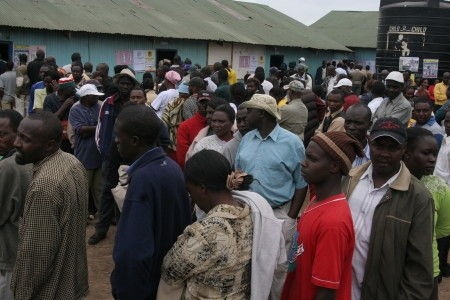
Polling Centre at Dagoretti, Nairobi

Some important reading while watching AFRICOM evolve

From the Small Wars Journal an article entitled “The Slow Motion Coup: Militarization and the Implications of Eisenhower’s Prescience”.  The author, William J. Olsen, is a professor at the National Defense University’s Near East South Asia Center for Strategic Studies, a counterpart to the Africa Center for Strategic Studies:

Or another simple question: Why do we have Combatant Commanders?  This is a model drawn from WWII, made formal and deeply rooted as the result of the Cold War.  Both are over.  Why does the establishment linger?  And if we are to have a pro-consul per region, why a military officer?  Why not a senior civilian with a military adviser?

In this context, something else I have long recommended reading for getting a “feel” for AFRICOM is Chapter Seven of Robert Kaplan’s Imperial Grunts: The American Military on the Ground.  The chapter is titled “CENTCOM, Horn of Africa, Winter 2004, with notes on East Africa”.  Although the period Kaplan covers is before the stand up of AFRICOM as a separate Combatant Command, he visits the Marines of the Combined Joint Task Force-Horn of Africa at Camp Lemonier, Djibouti and accompanies an Army Civil Affairs Team setting up in Lamu, Kenya:

     These teams had a twofold mission: make a sustained contribution to the island’s quality of life, so that the inhabitants would see a relationship with the U.S. as in their best interests; and more immediately, be the advance guard for U.S. Marines from the U.S.S. Germantown coming ashore to repair a school and conduct a MEDCAP.

Lamu was an example of the new paradigm for projecting American power: modernize host country bases for use as strategic outposts, maintain local relationships through humanitarian projects, then use such relationships to hunt down “bad guys.”  Whether it was upgrading a runway, digging a well, or whacking a terrorist, the emphasis was always on small teams.

More broadly:

    The new paradigm gave (Marine) Brig. Gen. Robeson a sort of power that no U.S. ambassador or assistant secretary of state quite had.  Not only wasn’t he burdened by the State Department’s antiquated bureaucratic divisions but his ability to deal with the regions’s leaders and strongmen may also have been helped by a cause-and-effect, working class mind, disciplined by the logic of Marine tactical operations manuals and the classical military education he had received at Fort Leavenworth.  Though democracy was gaining in the region, many of the elected leaders with whom Robeson had developed relationships were former guerrilla fighters and military men . . .

The fact that generals like Mastin Robeson were in the diplomatic forefront, somewhat at the expense of the State Department, troubled commentators who assumed the permanence of industrial-age categories of bureaucratic responsibility, categories helped into being by the nineteenth-century professionalization of European militaries, which consequently separated them from civilian command structures.  But the distinctions appeared to be weakening.

From a review at Foreign Affairs:

Kaplan’s book is wider ranging. His underlying thesis is that the places he visits represent the periphery of a new American empire, whose fate will be determined by how its foot soldiers — the grunts — engage with the local populations. The analogy is to the frontiersmen of the nineteenth century: everywhere he goes he is welcomed to “Injun Country.” It is probably best not to worry too much about the thesis, which is half-baked, and instead enjoy the insights and reportage from a master of this sort of extreme travel writing.

#KenyaDecides – remember the history on 2007: “U.S. congratulates Kenyan president on re-election”; U.K. “Government voices ‘real concerns’ over Kenyan election ‘irregularities’”

US congratulates Kenyan president on re-election
(AFP) – Dec 30, 2007
WASHINGTON (AFP) — The US State Department Sunday congratulated Kenyan President Mwai Kibaki on his re-election, and called on all sides to accept the results despite opposition allegations of ballot fraud.
“We obviously congratulate the president on his election,” department spokesman Rob McInturff told AFP.
“Again we would call on the people of Kenya to accept the results of the election and to move forward with the democratic process,” he said.
Kibaki was sworn in Sunday less than an hour after Kenya’s electoral commission announced he had defeated opposition leader Raila Odinga, who has accused Kibaki of stealing the election by rigging the tallying process.
The result’s announcement triggered riots in bastions of Odinga’s Orange Democratic Movement in the capital Nairobi and western Kenya.
“I think the electoral commission in Kenya and the commissioner there would be the ultimate authority, and we would look to them to investigate any claims of fraud or mismanagement,” McInturff said.
“That said we would also, given that the results are out, congratulate and support the president and look forward to working with the people of Kenya in the coming years.”

[British] Government voices ‘real concerns’ over Kenya election ‘irregularities’

AFP, London, 30 December 2007

Foreign Secretary David Miliband on Sunday expressed “real concerns” at “irregularities” reported in the Kenyan presidential elections.

Miliband urged leaders in Nairobi to work together to address the irregularities noted by European Union observers and others, in a joint statement with International Development Secretary Douglas Alexander.

The pair said deaths in election-related violence – in which 18 people have died since Thursday’s ballot – had marred the election in the former British colony, which became independent in 1963.

“This is a pivotal moment for Kenya, a time when the democratic process and election outcome has to be seen to be fair in the eyes of the Kenyan people,” they said.

“We congratulate Kenyan voters for conducting their vote in an orderly and dignified manner.

“But we have real concerns at the irregularities reported by the EU observers and others.” …

EU election observers in Kenya said Sunday that the country’s electoral commission had failed to ensure the vote’s credibility.

US questions Kenya poll ‘anomalies’

NAIROBI (Thomson Financial, 31 Dec 2007)

The US voiced concern today about ‘anomalies’ in Kenya’s disputed presidential election, noting that some constituencies had declared bizarrely high turnout figures.

‘The United States is however concerned by serious problems experienced during the vote-counting process,’ said a US government statement released by its embassy in Nairobi.

‘These included various anomalies with respect to unrealistically high voter turnout rates, close to 100 percent in some constituencies, discrepancies in the number of votes reported for the respective candidates, apparent manipulation of some election reporting documents, and long delays in reporting results.’…

Kibaki was hastily sworn on Sunday and appealed to the opposition to work with him in restoring stability across the east African nation, home to around 37 million people.

‘It is important that the rule of law be respected. Those alleging vote tampering may pursue legal remedies and should be able, consistent with respect for freedom of speech, to make their case publicly,’ Kibaki said.


Disputed Vote Plunges Kenya Into Bloodshed

Jeffrey Gettleman, New York Times, 31 Dec 2007 Nairobi, page 1

…It took all of about 15 minutes on Sunday, after Kenya’s president was declared… for the country to explode.

“It’s war,” said Hudson Chate, a mechanic here, “tribal war.”… As the riots spread… the government banned all live media broadcasts. Western observers said Kenya’s election commission ignored unmistakable evidence of vote rigging to keep the government in power. Now, one of the most developed stable nations in Africa, which has a powerhouse economy and $1 billion/year tourism industry, has plunged into intense uncertainty, losing its sheen as an exemplary democracy and quickly descending into tribal bloodletting…

In Mathare… Luo gangs burned more than 100 homes… the only figures in downtown Nairobi, the capital which is usually choked with traffic, are helmeted soldiers hunched behind shields…

The European Union said its observers witnesed election officials in one constituency announce on election night that President Kibaki had won 50,145 votes. On Sunday… those same results were 75,261 votes.

Koki Muli, co-chairwoman of the Kenya Election Domestic Observation Forum, said she was in the room on Sunday when the EC was present with dozens of suspicious tally sheets – some missing signatures, others stamps – most from the President’s stronghold in central Kenya. In some areas more people voted for president than were registered to vote. “I saw this with my own eyes,” she said.

Ms. Muli said 75 of the 210 constituencies… more than one-third of the vote… had serious question marks… but [after initially saying it would] the EC refused to investigate… the commission then reconvened in front of reporters chosen by government officials and declared Kibaki the winner [by a 2% margin]… Kenya’s courts are notoriously corrupt… the first batch of results showed a sweeping victory for [Odinga]… ahead by over a million votes on Friday… Ms. Muli said it was clear the government had rigged the election….