Tanzania Update

Reuters: “Tension mounts in Tanzania over delayed vote”:

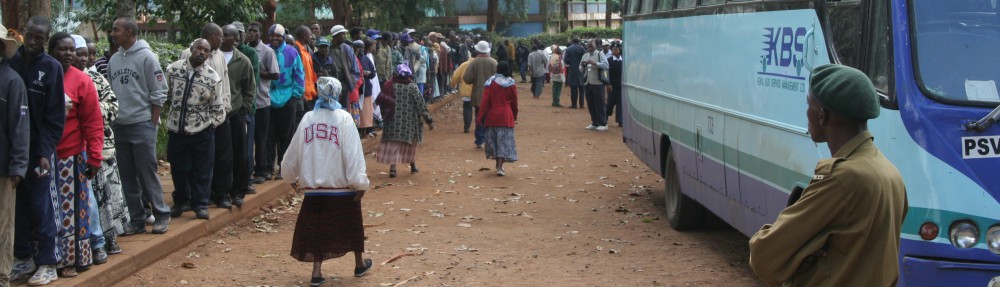
DAR ES SALAAM (Reuters) – Tanzanian police used teargas to disperse opposition supporters in the commercial capital on Monday as tension rose due to delays in releasing the results of Sunday’s presidential and parliamentary elections.

The protesters in Dar es Salaam were angry at the outcome of a council election run alongside Sunday’s national votes that are expected to give President Jakaya Kikwete another five years at the helm of east Africa’s second largest economy.

While opinion polls show his lead narrowed as his main opponent Willibrod Slaa of the Chadema party campaigned hard on an anti-corruption platform, analysts predict Kikwete’s pledge to keep fighting poverty should hand him a final term.

Members of the opposition said the delays were in areas where their candidates were likely to win parliamentary seats.

“The situation is tense … I have received reports that police have used teargas in Mwanza, Arusha and Dar es Salaam. People are restless because they want the results to be made public,” said Mwesiga Baregu, Chadema campaign manager.

“The situation is bad. We have reached a point where we might see bloodshed, just like what happened in Kenya when the election results were delayed.”

Violence erupted after Kenya’s 2007 election following delays in releasing results and accusations that the incumbent Mwai Kibkai had stolen the vote.

BURNING TYRES

Police said they used water cannon and teargas to disperse the crowds outside a polling station in Dar es Salaam.

“Riot police were called in after crowds burnt tyres on the road and damaged at least one vehicle at Tandika area in Dar es Salaam,” Temeke Regional Police Commander David Miseme told reporters on Monday.

“At least 15 people were arrested. No injuries have been reported so far.”

Tanzania’s electoral authorities said they would issue more results on Tuesday after a handful were released giving Kikwete an early lead.

International observers said the poll was well-organised and well-conducted on the whole, but the East African Community’s election observer mission to Tanzania said it too was concerned by the delays in releasing of the poll results.

“It is very slow compared to other East African countries. It is taking too long, we don’t know the reasons,” Abdul Karim Harelimana, head of the EAC election observer mission to Tanzania told Reuters in Dar es Salaam.

Kikwete led with 66.94 percent of the vote while Slaa garnered 17.36 percent in 10 of the 239 constituencies where results have been released.

The results covered constituencies with a combined total of less than 60,000 votes among 19.6 million registered voters.

Election Day in Tanzania [updated Nov. 1-“the best in Africa”]

Uchaguzi citizen monitoring/mapping is up and running.

EU Election Observation Mission Tanzania

Update–Nov. 1: “EU Interim Observers’ Report Ready Tuesday” at AllAfrica.com from the Tanzanian Daily News

Arusha — THE European Union Election Observation Mission will release an interim report on the 2010 Tanzanian General Elections, next Tuesday.

“The preliminary statement on the mission’s findings will be issued on Tuesday from 11.00 am during a press conference that I am to conduct at the Movenpick Hotel in Dar-es- Salaam,” said the Chief Observer, Mr David Martin.

Speaking in Arusha, Mr Martin who was accompanied by long term observer Mr Andreas Jordan said his team has met local party leaders here, community members and have even visited rural villages but he intends to observe the actual voting process in Dar es Salaam before compiling the initial report.

“The provisional report is expected to be a seven-page manual whose final details are to be added on Monday after the polls,but the real and ultimate comprehensive election report is due to be ready in two months time, possibly early 2011,” he said.

“And don’t expect the term ‘Free and Fair’ anywhere within the soon to be publicized EU-EOM reports. We usually do not use such words,” said Mr Martin, adding that the way they conduct their mission is extremely different from other international observers.

However, the EU Chief Observer said from what his team has seen so far, Tanzania’s poll conduct should be the best in Africa.

“Tanzania must go down the record as an exemplary country compared to other states on the continent in the way her people, political parties and politicians conduct their campaigns as well as how they brace themselves for the national elections in general,” praised Mr Martin.

“Having worked around the globe, different continents and states, we have amassed enough experience,” said the EU-EOM chief, adding that in contrast to other countries on the continent, he can officially comment that Tanzania is the best in Africa.

But while at that, he pointed out that the conduct here was still far from being perfect, only better than all other African countries they have ever worked with.

“International Election Observers Descend on Dar Es Salaam” at AllAfrica.com from the Tanzanian Daily News:

The number of local monitors is around 8,000, according to NEC. Election monitoring, among other things, is aimed at putting to test integrity and credibility of the country’s electoral process, after re-introduction of multiparty democracy in 1992. The primary objective of observers is to assess the conduct of an election process on the basis of national legislation, regional and international standards.

Foreign observer mission in the country include those from the European Union (EU), African Union (AU), Southern African Development Community (SADC), East African Community (EAC) and Japan. Most of the groups say that they have a common mission of ensuring that the country undertakes free and fair elections.The chairman of EAC observers involving 18 people, Mr Reuben Oyondi, told reporters earlier this week that they have planned to visit several areas to monitor the preparations for the polls

Transparency International Annual Corruption Perception Index released [corrected and updated]

The new Transparency International corruption perception rankings for 2010 have been released today.

For East Africa:

66 Rwanda (4.0 score on a scale of 10) [up from 3.3 for 2009]
116 Ethiopia (2.7) [unchanged]
116 Tanzania (2.7) [up from 2.6]
127 Uganda (2.5) [unchanged]
154 Kenya (2.1) [down from 2.2]
170 Burundi (1.8) [unchanged]
172 Sudan (1.6) [up from 1.5]
178 Somalia (1.1–lowest) [unchanged]

The United States dropped to 22nd with a 7.1 score.

The new report was drawn from surveys taken from January 2009 to September 2010.

For these listed East African countries, there was no demonstrated significant change from 2009 to 2010.

Given its methodology, the CPI is not a tool that is
suitable for trend analysis or for monitoring changes in the
perceived levels of corruption over time for all countries.
Year-to-year changes in a country/territory’s score can
result from a change in the perceptions of a country’s
performance, a change in the ranking provided by original
sources or changes in the methodology resulting from TI’s
efforts to improve the index.
If a country is featured in one or more specific data
sources for both of the last two CPIs (2009 CPI and 2010
CPI), those sources can be used to identify whether there
has been a change in perceived levels of corruption in
that particular country compared to the previous year.
TI has used this approach in 2010 to assess country
progress over the past year and to identify what can be
considered to be a change in perceptions of corruption.
These assessments use two criteria:
(a) there is a year-on-year change of at least 0.3 points in
a country’s CPI score, and
(b) the direction of this change is confirmed by more than
half of the data sources evaluating that country.
Based on these criteria, the following countries showed
an improvement from 2009 to 2010: Bhutan, Chile, Ecuador,
FYR Macedonia, Gambia, Haiti, Jamaica, Kuwait and
Qatar. The following countries showed deterioration from
2009 to 2010: the Czech Republic, Greece, Hungary,
Italy, Madagascar, Niger and the United States.

The Dar Side? Yet another President’s Electoral Commission

With elections in Tanzania set for October 31, the East African today reported “Fear, anxiety build up ahead of Tanzania’s election showdown Sunday”.

Most commentators, including Africa Confidential have not gone so far as to suggest that President Kikwete of the Nyerere ruling party CCM faced any real likelihood of defeat, but the East African asserts that an opposition surge has resulted in a serious two man race:

An opinion poll by non-government organisation Tanzania Citizens Information Bureau found that if elections were held between September 27 and October 10, Dr Willbrod Slaa, 62, would obtain 45 per cent of the votes cast against Kikwete’s 41 per cent.

Two earlier polls, one by the Synovate group and the other by a University of Dar es Salaam think tank, showed that Kikwete would win with 61 per cent and 71 per cent respectively.

Analysts say that in the eyes of the public, CCM has gradually deviated from its founding values — fighting corruption, ensuring less spending on government administration and provision of social services — and that its leadership is firmly in the pockets of the capitalist class.

At the same time, Chadema, a 1992 breakaway from CCM — then led by Edwin Mutei, former governor and finance minister who disagreed with Nyerere, his boss then, on fiscal policy — has been making the fight against corruption the key plank of its electoral platform.

This play of perceptions seems to be earning Dr Slaa political mileage, and troubling Kikwete’s advisers.
. . . .
It appears that Chadema’s choice of presidential candidate was designed to exploit the frictions within CCM and expose the mismatch between its founding principles and the current reality.

Dr Slaa crossed from CCM to Chadema in 1995 after the party did not let him contest a political post for which he had won the primaries. He stood on the Chadema ticket to represent Karato District in parliament and won.

The catholic priest-turned-politician, who has built a reputation of himself as a man who speaks his mind and fearlessly fights corruption, brought his social-democratic values to a Chadema till then known as a centrist outfit.

Dr Slaa has pledged to cut the salary of the president by 20 per cent and those of Members of Parliament by 15 per cent.
. . . .
The opposition has accused the ruling party of using state resources to facilitate its campaign. There are fears of rigging and ultimately violence during and after the election.

The Electoral Commission has said that there are about 19 million registered voters, “However, scientific demographic surveys indicate that there cannot be more than 16 million voters in Tanzania,” said Ismail Jussa, CUF deputy secretary general.

“Electoral corruption has never reached this level: There are politicians out there buying votes, but nothing is being done to curb this,” Mr Jussa added.
. . . .
There are concerns with the electoral legal framework. The Elections Act 1995 provides for a National Electoral Commission to be appointed by the president, which in turn appoints district election officials who happen to be government officials.

A recent amendment provided for the Commission to appoint officials, in the event that district executive directors cannot supervise elections in the areas, but such new appointees are also civil servants. “The Electoral Commission is not independent,” Chadema’s Mnyika told The EastAfrican.

Electoral Commissions appointed unilaterally by a president who is running for re-election are a disaster waiting to happen, as we saw in Kenya in 2007. This situation allowed fraud in Uganda in the last election and theatens it again in February 2011.

Tanzania is a MCC compact country and a U.S. favorite. Kikwete visited Kibaki in Nairobi in early 2008 said to be carrying a message on behalf of the U.S. and helping to persuade Kibaki to agree to negotiated toward a deal to allow a role for ODM along with PNU in a power-sharing for national unity. The Tanzanian election has been low on my radar screen with all of the many problems in the region and certainly State and USAID have more than their hands full of challenges. Let us hope Tanzanian officials rise to the occasion.

Trade and Aid [Update]

A Good African Tale: an African entrepreneur struggles for recognition in rich county markets from the Economist.

Update: “Rwanda Coffee Success Story” from William Easterly’s AidWatch (HT Texas in Africa)

Nick Wadham’s latest in Time: Bad Charity (All I got was this lousy t-shirt) — and his related blog post, Top-Down Aid for Africa.

Texas in Africa has a great related multi-part series of discussion questions May 4-7 about the Western approach to aid and development in Africa:

This week I’ve been trying to sketch an outline of how Westerners tend to develop and characterize our relationship with Africa and the people who live there, specifically with reference to the international aid and development system. I’ve argued that the savior mentality is misguided, that Africa is not rightfully ours to save, and that a better way to assist would be through a paradigm of empowerment. . . .
Today I want to conclude this series by thinking about what is probably the biggest barrier to moving into an empowerment paradigm: the governments that give and receive aid. . . .
Why? Because aid – for donor governments and the governments which receive the bulk of aid – is inherently political. Except in cases involving natural disasters or epidemic disease, donors don’t typically give freely to everyone out of the goodness of their intentions. Aid projects are funded at least in part (and sometimes entirely) on the basis of donor priorities. When aid projects take into account the real, expressed needs of recipients (which is, I’m glad to say, increasingly real for most project), they are often structured in such a way as to advantage suppliers or producers in the donor state, or to reward good governance or provide support to an ally.
As we might expect, there is often a contrast between donor goals and what is actually needed in order to improve the material situations of the recipients. . . .


UPDATE
NYTimes: “At Front Lines, AIDs War is Falling Apart”; “Paper Cuts: How Obama’s Father Came to Hawaii”; “Letters: From Kenya to America”

Reuters: Donors to slash Tanzania budget aid.

Nick Wadhams at NPR:“Somali Pirates Take the Money and Run, to Kenya”

The Times (London): Book review–“War Games: The Story of Aid and War in Modern Times by Linda Polman
Humanitarian aid prolongs conflict and misery because the bad guys learn how to exploit it”
;
“Easy Money: the great aid scam”

Bits to Start the Week–Coffee, Al Shabaab, EA Common Market, CIA

More on Kenyan coffee branding from the Business Daily. Kenya’s coffee sector makes up 3.5% of GDP–annual production is currently 50,000, having peaked at 130,000 tonnes in 1989/89, with the decline attributed to “mismanagement, indebtedness and bad returns”
———–
“Al-Faisal’s gone, questions linger” from Muthoni Wanyeki’s column in the East African.
———–
Also from the East African, Charles Onyango-Obbo on the East African Common Market: “Who’s Afraid of Big Bad Kenya?”

One commonly hears statements like the “Kenyan economy is bigger than Tanzania’s and Uganda’s combined.” Yes, but that was 20 years ago.

Kenya’s gross domestic product in 1990 was $11 billion. Tanzania’s was $5.4 billion, and Uganda’s $4.03 billion. Kenya’s economy then was bigger than Tanzania and Uganda combined; twice that of Tanzania, and nearly three times Uganda’s.

By 2008, Kenya’s GDP was $31 billion. However Tanzania’s was $21 billion, and Uganda’s $15.8 billion. It’s no longer bigger than Tanzania’s and Uganda’s combined; it is not double that of Tanzania; nor is it three times bigger than Uganda’s. Indeed, depending on the GDP figures you look at in three or so years, Tanzania could be East Africa’s largest economy.

The story of the past 20 years in East Africa, therefore, is not how large Kenya’s economy is compared with those of its neighbours, but rather how much the others have closed the gap.

———-
“Row Clouds Process to Pick New KAA Boss to Replace Muhoho” from the Sunday Nation is a “must read” as for anyone that wants to assess how locked down or open opportunities in Kenya are now in the second Kibaki administration and how public business gets done.
———-
Last for now, but not necessarily least, the Standard on CIA Director Leon Panetta’s visit to Nairobi.