Macmillan banned by World Bank over Sudan bribes – Times Online.
Macmillan banned by World Bank over Sudan bribes – Times Online
Reply
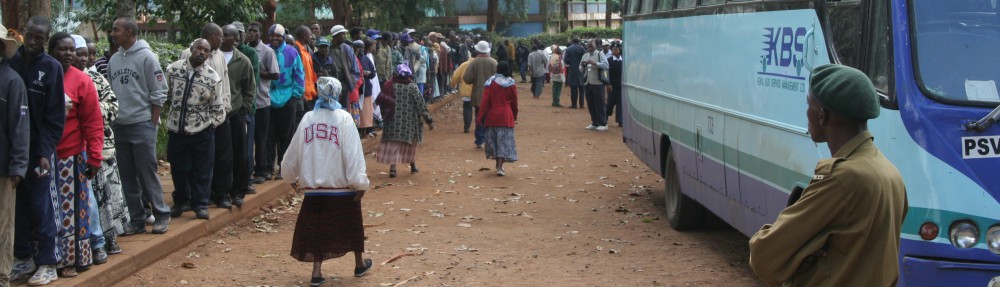
Jeffrey Gettleman from Khartoum on the start of voting Sunday.
Reuters says that the largest Sudanese observation group reports that the National Election Commission was “clearly not ready” for the voting and that the observers have called for an extension of the scheduled three day voting period.
“In Southern Sudan for the Money”
JUBA, Sudan, April 9 (Reuters) by Ed Cropley – The only thing that’s cheap in southern Sudan is life.
One of the world’s poorest regions, where four out of five people are illiterate and one in five children fails to make it to their fifth birthday, the south’s economy has been turned on its head since the end of a 22-year civil war in 2005.
A flood of foreign aid workers and more than $2 billion a year in oil revenues under a peace deal with the central government in Khartoum has transformed the south into one of the most expensive corners of Africa.
. . . .Nobody knows how many people live in the city, although some say its population has trebled in the last five years under the weight of tens of thousands Kenyans and Ugandans out to make a quick buck.
“Earning $100 is difficult in Kenya. Here it’s easy,” said Amos Njay, a Nairobi taxi driver hoping a year in Juba will set him up in a trucking business.
Africans are not the only ones with an eye on the cash.
Foreign aid workers, holed up behind barbed-wire fences and armed guards in semi-permanent tented camps on the banks of the Nile, boast of earning $10,000 a month tax-free and with all their living expenses taken care of.
“You know what they say: in places like this you only get missionaries, mercenaries and misfits. Me? Sure, I’m just here for the money,” said one U.S. aid contractor knocking back a cold beer in a bar on the banks of the Nile.
Other drinkers ranged from dapper pro-democracy activists from the U.S. International Republican Institute to former soldiers whose lives are spent treading in the heels of conflict across the globe, cleaning up mines and unexploded bombs.
. . . .
AFP story via Yahoo News: Update on opposition boycotts; EU pulls observers from Darfur
“Are the private sector and civil society natural enemies?”–insightful piece from the Nation Groups’s Pan-African Media Conference by Muthoni Wankeki in Pambazuka.
Meanwhile, a new survey reported in Business Daily indicates that Kenyan business leaders are worried about a repeat of election violence.
“In Defense of the Voice of America” by Alemayehu Mariam in Pambazuka, reprinted from Huffington Post.
Human Rights Watch reports on pre-election environment in Sudan and Ethiopia, says April and May elections unlikely to be “free and fair”. Ethiopia: Repression Rising Ahead of May Elections. Sudan: Government Repression Threatens Fair Elections. Daily Nation story here.
Sudan prez threatens to expel election observers
By SARAH EL DEEB
CAIRO — Sudan’s president threatened Monday to expel foreign observers over their recommendations to delay the country’s first multiparty elections in decades due in April.
Another terrorism suspect escapes from Kenyan custody under suspicious circumstances.
KANU leaders right about one thing at least–the Administration Police should be disbanded and merged into the normal police force. The AP has grown to be equivalent in size to the 40,000 member national police, and is obviously a security threat in its own right. This was evident in the deployment of the AP to support the Kibaki re-election effort in December 2007 amid bold-faced denials, and spiraling rumors–helping to lay the groundwork for the post-election violence–as well as participating in it directly. [For Gideon Moi to pledge to tackle corruption is something else again . . . . ]
Carson says US to increase relative focus on food security in Africa policy.
Business leaders plan to use “Prime Minister’s Round Table” discussion to focus on insecurity–one idea: “re-deployment of police from non-core activities such as managing buildings, stadiums and chauffeuring civil servants, freeing them to carry out their core mandate of maintaining law and order.”
The EastAfrican has separately learned that key Western democracies and institutions, fearing that independence for the South in its present state could see the area slide into anarchy, have quietly urged President Salva Kiir’s government to go slow on secession.
“Independence for the South should be put off for a few more years primarily because of lack of capacity in the South to run a stable and secure state,” said a source privy to Western analysis of the evolving situation in Sudan.
He added: “There is no institutional infrastructure to support a state, so there is a high chance that the country will degenerate into a Somalia-like situation. This would open a ‘corridor of terror’ across the region that could be infiltrated by Al Qaeda and its associates to create instability that would run counter to Western interests.” Continue reading
“Sudan’s capital sways to hip hop”
Ethiopia’s Zenawi says he will authorize jamming of Voice of America Amharic broadcasts, comparing VOA to Radio Mille Collines
Dysfunctional governance in Kampala–“‘The Bastard Child of Nobody?’–Anti-Planning and the Institutional Crisis in Contemporary Kampala”
This is Kenya’s version of “the oil curse” or “the resource curse”.
Nairobi is the place to be in Sub-Saharan Africa (and outside of South Africa) for international meetings and conferences. It is a relatively comfortable place to live for middle class or wealthy Westerners, or young aid workers. An international city with a certain level of cosmopolitanism, yet of manageable size and scope relative to so many burgeoning cities of the less developed “South”. A headquarters for two UN agencies. A diplomatic critical mass, with lots of representation from all sorts of countries around the world that have little obvious presence in Africa, but also a crossroads for representation of everyone playing for a major piece of the pie (Iran, Libya, China, India, the Gulf States–as well as obviously the US and Europe). And you can go on business, and then take a safari on the side.
From the US, soldiers go to Djibouti (the Combined Joint Task Force-Horn of Africa, at Camp Lemonier) while diplomats go to Nairobi. The US runs its Somali diplomacy from the Embassy to Kenya rather than Djibouti which would be the more obvious place on paper. Likewise, Somali politicians tend to live much of the time in Nairobi. Nairobi is the place to invest cash generated in Somalia.
Nairobi is the “back office”, and in some cases the only office, for much of relatively huge amount of US aid-related effort for Southern Sudan, as well as that from other countries.
Nairobi has something like 8% of the Kenyan population, and perhaps 60% of the GDP (don’t let anyone tell you they know any of these figures too precisely). Perhaps 50-60 percent of the population lives in informal settlements (“slums”) whereas the other half lives as “the other half”. Most national level Kenyan politicians holding office live primarily in Nairobi (although they may have homes in a constituency they represent in Parliament as well).
When I was the East Africa Director, based in Nairobi, for IRI (where our much bigger Sudan program was also headquartered) as an American I felt that my government at that time (2007-2008) was falling into the trap of recreating a Cold War paradigm for our international relations by looking around through our “War on Terrorism” telescope. And that in Kenya there were a lot of international interests that valued stability over reforms for reasons that related more to the current role of Nairobi than the long term interests of Kenyan development.
Certainly Nairobi is a resource that has great value–as does oil, for instance–it’s just a question of whether Kenyans can find a way to use it to the broad advantage of the nation or whether it will continue to be exploited to disproportionately benefit the most powerful. Including being used to help keep them in power when more Kenyans want democratic change.
Just this past week Kenya hosted an IGAD meeting on Sudan–and flouted its obligations as a party to the Rome Treaty on the ICC by inviting President Bashir of Sudan while under indictment. Meanwhile the ICC is considering whether to allow formal investigation of key Kenyan leaders for the post-election violence from 2007-08. But Nairobi is such a great place to have these conferences . . . and Sudan is so important (Khartoum is no Nairobi, but it has oil).
