
Berthing Allotment--Kenya Railways, Nairobi
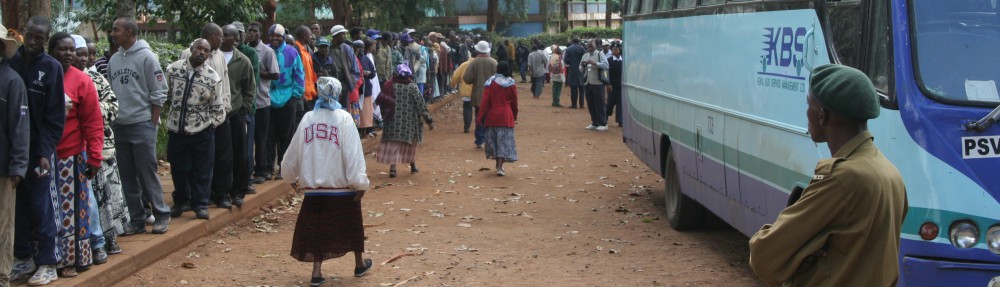
Berthing Allotment--Kenya Railways, Nairobi
“MP Falls Short in Recount” from the Saturday Nation
In other words, this race was not close based on ballots cast if the recount is anywhere near accurate. (Update: Will have to look into this further to have an educated opinion about whether that is the case.) Which of course doesn’t touch the other problems of “2 million dead voters” and such.
The next step is to return to the court that ordered the recount.
The candidate receiving the most votes in the recount, then-MP Maina Kamanda, running for re-election on the PNU side, asserts that he lost through “falsification of Form 16A”. This would certainly seem to be an obvious explanation–and the one that would be accord with the evidence that has come to light in regard to the Presidential election and in other constituencies.
I remember Ambassador Ranneberger explaining to us all that recounts were “impossible” when the EU and others called for them at the beginning of 2008.
An important thing to note here is that a recount could have cost various ODM politicians their parliamentary seats, just as it might have cost Kibaki the presidency. Everyone who was tapped as a winner by the ECK by the evening of Dec. 30, 2007 benefited in part at least from leaving the election results as they were claimed to be by the ECK and negotiating among themselves from there. The real losers being of course the voters.
Kevin Kelley in the East African:
Kenya serves as “a major base” for Islamist groups battling Somalia’s Transitional Federal Government, the United Nations says in a recent report that also details the Kenyan government’s training of TFG forces — in apparent violation of a UN embargo.
Kenyan nationals account for about half of all foreigners fighting in Somalia under the banner of the Al Shabaab insurgency force, the report says.
Many of these fighters are recruited through a support network in Nairobi consisting of “wealthy clerics-cum-businessmen, linked to a small number of religious centres notorious for their links to radicalism,” the UN Monitoring Group on Somalia states in its March 10 report.
Leaders of Al Shabaab and Hizbul Islam, the other main insurgent group in Somalia, “travel with relative freedom to and from Nairobi, where they raise funds, engage in recruitment and obtain treatment for wounded fighters,” the Monitoring Group finds.
Some African and European diplomats based in Nairobi meanwhile engage in visa fraud that enables the smuggling of illegal migrants into Europe and other destinations for fees of about $12,000 for a man and $15,000 for a woman, the UN says.
In the meantime today, BBC reports that hundreds marched in Mogadishu in a second public protest against al-Shabab
This is Kenya’s version of “the oil curse” or “the resource curse”.
Nairobi is the place to be in Sub-Saharan Africa (and outside of South Africa) for international meetings and conferences. It is a relatively comfortable place to live for middle class or wealthy Westerners, or young aid workers. An international city with a certain level of cosmopolitanism, yet of manageable size and scope relative to so many burgeoning cities of the less developed “South”. A headquarters for two UN agencies. A diplomatic critical mass, with lots of representation from all sorts of countries around the world that have little obvious presence in Africa, but also a crossroads for representation of everyone playing for a major piece of the pie (Iran, Libya, China, India, the Gulf States–as well as obviously the US and Europe). And you can go on business, and then take a safari on the side.
From the US, soldiers go to Djibouti (the Combined Joint Task Force-Horn of Africa, at Camp Lemonier) while diplomats go to Nairobi. The US runs its Somali diplomacy from the Embassy to Kenya rather than Djibouti which would be the more obvious place on paper. Likewise, Somali politicians tend to live much of the time in Nairobi. Nairobi is the place to invest cash generated in Somalia.
Nairobi is the “back office”, and in some cases the only office, for much of relatively huge amount of US aid-related effort for Southern Sudan, as well as that from other countries.
Nairobi has something like 8% of the Kenyan population, and perhaps 60% of the GDP (don’t let anyone tell you they know any of these figures too precisely). Perhaps 50-60 percent of the population lives in informal settlements (“slums”) whereas the other half lives as “the other half”. Most national level Kenyan politicians holding office live primarily in Nairobi (although they may have homes in a constituency they represent in Parliament as well).
When I was the East Africa Director, based in Nairobi, for IRI (where our much bigger Sudan program was also headquartered) as an American I felt that my government at that time (2007-2008) was falling into the trap of recreating a Cold War paradigm for our international relations by looking around through our “War on Terrorism” telescope. And that in Kenya there were a lot of international interests that valued stability over reforms for reasons that related more to the current role of Nairobi than the long term interests of Kenyan development.
Certainly Nairobi is a resource that has great value–as does oil, for instance–it’s just a question of whether Kenyans can find a way to use it to the broad advantage of the nation or whether it will continue to be exploited to disproportionately benefit the most powerful. Including being used to help keep them in power when more Kenyans want democratic change.
Just this past week Kenya hosted an IGAD meeting on Sudan–and flouted its obligations as a party to the Rome Treaty on the ICC by inviting President Bashir of Sudan while under indictment. Meanwhile the ICC is considering whether to allow formal investigation of key Kenyan leaders for the post-election violence from 2007-08. But Nairobi is such a great place to have these conferences . . . and Sudan is so important (Khartoum is no Nairobi, but it has oil).

Lauren Gelfund writes from Nairobi in World Politics Review on the current situation in Ethiopia ahead of elections and the issues facing Western donors. Note the venue at Nairobi’s Habesha restaurant, a popular expat haunt and one of my family’s favorites.
Kenya’s Kibera slum overflows with street art — latimes.com
Feature on Solomon Munyundo, a.k.a Solo 7

Solo 7 — Toi Market

Solo 7–Kibera
U.N. Experts Get Threats in Inquiry Into Somalia – NYTimes.com.
It seems that anyone looking into anything sensitive in Nairobi is subject to threat these days. This will be a good test of where things stand on impunity. If people can make death threats against people dispatched on behalf of the U.N. Security Council without getting arrested it wouldn’t seem to bode well for the rank-and-file journalist, lawyer or activist.
“Ironically, nearly all the time, the role of Government has been to pull back the population through embezzlement of their tax contributions in immoral, treacherous and unbelievable corruption scandals. Mismanagement of public affairs and general destruction of the economy, sleaze and ineptitude have been the hallmarks of Government. . . . The standard of life, therefore remains woefully low. . . .
. . . .
[T]he democratization ‘achievements’ so far are both superficial and deceptive. . . . the ability of the Kenyan people to hold the Government to account–whether through the National Assembly or through electoral action, or through civil society action–is so severely constrained that Kenyans find themselves helpless even in the face of an offensive regime that is also characterized by broken promises such as a new and desirable Constitution, a commitment to fight crime, creation of employment, fairness in allocation of all public resources and an end to corruption. . . .
. . . .
Corruption is the hallmark of senior officials in Government. . . .Corruption has reached such levels that it threatens to write off the future of our country. It has bred such disorder in our society that rules are disregarded and national wealth squandered at will. . . . I repeat, the problem with Kenya is simply and squarely a matter of bad leadership and poor governance.”
Kalonzo Musyoka, on the Kibaki Administration, in 2007
This is what the now-Vice President of Kenya had to say in the campaign booklet he gave me when I went to meet with him the first week of June 07 when I arrived in Nairobi to step in as the Resident Director for the East Africa office of the International Republican Institute.
Credit to the artist, Solo 7, for the painting in the header image from Toi Market, Nairobi, January 2008.