The Foreign Policy establishment will continue to hold Beltway confabs and hearings about “Africa policy” but the author of “The Flight 93 Election” is running Policy Planning at State and Congress has neutered itself.

I think it is probably a sucker’s game to do too much mastication around the idea of what Trump II may do in or in relation to Africa by reference to the Kennedy through Biden 1961-2025 “A.I.D./USAID Era” of African relations.

Take a moment to read Michael Anton’s famous opinion piece in the Claremont Review of Books from July 2016 entitled “The Flight 93 Election”. This is the very same Michael Anton who is the Trump II Director of Policy Planning at the State Department.

As far as I am concerned the wood chippering of USAID, programs and especially people, is best understood in the intellectual “Cold Civil War” environment as a subspecies of “Defunding the Left” (something that I had some involvement in as a College Republican leader back in the”Reagan Revolution” days) rather than a more specific foreign policy pivot. The impact on Africa, Africans, and relations with African states specifically is just collateral damage in “The Third World” in Flight 93 terms.

Probably better to study the Eisenhower Administration—when decolonization was close enough to warrant standing up a separate Africa Bureau in the State Department but many in Congress addressing foreign policy represented segregated Jim Crow States and districts and the question of civil rights for Black Americans generally was much in contest. And perhaps a counterfactual to identify what a Goldwater Administration Africa policy might have been. [Recognizing that Eisenhower was seen as a proto-Communist by many of the ideological godfathers of the current Trump II core thought leaders.]

The most important American regarding Africa policy is likely Elon (“We’ll Coup Who We Want To“) Musk, and ProPublica has an expose about how aggressively the new Trump II State Department leaned on Gambia for Musk’s Starlink business.

Musk has used his X megaphone (the repurposed Twitter) to spread accusations of a genocide against white Afrikaners in snyc with the rest of the Trump Administration declaring same as the basis for the new program to designate Afrikaners as “refugees” and resettle them in the US. In the context of “The Flight 93 Election” view of seeing “Third World” immigration as the most daunting failure of the pre-Trump Conservative Movement and pre-Trump Republican Party as well as the ultimate goal of the Left “enemy within”, it makes perfect sense to affirmatively bring in Afrikaners while expelling “non-Western” refugees impacted by wars or terrorism elsewhere in Africa or “The Third World”.

Beyond the barriers of “culture” and “development” to finding time out from the Cold Civil War to develop an actual foreign policy strategy for Africa, the Trump II Administration will not be able to take this on without having first a strategy for China. I do not expect that four years will be long enough for Trump to make many of the necessary choices. So far the most important fork in the road in the Trump II China policy (and foreign policy writ large) is the announcement by Treasury Secretary Bessent that the US does not seek to decouple with China.

In the meantime, gutting the State Department means that more of the burden of diplomacy as well as development will be left to AFRICOM by default. Of course the Trump policy of refocusing the Pentagon on “warfighting” by a more lethal warrior class and enhanced technology cuts away from the likelihood that AFRICOM as a Combatant Command will be more rather than less dexterous and ultimately successful at diplomacy than it has been since starting to take up that burden at inception in 2008 as what the G.W. Bush Administration conceived as a “different kind of Combatant Command.”

Congress has elected to defer wholly to Trump II on Africa policy so far as the major changes have been effectuated with the demise of USAID. The Senate Foreign Relations Committee didn’t even hold a hearing (!) on the demise of USAID and the hearing in the House was not of any legal relevance in spite of the preponderance of the testimony debunking the basic rationale of Musk for the “woodchippering”.

Last week the Senate Committee solicited the thoughts of Joshua Meservy of the Hudson Institute, previously Heritage, and Michelle Gavin of the Council of Foreign Relations on “East Africa & The Horn: At a Turning Point or Breaking Point” but again, no real indication that Congress will do anything to get involved as opposed to deferring entirely to Trump II.

While some associated with the Trump II administration pay lip service to an approach of “trade not aid” in the aftermath of the death of aid, there is no evidence of comparative substance to the words. The UAE is the latest country after China to completely dwarf U.S. current and planned financial investment in Africa and like China provides a counter to previous U.S. expressed values on governance and the rule of law, and not just in relation to war and mineral smuggling in Sudan and Central Africa.

See “UAE Pouring Money into Africa, Seeking Resources Resources and Power” in the New York Times on May 17:

“In 2022 and 2023, the Emirates announced a total of $97 billion in investments in Africa — three times China’s total, according to fDi Markets, a database of foreign investments. U.S. investment in 2023 was about $10 billion.”

“Meanwhile, Mr. Trump has fast-tracked America’s exit from Africa, ending billions of dollars in funding, dismantling the U.S. Agency for International Development and ending all contributions to the African Development Bank. The State Department’s reorganization plan also calls for the elimination of most operations in the region.”
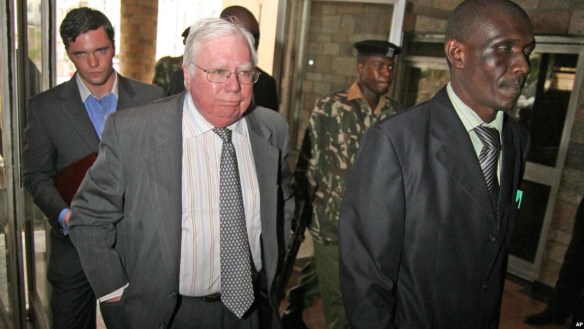
Birther John Corsi in Kenya to investigate Senator Obama
Jerome Corsi, bestselling “Obamanation” and “Where’s The Birth Certificate” author in Nairobi during early Birtherism era.

US State Department issues Genocide Determination in Sudan

Statement from Secretary of State Blinken:

Genocide Determination in Sudan and Imposing Accountability Measures

On April 15, 2023, the Sudanese Armed Forces (SAF) and the Rapid Support Forces (RSF) launched a conflict of unmitigated brutality that has resulted in the world’s largest humanitarian catastrophe, leaving 638,000 Sudanese experiencing the worst famine in Sudan’s recent history, over 30 million people in need of humanitarian assistance, and tens of thousands dead.  In December 2023, I concluded that members of the SAF and the RSF had committed war crimes.  I also determined that members of the RSF and allied Arab militias had committed crimes against humanity and ethnic cleansing.   

The RSF and RSF-aligned militias have continued to direct attacks against civilians.  The RSF and allied militias have systematically murdered men and boys—even infants—on an ethnic basis, and deliberately targeted women and girls from certain ethnic groups for rape and other forms of brutal sexual violence.  Those same militias have targeted fleeing civilians, murdering innocent people escaping conflict, and prevented remaining civilians from accessing lifesaving supplies.  Based on this information, I have now concluded that members of the RSF and allied militias have committed genocide in Sudan.   

The United States is committed to holding accountable those responsible for these atrocities.  We are today sanctioning RSF leader Mohammad Hamdan Daglo Mousa, known as Hemedti, for his role in systematic atrocities committed against the Sudanese people.  We are also sanctioning seven RSF-owned companies located in the United Arab Emirates and one individual for their roles in procuring weapons for the RSF.  In addition, we are today announcing Hemedti’s designation under Section 7031(c) for his involvement in gross violations of human rights in Darfur, namely the mass rape of civilians by RSF soldiers under his control.  As a result of this designation, Hemedti and his immediate family members are ineligible for entry to the United States.  

Hemedti has wantonly ignored commitments under international humanitarian law, the 2023 “Jeddah Declaration of Commitment to Protect the Civilians of Sudan,” and the 2024 Code of Conduct produced by the Advancing Lifesaving and Peace in Sudan initiative.  This code includes commitments to allow the unimpeded passage of humanitarian relief and prevent war crimes such as sexual violence, which the RSF and aligned militias under Hemedti’s leadership have committed.  

Today’s action is part of our continued efforts to promote accountability for all warring parties whose actions fuel this conflict.  The United States does not support either side of this war, and these actions against Hemedti and the RSF do not signify support or favor for the SAF.  Both belligerents bear responsibility for the violence and suffering in Sudan and lack the legitimacy to govern a future peaceful Sudan.  The United States continues to evaluate additional actions to impose costs on those perpetuating the conflict and atrocities against the Sudanese people.  We also continue to support the Sudanese people in achieving their aspirations for a peaceful, just, and inclusive democratic future, which is why in December I announced that the United States will provide $30 million to support Sudanese civil society actors.   

The Department of the Treasury actions were taken pursuant to Executive Order 14098, “Imposing Sanctions on Certain Persons Destabilizing Sudan and Undermining the Goal of a Democratic Transition,” as amended.  For more information on today’s action, see Treasury’s press release. The public designation is made pursuant to Section 7031(c) of the Department of State, Foreign Operations, and Related Programs Appropriations Act, 2024 (Div. F, P.L. 118-47), as carried forward by the Further Continuing Appropriations Act, 2025 (Div. A, P.L. 118-158). 

The value of life; the price of office–genocide and elections in East Africa

Muthoni Wanyeki asks in The East African if anyone cares that genocide is looming in South Sudan.

Meanwhile, Kenya is paying an average of about $343,000.00 “severance” to each of the outgoing Independent Electoral and Boundary Commissioners for leaving earlier this fall rather than completing their terms through November 2017.  No signs of accountability for the #Chickengate bribes to the IEBC by Smith & Ouzman that were prosecuted by the UK and no sign of accountability for corruption in the subsequent 2013 election technology procurements.

While the “buyout” has been negotiated, the incumbent IEBC staff without the “servered” Commission has been proceeding to undertake election preparations that will be fait accompli for the new Commission when it is appointed next year.  Accordingly, the chief executive has proceeded to report plans to spend an astounding 30Billion KSh to conduct the 2017 general election, while setting a target of 22 million registered voters. In other words and figures, roughly $13.40US per registered voter if the target is met or $19.60US per currently registered voter. (For comparative data from places like Haiti and Bosnia,see The Ace Project data on cost of registration and elections.)

Old KANU Office

Solo 7–Kibera

Is Libya to Burundi in 2016 as Somalia was to Rwanda in 1994?

US Army deployedI have no answer to this question, and I hope and pray it is just something to think about abstractly.

What I am getting at is that for purposes of public consumption at least the Western democracies were in denial in 1994 about the risk of mass slaughter and eventually genocide and failed to act to an extent that we all pretty well have acknowledged shame about.  (No one bothers to suggest that China, Russia or other non-Western powers would be expected to be similarly troubled.) It seems to be recognized that the U.S. was the “indispensable” party that would have had to push forward to make intervention happen, but elected instead to pull back.  There is regret that we did not take affirmative action.

It also seems to be accepted that the “Black Hawk Down” disaster and generally unsatisfying experience of “humanitarian” intervention in Somalia took strong measures involving Americans off the table for Rwanda.  The Genocide Documentation Project by the National Security Archive and U.S. Holocaust Memorial Museum has helped us to see now how this actually played out back then.

Post-Rwanda 1994, of course, there has been over the years the notion that we learned a valuable lesson from that particular genocide and could now say “never again” with a newly “doctrinized” post-Cold War sense of purpose of a Responsibility to Protect.

Unfortunately the timing gets complicated by other events.  We are in a presidential election year.  Now the last major “humanitarian” intervention involving U.S. forces was Libya.  While initially celebrated, it has become a politically dicey sore spot.  The tragic loss of American lives later at Benghazi was fortunately not televised, but we now have a feature Hollywood movie coming anyway.  While Washington collectively is not yet ready to examine the decision making process on intervening or not, the specics of the Benghazi incident have attracted more investigation than I recall from “Black Hawk Down” as such.  The larger negative geopolitical fallout from the intervention in Libya has become much more apparent much sooner than in Somalia in the early ’90s and already appears to be a major concern of many facets and no easy solutions.

In that sense the factors supporting a cautionary holding back from acting are greater in 2016 than in 1994 (and of course I haven’t even mentioned Iraq/Syria and Afghanistan).

We have hoped that we would not be indispensable on Burundi, in particular that the (post-Gaddafi) African Union could find common purpose and means to act.  That hasn’t happened.  My perception is that there might be reason to hope for this sort of AU action many years in the future but that the capacity is really just not there now.

It has to be noted that governance in the region has continued to be dominated by what could be called a “league of extraordinary generals”–Kagame and Museveni as well as, in a sense, Nkurunziza.  Nearby Mugabe remains and Kabila the younger.  Who can really be an honest broker or claim with a straight face to be primarily acting on global “humanitarian” values without outside leadership?

Museveni and Nkurunziza are militarily allied with the West in the current AMISOM effort in Somalia which will need to continue for some long time yet.  Museveni is involved with the US in our Lord’s Resistance Army operation which presumably is indefinite at this point.  Kagame has apparently decided to postpone the transition to a postwar elected leadership by his constitutional referendum lifting term limits, like Museveni did long ago.  He probably expects a relationship at least as good with the next U. S. administration for his re-election in 2017. He appears to continue to be a darling of Davos and to be working with a variety of endeavors involving commodities trade and related regionalization that enjoy quasi-official support around Washington aside from the public foreign aid.

And now we see the leak through Reuters of the confidential report under UN auspices of Rwandan involvement in training and supporting rebels in Burundi already.

If, God forbid, things turn sharply for the worse in Burundi, and there “isn’t anyone else,” would the U.S. seriously consider an emergency humanitarian intervention or not?  If not, are we prepared to explain to our children why not, again, while living also with the consequences?  I am in no way qualified to advocate for or against a particular course of action, nor do I know the backstory of the latest facts on the ground, I am just asking the questions as to our policy parameters as a taxpayer/citizen/ voter and a person of humanitarian concern.

Famed photojournalist Mo Dhillon responds to AU on the ICC trials: “African Unity leading Africa towards disaster”

Sir Mohinder Dhillon, renowned Kenyan photographer, photojournalist and filmmaker shared this new essay which he also submitted to the ICC judges:

“GADDAFI AND MUSEVENI”
Gaddafi and Museveni

African Unity leading Africa towards disaster.

I’d like to challenge the AU to tell me which tribunal or judiciary in Africa will ever convict a sitting Head of State. This attempt to renege on a commitment to the ICC is nothing more than a sinister plot by Africa’s dictators to save themselves from any kind of accountability. It was initiated by the late Colonel Gaddafi, who bailed the AU out of a financial crisis, thereby buying the loyalty of other African leaders whose necks were also on the line. To save himself from international justice, he wanted Africa out of the reach of the ICC. Shame on such leaders! Contrary to any suggestion of restoring national sovereignty, the aim of these people is for Africa to be out of the Rome Treaty so that they can continue with their evil intentions where money and power counts for everything and the ordinary African can rot.

Our memories in Africa are very short, particularly in the case of perpetrators of genocide, rape and murder. Those who support the AU line that accused Kenyans should be tried locally should remember that not so long ago Parliament and other local bodies preferred to hand over cases to ICC. Remember the slogan that was on the lips of all Kenyans:  “Don’t be Vague, Ask for Hague”. Kenya was given 12 months to put their act together and they did not move an inch. Kenyan authorities were going to investigate several thousand of other perpetrators but none was investigated due to lack political will despite some of perpetrators were recognizable carrying out crimes against humanity. AU is becoming laughing stock in promoting impunity.

The early history of Kenya’s ICC cases seems already to have been forgotten. After the post-election violence in 2008, the Peace Accord appointed the Waki Commission which produced 529 pages report on 16 July 2009 along with 6 boxes of documents and supporting material. A sealed envelope containing names of those considered most responsible for the violence was given to Kofi Annan as mediator.   Kenyan Government tried for one year to establish a local tribunal but parliament blocked this, leading to the involvement of the International Criminal Court.  The ICC Prosecutor, Luis Moreno Ocampo opened the envelope, inspected its contents and re-sealed it, before proceeding at Kenya Government request to carry out investigations and develop the resulting cases for ICC.

Kenya must smell the rat behind the intentions of our neighbours in Ethiopia, Uganda and Sudan, who are guilty of gross human rights violations in their own countries. Most recently, these include muzzling the media and arresting journalists and civil rights workers, but there is a long track record of crimes against humanity in each country. The AU has failed miserably to bring the perpetrators to book, as have the local judicial systems.

Until fifteen years ago, I filmed all the OAU meetings since its inception in 1963. For most of that time, the fight against apartheid in South Africa was the only factor that held this organisation together – otherwise I’m sure it would have disintegrated. It is a matter of record that crimes against humanity on the rest of the continent have far outweighed the evils of apartheid both in terms of scale and sheer lack of accountability. Why the double standard?

It is abundantly clear that most of Africa’s leaders are more concerned with protecting themselves than they are with securing justice for ordinary people. Although we in Kenya have made enormous strides in securing personal freedoms over the last twenty years, I am deeply concerned about the negative influence of our dictatorial neighbours in Uganda, Sudan and Ethiopia, where media houses are being closed down for flimsy reasons, where opposition is not tolerated and large numbers journalists and activists languish in dungeons without being charged. Kenyan genocide victims need closure just like the victims of Charles Taylor in Liberia, where the ICC was applauded for a job well done. There can never be adequate compensation for loss of life, limbs or dignity but at least some measure of justice was served.

Members of Kenya’s Government are shouting empty slogans about protecting their sovereign rights, in complete contradiction of their earlier position. I trust that the Kenyan people can see for themselves the total insincerity of those who are driven by nothing more than fear for themselves, and total disregard for the victims of violence. . . .

Here is the whole document: African Unity leading Africa towards disaster (5)


Unintended Consequence of al-Bashir Invite–more leverage for ICC on Kenya Post-Election Violence?

From Tom Maliti, Associated Press

NAIROBI, Kenya – Kenya on Friday allowed the International Criminal Court to open an office in the country, a development that comes after Kenya’s commitment to the court came into question when the nation hosted Sudan’s indicted leader last week.
ICC Prosecutor Luis Moreno Ocampo is investigating top Kenyan leaders and businesspeople for their roles in the country’s December 2007 to February 2008 post-election violence that killed more than 1,000 people.

On Friday, Kenya granted the ICC immunity from legal challenges, tax exemptions and other privileges in a letter signed by Foreign Affairs Minister Moses Wetangula.

The move comes only a week after Kenya hosted Sudanese President Omar al-Bashir during a ceremony for Kenya’s new constitution.

. . . .

Kenyan Cabinet leaders, including Wetangula, met with ICC Registrar Silvana Arbia on Friday.
"We have agreed to comply with every aspect of the (ICC) request for the privileges and immunity which their officers require to be able to undertake their work," said Minister of State for Internal Security George Saitoti, who chairs the Cabinet subcommittee on the ICC.

"I trust that the government of Kenya will fully respect its obligations under the Rome Statute," which established the ICC, Arbia said after receiving the letter.

The ICC registrar has been in Kenya since Wednesday to seek government assurances it will cooperate with the court and educate the public about how it operates.

For a cautionary, but realistic view of where Kenya is a the moment, see the latest post from "Maina’s Blog", wherein Maina Kiai stresses the ICC status and throws cold water on the Truth, Justice and Reconciliation Commission:

Impunity and lack of accountability also needs to be addressed via the Truth, Justice and Reconciliation Commission, which is unfortunately now turning into a bigger farce than could have been anticipated! How a potential witness—in a negative way–can Chair the TJRC beats comprehension! How someone who is supposed to lead reconciliation can be so arrogantly obstinate boggles the mind. If Bethuel Kiplagat does not get what conflict of interest is, his competence and integrity as Chair are marred ab initio. Worse, he has now gone out and hired other potential witnesses as staff for the TJRC! Which means that these survivors—and a large majority have been on the margins of society precisely because of the violations they suffered–who are now staff will not be testifying at the TJRC as that would be another conflict of interest! What better way to destroy an institution, and weaken it before it starts than this?