Kenyan Justice Minister claims he did not know of renditions to Uganda, calls it “a failure of institutions”

Another surprising statement from Mutula Kilonzo:

NAIROBI (Reuters) – Kenya’s justice minister said the rendition of Kenyans to Uganda to face charges of involvement in bomb attacks in Kampala should not have occurred and that parts of the judicial system had failed.
Mutula Kilonzo comment’s to Reuters in an interview late on Wednesday supported the view of two high court judges who have criticised the transfer of several suspects to Uganda.

"It is a failure of institutions because it should not happen. The judge in many respects is dead right because if you believe a Kenyan citizen has committed an offence, put him through the process," Kilonzo said late on Wednesday.

Judge Mohamed Wasarme said on Tuesday the transfers flouted the rights of the Kenyan citizens.

On Thursday a high court judge labelled the arrest, detention and removal of one of the Kenyan suspects as illegal.

A total of 38 people, including Ugandans, Kenyans and Somalis, have been charged with terrorism over the twin bomb blasts in the Ugandan capital that ripped through crowds watching the World Cup final in July.

The Kenya Human Rights Commission, a civil society group, says 13 Kenyans were illegally transferred to Uganda.
. . . .
Reprieve, a UK-based legal rights group, said worrying new patterns of counter-terrorism were emerging in east Africa.
"If it’s true Kilonzo was unaware of the renditions, then what we’re talking about is a rogue police force … that operates outside all chains of command," said Clara Gutteridge, a deputy legal director at Reprieve.

Earlier in the week we have seen Kilonzo back down on last week’s statement that the ICC was no longer needed to prosecute Kenya’s Post Election Violence since Kenya had passed a new constitution that would reform the police and courts. Hmm. . .

U.S. AFRICOM Troops to Congo? To attack the LRA?

Wired has a piece on their Danger Room blog suggesting “why the US should send troops (and spooks)” to the Democratic Republic of the Congo, to pursue the Lords Resistance Army, on the theory that what is missing is military capability and we are the ones that have it:

Africom is not designed to mount Afghanistan-size wars. It’s all about brief, targeted intervention, influence and the Pentagon’s new favorite word, “partnership.” “Admittedly, this is an indirect and long-term approach,” Maj. Gen. William Garrett, then-commander of Africom’s land troops, told me earlier this year. Recently, U.S. Special Forces helped form a new “model” Congolese army battalion. And earlier this month in Kinshasa, Congo’s sprawling capital, a hundred U.S. Army doctors and medics teamed up with 250 Congolese personnel for a couple weeks of training. “The U.S. has determined it wants to be more involved in Africa,” explained Army Lt. Col. Todd Johnston, the exercise commander.

So why not get involved where it can really help? That’s what advocates of U.S. action in Congo are asking. After all, this is a mineral-rich country that takes millions and millions in foreign donations, mostly from America. So find the LRA, and kill or capture the chiefs before they make an already desperate country even worse.

But do it the Africom way. No massive troop deployment. No occupation. No drawn-out conflict. No headline news in the U.S. Just a few spooks, a few commandos, some airplanes and choppers and the permission of Congolese president Joseph Kabila. By American military standards, it wouldn’t take much. But it would make life a lot safer for millions of people in Central Africa — and might help reduce the cost to the world of keeping Congo on life support. Plus, it could show the way forward for a smarter, less expensive American way of war.

There are just two problems. First, the U.S. military has tried taking out the LRA before, albeit indirectly — and failed. Last year, Ugandan and U.N. forces acting on U.S.-provided intelligence launched an offensive aimed at taking out LRA leadership. But the rebels escaped … and killed hundreds of civilians as they hacked their way deeper into the forest.

Second, despite a growing body of legislation meant to define America’s role in Congo’s conflicts, at the moment there’s no clear U.S. policy regarding Congo and no prospect of one emerging anytime soon. The U.S. military might be the best solution to Congo’s LRA problem, but it’s a solution lacking one key component: political will.

It’s a bit hard for me to understand how you can present an argument for sending US troops into the Congo, with the permission of President Joseph Kabila, to hunt down the LRA, without any serious discussion of the ramifications of this in relation to all of the other conflicts and issues in Eastern Congo involving foreign-supported militias, ethnic groups, etc. Or how you address the issues involving the fact that the LRA ranges across four different countries and originates in Uganda rather than the DRC. If you don’t cross borders, you fail and you have to stay indefinitely in the DRC to have any hope of keeping the LRA elsewhere–do you follow them into Sudan, for instance, based on permission from Joseph Kabila? Do we have US troops fighting in Uganda during the February elections?

Conceptually, I fully appreciate the impulse to act directly instead of just through training others to try to put a stop to the LRA–however, I just don’t buy this as a legitimate assessment. Part of the reason is that reading carefully, you see that what Axe is describing is not just  a lack of capability by the DRC, but also a lack of will. This makes the whole thing a bit disingenuous.

Robert Kaplan waxed poetic in the Atlantic back in 2007 at the inception of AFRICOM about the nature of the combatant command as a new “under one roof” State Department, USAID and military entity for “nation building”. Based on the GAO report issued in July on the status of AFRICOM (h/t Dr. Carl LeVan) any such ambitions are at an embryonic stage as AFRICOM has yet to formalize its own basic planning documents and at least at that time still had not really worked out how to handle the role of the Combined Joint Task Force–Horn of Africa in Djibouti, which is the actual on-continent U.S. base. Likewise, AFRICOM as of July had only 29 people at headquarters from State and USAID and did not use any methodology to actually measure or evaluate its various programs in civil affairs, rule of law, etc., etc., which might or might not complement other things done by others from the U.S. government.

Does this piece in Wired represent the “tip of the spear” in the search for an alternative role for AFRICOM–more “rapid strike force” and less “nation building”?

When someone floats an idea and says “plus, it could show the way forward for a smarter, less expensive American way of war”, start by being afraid for your children and your wallet. And suggest that they may want to experiment on this in Afghanistan and/or Iraq first.
Development Challenges: Ugandan Elections and Hunger in NE Kenya

Uganda Elections—Here is an interesting report regarding the various NGO efforts to the potential violence that is a growing concern in relation to Uganda’s upcoming February 2011 elections. Concerns expressed include questions about excessively expensive or wasteful projects, the need to distinguish between important and effective groups and those “which are just parasitic”, and the degree to which donors should dictate the use of funds and the extent to which this may influence the political process.

One project singled out for scrutiny is a soccer tournament “to reconcile the warring political parties” organized by the Global Peace Festival Foundation, an organization launched by Prof. Apollo Nsibambi, the prime minister, on August 30.

In total, the two football competitions will cost GPFF Shs 610 million–enough money for a strong opposition party to run a successful compaign. Moreover, experts say that the majority of NGO funds are spent on workshops, furnished offices, and workers’ remuneration, leaving very little for the real projects.

According to the NGO registration board, there are over 8500 civil society organizations in Uganda and of these over 1000 are aimed at preventing violence or promoting election integrity.

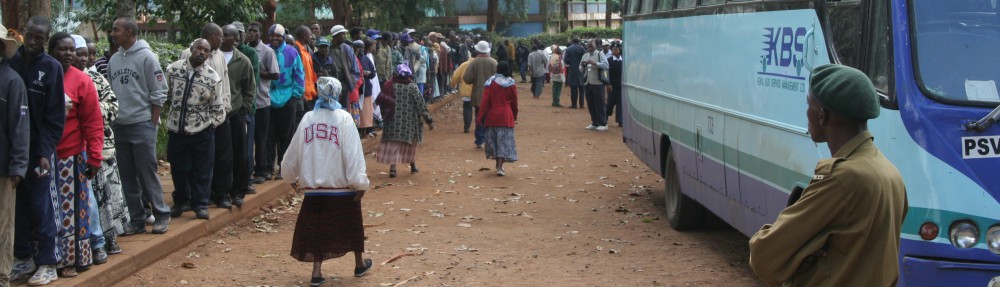
Northeastern Kenya–high levels of child malnutrition continue to exist in spite of better rains recently according the the World Food Program. The previous drought reduced herds, so pastoralists continue to lack meat, milk and blood. Likewise, general underdevelopment from lack of health care facitlities, lack of roads and transportation, and lack of education (mothers’ illiteracy contributes to lack of knowledge about proper nutrition for children). A report today on IRIN entitled “Instability Without Borders” explains that the spillover effects from instability and al-Shabaab control of bordering areas of Somalia has driven some aid organizations out and greatly driven up costs for others, reducing the ability for service delivery to address these problems. While the border is porous to the flow of small arms and raids, it appears from the report that Kenya’s police high police presence has helped prevent major escalations on the Kenyan side of the border, the threat from previous cross-border kidnappings and raids, along with the general insecurity and prevalence of arms has resulted in a daily 12-hour curfew and a standard requirement that all travel include armed escort and has led many organizations to park their own vehicles and only travel in hired transport.

Record inflows to “Frontier Africa Funds” reflect continuing “mainstreaming” of global investment in Africa

Reuters reported record inflows of $660M into African regional equity funds in the past 12 months, with positive inflows in 51 of the 52 weeks based on a report from EPRF Global in Washington. Not large numbers on a global scale, but definite confirmation of the arrival of Africa into the mainstream of emerging markets equity investment.

Certainly this number is much smaller than aggregate aid flows of various types, but it also represents only public equity funds and does not capture the scope of overall international investment, particularly private equity. How this fits in to the overall development picture is a worthy subject of study. It surely creates opportunities for growth and reflects some underlying optimism in future governance and stability at least in some major markets.

One question of course is competition among developed countries for deals in a growing African market. Here is a fascinating story from Uganda’s “Independent” entitled “German, US, UK envoys fight over EC [Electoral Commission] tender”.

“Political Stability”, “Investor Confidence” and meaningful elections in East Africa

Wednesday’s Nairobi Business Daily features a story headlined “Political stability lifts investor confidence in East Africa“:

Easing political tensions and the ongoing search for uniform governance standards in East Africa has lifted business confidence in the region and is encouraging investments that could boost employment.

Buoyed by recent peaceful elections, investors in the five EAC member countries said governance based on the rule of law had significantly lowered political risk, creating a stability that has allowed them to engage their expansion gears once again.

Rwanda and Burundi successfully concluded presidential elections last month, a trend that has been crowned by Kenya and Zanzibar early this month when they conducted peaceful referenda.

“It is satisfying for investors — and regional blue chip players in particular — when elections are peaceful the way we are witnessing them,” said Mr Peter Munyiri, KCB deputy CEO in charge of group business.

The bank, which has just raised Sh12.5 billion from its highly publicised rights issue, says it will use part of the money to mobilise savings and create a large pool of credit across the region, “Certainly the political and sovereign risks in the region set an attractive business environment and KCB can comfortably lend more money, with the region also expected to become the home for lots of overseas funds looking for investment destinations,” said Mr Munyiri.

It is certainly striking to see the presidential elections in Rwanda and Burundi labeled as “successful” when in both cases the sitting administrations essentially disqualified the opposition and conducted elections without meaninful competition–in Burundi without even a token alternative on the ballot. The notion of a security tradeoff between “stablity” and democratic political openness is certainly a familiar refrain in East Africa but it is rare to see a statement this explicit of an attractiveness to investors of meaningless but peaceful voting.

A follow up question is whether investors care about the political reforms so fervently hoped for as a result of the safe passage of the new Kenyan constitution, or is it just that fact that the vote was held without significant violence? Each of these countries presents a very different situation in many respects: at one extreme, Rwanda is relatively underdeveloped and poor outside Kigali and is hugely dependent on aid, but gets high marks for having relatively little corruption, and rapid progress in some areas of development while seeming to move further away from political openness. Kenya has had fairly robust overall growth most years post-Moi and receives a relatively small amount of its direct government budget from official assistance; at the same time it remains notoriously corrupt, has huge inequality and radically uneven development. In recent months, Kenya reformed its election commission and midwifed a new constitution that 90% of Kenyans reportedly are glad to have passed. So the trend on democracy in Kenya seems to be running now in the opposite direction from Burundi and Rwanda.

With security concerns rising with the latest bomb blast killing 6 MPs in Mogadishu and the July bombings in Kampala, how does the “investor confidence” factor play out in assessing the risks that are worth taking to support democracy in Uganda with elections coming in February?

The President’s Electoral Commission–is Uganda travelling the road Kenya took to violence in 2007?

“Electoral Commissions, Africa’s New Kingmakers” from The Independent in Kampala.

During the immediate weeks of violence and uncertainty in Kenya following the December 2007 election I had lunch with a politician from the western part of the country. This person had been in parliament but both lost out for re-election as a PNU candidate and was personally impacted by the violence. The story of the election as related from the perspective of this person for whom I have great respect was that as soon as President Kibaki acted unilaterally to appoint his own choices to fill the seats on the Electoral Commission of Kenya in the fall of 2007, the opposition figures in the area represented by this MP felt that it was clear that Kibaki and his team were committed to rigging the elections to stay in power and all bets were off. From that point, this person felt that their own chance for a fair election in an opposition oriented district were also taken away.

An election commission appointed by one candidate, a sitting president running for re-election, is a recipe for serious trouble. In Kenya the mechanism was in place through the 1997 Inter-Party Parliamentary agreement for collaborative appointment of the ECK membership. Unfortunately, the agreement had not been given binding force of law. When Kibaki chose to ignore the prior agreement and acted to fill the ECK with his own people, Western donors in public consoled themselves with the notion that the Kibaki’s last minute reappointment of the ECK chairman Samuel Kivuitu, who had acquited himself appropriately in the 2002 election and the 2005 referendum (both landslides) would be enough to save the day. And Kibaki had not technically violated the letter of the law in making unilateral appointments.

Ultimately, we now know, Kivuitu was sidelined to allow the manipulation of the vote tallies, and was successfully pressured to go ahead and declare Kibaki the winner when he admittedly did not know who had won and to facilitate an extraordinary “quickie” swearing in of Kibaki that Sunday evening at State House.

In the case of Uganda, we have the determination of the Ugandan Supreme Court that there were serious problems with the last election in 2006. Althought the Ugandan Electoral Commission has just issued a statement denying incompetence and asserting that past problems have been addressed, this message on behalf of “the government” does not attempt to argue that the Commission is substantively independent from the incumbent administration.

What real excuse has Museveni offered to reject the concerns of donors to reform the Commission to secure a level playing field for 2011?

Freedom and Razor Wire, Kampala

People in Kampala and towns around Uganda move past signs and slogans of this type going about their business every day.

Freedom of expression is your right

Tough Neighborhood

As the Referendum campaigns have by Kenyan election rules ended today, it’s a good time for a bit of catching up on the challenges in the region.

With elections coming up on August 9 in Rwanda, Mike Plantz has a new piece from Chatham House “Rwandan Election: Doubts About the Poster Boy”

For similar conclusions on Somalia and Somaliland from different sources, try “Somalia’s Rough Road to Peace” from Abena Ampofoa Asare in Pambazuka and “Ballots and Bullets: The Tale of Two Somalia’s” from J. Peter Pham, published everywhere but here is the Somaliland Press version. I had also missed Bronwyn Bruton’s op-ed in the NY Times (HT to the Sahel Blog).

On Uganda, with elections upcoming early next year, the U.S. lobbyists representing Museveni, the Whitaker Group (the group that picked up Jendayi Frazer when she left the State Department) has moved out of “public sector” work and is wrapping up their contract, seeing more opportunities on the non-public side.

Carson in Uganda on political risks as activists arrested

Daily Monitor: US warns against loss of political freedoms:

This followed countrywide arrests by police yesterday of reported 80 opposition activists who, operating under the National Alliance for Free and Fair Elections, tried to demonstrate in demand for credible 2011 polls. The government last evening defended the police clampdown on grounds that “the terrorist threat is still with us.”

Government’s defiance
Information Minister Kabakumba Masiko said: “We are not going to compromise our security for anything, no. As NRM government, we are encouraging all types of freedoms and we shall protect and promote rights of all citizens. But nobody is going to use that as a pretext to terrorise Ugandans.”

The US diplomat, who once served as US ambassador here, yesterday made a guarded U-turn on his 2005 criticism that President Museveni, by removing constitutional presidential term limits, was turning into a dictator like Zimbabwe’s Robert Mugabe.

The latest in the Rift Valley Railroad saga–how business is done in Kenya

New status in Rift Valley Railroad saga: Transcentury connections win the day.

Jaindi Kisero in The East African

“High-profile Kenyan investment house, Transcentury Ltd has earned a guaranteed position of chair of the board of the newly restructured Rift Valley Railways Investments, under a new deal struck with wealthy Egyptian private equity firm, the Citadel Group.

Rift Valley Railways runs the 1,200-kilometre metre gauge between Mombasa and Kampala under a 25 – year concession. The arrangement is spelt out in a new shareholders agreement with Citadel, which has been seen by The EastAfrican.

Hammered after months of lengthy negotiations, the agreement is largely viewed by insiders as representing a tactical retreat by the wealthy Egyptian equity fund to accommodate the interests of the politically- influential local shareholders of TransCentury.”