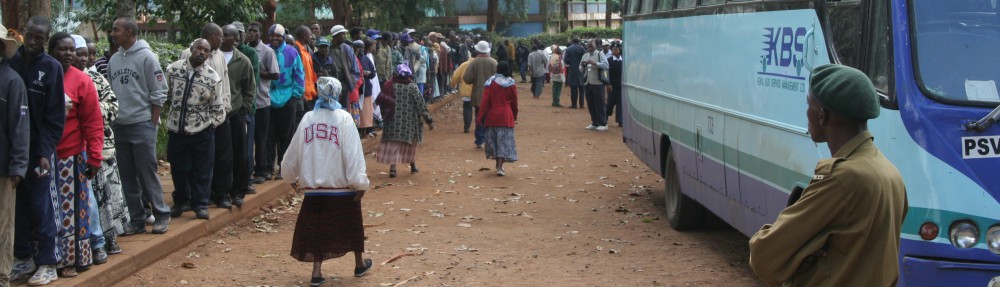
Meles Claims Win in Ethiopia–Preliminary Results Due 9am EDT

Daniel Howden in The Independent with early coverage: “Meles claims election win in Ethiopia despite poll fraud claims”.

The BBC reports that EU observers were “encouraged” by high turnout and relative calm, but will investigate complaints of irregularities. Reuters says preliminary results due at 1500 GMT Monday.

Links from this week

Needed: “A stronger resolve on Kenya’s Internally Displaced Persons” from KenyaImagine.

From New York, Kevin Kelley reports in the Saturday Nation that accused Times Square bomber Faisal Shazhad, cooperating with authorities, has said that he was inspired by Sheik Abdullah al Faisal, the Jamaican deported from Kenya in January.

Ngugi wa Thiong’o interviewed by Reuters on release of the first volume of his memoir “Dreams in a Time of War”.

VOA Special Report: “Ethiopia Votes”. You may remember that Ethiopia started jamming the VOA Amharic service back in March in the lead up to the elections.

At the Economist: “Ethiopia’s elections: Five more years–the results are not in doubt, only the prospects of millions of impoverished and hungry Ethiopians”

“More Repression, Less Democracy, No Real Outcry” from Africa Works. “Rule of law is not enough in lands where repression is a cost of doing business.” Also, if you missed it a good piece titled “The Next Empire” by Howard W. French in the May Atlantic, traveling to observe the Chinese in Africa.

GAO says U.S. Dept. of Defense needs to determine future of Horn of Africa Task Force; report highlights challenges regarding coordination and effectiveness of civil affairs/development work

Government Accountability Office release.

The full 45 page report is here.

When we met with CJTF-HOA officials in October 2009, they estimated that, in addition to other tasks, about 60 percent of the task force’s activities focus on civil affairs projects. To conduct these quick, short-term projects, CJTF-HOA has established small civil affairs teams (for example, five or six personnel) who deploy to remote areas to engage the local communities and perform activities such as medical and veterinary care for local communities. While deployed, the teams generally nominate project proposals based on assessments they conduct as to what the communities need. The proposals are reviewed for approval by USAID, the embassy, CJTF-HOA, and AFRICOM prior to execution. During our October 2009 visit to the U.S. embassy in Ethiopia, we learned of several project proposals from civil affairs teams deployed in the country, ranging from under $10,000 to about $200,000—including the construction of a teaching farm, school renovations, training for local mechanics,

construction of an orphanage, and renovation of a bridge. None of the project proposals in Ethiopia had been approved at the time of our visit. CJTF-HOA officials told us that the project approval process can be lengthy, potentially lasting an entire year. This is generally longer than the tour rotations of some CJTF-HOA civil affairs team personnel.

. . . .

Furthermore, CJTF-HOA is coordinating with the Navy and coalition partners in CENTCOM’s Coalition Task Force 151, which conducts maritime security operations to protect shipping routes in the Gulf of Aden, Gulf of Oman, Arabian Sea, Red Sea, and Indian Ocean. AFRICOM has also established a socio-cultural research and advisory team on a semipermanent basis at Camp Lemonnier. The team consists of one to five social scientists who conduct research and provide cultural advice to the command.

. . . .

Other CJTF-HOA proposed activities may not consider the full range of possible effects or may not be clearly aligned with AFRICOM’s mission. For example, Department of State and USAID officials we contacted at one U.S. embassy expressed concern that some of the activities that CJTF-HOA had previously proposed, such as building schools for the partner nation, did not appear to fit into a larger strategic framework, and said that they did not believe CJTF-HOA was monitoring its activities as needed to enable it to demonstrate a link between activities and mission. These officials told us that instead of leveraging long-term data to guide future activity planning, CJTF-HOA may be proposing activities without considering the full range of potential consequences. The embassy officials cited a past example where CJTF-HOA had proposed drilling a well without considering how its placement could cause conflict in clan relationships or affect pastoral routes. Officials at other embassies described similar problems with CJTF-HOA proposals. To mitigate such issues, U.S. embassies have steered CJTF-HOA toward contributing to projects identified by USAID, which are better aligned with embassy and U.S. foreign policy goals. Moreover, some CJTF-HOA activities appear to be sporadic, short-term events that may not promote sustained or long-term security engagement. Continue reading

Friday links

“Are the private sector and civil society natural enemies?”–insightful piece from the Nation Groups’s Pan-African Media Conference by Muthoni Wankeki in Pambazuka.

Meanwhile, a new survey reported in Business Daily indicates that Kenyan business leaders are worried about a repeat of election violence.

“In Defense of the Voice of America” by Alemayehu Mariam in Pambazuka, reprinted from Huffington Post.

Human Rights Watch reports on pre-election environment in Sudan and Ethiopia, says April and May elections unlikely to be “free and fair”. Ethiopia: Repression Rising Ahead of May Elections. Sudan: Government Repression Threatens Fair Elections. Daily Nation story here.

And for the first time a senior SPLM leader has called for Bashir to face the ICC charges against him in The Hague.

“Offbeat”

“Sudan’s capital sways to hip hop”

On Safari in Chanute, Kansas

Ethiopia’s Zenawi says he will authorize jamming of Voice of America Amharic broadcasts, comparing VOA to Radio Mille Collines

Dysfunctional governance in Kampala–“‘The Bastard Child of Nobody?’–Anti-Planning and the Institutional Crisis in Contemporary Kampala”

“Ethiopia: Democracy or Stability”

Lauren Gelfund writes from Nairobi in World Politics Review on the current situation in Ethiopia ahead of elections and the issues facing Western donors. Note the venue at Nairobi’s Habesha restaurant, a popular expat haunt and one of my family’s favorites.

Corruption and Geopolitics

The Economist has highlighted the ongoing competition in Africa, including in Kenya, between Iran and Israel: “A Search For Allies in a Hostile World“.  In the East Africa/Greater Horn region, Sudan is Iran’s key ally and Ethiopia is Israel’s.

With diplomatic battles approaching over sanctions for Iran’s nuclear program in the context of all of the existing competition for influence, resources and business opportunities, the leverage for existing African players to extract corrupt rents are likely to increase. The Kenya Publicity Tour to Washington last week invited the US to once again move away from a strong stand on corruption and move on with greater government to government support and incentives for investment without waiting to see actual reforms in light of the 2007 election debacle.

To date we haven’t seen accountability for the multi-year theft of public education funds that triggered first the UK and then the US to freeze a small amount of education assistance.  While the PM and others are pressing for the resignation of the Education Minister, the funds have gone missing each year of the first Kibaki Administration as well, as indicated in the report from Transparency International.  Removing the current minister (who presumably would remain a Member of Parliament and, if patterns hold, soon enough get another ministerial appointment in another agency) is not a substantive answer.

Likewise, action on the Rift Valley Railroad concession remains elusive and deferred.  And accounting for the “Internally Displaced Funds” associated with the “Internally Displaced Persons” from the post-election violence remains outstanding. And the bills continue to come due, literally, from the Anglo Leasing scandal (you may remember this as the scandal that was supposedly caught in time to prevent major loss to the taxpayers–doesn’t seem to be working out that way).

Key players, at least, in the US government supported Kibaki’s re-election in 2007 in spite of the corruption concerns. Is Kenya better off now? What US interests were actually advanced? In particular, how is the situation in Somalia better now than it was in the fall of 2007? Let’s “don’t get fooled again” and maintain a focus on helping Kenyans who share the values to which we aspire to build a stronger and more prosperous country–by maintaining a strong and steady focus on improved governance and fighting corruption. We have a bad record on the geopolitical gamesmanship in Kenya, in my estimation, and values aside, I don’t think it has worked very well.
Updated: Some other African presidential election developments

In Sudan, BBC reports that former Prime Minister Sadiq al-Mahdi is entering the April race for President against Bashir.  Al-Mahdi promises action on Darfur.  This should be interesting.  BBC’s take is that this raises prospects for the legitimacy of the election (in which the SPLA chose not to offer its strongest challenge).  Maybe.  It might also raise the stakes for Bashir–is he willing to lose an election and leave office based on how the votes are actually cast?  While under ICC indictment?

Across the continent, perhaps the West’s and America’s very favorite African president has–wait for it–announced that she is running for a second 6 year term in next year’s election despite having pledged originally that she would only serve one term.

Good business for Johnson-Sirleaf’s American lobbyists and consultants anyway–hope it is good for Liberia.  Perhaps this is a positive development from a gender equality angle anyway:  maybe women are just as inclined to hang on to power, and just as disinclined to leave the presidency as men.

When Liberian President Ellen Johnson-Sirleaf was running for office, she boldly told this programme that once elected into office, she would only serve one six year term.

But a week in politics is a long time and 5 years is an eternity.

Yesterday, president Johnson-Sirleaf made a major U-turn when she announced that she will seek a second six-year term in next year’s elections.

And The Economist reports that “worries about Ethiopia’s election, due in May, are growing” while noting that “most Western governments seem keen to downplay Mr. Mele’s human-rights record, hoping his re-election will keep his country stable.”

Human Rights Watch–New World Report/Kenya Chapter

From the new Human Rights Watch World Report. Note: “The police regularly targeted civilians for killings and other violence in 2009, as in previous years.” http://www.hrw.org/en/world-report-2010/kenya

The Uganda chapter is here, and the Ethiopia chapter is here.

In the Quicksands of Somalia | Foreign Affairs

In the Quicksands of Somalia | Foreign Affairs.

I highly recommend this article which I have referred to several friends.  The author was the program officer at the National Endowment for Democracy who worked with our Kenya program funding and I met her briefly on the way to Africa in June 2007.  From my perspective, she seems to have it right and I would simply add that the consequences of the US support for first the invasion by Ethiopia, and then the African Union force to try to uphold the Transitional Federal Government have included the US incurring debts to be paid to other governments in the region, including Kenya and Uganda.