Carter Center releases final report on Kenya 2017 elections, finds “major setback in democratic development”, urges momentum on IEBC reform, transparent technology

Here is the link to the Carter Center press release and the full report at 172 pages is here.

I am still reviewing the full report, but in summary:

Kenya’s 2017 general electoral process was marred by incidents of unrest and violence throughout the extended electoral period and by harsh attacks by top political leaders on electoral and judicial authorities that seriously undermined the independence of the country’s democratic institutions and the rule of law. The confrontational tactics and actions of Kenya’s political leaders polarized the country and exposed the deep tribal and ethnic rifts that have long characterized its politics. Regrettably, the elections represent a major setback in Kenya’s democratic development.

As far as pre-election deficiencies the report notes the late appointment of the IEBC Commissioners leaving inadequate preparation time overall, as well as highlighting a voter register that was improved but still had major inadequacies.

The report, while noting the ELOG parallel sample results as consistent with the IEBC’s announced results, emphasizes the problems with post- voting results transmission and announcement (in the context of that confrontational rhetoric and polarized environment):

Unfortunately, for unexplained reasons, the IEBC did not utilize the full seven-day period provided by the law to consolidate and post all the official polling station results forms. Instead, the IEBC hastily declared the final presidential election results on Aug. 11, just three days after election day, based on the constituencylevel results forms, and prior to the receipt of all polling-station level results forms. Worse still, election authorities failed to ensure that parties had timely access to official polling-station level results in the days following the announcement of official results, which made it impossible for parties and observers to fully verify and cross-check the results against their internal data and reports in time to include any key evidence in court petitions.

In its press release the Carter Center recognizes the opportunity presented by the decrease in tension under the “handshake” but urges momentum on needed reforms and recommendations spelled out in the report. The existing IEBC was to host a “national stakeholders” conference this week with over 300 invitees with some of these areas touched on in the agenda, but I cannot imagine much bankable progress until there is a full commission and resolution of procurement fraud questions raised by a finalized internal audit report.

As the Center cautions:

Recent political posturing over the 2022 presidential election and the upcoming national census and boundary delimitation process raises concerns that an electoral reform process could be delayed.

To move electoral reform forward, parliament should move swiftly to ensure that the requisite number of IEBC commissioners are in place. Meaningful reform cannot be implemented without a fully functioning commission.

“The great observer gamble” is a “must read” on the Zimbabwe election and international election observation

An important election and election observation drama is playing out now in Zimbabwe, and “The great observer gamble” (free feature) in Africa Confidential is the key explainer.

Subhead: “After an eight-month charm offensive wooing bankers and diplomats, the government is failing the legitimacy test”

Please follow the link and read in full.

In this case the U.S.-funded joint NDI-IRI international observation mission made a difference in international understanding of the difficult realities of the election in the context of seemingly conclusory approvals from the regional SADC (of which Zimbabwe is a member) and the African Union.

I have no criticism of the NDI-IRI effort and as far as I can tell my old colleagues have upped their game in important ways in this situation from my previous experience in Kenya. At the same time I would note that with the incumbent government already under sanction and not an important U.S. ally, and in a fairly small (in population) country with lots of opposition support in the U.S., this was a case where it was easier to stick to the facts of the vote without getting caught in a diplomatic undertow.

An important question now is how IFES in supporting the Zimbabwe Election Commission will handle the announced election challenge litigation from the primary opposition. With a fraction of one percent margin over the 50 percent runoff threshold and a lot of delay and uncertainty with the central tally (aside from voter register and larger “playing field” issues, this looks quite a lot like Kenya 2013, which I have been looking into through the Freedom of Information Act.

Mnangagwa’s team may have done enough to allow the most enthusiastic business people and governments to step up re-engagement. Much will depend on the strength of the opposition’s case at the election tribunal and the credibility of its handling by the courts.

Africa Confidential

[Update – the judicial challenge has been file. As in Kenya the process is truncated by a 14 day deadline for the court to rule.]

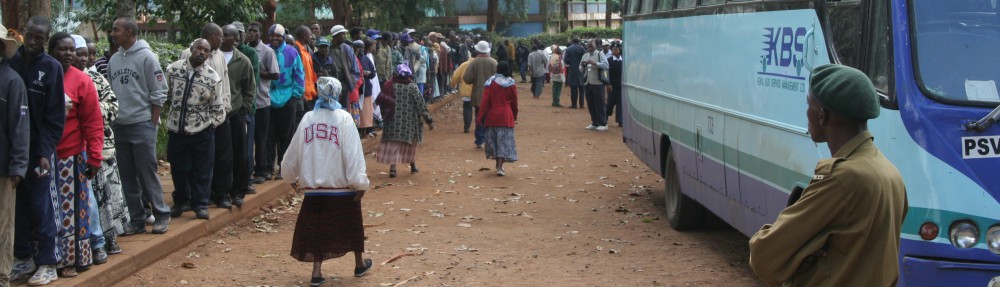
[This is one of my photos from the IRI Kenya 2007 Observation, as we arrived at Olympic Primary School in Kibera, Nairobi. One of the Zimbabwean newspaper sites used a copy of this image with the gentleman on the left cropped out for their Zim coverage.]

With DRC’s Kabila backing substitute candidate this year, time to review international observation experience from 2011 vote

[Updated Aug 9]

The Democratic Republic of Congo stands out as a wealthy country with mostly very poor voters, a fairly poor government, extremely poor governance, high corruption, pervasive political violence, a current humanitarian crisis on a Yemani scale and as a “honeypot” for some of the worst people in the world.

The announcement, at the filing deadline, that term-limited incumbent president Joseph Kabila would not be his faction’s candidate in the upcoming national elections (legally due last year) has generated some relief. See “Joseph Kabila, Congo strongman, will step down after 17 years in power” in the New York Times.

In Congress, Representative Ed Royce, chairman of the House Foreign Affairs Committee, said he approved of Mr. Kabila’s decision — “after 17 dark and bloody years” — to step down.

“Now, deadly government crackdowns must stop so the Congolese people can choose their next president in free, fair and transparent elections,” Mr. Royce said. “Any credible election will allow opposition candidates to run campaigns free from legal harassment, intimidation and physical harm.”

A decent election in December would be a huge “win” for Congolese and for international democracy advocates but sobriety is in order as to whether that becomes a realistic possiblity as the much-delayed date approaches.

At the time of the last election in 2011, Africa democratizers were buoyed by an understood success story in Ghana, the hope of an “Arab Spring”, the lull of violence in Iraq and more generally encouraging environment. As explained in my posts from that time, the U.S.- funded International Observation Mission (conducted by the Carter Center) found the election to fall short of adequacy by the applicable international standards and said so explicitly.

Initially standing up to Kabila over the failures of his alleged re-election and pushing for them to be addressed appeared to be U.S. policy.  If so, we apparently changed our mind for some reason.  Tolerating a bad election then leaves us in a more difficult position with seven years of water under that bridge.  The U.S. has stepped up recently to pressure Kabila to schedule the election, allow opposition and stand down himself.

In this vein, we need to be careful, and transparent, as things proceed to continue to evaluate realistically what is feasible and where we are really able and willing to assist.  In particular, the decision to initiate and fund one or more Election Observation Missions for a vote in these circumstances should involve serious soul-searching at the State Department (and/or USAID).

On the last election:

DRC: “We have to debunk the idea that it is peace versus transparent elections. The idea that lousy elections are going to bring piece is madness.”

Carter Center calls it as they see it in DRC

U.S. and other Weatern donors support review of election irregularities in DRC — offer technical assistance

State Department to Kabila on DRC Presidential Election: “Nevermind”?