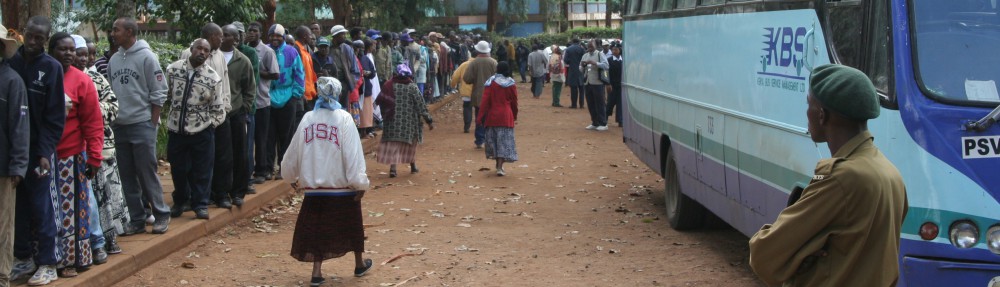
Inter-faith peace efforts in North Eastern Province after Garissa church attack

There are encouraging signs that Kenyans are sticking together in spite of the tensions associated with the Al Shabaab conflict:

Nairobi, Kenya (ENInews). After grenade attacks on a church in northern Kenya blamed on Islamic extremists, religious leaders said they were redoubling inter-faith peace efforts. At the same time, about 100 kilometers away, Christian relief agencies were carrying out humanitarian work in Dadaab, the world’s biggest refugee camp, despite security threats.

Two grenades were lobbed into the East Africa Pentecostal Church compound in the town of Garissa on 5 November, killing two people and injuring five others. The attack has been blamed on al-Shabab militants who are facing a Kenyan military operation in southern Somalia.

“We are alarmed by this blatant attempt by evil forces to drive a wedge between Christians and Muslims,” Sheikh Adan Wachu, general secretary of the Supreme Council of Kenya Muslims told a news conference on 10 November in Nairobi.

Speaking under the auspices of the Interreligious Council of Kenya, he said the militants had hoped to ignite Christians-Muslims violence, but had failed. He said the faiths were united against groups that misuse religion to cause anarchy and would be preaching that message in churches, mosques and temples.

“We have lived peacefully with one another for long. Therefore we choose not to interpret this as religious war,” the Rev. Joseph Mwasya, a clergyman from Garissa said on 8 November at a news conference.

At Dadaab, many agencies have scaled down since October when threats escalated, but the Rev. Eberhard Hitzler, the director of the Department for World Service of the Lutheran World Federation said on 8 November the organization will continue to deliver humanitarian relief at the camp.

“We have not yet the impression that the current situation in Dadaab constitutes a serious crisis, despite the security risks increasing for the organization; so we should set up a team to respond to it,” said Hitzler whose organization is responsible for housing and security in the camp. The 20-year-old settlement now contains more than 460,000 refugees who have fled war, famine and disease in Somalia.

[With acknowledgements to ENInews. ENInews, formerly Ecumenical News International, is jointly sponsored by the World Council of Churches, the Lutheran World Federation, the World Communion of Reformed Churches, and the Conference of European Churches.]

Are we watching the early stages of a broader conflict in the Greater Horn of Africa?

Now that Kenya has initiated a full-fledged ground war in Southern Somalia, the obvious and necessary question becomes “what are the near term unintended consequences?”. It is hard to be too clear about what is “unintended” because Kenya’s intentions, on either the military or the political side, are not altogether clear in the first place, but here is one possibility that few would desire:

Simon Allison posits in South Africa’s Daily Maverick: “Kenya’s Somali raid threatens to explode into regional conflict”, noting Kenya’s confrontation with Eritrea regarding alleged arms flights to supply Al Shabaab:

. . . This begs the question: what does Eritrea have to gain by funding a Somali Islamic fundamentalist militia?

The answer lies neither in Somalia nor Eritrea, but in the country that looms large between them: Ethiopia. Ethiopia is Eritrea’s nemesis, having occupied Eritrea for decades until Eritrea achieved its modern independence with a hard-fought and vicious civil war. But Eritrea can’t relax, ever, because it has the one thing that land-locked Ethiopia wants more than anything else in this world: a port. And rapprochement is not the style of Eritrea’s slightly mad President Isaias Afwerki, whose militaristic foreign policy has left Eritrea in the international wilderness.

Instead, Afwerki has fomented instability in Somalia, hoping the chaos next door will keep Ethiopia and its military occupied. Ethiopia is deeply involved in the Somali conflict itself, and its troops make frequent cross-border raids to chase rebels who are agitating against the Ethiopian government in the ethnically Somali province of the Ogaden. As International Crisis Group’s Somalia expert Rashid Abdi explains: “Eritrea definitely has been supportive of Al Shabaab for a long time and this support is not ideological. It’s essentially meant to counter Ethiopia’s influence in Somalia.”

So while we don’t know if it really was Eritrea sending planeloads of weapons to Al Shabaab during the current conflict with Kenya, this nonetheless represents the first step in turning what is a domestic conflict into a larger, regional issue. In a way, it doesn’t really matter if Eritrea was involved or not, as long as Kenya thinks they were, they will be implicated.

Kenya has said it will pursue its claims against Eritrea, saying that it has a “series of options” to deal with them. It’s unclear what these options are, but it’s unlikely that any of them will ease tensions in the Horn of Africa. And whenever Eritrea gets involved in something, it’s not long before Ethiopia follows suit – on the opposite side, of course. So what started out as a Somali issue might just turn into something much, much bigger, not forgetting that Uganda and Burundi are already involved as they are the only countries to have contributed troops to the African Union mission in Somalia.

Kenya hoped its Somali incursion would be quick and easy. But its troops are getting bogged down in the mud and are struggling to even find the enemy. And on the diplomatic front, as the incursion starts looking more and more like an invasion, other countries are inevitably getting involved, making it even less likely that Kenya can extricate itself from Somalia quickly or easily.

U.S. not participating in Kenyan offensive in Somalia, says State Department

Contradicting the previous reports from Kenyan military spokesmen, the U.S. responded yesterday as reported by the Voice of America:

The United States has denied taking part in Kenya’s operation against al-Shabab militants in southern Somalia.

A U.S. State Department release said Tuesday that the U.S. has helped Kenya build its border defense capacity for years, but added, “The United States is not participating in Kenya’s current operation in Somalia.”

A Kenyan army spokesman said Sunday that so-called “partners” had launched airstrikes against al-Shabab, and indicated that one of those partners was the United States.

The Kenyan army spokesman also said the French Navy had shelled the al-Shabab stronghold of Kismayo.  The French navy denied that claim on Monday.

Kenya sent troops into Somalia this month in pursuit of al-Shabab militants, which it blames for a series of cross-border kidnappings.

Somalia’s president said Monday that he opposes the Kenyan intervention.  President Sheikh Sharif Sheikh Ahmed said only African Union troops can operate legally in Somalia.

That drew a sharp response from a top Kenyan lawmaker, Deputy Speaker of Parliament Farah Moallim, who told VOA Somali Service Tuesday that Kenya has a right to defend itself.

.  .  .  .

As reported by the BBC, France, on the other hand, has said that it will provide logistical support to the Kenyan forces–while denying reports that its Navy was involved in shelling Al-Shabaab positions.

U.S. Drones and TFG Join in Kenyan Offensive; Embassy Warns Americans in Kenya

From the Daily Nation:

Al Shabaab militants were on the back foot on Saturday evening as they faced heavy bombardment from multiple fronts from a combined force of Kenyan troops, US drones, African Union peacekeepers and Transitional Federal Government fighters.

Reports from the battlefront indicated that Kenyan troops were advancing towards four al Shabaab-controlled towns as they launched a final push to capture the Kismayu port and Afmadow in Central Jubaland.

There was progress on the diplomatic front, too, when the Intergovernmental Authority on Development (Igad) member states endorsed the military offensive against the militants during a special conference held in Addis Abba Ethiopia on Friday.

The Igad Council of Ministers urged the United Nations Security Council to impose a blockade on Kismayu, a move which will effectively cut off billions of shillings collected by the militants to fund their insurgency.

A statement from the military said Kenyan security forces were advancing towards Burgavo town in southern Somalia after capturing Oddo on Friday. (READ: Kenya targets al Shabaab’s lifeline)

Another group was marching towards the town of Badade from the direction of Kolbio which they conquered on Friday. The troops had earlier bombed areas around Munarani near Oddo from the air, flattening an al Shabaab command centre.

“US Warns of Imminent Threat in Kenya” from Reuters in The Standard, indicates that the U.S. Embassy in Nairobi Saturday issued a warning with the usual language regarding risk to Americans in Kenya from reprisal attacks on prominent facilities or places known for concentration of Westerners, and indicated that official American travel to Kenya would be curtailed.

Will Kenyan Military Engagement in Southern Somalia Disrupt Kenyan Reforms?

Readers will undoubtedly be following the news of the Kenyan military moving to challenge al-Shabaab well across the border in southern Somalia.  I don’t feel that I have anything particularly profound to add to what is readily available on the direct events, but I did want to suggest some questions that need to be considered as to how this military action will interact with democracy and governance at a critical time in Kenya.

In Nairobi, three names have now been passed to the President and Prime Minister for consideration for nomination to chair a new Independent Electoral and Boundaries Commission.  Preparations for the next election are running behind as is the overall “reform agenda” including other key aspects of implementing the new Constitution.  There is progress in some areas, “backsliding” in others, and time is short.

The threat of terrorism by Islamist extremists has been a part of the fabric of Kenyan governance and international relations for a long time now, especially since the 1998 Embassy bombings.  Al-Shabaab has been willing to starve civilians and commit a variety of atrocities on Somalis, and engaged in external terrorism in Kampala last year.  Kenya has a right to be concerned and a right and obligation to protect its citizens and territory.  At the same time, it would be naive not to recognize the potential for this new military action to distract and divert resources from other critical work that needs to be done within the Kenyan government.

Likewise, this new environment will present a big challenge to the United States, and perhaps to the UK and EU in supporting the reform process.  We went through this before in 2006 and 2007.  Compare U.S. criticism of corruption in the Kenyan government before and after the Ethiopians invaded Somalia in December 2006.  (I have no evidence of any correlation between the dramatic change in tone on corruption and events in and relating to Somalia–and no one has ever suggested one to me.  But then, no one has really offered any other clear explanation either, so I have had to wonder about this.)  Heightened military interaction with Kenyan forces could in theory make it harder for the U.S. to push consistently for reforms in Kenyan governance or lower reforms on the list of U.S. priorities.  To me, reform is the best medicine to fight the threat of terrorism and regional instability, and terrorists will always have access to Kenya as long as key pieces of the Kenyan governance structure can be purchased.  But sometimes it is hard for us to keep our eye on that ball when there are challenges from immediate disruptions.

An then there is the upcoming election itself.  If it was ultimately “best not to know” who won in 2007, how much risk can be tolerated to try for a freer and fairer Kenyan election in 2012?

East Africa ranks fourth of five regions in 2011 Mo Ibrahim Foundation Governance Rankings–Tanzania, Uganda and Kenya each move up from 2010

2011 Governance Rankings for East Africa
Rank (of 53-followed by raw score)

4th Seychelles 73
13th Tanzania 58
20th Uganda 55
23rd Kenya 53
25th Rwanda 52
29th Djibouti 49
31st Comoros 47
34th Ethiopia 46
37th Burundi 45
47th Eritrea 35
48th Sudan 33
53rd Somalia 8

Here is a link to a summary brochure of the East Africa findings.

Here is my post from last year’s release.  Tanzania has moved up from 15 to 13, Uganda from 24 to 20 and Kenya from 27 to 23.

Famine Aid for Somalia/Horn of Africa this morning

This morning at church, on a beautiful, sunny, cool day in coastal Mississippi, we had a “packing event” for international food aid for Somalia through the group “Stop Hunger Now”.  We also donated $5,000 through special offerings collected by our youth.  We have done these events before, but our minister was aware of this crisis now and called to say that we wanted to respond.

Stop Hunger Now is an international hunger relief agency that has been fulfilling its commitment to end hunger for more than 12 years. Since 1998, the organization has coordinated the distribution of food and other lifesaving aid to children and families in countries all over the world.

Stop Hunger Now has provided more than $70 million dollars worth of direct aid and 34 million meals to 72 countries worldwide.

Stop Hunger Now created its meal packaging program, in 2005. The program perfected the assembly process that combines rice, soy, dehydrated vegetables and a flavoring mix including 21 essential vitamins and minerals into small meal packets. Each meal costs only 25 cents. The food stores easily, has a shelf-life of five years and transports quickly.

Stop Hunger Now works with international partners that ship and distribute the meals in-country. Stop Hunger Now primarily ships its meals to support school feeding programs, but also provides meals to our in-country partners for crisis relief.

The packaging operation is mobile, (i.e. it can go wherever volunteers are located), and can be adapted to accommodate as few as 25 and as many as 500 volunteers at a time. One SHN packaging event can result in the packaging of more than 1,000,000 meals or product servings. The use of volunteers for product packaging has resulted in an extremely cost-effective operation while, at the same time, increasing awareness of global hunger and food insecurity issues across a broad cross-section of the US population.

Here is more information about the work of Stop Hunger Now in Somalia and Kenya.

David Axe on “America’s Somalia Experiment”–a timely reminder of policy in the Horn of Africa in 2007-08

David Axe on “America’s Somalia Experiment”  this week in The Diplomat:

The complex US-led intervention in Somalia, a decade in the making, represents offshore balancing at its most potent and urgent. The Libyan rebellion was outside the United States’ core interests. For Washington, intervening in Libya was optional. But Somalia, a failed state since 1991 and an al-Qaeda safe haven, represents a direct threat to the United States, and indeed has inspired the first American suicide bombers.

If offshore balancing, with its emphasis on air and sea power and proxy armies, is to define the US strategic approach to Asia and the Pacific, it first must succeed in Somalia.

For advocates of the strategy, there are reasons for hope. US offshore balancing in Somalia came together gradually, almost by accident, as separate interventions chased the converging problems of famine, terrorism and piracy. Today, this increasingly unified US effort seems to finally be bearing fruit, as American-supported foreign armies rapidly gain ground against al-Qaeda-affiliated Islamist fighters.

However, sceptics too might find ammunition in the United States’ Somalia strategy. For while current US efforts in Somalia have managed to avoid a major ground-force deployment – and  indeed have been essentially bloodless for Washington – they have at the same time failed to bring a speedy end to the country’s crises. The recent territory gains are encouraging but hardly decisive – and certainly reversible.

.  .  .  .

The ICU didn’t explicitly advocate terrorism, and there were probably only a handful of al-Qaeda operatives hiding out in Somalia at the time. But that nuance was lost on the George W. Bush Administration. Washington pledged support for the Ethiopian attack, including ‘intelligence sharing, arms aid and training,’ according to USA Today.

With this backing, plus air cover provided by US AC-130 gunships and carrier-based fighters and assistance on the ground by US Special Forces, the Ethiopian army launched a Blitzkrieg-style assault on Somalia in December 2006.

Ethiopian tanks quickly routed the ICU’s lightly armed fighters. ‘The Somalia job was fantastic,’ Abu Dhabi Crown Prince Sheikh Mohammed bin Zayed Al Nahyan told then-US Central Commander boss Gen. John Abizaid in 2007.

The Bush Administration agreed with that assessment, at least initially. And the proxy approach to African security challenges quickly became central to Washington’s policy for the continent. In 2007, the Pentagon formed a new regional command called ‘Africa Command’ to oversee operations in most of Africa.

.  .  .  .

In Somalia, the Ethiopian invasion and subsequent two-year occupation only served to rally the country’s Islamic extremists. Al Shabab coalesced from the remains of the ICU’s armed wing and launched a bloody, and surprisingly popular, insurgency against the Ethiopians.

Also targeted: the UN- and US-sponsored Transition Federal Government, formed under the protection of the Ethiopians, plus the new African Union peacekeeping force composed mostly of Ugandan and Burundian troops and funded by the United Nations and Washington.

Al Shabab also strengthened ties with al-Qaeda, which had sent operatives to advise clan forces during the 1993 Battle of Mogadishu and, more than a decade later, still maintained a small presence in Somalia. The al-Qaeda-Al Shabab alliance helped Al Shabab pull off a twin suicide bombing in Kampala, Uganda, on July 11, 2010 that killed 74 people.

.  .  .  .

US support for the peacekeepers and the TFG represents the proxy portion of Washington’s offshore balancing in Somalia. Naval patrols, Special Forces raids and strikes by Unmanned Aerial Vehicles round out the strategy. At first, however, the main air and sea initiatives weren’t directly tied to the proxy fight on the ground.

In parallel with its support for Ethiopia’s attack on Somalia, the Pentagon in 2006 was in the process of standing up an East African counter-terrorism complex anchored by secret bases reportedly in Ethiopia and Kenya. From there, US Special Forces and armed drones struck at terrorist targets in Somalia, occasionally in cooperation with naval forces.

In 2007, Special Operations Command aircraft launched at least two helicopter raids on al-Qaeda and Al Shabab operatives in Somalia. On no fewer than three occasions in 2007 and 2008, commandos spotted targets for US warships firing Tomahawk cruise missiles at Somali targets. Some of the same warships help make up Combined Task Force 150, a US-led international naval force assigned to intercept arms shipments bound for Al Shabab and al-Qaeda in Somalia.

“The Queen of Khat”, Somaliland, and the Future of Agricultural Trade?

A “must read” this morning on culture, trade and agriculture in the Horn of Africa, from Phillip Hedemann in Die Welt translated at Worldcrunch–read the whole thing, but here are some excerpts:

For many Africans khat is a stimulant drug that also stills hunger pangs. But the world’s biggest seller of khat doesn’t fit the typical profile of a drug dealer.

In Somaliland, not a lot works. Somaliland is a republic in the north of Somalia, which, although it declared itself a sovereign state, is not internationally recognized as such. But one thing you can count on here: Suhura Ismail’s trucks, driven at breakneck speed, arriving as regular as clockwork every night on the unpaved roads. The trucks are delivering khat, a drug that is mostly forbidden in Europe.

In Somaliland, on the other hand, the business is legal – and booming. Up to 80% of all men in the tiny country in the Horn of Africa are addicted to khat. Suhura Ismail says she herself has never tried chewing the bitter leaves. But it has made her rich, and in her homeland, Ethiopia, she is a highly respected entrepreneur.

“I was just voted Businesswoman of the Year,” she says. “And then I got a bill for back taxes amounting to 48 million Birr (1.9 million euros.) But we’ll figure something out. I have good connections with the Prime Minister.”

The 49-year-old mother of ten is the biggest khat dealer in the world. And although she does have a flashy gold tooth, there is none of the usual baggage about her that usually attends international dealers: no body guards, no fake names, no fear of other drug cartels or the police — though the tax man is a bit of a bother.

Then again, this Ethiopian woman would not describe herself as a drug dealer. The devout Muslim sees herself simply as an entrepreneur. Her family business sells between 30,000 and 40,000 kilos of khat each day.

In the 1990s, when coffee prices fell, many farmers in Ethiopia switched to growing khat. Since then, the drug has become one of the country’s major export goods – and the government of the world’s 12th poorest country wants its share. Ismail brings in foreign currency, or at least she does when she pays what she owes the state, which is 30% of her profits.

.  .  .  .

The girl who used to hawk khat from a roadside stand is now an entrepreneur with more than 1,000 employees, as well as her own airline, Suhura Airways. “In the world khat trade, Suhura is uncontestably numero uno,” says Ephrem Tesema, who wrote a thesis at Basel University on the production, distribution and use of khat. “And in Ethiopia she is thought to control over 50% of the market.”

Ultimately, Ismail’s great breakthrough was in removing the stigma associated with the drug. “She did a lot of PR, so in Ethiopia now the leaves are just another commercial product,” says Tesema.

Suhura Ismail says she would like to expand into Europe, and is hoping that the continent’s biggest market, Germany, will legalize the drug. It’s a country she’s familiar with. When her husband started having trouble with his teeth she flew with him to Frankfurt for dental work. Now, back home, his teeth are again in good shape, and he can return to chewing his daily consumption of the green leaves.

Enough: Menkhaus on Somali Famine–Somaliland, al-Shabaab and TFG

Here are excerpts from  “Q&A:  Somalia Expert Ken Menkhaus on the Famine”, at the “Enough Said” blog (h/t to AidNews)

How are independently governed areas like Somaliland and Puntland faring? I understand the crisis hasn’t been as severe in those areas, but it’s interesting to consider how governance factors in to either prevention or response to the famine.

MENKHAUS: Actually, the drought has been quite severe in the north of Somalia as well, but what is interesting is that the north is generally much more arid than the south. The south has rivers and generally has better rainfall. But the north, despite being more arid and being affected by the drought, has not seen famine. The reason for that is pretty straightforward: There is a social peace, [managed by clan elders]. There is governance. The Somaliland government has been able to maintain a reasonable level of security and stability that has allows for the flow of commercial food, and as the drought hit, for the flow of international assistance. As a result, they have been hosting more and more displaced people from the south.

There have been conflicting reports on whether the militant group al-Shabaab would let aid groups into the most gravely affected parts of Somalia or not. But you’re in touch with people in the region all the time – local sources, aid groups, governmental entities. How has the group’s presence impacted the response?

MENKHAUS: We’re pretty sure that Shabaab is splintering now. The famine has been a source of tension within the organization, and the hope is that we’ll see some breakaway wings again that would say, ‘our people are starving, and we welcome aid.’ It would be very risky for those splinter groups, but desperate times call for desperate measures. That could open some space for aid groups to come in. That’s the last best-case scenario we’ve got left, because right now we have people flooding the Kenyan border, and that creates a massive, long-term refugee crisis that will haunt us.

It’s important to flag the breaking news that Shabaab has pulled out of Mogadishu. We’re still trying to make sense of that – Is it a tactical measure? Do they want to launch more hit-and-run attacks instead? There are a lot of possible explanations, but it could be that the social pressure now is so great that clans are rebelling, that the group is fragmenting and actually being pushed out by local Somali communities. That would be a major break for the famine response. Regardless, Shabaab’s in trouble. [The famine] is just disastrous for this group – by blocking food aid, blocking people from getting out, they have just shredded what little credibility they had left with Somalis and jihadist around the world.

What lessons should the international community take away from this present humanitarian crisis? How should the U.S. government revamp its approach to Somalia or to the Horn more broadly to help prevent crises from continuing to occur in regular intervals?

MENKHAUS: This crisis is a potential opening, both for humanitarian response and for new policy directions on Somalia. The scale of this crisis has forced people to do a fundamental rethink of all of our policies and assumptions.  .  .  .But the broader question is what do we do about governance in this country. Shabaab may be crumbling, but the TFG remains irrelevant and is just a source of massive corruption. I think what we’re going to see over the next year is a rethink about continuing to support the TFG versus finding alternatives. But it’s difficult to get people to think about alternatives when we’ve got such immediate problems.