The Dar Side? Yet another President’s Electoral Commission

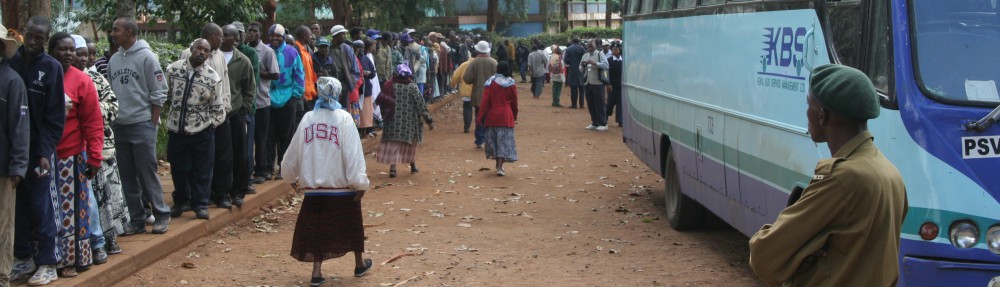
With elections in Tanzania set for October 31, the East African today reported “Fear, anxiety build up ahead of Tanzania’s election showdown Sunday”.

Most commentators, including Africa Confidential have not gone so far as to suggest that President Kikwete of the Nyerere ruling party CCM faced any real likelihood of defeat, but the East African asserts that an opposition surge has resulted in a serious two man race:

An opinion poll by non-government organisation Tanzania Citizens Information Bureau found that if elections were held between September 27 and October 10, Dr Willbrod Slaa, 62, would obtain 45 per cent of the votes cast against Kikwete’s 41 per cent.

Two earlier polls, one by the Synovate group and the other by a University of Dar es Salaam think tank, showed that Kikwete would win with 61 per cent and 71 per cent respectively.

Analysts say that in the eyes of the public, CCM has gradually deviated from its founding values — fighting corruption, ensuring less spending on government administration and provision of social services — and that its leadership is firmly in the pockets of the capitalist class.

At the same time, Chadema, a 1992 breakaway from CCM — then led by Edwin Mutei, former governor and finance minister who disagreed with Nyerere, his boss then, on fiscal policy — has been making the fight against corruption the key plank of its electoral platform.

This play of perceptions seems to be earning Dr Slaa political mileage, and troubling Kikwete’s advisers.
. . . .
It appears that Chadema’s choice of presidential candidate was designed to exploit the frictions within CCM and expose the mismatch between its founding principles and the current reality.

Dr Slaa crossed from CCM to Chadema in 1995 after the party did not let him contest a political post for which he had won the primaries. He stood on the Chadema ticket to represent Karato District in parliament and won.

The catholic priest-turned-politician, who has built a reputation of himself as a man who speaks his mind and fearlessly fights corruption, brought his social-democratic values to a Chadema till then known as a centrist outfit.

Dr Slaa has pledged to cut the salary of the president by 20 per cent and those of Members of Parliament by 15 per cent.
. . . .
The opposition has accused the ruling party of using state resources to facilitate its campaign. There are fears of rigging and ultimately violence during and after the election.

The Electoral Commission has said that there are about 19 million registered voters, “However, scientific demographic surveys indicate that there cannot be more than 16 million voters in Tanzania,” said Ismail Jussa, CUF deputy secretary general.

“Electoral corruption has never reached this level: There are politicians out there buying votes, but nothing is being done to curb this,” Mr Jussa added.
. . . .
There are concerns with the electoral legal framework. The Elections Act 1995 provides for a National Electoral Commission to be appointed by the president, which in turn appoints district election officials who happen to be government officials.

A recent amendment provided for the Commission to appoint officials, in the event that district executive directors cannot supervise elections in the areas, but such new appointees are also civil servants. “The Electoral Commission is not independent,” Chadema’s Mnyika told The EastAfrican.

Electoral Commissions appointed unilaterally by a president who is running for re-election are a disaster waiting to happen, as we saw in Kenya in 2007. This situation allowed fraud in Uganda in the last election and theatens it again in February 2011.

Tanzania is a MCC compact country and a U.S. favorite. Kikwete visited Kibaki in Nairobi in early 2008 said to be carrying a message on behalf of the U.S. and helping to persuade Kibaki to agree to negotiated toward a deal to allow a role for ODM along with PNU in a power-sharing for national unity. The Tanzanian election has been low on my radar screen with all of the many problems in the region and certainly State and USAID have more than their hands full of challenges. Let us hope Tanzanian officials rise to the occasion.

AFRICOM and the “Whale of Government” Approach? [Updated]

Ok, maybe it’s tilapia instead of whale, but I thought this blog post from AFRICOM public affairs was worth a look:

By Dace Mahanay, Bush School of Government and Public Service at Texas A&M University graduate student

Note: Dace Mahanay is currently interning with the Borlaug Institute on an AFRICOM agriculture project in Kisangani, DRC. He is sending periodic blogs detailing the project’s progress.

At Camp Base, just outside of Kisangani in the Democratic Republic of the Congo, the Norman Borlaug Institute for International Agriculture continues to work with Agriculture Company (AgCo), a company of Congolese soldiers (Forces Armes de la Republique Democratique du Congo, widely known as FARDC), in an effort to provide sustainable methods of food production for the training center and U.S.-trained light infantry battalion. From fish farming to the cultivation of cassava, the needs of soldiers are being met in a sustainable way that is positive for the future of Camp Base and the community of Kisangani as a whole.

The last few weeks have been an exciting time for the agricultural project. A fish farming expert from the U.S. visited the project and provided valuable recommendations for increased production of tilapia and African catfish. The first batch of harvestable tilapia will be ready in the next couple of months and will be an excellent source of protein for FARDC soldiers.

The President’s new development policy invokes a “whole of government” approach, and I did learn last week about some encouraging specifics in coordination, such as the fact that the MCC has, for the first time, executed an actual Memorandum of Understanding with USAID. Nonetheless, if AFRICOM as a military combatant command, is going to be leading agricultural projects in places where we are not openly militarily engaged except in “permanent” and ongoing training and related activities, what are the lines between civilian and military? Between defense/security/diplomacy and development/agriculture assistance?

It sounds like a great program from an agricultural standpoint. Also sounds like it gets into areas that could involve unintended consequences if all the local circumstances are not well understood.

Update: Here is a story raising the issue of reports of rape and murder by the Congolese army:

Government troops are raping, killing and robbing civilians in the same area of eastern Democratic Republic of Congo where militias carried out mass rapes more than two months ago, a top United Nations envoy said.

Margot Wallstrom, who is responsible for UN efforts to combat sexual violence in conflict, told the Security Council that UN peacekeepers have received reports of rapes, killings and looting by government soldiers.

“The possibility that the same communities who were brutalised in July and August by FDLR and Mai Mai elements are now also suffering [at the hands of the army] is unimaginable and unacceptable,” she said, referring to the Rwandan-led rebels from the Democratic Front for the Liberation of Rwanda.

Millennium Challenge Corporation roundtable

The Millennium Challenge Corporation was kind enough to include me this morning in a roundtable discussion on the President’s new global development policy with around a dozen bloggers and Sheila Herrling, Vice President of Policy and Evaluation and Charles Cooper, Vice President of Congressional and Public Affairs.

It was fun for me as someone outside of Washington blogging as a matter of personal interest in the issues I write about to have a place at this table and I certainly learned a good bit about what the administration is getting at with their approach, as well as getting some insight into what some of the “thought leaders” and groups are interested in. Hopefully I contributed to the overall dialogue.

Well worth a vacation morning in Washington. I’ll hope to follow up with some of the other participants and read up a bit and have more on this event over the weekend, but in the meantime, I wanted to make sure to post a public thanks to everyone at MCC who made this available.

Kenyatta reports frustration with US on aid, but new reports show more corruption problems

From an AP report today, in the Boston Globe:

Kenya’s deputy prime minister, Uhuru Kenyatta, said he also would like to see more cooperation from the United States on stabilizing Somalia and fighting piracy off the Horn of Africa.

Kenyatta said U.S. officials, including Vice President Joe Biden, had said that Kenya could expect more aid through an agreement with the Millennium Challenge Corp. after it pushed through a new constitution.

The constitution was signed in August, but Kenyatta says U.S. development agencies are insisting on evidence of progress in taming corruption.

Kenyatta asked, in his words, “Why do they keep changing the goal posts?”

At the same time, however, the Daily Nation ran a story headlined “Revealed: Fraud and waste of tax billions”:

The government lost billions of shillings from the tax kitty during the 2008/2009, according to the latest Controller and Auditor-General’s report.

Discipline was so poor that ministries spent fortunes and then pushed the bills to the following financial year in the so-called pending bills.

But the biggest scandal is in imprests where government officials are given money for travel, accommodation and other official expenses, which they fail to account for. In the period under review, public officials failed to provide proof of how they spent Sh3.4 billion in imprests.

Paid to fake IDPs

In some cases, the officers could not explain how they spent public money. Some of it was paid to fake internally displaced persons (IDPs) in apparent widespread fraud.

A total of Sh7 billion was poured into funny imprests or nobody can explain how the money was spent.

So prevalent is the imprest abuse and fraud that some of the civil servants have left the service holding the money, meaning that it will never be recovered. The auditor questions why officials were allowed to pile up unaccounted for imprests, even though there were rules on accounting for such funds.

I attended a discussion at the National Endowment for Democracy (NED) back in the summer of 2009 with key Kenyan parliamentary leaders–this was the key theme then when I asked a panel what message they would have to Americans interested in being helpful to Kenya: more aid dollars, through the Millennium Challenge Corporation particularly. It seems to me that good governance and limiting corruption have always been understood to be key MCC criteria. Kenya has a lot going for it–a lot of advantages over other poor countries–so why the special pleading? As long as new scandals continue to accrue while the old ones fester unaddressed, it does not seem to me that Kenyan politicians are entitled to be frustrated with the US for not ramping up government-to-government aid expenditures.

Some optimistic observations on development and democracy, and some more aid-trade stories

“A New Dawn for Africa” from Johnathan Dembleby in the Daily Telegraph.

The boss of the call centre was born in Nairobi but left for the States to make his fortune. He became a big player in corporate America but now he is back home, running Kenya’s largest call centre, which has contracts with Britain and the United States as well as domestically. What brought him back? “I saw a chance to make serious money here. If they can do it in India, why not Kenya?” He abhors Africa’s “begging-bowl image” and the cronyism and corruption that bedevil his own country, but he is an optimist. “Of course we need better leadership but Kenya is full of entrepreneurs – that’s the way forward.”
. . . .
There are scores, hundreds, thousands of such examples. It is not yet a flood but it is more than a trickle as a steady stream of African émigrés return to make a better life for themselves and their families in their own countries. This “brain gain” does not yet balance the “brain drain” but it is a symptom that much of Africa is changing for the better. While the fundamental conditions for a thriving economy – the rule of law and transparency – are not yet deeply rooted in any African state, the foundations are at last being nurtured in many of them.
. . . .
Democracy is still a fragile flower but has started to bloom in many parts of the continent including Nigeria. Though instability is a constant predicament, tyrants and military dictators are now the exception not the rule. Freedom of expression, dramatically enhanced by Twitter and Facebook and the ubiquitous mobile phone, is proving exceptionally difficult to suppress except by the kind of brute force that only a tiny minority of African regimes are nowadays willing to exercise. Whether it is for these reasons or because they have been voting with their feet to confirm the latest New Scientist survey – which reports that regardless of their multiple tribulations, Nigeria is home to the happiest people on earth – some 10,000 Nigerians returned home last year. A similar flow is reported in many other countries.

None of this is to magic away the desperate circumstances that millions of Africans endure. Over the past 40 years, I have witnessed far too much hunger and too many deaths from disease, conflict and tyranny to be a Pangloss about this continent. The suffering is heart-breaking, the inequities are offensive, and the corruption is corrosive. My point is that these miseries are very far from being the whole story. The Africans I met on my 7,000-mile journey through nine countries resent the pitying and patronising attitudes that are so often adopted towards them by a Western world which – from their perspective – doles out aid with one hand while nicking the oil and minerals (by which the continent is blessed in super-abundance) with the other.

Again and again, at every level, people told me: “Don’t give us aid – trade with us fairly. Stop ripping us off.” Of course, most of them don’t mean that literally; they simply want a relationship with the rest of the world that is grounded in greater respect and understanding. Well-meaning sound bites like Tony Blair’s “Africa is a scar on the conscience of the world” inadvertently label as “victims” hundreds of millions of energetic and hard-working individuals who are resilient, inventive and enterprising – and who live in vibrant and peaceable communities that have much to teach our own dysfunctional societies.

On the aid front, “Dar rushes to spend $700M as U.S. official jets in”, from The East African. Worth noting that this $700M from the Millennium Challenge Corporation for Tanzania approaches twice the amount of the annual budget for AFRICOM. A BBC report asks five years after the Gleneagles Summit: “Did more African aid deliver fewer coups?”

And back on the entrepreneurial side, see “Trader in grasshopper delicacy hops to fortune” from the Standard.