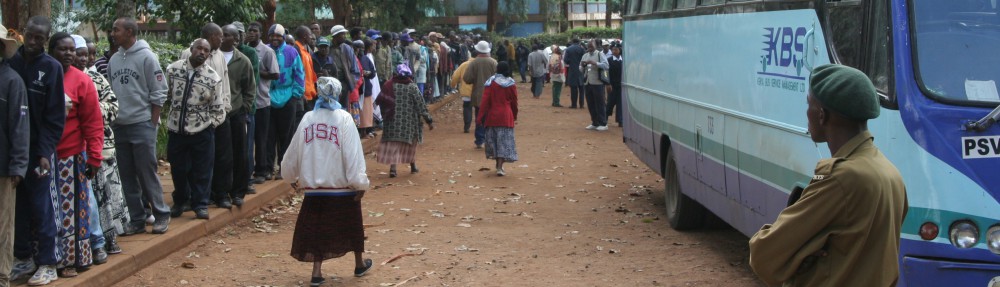
Why be concerned about election violence with the Kenyan referendum?

It seems to me that there are several obvious reasons.

Most basic is the simple fact that since Moi relenquished de jure one-party KANU control, there has been significant violence in each national election that was close (the 2002 presidential election was a landslide and featured Moi fronting a Kikuyu standard bearer who was not strong in Central Province against a Kikuyu establishment figure supported by Raila Odinga–in other words, a sui generis “perfect calm”; likewise the 2005 Referendum was not especially close and followed the 2002 general.) The “usual suspects” from 1992, 1997 and 2007 are still in power in government and business and have ample resources available.

There has been no meaningful progress yet in regard to the “culture of impunity”. The Government of National Unity has not delivered a local tribunal to address the crimes layed out in the Waki Commission report. The ICC process is still hoped for, but has not resulted in indictments of anyone to date and the key people expected to someday face the ICC are very much players in the GNU today and will be for the forseeable future.

The “Truth and Reconciliation” process was politically stillborn in terms of doing anything that would have changed the dynamic of tension for this election.

The Waki Commission report shows that the Kenyan intelligence service knew about significant issues of likely planned violence ahead of the 2007 election, but action was not taken to stop it. No explanation of this has been provided, nor are there obvious reforms implemented to make sure that the same situation (whatever it was) is not repeated.

Corruption is more entrenched than ever, in the sense that no real action has been delivered in response to even the new, and in some cases, particularly outrageous scandals coming from the Government of National Unity–much less anything about Goldenburg and Anglo Leasing and all the many, many other scams that have created pools of ill gotten gains that can be reinvested in politics as needed.

Even the newspapers have reported ethnic threats in the Rift Valley, and ethnic rhetoric is clearly being employed. To the baseline of ethnic tension, and ethnic division within religious groups that was a problem in 2007 has been added an increase in tension between many churches and the State over views or interpretations related to the khadi’s courts and abortion. These is always some baseline of tension between many Muslims and the State, but now there seem to be attempts to drive a much greater wedge between Muslims and Christians themselves at a grassroots level.

I could go on.

To top it off, it was clear by last fall that there was a significant ramping up of the flow of guns and ammunition into areas where there had been violence featuring more “traditional” weapons in 2008. And six people were killed by two grenades in Uhuru Park as the campaign kicked off.

This is not a prediction of violence–but rather an assessment that all the necessary ingredients are there. By all means we should hope for the best and pray for peace. But we should also be mindful of the danger and the United States as a major donor and “ally” should not be caught off guard. We know how much suffering election violence can cause. Foolish complacency is the hobgoblin of little hearts.

Washington Post headlines religious tension on khadis courts issue

“Kenya’s constitutional vote on sharia courts pits Muslims against Christians”

What an unfortunate mess. This is one, inevitably emotional issue, on which reasonable people can disagree–and those same reasonable people could still vote for (or against) the proposed new constitution regardless of their position on this one issue. Clearly tensions are being exploited.

From the U.S. side, I want to believe that people who wade in to this mean well, irrespective of the issue about the road to hell being paved by good intentions. At the same time, I have to wonder and worry about whether people who have a record of doing ignorant and irresponsible things like generating e-mails that end up discussed on the front pages on newspapers in Kenya (the day I left the country during the U.S. presidential campaign) asserting that Muslim-Christian tension and an alleged Obama-Odinga “secret Muslim” pact to impose sharia were involved in Kenya’s election and post-election violence.

As Vote Nears, Former Deputy Commander of Kenyan Administrative Police continues in hiding

As the Kenyan constitutional referendum approaches, most other aspects of the “reform agenda”, in particular accountability for wrongdoing in the last election, remain stymied. The Internal Security portfolio has passed from John “Rattle the Snake” Michuki, who continues in Cabinet as a key insider, to George Saitoti, another of those who seems a conspicuously odd choice of partners for anyone promoting reform in the security services.

From the Nairobi Star via All Africa.”

Nairobi — GOVERNMENT is about to dismiss a key potential witness for the International Criminal Court.

It has written to Oku Kaunya to show cause why he should not be fired as Nyanza Deputy Provincial Commissioner.

In December 2007 he was the Deputy Commandant of the Administration Police and Commandant of the AP Training College in Embakasi. He had originally been scheduled to take over from AP Commandant Kinuthia Mbugua in 2008.

It has been alleged that the Administration Police was partly responsible for the mayhem that followed the December 2007 elections.

Kaunya left Kenya in April this year and has not returned. It has been rumoured that he will be a key witness for ICC prosecutor Luis Moreno Ocampo.

Government has taken Kaunya’s absence from work as desertion from duty which, according to the Civil Service regulations, is punishable by summary dismissal.

Sources in the Office of the President, to whom the Provincial Administration answers, told the Star that the letter was written in mid-June and sent through the Post Office.

Internal Security assistant minister Orwa Ojodeh confirmed yesterday that Kaunya had deserted duty and clarified that any communication sent to him was in line with government policy.

“If government officers desert duty as he did, then they have to give an explanation,” said Ojodeh.

The minister however said he could not confirm whether government had formally written Kaunya.

After receiving death threats from unknown people, Kaunya slipped out of Kenya in April claiming he needed medical treatment for a kidney problem. His whereabouts remain unknown but he is believed to be in Europe.

He may turn out to be a key witness should the International Criminal Court try the perpetrators of the post-election violence.

Kaunya headed the AP Training College which, according to the Waki Report, was a central link in the disruption of the December 2007 election.

The Waki Report said 1,600 officers were sent to the college for “special training” so they could act as election agents for the PNU.

“All officers deployed were dressed in plainclothes, easily identified as they were not from the local community and travelled in large groups by more than 30 chartered buses,” the report said.

“In addition, they received Sh21,000 each for their duties. The entire exercise was called off after some officers were killed and many more injured by citizens,” the Waki Report concluded.

Investigators from the office of ICC prosecutor Ocampo have been in Kenya and they are expected to finalise their investigations in October before Ocampo can ask for the ICC to issue arrest warrants for the key suspects.

As many as 20 witnesses whose testimony is considered crucial have been placed under protection. Several have been flown out of Kenya while others are being protected in safe houses in Kenya.

Yesterday Kaunya’s wife Millicent said the government was aware of her husband’s continued stay abroad and that she had not received any communication about his employment status.

“I have not heard anything so far but he (Kaunya) is out and the government knows why,” said the wife without revealing further details.

Ajaa Olubayi, Kaunya’s lawyer, said he last spoke with his client two months ago.

“I haven’t spoken with him for quite some time and I would not be in a position to say whether he has been asked to explain his absence from work,” said Ajaa

In April Kaunya’s wife said her husband had been feeling unwell and travelled to Germany for treatment from where he was to proceed to see their daughter in the USA.

In January 2004, while he was the Uasin Gishu DC, Kaunya called for the abolition of the Administration Police and the Provincial Administration.

He was supporting those delegates to the National Constitution Conference who wanted the Provincial Administration removed from the Draft Constitution that was finally defeated in the 2005 referendum.

Kaunya’s comments were surprising to the AP command, especially Commandant Kinuthia Mbugua who had waged a spirited battle to have the force retained.

In 2007 Kaunya was promoted to head the Administration Police Training College, a post that put him second only to Mbugua in the AP chain of command.

However in June 2008 Mbugua interdicted Kaunya for putting on the rank insignia of the AP Commandant, apparently in preparation for the departure of Mbugua.

He eventually returned to his post in December 2008 but that did not end his tribulations.

Seemingly to ensure he did not testify to the Waki Commission in early 2009, Kaunya was sent for an impromptu “holiday” in Thailand.

When he returned, he was given a scholarship to the Karen-based National Defence College from which he graduated last December.

Sure, we can hope for responsible behavior by the political powers that be in Kenya in the referendum–but to expect it under the circumstances would certainly be foolish.

Here is the link to “Divide and Rule: State-Sponsored Ethnic Violence in Kenya” by Human Rights Watch from 1993, featuring discussion of then-Vice President Saitoti, who was given the Internal Security portfolio by Kibaki in January 2008, during the post-election violence and before the mediation deal ushering in “the reform agenda”.

Kenya Referendum Slugfest One Month Out and other news

“‘No’ Team Attacks U.S. Envoy Over New Kenya Law” Daily Nation, July 2

My take: the Referendum campaign continues to get messier. And we are not helping, having not learned our lesson from the last election. Ranneberger endorsed the draft constitution, then the Administration backed off, after GOP Congressmen complained, raising the tenuous issue of U.S. legal restrictions on “lobbying for abortion” overseas–muddying the waters by not addressing the matter clearly. With the Biden visit and Obama speech on KBC, the official line was that we were not trying to tell Kenyans how they should vote, but were offering inducements if they did vote yes. Now Ranneberger is again making himself an issue in the yes/no campaign in Kenya directly. At this point, I think we (the United States) need to be very concerned about a non-violent and free election and a credible and accepted result, which is the thing of foremost importance. I think the proposed constitution has important positives and am concerned that missing the opportunity to pass this now could be very unfortunate, but Kenyans have to decide this for themselves–and frankly I do not think that they are more likely to vote “yes” because the Ambassador gets mixed up in it.

If many of Kibaki’s circle of ministers are “watermelons”, green on the outside but red on the inside, are we “kiwis”, brown and fuzzy on the outside and green on the inside (and foreign)? Could we be straightforward and consistent, just to try it out and see if that works better than what happened last time?

Certainly the Administration sent another very mixed signal by extending Ranneberger’s tenure again.

Some links of interest:

“House’s Special Gift to Kenyans in Choice to Lead Anti-Graft Agency” Kwamchetsi Makokha spoofs the nomination of P.L.O. Lumumba to head the Kenya Anti-Corruption Commission, Daily Nation, July 2

“Fear and Loathing in Nairobi” John Githongo writes in the new Foreign Affairs (subscription).

ABC News: “Some of the Best Paid Politicians in the World are in . . . Kenya???”

“Jeffrey Gettleman: Reporting from Nairobi” on NPR’s Fresh Air

“Current Conditions and U.S. Policy in the Horn of Africa”, Congressional Testimony by Ted Dagne of CRS, June 17

Coverage of Kenya’s Constitution Campaigns

Nick Wadhams in Time has a good overview.

In the Star courtesy of the Mars Group media pages Wycliffe Muga suggests that William Ruto’s role as a “no” leader reflects his strategic plan to establish himself as political boss of the Upper Rift Valley rather than a serious expectation of actually defeating the proposed constitution.

In this month’s free article, Africa Confidential says “Campaigning for next month’s constitutional referendum is a mixture of ideology, religion and personal ambition – and now the thugs have moved in”.

Mugambi Kiai writes in the Star (via Mars Group): “It is so easy to miss the obvious. There is so much shouting around narrow sectarian issues that the massive gains in the proposed constitution are hardly getting any airtime” and goes in to detail several of the governance reforms.

Daily Nation says Gov’t fed misinformation on bombing: “We are surrounded by liars.”

Mutumu Mathiu, Managing Editor of the Daily Nation, explains the confusion about the facts of the grenade killings in Uhuru Park:

For every inaccurate report in the newspaper, there is a chain of people who have lied and misled the press.

An official I called told me only 24 people had been hurt. Complete disinformation. Our reporter had physically counted 75 patients.
. . . .
Finally, officials speculated that it was a home-made device, made from party crackers. This is what we told Kenyans who read our early editions.

We are surrounded by liars. The government does not hire people to give information to the media. It hires liars to mislead the media.

Update: Good writing on the context of the bombing from Jeffrey Gettleman in the NY Times.

Grenades said to cause 5 deaths at Nairobi “no” rally

The reporting on the tragedy around Sunday’s “No” rally against the new constitution in Uhuru Park has been a bit confused. Earlier BBC said the deaths were caused by a stampede and indicated that it was unclear whether there had really been an explosion or not. The AP report carried in the New York Times and elsewhere indicated an explosion, and now the latest on BBC has PM Odinga saying that the detonation of three grenades had been identified as the cause.

Raila also announced a government investigation. Hard to know to what extent the investigation will be serious, and to what extent there will be public information.

Obviously the referendum is going to be going forward in a tense environment. The latest polls, while still strongly “yes” suggest some erosion of support, and there does seem to be a sense that the issue is tightening up as various interests become clearer and swing into action both in public and behind the scenes.

Skullduggery on the Contitution in Kenya

NARC-K, the party now led by Martha Karua, has issued a public warning about powerful forces scheming to derail reforms under the proposed new constitution. As when she raised the alarm some months ago about bribery in parliament she has not named names. Karua, having fronted for the PNU hardliners in the Annan-led “mediation” following the 2007 elections and served as Kibaki’s first Justice Minister, has been on the inside, has been around quite a while, and is  recognized as a sharp lawyer.

It certainly seems that the announced High Court ruling on the 2004 challenge to the Khadi’s courts is being widely viewed as transparently political in timing.  Likewise the investigation into the insertion of “national security” as a general qualifier of individual rights under the proposed Bill of Rights at the Government Printing Office has not been resourced seriously, has stayed away from people in power and extended in duration, seemingly set up to fade into the distance as such investigations normally do.

Credibility of the voting and counting in the referendum on August 4 may well be at issue, and handling this correctly and transparently will be vital for Kenya’s future. I hope that we in the United States are doing a good job with our support for the IIEC especially.

Waking up to the challenges in Kenya

Yesterday’s big news from Kenya was the ruling by a court panel in a 2004 constitutional challenge to the Khadi’s Courts on grounds of discrimination and the separation of church and state. The 2004 plaintiffs were clergy, some of whom are involved in the current “No” campaign (and others not). The Attorney General has announced he will appeal, which will of course carry the case out beyond the date of the August 4 referendum on the new constitution.

While I am not a Kenyan lawyer, I think that the approval of a new constitution at the referendum would render the current case moot before reaching finality, but in the meantime, the ruling will surely energize the “No” campaign and give greater relative attention to the new draft constitution’s provisions continuing the Khadi’s courts for “family law” and related matters among Muslims on a consensual basis. Surveys have shown that large majorities of Kenyans find the draft constitution a mixed bag, with things they prefer and things they don’t, with the balance weighing in favor of the overall reform. This ruling could have some real impact on that balancing act.

As an American Christian I have been favorably impressed by the general ability of Kenya’s Christian majority and Muslim, traditional and other minorities to get along and live among each other respectfully relative to so much of the rest of the world. As with tribalism, this has the potential to be one more opportunity for politicians with wholly irreligious motives to exploit and divide based on emotions, especially fear.

Certainly the last thing the Kenyans need as they work through this is outsiders who also have other priorities injecting themselves and their money into the campaign.

Meanwhile, back inside the Beltway . . .

Three Republican Congressmen have asked the Inspectors General of USAID and the State Department to investigate the notion that Ambassador to Kenya Michael Ranneberger and others are violating U.S. law prohibiting the use of foreign aid funds to lobby for or against abortion. The theory here is that activities supporting passage of a new Kenyan constitution constitute lobbying for abortion because the final proposed draft, which states that life begins at conception (unlike the current constitution) and makes abortion generally unconstitutional also has potentially ambiguous language that allows some “health of the mother” exception.

In other words, the proposed new Kenyan constitution is much more favorable from a pro-life perspective than the U.S. Constitution as interpreted by the U.S. Supreme Court over the past thirty-plus years.

I remain convinced that Kenyans are wholly qualified to make up their own “hearts and minds” and cast their own votes. If we can avoid confusion and help the process of the vote itself that’s good. We don’t have a great track record, especially in the last election, and in the past in giving too much public and private support for too long to Moi. We should be humble and careful.

Jeffrey Gettleman has a rundown of the American culture wars, East African front, in the NYTimes.