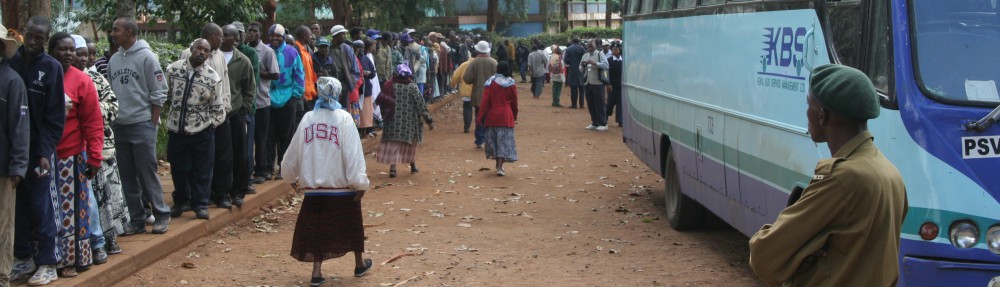
We approach the halfway mark in the second Kibaki administration and watch as Kenyan politicians grapple with how to position themselves most advantageously for the next election, and as Kenyan wananchi hope for any opening toward the restoration of the sense of hope and empowerment experienced in the 2002 election. Much of the focus right now is on the process by which the members of the political elite mediate among themselves what to offer to the public for vote in a referendum on a new constitution.
Obviously this is a high stakes endeavor involving a degree of risk that Kenyan politicians do not normally indulge–which is why Kenyans continue to have a constitution that no one admits to liking and everyone promises to change when they are running for office. The first Kibaki administration lost its moment of public goodwill over the failure to accept reforms limiting presidential power. This created an opening for a new opposition center of gravity with the “Orange Democratic Movement” and ended the opportunity for Kibaki to win a majority in seeking re-election in 2007. With the old constitution, however, Kibaki did not need a majority to keep power.
To my way of thinking, it may be a distraction to focus too much right now on most of the intricate issues of law presented in the Committee of Experts draft constitution, in that the reality is that Kenya is simply not at a point where the law as written is such an important determinate of the rules of everyday life either for citizens or leaders. To me, the big picture issues of how Kenya will be governed in the future, if a new constitution is approved, are (1) how the president is chosen and (2) devolution versus centralization.
Presidential Elections to Date and the Current Pursuit of 2012
The political class seems to have abandoned the idea of having a Prime Minister which has been seen as a central point of contention in the past. To me this reflects the final denouement of the notion of the second Kibaki administration as being a “coalition government” involving “power sharing” between a Kibaki-led PNU establishment and an Odinga-led opposition.
In a nutshell, Kibaki in seeking a second term lost around 20-points off his 2002 majority, but the ECK which he appointed declared him to have won a plurality and to have met the thresholds of 25% in each of five provinces. Almost all outside observers have concluded that the election was stolen and surveys indicated that 75% of Kenyans believed so as well. Kibaki won a majority in the 2002 campaign and lost it in his performance in office, but retained power.
Since Moi conceded to allow formal “multi-partyism” in the wake of the end of the Cold War Kenya has had four elections. In three, an incumbent president sought re-election, failed to get a majority of the vote, but was declared the winner with a plurality, followed by significant violence. This was the pattern of 1992, 1997 and 2007. In 2002 there was no incumbent due to a constitutional reform imposing a two-term limit–a “macro level” legal reform that was ultimately respected. In this unique situation, the two leading candidates to succeed the president were both key members of the elite political establishment, and simultaneously key members of the Kikuyu tribal and business elite. Under the circumstances, the obvious landslide winner was the candidate positioned as “the opposition” while also being, in fact, part of the core elite.
How much alike were the candidates in 2002? Let’s look at some reportage from today’s Sunday Nation:
Mr Kibaki’s apparent endorsement of Mr Kenyatta’s manoeuvres in PNU is hardly surprising.
Mr Kenyatta and Mr Kibaki share long-standing family ties. It is said that it was Mr Kibaki who suggested to Kenya’s first president, Jomo Kenyatta, that he should name his son Uhuru (freedom) to mark the attainment of independence in 1963.
The two families, whose private residences are barely 500 metres apart in the upmarket Muthaiga residential area in Nairobi, also share deep political connections.
George Muhoho, an uncle of the younger Kenyatta, was one of the founders of President Kibaki’s Democratic Party of Kenya.
While Mr Kenyatta has unquestionably taken up the role of the main man within PNU . . .
While 2002 might have seemed at first to be a breakthrough election representing a fundamental step up to a higher level of democratic development–rather than something of a bait-and-switch–by 2007 we were back to a situation where an incumbent who could not command a majority was seeking re-election.
Given the History, Why Not Create a Strong Prime Minister?
I think it would make sense for Kenyans to chose a presidential rather than parliamentary system, because a parliamentary system is based on functioning political parties. Having a “prime minister” without a party or parties in government and a party or parties in opposition in the parliament doesn’t make sense to me. Kibaki effectively gutted the nascent existing political parties as president by being elected to parliament and as president as the leader of the Democratic Party, but not using DP as a tool of governance nor leaving it, and disdaining to chose or form another party to run for re-election. Ultimately “PNU” was slapped together a the last minute, neither quite a party, nor quite a coalition–and was little more or less than the Kibaki re-election apparatus at the time.
Because Kibaki did not lead an organized party, after the election the claims on his loyalty were personal and tribal–he was not going to negotiate anything to do with the presidency–that was off the table–but spoils could be shared as he deemed necessary. Thus ultimately, he was able to cut a deal with Odinga without having to answer to a party. The settlement was against the wishes of many of his key partisans, including at least some of the PNU-side negotiators in the Kofi Annan-led talks which had in fact collapsed before the last-minute deal between “the principals”. After all, he was giving away jobs and titles that his second tier supporters wanted, rather than what he needed for himself.
ODM is likewise unlikely to survive the run-up to the next election. ODM had a certain level of potential as a party. It was strengthened as a party, I would argue, when Kibaki’s claim on Uhuru led Uhuru to pull KANU out of the opposition coalition. Uhuru couldn’t buck Kibaki and keep his seat in parliament and being leader of KANU was not enough for him without the seat. The clarity of the formal split with KANU left ODM in a position to develop as a party rather than a coalition. It survived the disruption of Kalonzo’s departure. It had a national leader in Odinga who even in the questionable ECK results won the vote in the entirety of the country other than Central Province by 1.5 million votes. Post-election however, its leader Odinga has no real power as Prime Minister to impose party discipline and Kenneth Marende whom ODM elected as Speaker its in greatest feat as a party holds an office that is treated in the strange current system as nonpartisan.
The Remaining Reform is the Requirement that the President Obtain a National Majority
Given the impracticality of expecting more from parliament or a prime minister without a level of development of political parties that simply has not transpired in these initial years of Kenya’s political opening, the reform that matters in my opinion, is to require that a presidential candidate obtain a national absolute majority. This would be a real change in and of itself, and could be one of those fundamental basics like the two-term limit that are actually honored and matter over time.