While mourning, and One_dering . . .

A piece that you might have missed on the Westgate attack that touches more of the bases than most: The Real Reason al-Shabab Attacked a Mall in Kenya by Bronwyn Bruton at DefenseOne.com.
Also: “Terror Strikes Nairobi, Crossing Borders” from Lauren Hutton at the Netherlands Institute of International Affairs (Clingendael).

And if you missed a wise perspective on the human context, here is Karen Rothmyer in The Nation: “Reflections on the Kenya Terror Attack”

Other lessons so far: from Abdul Haji, son of the Garissa Senator and former Defense Minister, who drove from another shopping mall (Yaya Centre) and helped rescue many at Westgate after a cell call from his brother who was stranded by the attackers, we learn that real heroes drink Dormans (and pack a pistol), and leave notes for the owners of cars they back into while rushing to rescue their brothers.  The story of the Haji-on-the-spot collaboration with the Kenyan Red Cross, a handful of plainclothes police and a kitted out group of what we might call “neighborhood watchmen” is just so deeply “Kenyan”.

Ambassador David Shinn appropriately noted on his blog that his biggest surprise about the Westgate attack is that it hadn’t happened sooner.  People I touch base with expect more, and we have additional attacks in Mandera and Wajir.  In order to stay safe and protect each other, it seems to me that Kenyans need to calmly but firmly and persistently press to get as much truthful information as possible about what happened at Westgate and take responsibility for their neighborhoods and surroundings.

The #WeAreOne_dering hashtag on Twitter has brought people from all over the world into the conversation about what really has really happened with this attack.

The United States, in particular, has spent millions on an ongoing basis, through the State Department and the Defense Department directly and indirectly on  “capacity building”, training, etc. for Kenyan security.  Given the meager preparation for and response to an attack like Westgate, we need to quickly recalibrate to account for the present reality and the immediate threat.

Here is my post from 2009 “Corruption and Terrorism/Security”. And from 2010 “U.S.-Kenya Relations: A counterterrorism versus reform tradeoff?”

And to address the religious dimension, here is an important post from African Arguments via allAfrica.com: “Somalia: To Beat Al Shabaab Kenya Must Expel its Religious Leader “Sheikh Hassaan” From Nairobi”.  And the National Council of Churches of Kenya has posted this flyer from the Inter-Religious Council of Kenya announcing a “We Are One in Prayer” event on October 1.

KPTJ Statement

Sharing the statement released by KPTJ this morning:

At this time of grief, we, Kenyans for Peace with Truth and Justice, wish to express our deepest condolences to the families of those who have been lost or remain missing, and wish a swift recovery to all those who have been hurt. We applaud the contributions of our fellow Kenyans to support rescue and security work and medical care for victims, as well as the unity our nation has demonstrated throughout this crisis. We condemn this despicable attack and support all work to rescue those still trapped at Westgate, and to end the situation as soon as possible and without further loss of life.

Two things to read after the Westgate attack (updated)

Simon Allison in The Daily Maverick has a piece today entitled “Nairobi attack: Why Kenya and why now?”  that strikes me as solid and recommended priority reading.

As far as where things are in Somalia this is probably a good time to read, if you missed it, Matt Bryden’s report “Somalia Redux?: Assessing the new Somali federal government” for the Center for Strategic and International Affairs, which provides a sobering corrective to any notions that recent progress in Somalia is more than a set of limited early steps toward any long term formation of a stable state.

Add this on the Kenyan security situation: “Kenya mall al-shabaab attacks reveal security cracks” Africa Report.

Why Westgate? [updated 9-24]

I certainly claim no special insight into the minds of Al Shabaab, but by virtue of having been around long enough to have been marked in childhood by the memory of the “Black September” attack on the Israeli athletes at the 1972 Munich Olympics, it isn’t a surprise to read that “Westgate Shopping Mall is one of several Israeli-owned businesses in Kenya.” “Shopping mall in premier complex that is home to international brands”, Saturday Nation.

Likewise, Nairobi’s upscale malls are hubs for internationals and expats, as well as symbols of the prosperity and comfort that can be found by the affluent in Nairobi and a source of local pride. The psychological and economic impact from mass murder at such a place is entirely different than mass murder of a similar scale in some other town or village, or in the slums.

I have to say I don’t believe these people would be sated if they ruled all of Somalia without challenge.

[Update: This post was an early reaction to news of the attacks. With the crisis nearing an end after three days, we don’t seem to really know much yet about the attackers and the specifics of the operation. Variety of contradictory information and lots of opinions, some derived from some substantial amount of experience and knowledge, some from little.]

Canadian High Commissioner misses the point in warning Kenyan politicians about ICC pullout

A diplomat has warned that the move last week by law makers to have Kenya pull out of the Rome Statute could jeopardise future search for international justice for Kenyans.

Canadian High Commissioner in Nairobi David Angell said pulling out of the Rome Statute, that established the International Criminal Court (ICC), would deal a blow to any future victims of violence that Kenyan judicial system would not handle.

“Canadian envoy warns in Kenyan ICC pull-out” Daily Nation

What search for international justice? Kenya’s last Parliament did not follow suspect William Ruto’s “Don’t be vague, go to The Hague” lead out of a preference for “international” justice over trying the suspects locally–rather it was an excuse for not prosecuting anyone themselves. Likewise the last Parliament did not then turn around and vote in December 2010 to withdraw from the ICC as soon as the charges came down against Ruto, Uhuru Kenyatta, Sang and the three others in consideration of the interests of “justice”. If the members of Kenyatta and Ruto’s Jubilee coalition who voted again to withdraw from the ICC on the eve of Ruto’s trial were in the least concerned about a “search for international justice” for victims of election violence–past or present–they would not have done so.

Kenyatta and Ruto as KANU leaders were on the side of election violence in Kenya in 1992 and 1997 and they certainly have not done anything to express remorse or “search for justice”–international or otherwise–for the victims. The very idea that there should be such a search for justice for victims of electoral violence is an affront to the political order in Kenya and on this Kenyatta and Ruto can easily circle the parliamentary wagons against the threat to their private sovereignty and that of their cohort.

The High Commissioner ought to appreciate that he is speaking to an audience which has, over many years, shown that it takes these thing deadly seriously. If the Canadians want to step into the current diplomatic vacuum in Nairobi to address the situation, I certainly applaud the intention, but they if they want to have influence they need to speak of things that their audience cares about.

Two “must reads” from Kenya ahead of the opening of the PEV trials at the ICC

3451378449_800db9e485_o
“Why Uhuru and Ruto must attend trials in The Netherlands” by George Kegoro in the Daily Nation.

.  .  .  .
I have found possible answers to this question in the record of the first presidential debate that was organised by the Kenyan media in the run-up to the March elections. The moderator, NTV’s Linus Kaikai, explored the question of the trials with Mr Kenyatta against the fact that he was seeking to become president of Kenya. Specifically Mr Kaikai wanted to know how Mr Kenyatta would juggle between attending his trial and the duties of presidency if he was elected to office.

On the night, Mr Kenyatta provided well-considered answers to questions surrounding their cases and the presidential bid. Referring to himself and his running mate Mr Ruto, Mr Kenyatta indicated that “it is our intention to follow through [the cases] and ensure that we clear our names”. He added that he considered accountability before the ICC as a necessary step towards ensuring that the kind of problems that Kenya faced in 2007 would not recur.

In his own words: “At the same time, we are offering ourselves for leadership in this country, a position that we believe and want to pass on to Kenyans, an agenda that will first and foremost ensure that the kind of problems of 2007 are put to an end.”

Asked whether the cases would affect his capacity to run the country, he said, “many Kenyans are faced with personal challenges and I consider this as a personal challenge”.

He said he considered that since personal challenges did not affect the capacity of other people to continue with their day-to-day jobs, they should not prevent him from doing so as well.

On that night, Mr Kenyatta concluded: “I will be able to deal with the issue of clearing my name while at the same time ensuring the business of government is implemented”.

Earlier, during the same debate, in answer to a question about his understanding of the problem of tribalism and how he would be different from Kenya’s first three presidents, Mr Kenyatta answered that “we have a new Constitution now” and added that “my job as president is to ensure that the Constitution is implemented”.
.  .  .  .

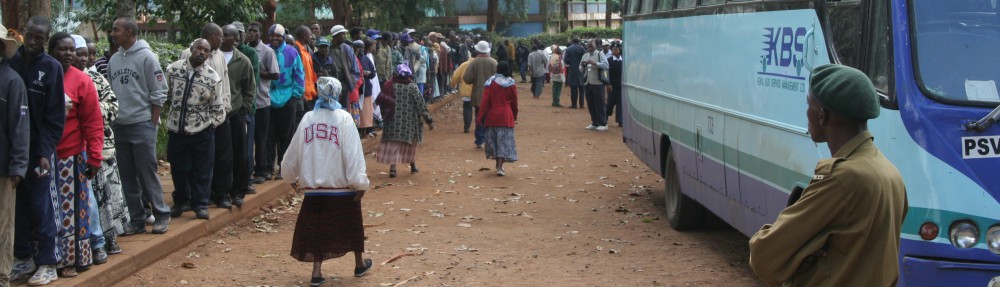
Kenya Bus Service (KBS) and Security at Polling Place

“The Eagle Has Landed: Kenya and the ICC” by John Githongo in The Star.

. . . .

. . . History is being made.

The ICC has redefined Kenya’s foreign policy totally and turned domestic politics inside out. Immediately after the post-election violence in 2008, Kenyans were clamouring for the ICC to intervene given the horrors that had just taken place.

Accountability, justice, impunity, reconciliation and other such words were the primary fodder of political discourse as we headed into the referendum on the constitution in 2010. Indeed, it can be argued that even among those most strongly opposed to the new constitutional dispensation, the dark looming cloud of the ICC and all its implications, especially the public mood that accompanied it through 2008 into 2010, all served to soften them up to demonstrate their pro-change, reformist credentials at a time when the country’s leadership and the messy albeit negotiated coalition arrangement was particularly unsatisfactory to the population.

If it hadn’t been for the ICC, perhaps more of the so-called ‘watermelons’ who pretended to support the new constitution while secretly being opposed to it, would have come out into the open with their true position.

.  .  .  .

. . . Parts of the Kenyan population are in just such a trap: caught between our preaching about and, yes, belief in, good governance and accountability; and its realities when brought to bear in our tribalised, politicised and fragmented political economy. Grimly put – ‘it hurts like hell when it is my tribesman who is being held accountable’. It hurts so much it leads to some of the most gibbering rationalisations of absurdity possible.

Continue reading

Is Washington, DC a logical place from which to fight global poverty? (Updated)

I thank those of you who have been reading some of my older posts while I have been primarily away from the blog the past few weeks.

Let me take time now to throw out a couple of “macro” observations as an observer of “development” practice in recent years and a life long observer and frequent past participant in American politics.  The first is just how strange it is from one perspective that organizations like USAID and especially the Millennium Challenge Corporation are located “inside the beltway” in Washington, DC.

Don’t get me wrong, Washington certainly has its share of poverty, but in general the Washington inhabited by agencies like USAID, the MCC and the World Bank operates in the thrall of the micro-economy generated by the brokering of the American federal government’s expenditures on the order of $4 Trillion annually.  It is a sui generis antiseptic boomtown quite disconnected from the economy of the rest of the cities and towns even of the United States, much less the rest of the world. Especially that of those facing the extreme poverty that the Millennium Development Goals were intended to overcome.

It just seems to me that we might, say, move one of our agencies like the MCC to West Virginia, for instance.

West Virginia is one of our poorer states, and one where we have this terrible problem of conflict between the need for jobs and the immediate and long term environmental harm done by strip mining and “mountain top removal” for coal.  West Virginia has an economy rooted in natural resources and agriculture, like most of the world, and unlike the District of Columbia–but it is close by, just a short drive.  Long serving Senator Robert Byrd was for many years famous especially for bringing federal agencies outside Washington to his state of West Virginia.  While this was widely derided as “pork barrel politics” by people from other states, those federal agency jobs go somewhere.  Putting a poverty fighting agency there might directly fight poverty as well as help us learn more about how to be most helpful elsewhere.

Update: On the topic of US aid transparency, here is great piece from Jennifer Lentner (@intldogooder) on Oxfam America’s “The Politics of Poverty” Blog: “More U.S. international aid data released–now what? A user’s perspective”.  Jennifer interviews Hon. Albert Kan-Dapaah a former minister in the Ghanaian government and former chair of the Parliamentary Public Accounts Committee.  He finds the current data important but “pretty scanty” toward meeting the needs of public officials and of civil society watchdogs.

New bi-partisan legislation—the Foreign Aid Transparency Act of 2013—would open the books on US foreign aid. More transparency will enable people like Hon. Albert Kan-Dapaah to hold their governments accountable for how they invest US resources. Learn more and contact your representatives here.

And stay tuned to Politics of Poverty to get more user perspectives on aid transparency data!