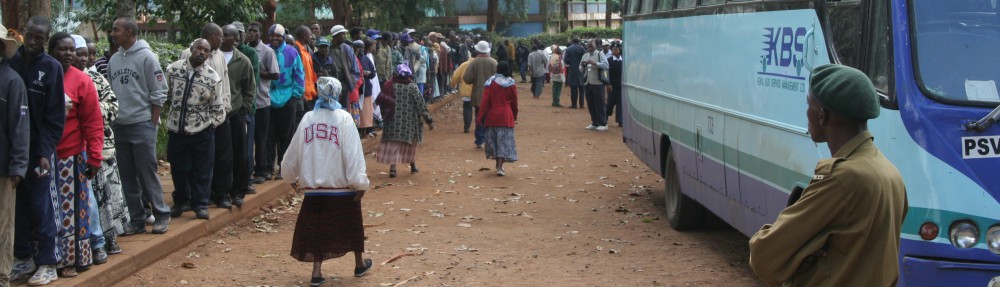
“The long, long vote count” –new reporting from Kenya in Africa Confidential

Election Observers

The new “free article” from this month’s Africa Confidential says better what I have been getting at about the extraordinary delay in releasing the results from the Kenyan election, along with new independent reporting on the facts:

. . . In the longer term, such doubts could prompt a re-evaluation of foreign election monitoring missions in Africa. Some on the European Union mission, for example, had serious doubts about the integrity of the process, but it quickly endorsed Kenyatta’s election. By that stage, the EU had contributed more than 50 million euros (US$66 mn.) to the cost of the elections, reckoned to total over $400 mn. One diplomat in Nairobi joked that it was a case of ‘responsibility without power’, meaning that the EU would be blamed for a messy result due to its financial involvement but had no power to change anything.

The IEBC found that a million more votes were cast in the presidential election than in any other, Africa Confidential has learned, although all were held on the same day. Opposition and civil society activists have raised questions about such discrepancies for several months.

An unnamed electoral commissioner quoted in the Nairobi daily The Star appears to confirm their suspicions: ‘We are having sleepless nights reconciling the presidential results and those of the other positions. Over a million votes must be reconciled with the others and if the requirement is not changed, then it will cast the IEBC in a negative light.’

Kenyatta’s supporters reject the concerns, arguing that it is natural that voters were more worried about selecting the national president than candidates for other positions. Few neutrals see this as credible. In the past, dramatically higher turnouts in presidential elections than in others on the same day have been taken as a sign of ballot-box stuffing.

It seems far-fetched that over a million Kenyans would queue for several hours to vote and then ignore all of the ballots apart from the presidential one, especially since there was great excitement about the contests for new, powerful positions such as senator and governor. None of the many election observers we asked said they had seen significant numbers of voters putting a ballot paper in the presidential box but not the others.

. . . .

Please read the whole piece; this is important for the future of Kenya and for future elections everywhere.


I am concerned that a move by the ICC to try Uhuru, Ruto and Sang “locally” would needlessly cost additional lives

3451378449_800db9e485_o

The Kenyan government, after years of lack of success in its various diplomatic efforts to block the ICC prosecutions of key figures in the political killings involved with the 2007-08 elections, achieved a potential breakthrough at the most recent AU meeting in Addis.  By getting a section of African strongmen and politicians to agree that the ICC shoe that they had promised to wear was pinching too tightly when it was not deferring to them as Heads of State as opposed to only pursuing lessor suspects out of power, the Government of Kenya raised the stakes for those nations that advocate a law-based international order and for the ICC as the only institution that remains with any potential to substantively express any tangible disapproval of the post-election murder and mayhem in Kenya in 2007-08.

It is in this context that the ICC will have to decide whether or not to accept a panel recommendation to move the trials from The Hague to Kenya or Tanzania.

Let me say that I am no fan of the decision to locate the ICC in The Hague in the first place.  Nothing against the Dutch and I do understand that The Hague has symbolism as a seat of the international law of nations.  Of course the criminal trials of individuals is something quite different and if anything in some ways undercut by the association.  We are confronted now with a situation in which the indictees have taken power in a member state–in a campaign initiated in the context of their defense to the ICC charges–and wish to avoid trial by mutating the individual criminal charges into a matter of the international relations of sovereign states.

So by all means move the Court to Botswana or Belize or some other more suitable location when it becomes logistically rational to do so, but these trials are supposed to be about the loss of life and limb in the “extra-electoral” context of the Kenyan fight for political power and it makes no sense to physically conduct the trial in such a way as to put more lives in the same type of jeopardy.

First, as a general proposition, witnesses against the President and Deputy President will never be able to live in safety in Kenya for any time in the foreseeable future after being identified and choosing to testify (they may wish to accept the danger of living in Kenya after testifying but this should not be asked or expected of them); this is the cold reality that should be readily evident to anyone who has paid attention to politics in Kenya over the years.  If it is understood that witnesses cannot testify in Kenya then why split up the trials over more than one location?  This process has already taken too long to no one’s benefit and supposedly the ICC has problems with resources and funding and a big backlog of cases already.

Second, estimates of the loss of life related to the most recent Kenyan elections with all priority on “peace” or stability over all else were still more than 500 people.  The police made extra-legal pronouncements restricting lawful civic expression and assembly; the country was basically shut down, the military was deployed and people were shot for breaking no law.  A trial in Kenya would be extremely expensive and quite dangerous by any informed reckoning.  The suspects on trial would be in charge of the “security” forces.  How many innocent lives will be lost for this?  No one can know ahead of time but it is grossly irresponsible not to count on some people who have no role in the trials dying for holding them in Kenya.

The whole point of the ICC is that it is “international”.  Thirty three other nations in Africa beside Kenya are members.  The reason for these cases being at the ICC was the tactical decision to vote in the “duly elected” Kenyan Parliament to “don’t be vague, go to The Hague.”  If “The Hague” no longer has the stomach for this, they should declare now that the task is too hard and walk away and make clear that Kenya, in spite of the work of the Waki Commission arising out of the AU-sponsored 2008 post-election settlement and the vote of its own parliament, is a zone of impunity, at least for suspects who arise above a political ceiling on potential accountability.  Otherwise, these trials need to be brought to fruition and be heard and appealed and done with purposeful speed and as few diversions as feasible.

We all know that the crimes alleged happened.  We saw them and heard them and see and feel their effects today.  Those of us who lived through this time in Kenya heard various bits and pieces of the details as these things were happening.  If the suspects or any of them are tried and acquitted then anyone who believes that they are in fact innocent of the roles alleged can celebrate that and all of us can finally mourn justice for these crimes along with the dead.

Somaliland rejects local UNSOM presence; Kenya reading

Khat Shop Hargiesa

Khat Shop Hargiesa

The Somaliland Sun reports that the Government of Somaliland has informed the visiting head of the new United Nations Mission to Somalia (UNSOM) that Somaliland will not host a UNSOM office. Somaliland wishes to continue hosting and receiving aid through various individual UN agencies and organizations but considers the overall UNSOM mission in support of the Federal Government of Somalia incompatible with Somaliland’s independent status.

In the meantime, the questions of governance for Kismayo and the “Jubaland” region remain an immediate challenge as does the unsettled Somaliland-Puntland border. Somaliland has indicated a desire to strengthen relations with Kenya, which shares a common interest in some degree of regional autonomy for Jubaland on the Kenyan border.

Of note on Kenya:

Wachira Maina–“ICC: Kenya’s is a lose-lose strategy even if African Union has its way” in The East African.

Dr. Stephanie Burchard, “How Fraud Might (Indirectly) Promote Democracy in Africa” in the Institute for Defense Analyses’ Africa Watchdiscussing the judicial review of Ghana’s presidential election in contrast to the procedure in Kenya.

David Anderson on the Mau Mau case, “Atoning for the Sins of Empire” in the New York Times.

Wycliffe Muga on “A Brief History of Election Rigging” in The Star.

Jaindi Kisero on “There is more to the Kenya Pipeline Company saga than nepotism; is it someone’s turn to eat?” in the Daily Nation.

Paul Wafula on “Hidden pain in financing Jubilee’s bag of goodies” in The Standard.

George Kegoro, “There’s need for an independent team to probe conduct of election” in the Daily Nation.

It’s mid-June: another month goes by without Kenya’s election results while Hassan goes to Washington [revised]

Form 34 Posted

Form 34 Posted

IFES, the International Foundation for Electoral Systems, hosted the latest round of its “IEBC goes to Washington” events with Chairman Hassan on June 12–this one purporting to discuss “lessons learned” from the March 4 election (link to webcast). A key lesson for the Kenyan government so far appears to be that if you sit on the election results long enough you can outlast the observers and the donors will pat themselves on the back anyway.

I didn’t make the trip to Washington for this event, in part because I don’t think the event should have taken place until after, at a minimum, the election results were released, if not other basic information we have all been waiting for. I did watch on-line. Here is my take:

My impression was that the objective of this event was indicated by the introduction and the conclusion. These were extravagant conclusory statements from IFES CEO Bill Sweeney about what a great success the Kenyan election was and what a great job the IEBC and its chairman did (and by implication of course IFES). Otherwise, there was just nothing new here. IFES’s Country Director Michael Yard gave a sober reminder of all the many things associated with basic electoral reform, like campaign finance laws, gender balance,etc. that remain undone–as he cautioned back in April 2012 with Hassan in Washington about the challenges of trying to do too much in too little time in introducing technology. The Washington triumphalism is “tone from the top” stuff that I haven’t heard from Yard or anyone else at IFES and I don’t doubt that everyone involved in actually working on the programs in Kenya did their best to avoid the kind of mess that actually came to pass.

From Sweeney’s argument, the reason this was all a great success–end of story–without even having results released three months later, is that “Kenya didn’t burn.” If I were a Kenyan I would be a bit offended by that. First of all “Kenya” didn’t “burn” last time–there was major violence in some places, including arson by militias, major sponsors of which, based on the confirmed ICC charges, got together this time. Kenyans of all tribes and persuasions were chastened by the post-election violence last time. Because of the experience, religious and community groups, civil society and the international community invested heavily in peacebuilding and conflict warning and resolution approaches. Threat of further ICC prosecutions hung over the key political actors that used violence last time. Thanks to a ruling by Speaker Kenneth Marende in Parliament and the High Court at the time, after passage of the new constitution in 2010, a new Chief Justice was appointed who was acceptable to the opposition as well as to the President, giving the opposition some hope in going to court after the IEBC ruling that the Uhuruto ticket had reached 50.07%. The Government of Kenya heavily deployed military, paramilitary and police force, especially in areas most supportive of the opposition, and the new Inspector General (chief) of police announced a ban of political assembly and peaceful protest, irrespective of the constitution–while gangs patrolled many of the slum areas. The biggest number of people killed last time were shot by the police, as reported by the Waki Commission. Last time the shoot to kill policy was unexpected; this time it was understood in advance. People stayed home after voting for many reasons that do not constitute an endorsement of the work and conduct of the IEBC.

Saying that the IEBC did a “great job” because “Kenya didn’t burn” is part of what I mean about having lower standards for elections in Africa–sorry if it’s impolite to notice.

The obvious question, of course, is that if Kenya not “burning” warrants so much public chest beating this time, should we include public discussion of “lessons learned” or any accounting or apologies for last time when so many people were killed and maimed?

Meanwhile back in Nairobi, the election results are being missed.

The Star: “Raila wants IEBC results released”:

“If indeed the IEBC conducted a free and fair poll, why is it delaying the computation of the election results three months later? They should announce so that we know what TNA, ODM, Wiper among other parties got,” Raila told the crowd at the Kabiro Primary School.

The Supreme Court on April 9 upheld the IEBC declaration of Uhuru as the winner after Raila’s Cord challenged the outcome of the presidential election.

The court ruled that the process was within the law and that Uhuru had been validly elected as the president.

Raila’s sentiments come against the backdrop of divisions within the IEBC over the computation of the results. An IEBC commissioner, who did not want his identity revealed, told the Star that the final figure was to be released before the end of last week but the disagreement among them had caused the delay.

The figures, according to the commissioner, were to be finalised before presentation of budget estimates to the parliamentary committee.

Whereas some commissioners want the the process finalised, others want the section of the Political Parties’ Act providing for the computation of results amended to give the commission more time. Those pushing for the amendment want the parties to share the monies on the basis of their representation in the Parliament and the county assemblies.

According to the commissioner, the variation of the results between the presidential and other positions was “irreconcilable”.

“The IEBC was to release the results before the end of the week but the huge variation between the presidential results announced on the 9th of March this year and the other positions combined is the source of the headache,” the source said.

Famed photojournalist Mo Dhillon responds to AU on the ICC trials: “African Unity leading Africa towards disaster”

Sir Mohinder Dhillon, renowned Kenyan photographer, photojournalist and filmmaker shared this new essay which he also submitted to the ICC judges:

“GADDAFI AND MUSEVENI”
Gaddafi and Museveni

African Unity leading Africa towards disaster.

I’d like to challenge the AU to tell me which tribunal or judiciary in Africa will ever convict a sitting Head of State. This attempt to renege on a commitment to the ICC is nothing more than a sinister plot by Africa’s dictators to save themselves from any kind of accountability. It was initiated by the late Colonel Gaddafi, who bailed the AU out of a financial crisis, thereby buying the loyalty of other African leaders whose necks were also on the line. To save himself from international justice, he wanted Africa out of the reach of the ICC. Shame on such leaders! Contrary to any suggestion of restoring national sovereignty, the aim of these people is for Africa to be out of the Rome Treaty so that they can continue with their evil intentions where money and power counts for everything and the ordinary African can rot.

Our memories in Africa are very short, particularly in the case of perpetrators of genocide, rape and murder. Those who support the AU line that accused Kenyans should be tried locally should remember that not so long ago Parliament and other local bodies preferred to hand over cases to ICC. Remember the slogan that was on the lips of all Kenyans:  “Don’t be Vague, Ask for Hague”. Kenya was given 12 months to put their act together and they did not move an inch. Kenyan authorities were going to investigate several thousand of other perpetrators but none was investigated due to lack political will despite some of perpetrators were recognizable carrying out crimes against humanity. AU is becoming laughing stock in promoting impunity.

The early history of Kenya’s ICC cases seems already to have been forgotten. After the post-election violence in 2008, the Peace Accord appointed the Waki Commission which produced 529 pages report on 16 July 2009 along with 6 boxes of documents and supporting material. A sealed envelope containing names of those considered most responsible for the violence was given to Kofi Annan as mediator.   Kenyan Government tried for one year to establish a local tribunal but parliament blocked this, leading to the involvement of the International Criminal Court.  The ICC Prosecutor, Luis Moreno Ocampo opened the envelope, inspected its contents and re-sealed it, before proceeding at Kenya Government request to carry out investigations and develop the resulting cases for ICC.

Kenya must smell the rat behind the intentions of our neighbours in Ethiopia, Uganda and Sudan, who are guilty of gross human rights violations in their own countries. Most recently, these include muzzling the media and arresting journalists and civil rights workers, but there is a long track record of crimes against humanity in each country. The AU has failed miserably to bring the perpetrators to book, as have the local judicial systems.

Until fifteen years ago, I filmed all the OAU meetings since its inception in 1963. For most of that time, the fight against apartheid in South Africa was the only factor that held this organisation together – otherwise I’m sure it would have disintegrated. It is a matter of record that crimes against humanity on the rest of the continent have far outweighed the evils of apartheid both in terms of scale and sheer lack of accountability. Why the double standard?

It is abundantly clear that most of Africa’s leaders are more concerned with protecting themselves than they are with securing justice for ordinary people. Although we in Kenya have made enormous strides in securing personal freedoms over the last twenty years, I am deeply concerned about the negative influence of our dictatorial neighbours in Uganda, Sudan and Ethiopia, where media houses are being closed down for flimsy reasons, where opposition is not tolerated and large numbers journalists and activists languish in dungeons without being charged. Kenyan genocide victims need closure just like the victims of Charles Taylor in Liberia, where the ICC was applauded for a job well done. There can never be adequate compensation for loss of life, limbs or dignity but at least some measure of justice was served.

Members of Kenya’s Government are shouting empty slogans about protecting their sovereign rights, in complete contradiction of their earlier position. I trust that the Kenyan people can see for themselves the total insincerity of those who are driven by nothing more than fear for themselves, and total disregard for the victims of violence. . . .

Here is the whole document: African Unity leading Africa towards disaster (5)


The more things change, the more they stay the same–what I wrote on “the Parliamentary pay fiasco” in 2010

English: Kenyan parliamentarian building, Nairobi

English: Kenyan parliamentarian building, Nairobi (Photo credit: Wikipedia)

Here is what I wrote on July 14, 2010:

The Parliamentary pay fiasco is a stark reminder of how out of touch Kenya’s political classes can be with the needs of the general public, the wananchi. Corporate CEOs may get “plus ups” in their compensation packages to pay for their taxes, but the notion that MPs in Kenya should be taxed fully on their compensation only if they get more pay, so as to make more than Members of Congress in the U.S. or almost any other legislators in the world, is guaranteed to be offensive to most Kenyans.

While Parliament as an institution does seem to have been making progress in its functioning,  it still has a long way to go. As I have written before, one of the problems is that there are a fair number of MPs who likely did not legitimately win their elections based on the problems shown by the Kreigler Report looking at the last election. And many of the people in the previous Parliament that had a record of serious public service and support for reform were defeated for re-election, in many cases at the party primary level.

We have heard rumors and discussion of bribery issues in parliament irrespective of the high pay–what are Kenyan taxpayers getting for their money?

A positive aspect to this is that it may help unite those who are frustrated by poor governance and selfishness by the political classes. The momentum from protesting this foolishness may help pass the constitutional referendum by prioritizing voters attention on the many positive aspects of the draft constitution instead of on the “contentious provisions” that have seemed to be attracting disproportionate energy.