A Must Read on the U.S. Government in Africa: “Pack like its Arizona”

There is so much that could be said in regard to a blog post I read and saved last week, but my policy on things related to the U.S. military is not to editorialize but to stay in “I report, you decide” [wink] mode.

If you are interested in understanding AFRICOM, and perhaps more generally the U.S. government in Africa, I think you really do owe it to yourself to just take a moment to read this post, “Pack Like its Arizona” , from AFRICOM public affairs.

High level U.S. Delegation carries requests to Museveni on fair elections and Iran sanctions

Ambassador Johnnie Carson, Assistant Secretary of State for African Affairs, was joined by the acting Assistant Secretary of State for International Security Affairs and Non-proliferation, and by General “Kip” Ward, AFRICOM Commander, in meeting Wednesday with Ugandan President Museveni. According to the Daily Monitor the U.S. was requesting that Museveni agree to reconstitute the Ugandan Electoral Commission ahead of next year’s election and support a U.S. draft resolution on Iran sanctions with Uganda’s current vote on the UN Security Council.

Museveni rejected the request regarding the Electoral Commission. Inter-Party Cooperation (“IPC”), the grouping of four opposition parties, has said that it will boycott next year’s elections if the composition of the Electoral Commission is not reconfigured. No word on the answer on the U.N. sanctions vote but it doesn’t sound positive.

On the electoral issues, The New Vision reports:

Museveni advised the delegation and other foreigners, who are approached by the “opportunistic” opposition members about Uganda’s problems to always, offer them a cup of coffee and send them back because Uganda has structures that can solve its problems.

On international issues:

Museveni challenged Americans to give him concrete evidence that the Iranians are developing nuclear weapons and that they have refused to comply with the regulations.

On Somalia, the President said there was need to take tougher action against the terrorists and ensure a roadmap towards elections so that the Somali people recover their sovereignty from the gunmen.

Discussing the Sudan issue, the Americans assured Museveni of their commitment to full implementation of the Comprehensive Peace Agreement. Carson said they were preparing for the eventual outcome of the referendum expected to take place in April next year.

Carson’s immediate predecessor at the Africa Bureau, Jendayi Frazer, is with the Whitaker Group, the lobbyists for the Museveni government in Washington.

Meanwhile, back inside the Beltway . . .

Three Republican Congressmen have asked the Inspectors General of USAID and the State Department to investigate the notion that Ambassador to Kenya Michael Ranneberger and others are violating U.S. law prohibiting the use of foreign aid funds to lobby for or against abortion. The theory here is that activities supporting passage of a new Kenyan constitution constitute lobbying for abortion because the final proposed draft, which states that life begins at conception (unlike the current constitution) and makes abortion generally unconstitutional also has potentially ambiguous language that allows some “health of the mother” exception.

In other words, the proposed new Kenyan constitution is much more favorable from a pro-life perspective than the U.S. Constitution as interpreted by the U.S. Supreme Court over the past thirty-plus years.

I remain convinced that Kenyans are wholly qualified to make up their own “hearts and minds” and cast their own votes. If we can avoid confusion and help the process of the vote itself that’s good. We don’t have a great track record, especially in the last election, and in the past in giving too much public and private support for too long to Moi. We should be humble and careful.

Jeffrey Gettleman has a rundown of the American culture wars, East African front, in the NYTimes.

U.S. House Speaker Pelosi Visits AFRICOM Headquarters in Stuttgart

U.S. Africa Command Home

The Speaker is no stranger to Africa.

“I met my husband at a course called the History of Africa South of the Sahara, and I have been studying Africa for decades,” Pelosi said in a brief interview.

“At long last the United States and the world is treating the continent, and individual countries, with the respect that they deserve,” she added.

At the conclusion of her U.S. AFRICOM engagement, Pelosi said that she was leaving confident “that General Ward and all of those working with him have a respectful attitude to the countries of Africa, want to work with them to develop solutions, and I have confidence that they will succeed.”

Kenyan Constitution and the Rule of Law

Most people that I have talked to expect the new Kenyan constitution to pass in the upcoming August referendum in spite of opposition from several church groups and politicians. This is also the view of the US-based consultancy STRATFOR in a new report on Kenya. The Synovate poll taken in late April showed a heavy balance in favor of a “Yes” vote, including among those who had disagreements with some specific points in the draft.

Looking ahead, the question may become, how much will the changes in the law really matter?

The Brookings Institution published an interesting study by Daniel Kaufmann  earlier this year criticizing the tendency to focus too much on the de jure rules of law rather than the de facto workings experienced in practice, citing the current situations in Kenya and the U.S. as examples:

First, consider Kenya in 2007. The main aid donors, led by the World Bank and the United Kingdom’s aid agency, DfID, tended to praise the governance reform efforts of the Kenyan authorities, including those on legal initiatives and anti-corruption.[1] Subsequently, in the run-up to the presidential elections, these top donors, also including the United States, flooded the Kenyan government with funds. Kenya’s government was even awarded a special international prize recognizing its good governance efforts.[2]

Elections were held a few short days after the last 2007 World Bank press release in Kenya, which announced approval of funding yet another project for the government.[3] The elections were widely regarded by external organizations, such as the EU, and by many Kenyans[4] as rigged, in what was the culmination of years of systemic political corruption that infiltrated key legal and judicial institutions. Civil strife erupted and the full extent of the breakdown of law and order was exposed at a dire cost—thousands of lives were lost and vast socio-economic damages were inflicted.[5] Yet, the main aid donors appeared to be shocked that such corruption, electoral mismanagement, and turmoil could take place in Kenya.[6]

Around the same time and half the globe away, some rule-of-law institutions were being quietly undermined inside the world’s superpower: the United States. In April 2004, amidst euphoric financial sector growth, a meeting was held in the basement of the Securities and Exchange Commission (SEC).[7] The top executives of the main Wall Street investment banks gathered to weigh in on proposed SEC regulations that would relax restrictions on their investment houses.[8] A scant 55 minutes later, the investment bankers emerged with SEC approval; the new regulations exempted the investment groups from the leverage restrictions that apply to commercial banks, allowing the banks to massively expand their debt.[9]

In return for the green light to an enormous expansion of indebtedness, the investment banks agreed that the SEC would have more oversight over them, for which a special unit would be formed.[10] In practice, the oversight did not take place. In fact, the head of the SEC never created or staffed any such oversight unit.[11] The resulting financial debacle that followed is now well known. What is insufficiently appreciated is the fact that various manifestations of “soft” and “hard” forms of regulatory and legal capture by the elite financials were a factor leading to the crisis.[12]

There are many salutary features in the draft constitution, on paper, but the real question will be making them work in practice. Rule of law will crucially depend on reform of the police, consistently rated as among Kenya’s most corrupt institutions, as well as better access and more effectiveness in the court system.

The outstanding issue of prosecutions for post-election violence is a good immediate test. ICC prosecutor Luis Moreno-Ocampo is in Kenya now, and is said to have informed the government that he will seek to bring two cases against three key individuals each, in the Hague in the September-October timeframe. The government continues to pledge cooperation, but continues not to take specific steps to effectuate the law passed by Parliament to provide for witness protection.
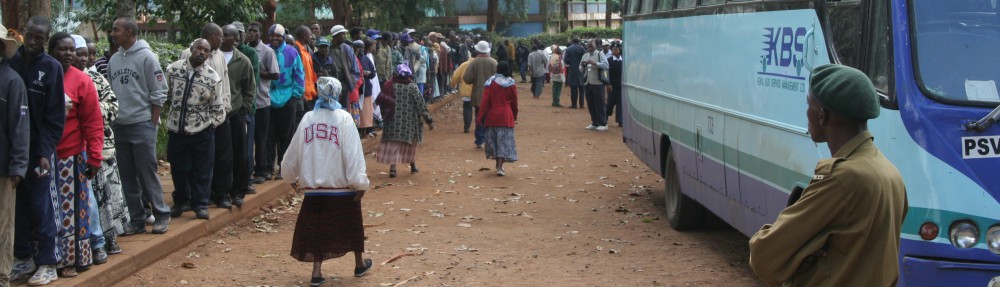
Democracy Arsenal challenges U.S. approach to democracy assistance

From Shadi Hamid of the Brookings Institution at “The Problem(s) with U.S. Democracy Assistance” at Democracy Arsenal:

In any case, the whole idea of “democracy assistance” is a bit odd and more than a bit hypocritical. We fund autocracies with billions of dollars of aid, then we fund some small NGOs so that they can oppose autocracy. Talk about mixed messages. Often, “democracy assistance” does not in fact assist democracy, since much of it goes to authoritarian governments themselves to help them govern more effectively. And a good chunk of NGO assistance goes to NGOs that are effectively GONGOs – government organized non-governmental organizations. GONGOs, needless to say, have nothing to do with democracy promotion. Even the money that does go to well-meaning NGOs is focused less on specifically democratic concerns and, as the Arabist notes, more on things like women’s empowerment, minority rights, etc., which are all important, but are not necessarily clearly linked to democratization – the movement, among other things, toward a political structure in which “alternation of power” is possible.

Certainly the imperative for democracy promotion organizations like IRI is to “follow the money” — to support overhead and bureaucratic and political heft by morphing to try to undertake whatever tasks the US government has funding for–regardless of core competencies and mission. I definitely wouldn’t go so far as to say that the US “GONGOs” have “nothing to do with democracy promotion”, but any honest assessment does have to recognize the inherent contradictions. “GONGOs” do face inevitable occasions when those contradictions between democratic ideals and policy choices by some in key positions in the US government are not successfully managed–as in my experience at IRI in dealing with the U.S. Ambassador in regard to the last Kenyan election.

Feingold’s Strong Statement on Uganda getting international coverage

Senator Russ Feingold, chair of the Senate Foreign Relations Committee Africa Subcommittee issued a statement last week expressing concern about the fragile state of democracy in a number of African countries, with strong words about the state of affairs in Uganda looking ahead to the February 2011 presidential elections.

On Sunday, The Observer in Kampala ran the statement in full, under the headline “Uganda remains a one-party state, U.S. Senator tells Obama”. Yesterday, The Guardian covered it in Uganda news.

From the statement:

Uganda, like Rwanda, is a close friend of the United States, and we have worked together on many joint initiatives over recent years. President Museveni deserves credit for his leadership on many issues both within the country and the wider region. However, at the same time, Museveni’s legacy has been tainted by his failure to allow democracy to take hold in Uganda. Uganda’s most recent elections have been hurt by reports of fraud, intimidation and politically motivated prosecutions of opposition candidates. The Director of National Intelligence stated in his testimony that Uganda remains essentially a “one-party state” and said the government “is not undertaking democratic reforms in advance of the elections scheduled for 2011.”

Uganda’s elections next year could be a defining moment for the country and will have ramifications for the country’s long-term stability. The riots in Buganda last September showed that regional and ethnic tensions remain strong in many parts of the country. Therefore, it is important that the United States and other friends of Uganda work with that country’s leaders to ensure critical electoral reforms are enacted. In the consolidated appropriations act that passed in December, Congress provided significant assistance for Uganda, but also specifically directed the Secretary of State “to closely monitor preparations for the 2011 elections in Uganda and to actively promote…the independence of the election commission; the need for an accurate and verifiable voter registry; the announcement and posting of results at the polling stations; the freedom of movement and assembly and a process free of intimidation; freedom of the media; and the security and protection of candidates.”