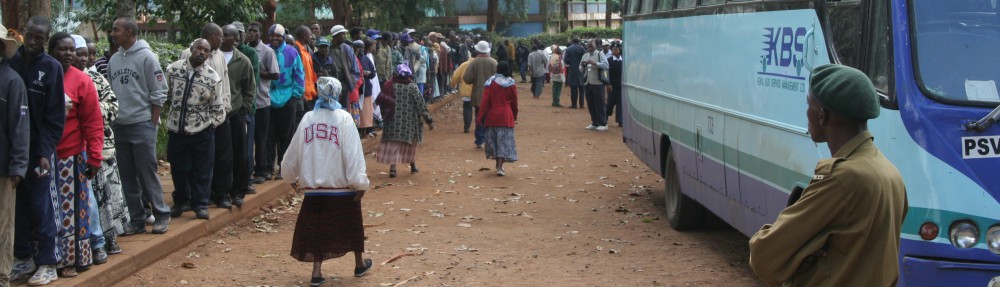
State of U.S. economic interchange with Kenya

So where do things stand economically between the United States and Kenya at the start of the Administration’s “new policy” for Sub-Saharan Africa?

Faded Aid

From the East African’s coverage of the Gration resignation, Envoy’s exit underlines new US strategy in Africa:

Over the past five years, the US clout in the local economic scene has been declining as Kenya continues to look east, specifically to China, India and Japan for aid. Whereas the US continues to be a major source of development aid, disbursing an estimated $3 billion between 2008 and 2011, China, India and Japan have emerged as new sources of infrastructure funding.

China is currently carrying out improvements of roads in Nairobi, while Japan is actively supporting the country’s energy sector.

America’s support has largely focused on health and military funding, with the US government set to give Kenya $14 million in military help this year.

In trade, whereas imports from the US have stagnated at Ksh45 billion ($535 million) since 2007, Kenya’s imports from China and India have more than tripled, rising from Ksh46 billion ($547 million) and Ksh56 billion ($667 million) to Ksh144 billion ($1.7 billion) and Ksh148 billion ($1.8 billion) respectively.

Kenyans had been hoping that General Gration, who spent his childhood in Democratic Republic of the Congo and Kenya, and spoke fluent Kiswahili, would take US-Kenya relations to a new level given his knowledge of Kenya, its people, its language, and its culture.  .  .  .

Assistant Secretary of State Carson testified on June 28 before the Senate Foreign Relations Committee on “Economic Statecraft” emphasizing the importance of the renewal of the Third Country Fabric provisions under AGOA, and the harm caused by uncertainty:

. . . As you know, many African countries are not taking full advantage of the benefits of AGOA. However, some AGOA beneficiary countries take good advantage of the provisions for fabric and apparel product lines. The third country fabric provision component of AGOA was designed to provide an opportunity for AGOA-qualified countries to be more competitive in labor intensive textile processes such as sewing, stitching, and cutting fabric.

It was widely recognized that most African countries were not able to compete in the more capital intensive process of producing fabric from raw cotton. African manufacturers have successfully used the AGOA third country fabric provision to create jobs, not just in the manufacturing countries but have used this provision to create cross-border pan-African supply chains. These supply chains also encourage regional integration – one of our key goals for the continent. Fabric and apparel exports are the second largest AGOA export after extractive industry products. However, these imports still account for less than two percent of U.S. imports.

I’d like to say a few words about what is likely to happen if third country fabric is not renewed. In our globally linked world, American buyers place orders six to nine to twelve months ahead. 95 percent of AGOA apparel and textile exports enter under the third country provision. And the AGOA third country fabric provision is the only way that African textile and apparel companies can remain competitive with larger producers such as China, Vietnam, and Bangladesh.

Without our help, jobs will continue to disappear in some of Africa’s most vulnerable economies, affecting primarily women and the families they support. Eighty-five percent of these imports come from just four countries: Lesotho, Kenya, Mauritius, and Swaziland.I know that diplomats from these countries have come to see you to emphasize the disproportionate effect that lack of renewal of this provision will have on their economies.

The effects of the loss of orders are troubling. At the AGOA Forum, the Swazi Minister for Trade told AGOA delegates that the loss of the provision will “shut the country down”. The textile and apparel sector is the largest formal sector employer with over 15,000 jobs and employment is already 41 percent in this small, landlocked country. Loss of just one of these jobs means that ten people lose their livelihood, since Swazi officials calculate that each textile job directly supports ten people. Lack of orders have already led to plants closures in Namibia, robbing people of their legitimate livelihoods and governments of much needed tax revenues. The Mauritians report that their orders are down 30 percent since January due to the uncertainty whether this provision will be renewed in a timely fashion.

The Trade and Politics Blog indicates that passage of the new bi-partisan legislation to extend the third country fabric provision is finally expected by the end of July before the Congressional Augut recess.  I hope this get squared away as soon as possible.

See “Africa Bureau announces vision to revitalize AGOA” and comment by Dr. Richard Mutule Kilonzo, Chief Executive, Kenya Export Processing Zones Authority:

The potential impact of a delayed renewal of the third country fabric provision of AGOA is grave. Third country fabric is the most successful components of the AGOA legislation and can be credited with over 100,000 direct jobs in Sub-Saharan Africa. Apparel orders are drying up due to the uncertainty surrounding the provision. In Kenya alone, over 40,000 factory workers could very likely lose their jobs if third country fabric is not renewed in a timely manner. The apparel industry in SSA rely on the third country fabric provision; without it there is a very real possibility that the investors in the apparel factories will pack up and move production to some other part of the world as happened in Madagascar following its loss of AGOA eligibility in 2009. This would cause enormous economic strife in countries that are strong partners of the United States. On September 30, 2012, the third country fabric AGOA provision will expire. With barely six months to go, further delay threatens the lives of 1 Million people, mostly women who work in the apparel sector. We estimate that each factory worker supports ten additional people. If third country fabric is not renewed soon, these jobs will disappear and Africa’s poverty rate will sour by over 55%.

Africa Bureau announces vision to revitalize AGOA

Assistant Secretary of State Johnnie Carson at CSIS from African Press Organization (APO):

While AGOA has achieved a certain amount of success, it has not solved Africa’s challenges and the region has not experienced a genuine economic revolution. Africa also continues to struggle to compete in an increasingly competitive global economy. For these reasons I am fully committed to revitalizing AGOA.

AGOA remains the centerpiece of our trade and investment policy with Africa. In 2012 the third country multi-fiber provision which allows textile producers to source their raw materials from other countries is set to expire and in 2015 the AGOA legislation itself will end. I would like to outline the State Department Africa Bureau’s vision for the next steps on AGOA:

1. Renew AGOA through 2025. The uncertainty about renewing the legislation creates a disincentive for potential investors to source production in AGOA eligible countries.

2. Renew the Third Country Multi-Fiber provision through 2022. The rules of origin for fabric under AGOA are one of the most important incentives to invest in textile production in AGOA eligible countries. This component of AGOA allows textile producers in AGOA countries to source their raw materials from other countries and still maintain their preferred access to the U.S. market.

3. Add South Africa to the Third Country Multi-Fiber provision. South Africa is the only AGOA eligible country not eligible for this provision and also the country best suited to take advantage of it.

4. Continue USAID’s Trade Hub and capacity building programs. Without this type of strong trade capacity building program AGOA cannot succeed.

5. Ensure that the Department of Commerce’s Foreign Commercial Service maintains their presence in Dakar and Accra. This is crucial not only for AGOA but for all of our economic initiatives in Africa.

6. Increase USDA’s capacity to provide phytosanitary certification. Agriculture exports remain an important and underutilized component of AGOA.

7. Tax incentives for earnings from AGOA investment. AGOA already provides substantial tariff savings for U.S. companies importing eligible products from Africa, but there are no other types of tax incentives provided under the legislation. Recommend that the U.S. government support an effort to eliminate the U.S. tax on repatriated revenues from American companies that invest in factories in Africa that produce AGOA exports to the US.

There has been a great deal of impressive economic news coming out of Africa recently. I am very encouraged by these positive developments. However, it is not the time for us to become complacent. Africa still faces huge challenges and we need to continue and revitalize our economic partnership. This is not only in the interest of our African partners, but in our interest as well. We need to maintain and improve upon AGOA today in order to continue to play a role in the growing dynamism in Africa tomorrow.

In the meantime, Russia is also seeking to “up its game” in African trade and investment.  Here is a link to “Buziness Africa”, a Russian magazine covering the subject, including AGOA.

New IMF Survey Predicts 5%+ Average Growth in Sub-Saharan Africa

IMF Regional Economic Outlook: Sub-Saharan Africa

The IMF identifies the biggest risk to a return to record pre-financial crisis growth levels in the region as an overall global slowdown, and also notes risk to the pace of policy reforms from the large number of elections scheduled for 2011.

Sub-Saharan Africa’s trading patterns have shown some dramatic shifts during the last few years toward China and other parts of developing Asia, the report said. These shifts were so marked that, by 2009, China’s share in the sub-Saharan Africa’s total exports and imports exceeded that between China and most other regions in the world.
Exports of goods and services make relatively small contributions to aggregate demand in most sub-Saharan African countries. Europe and other advanced countries remain the region’s dominant trading partners. However, in a minority of countries— including the major natural resource exporters— the impact of developing Asia on global export demand and commodity prices is expected to be significant in both the short and long term.

Overall, trade with Asia is therefore likely to be an increasingly important factor in maintaining growth for the region on its current trajectory. But the key drivers of African growth are likely to remain: political stability; the business climate, including the prudent exploitation of natural resources; and the quality of economic management.

Some optimistic observations on development and democracy, and some more aid-trade stories

“A New Dawn for Africa” from Johnathan Dembleby in the Daily Telegraph.

The boss of the call centre was born in Nairobi but left for the States to make his fortune. He became a big player in corporate America but now he is back home, running Kenya’s largest call centre, which has contracts with Britain and the United States as well as domestically. What brought him back? “I saw a chance to make serious money here. If they can do it in India, why not Kenya?” He abhors Africa’s “begging-bowl image” and the cronyism and corruption that bedevil his own country, but he is an optimist. “Of course we need better leadership but Kenya is full of entrepreneurs – that’s the way forward.”
. . . .
There are scores, hundreds, thousands of such examples. It is not yet a flood but it is more than a trickle as a steady stream of African émigrés return to make a better life for themselves and their families in their own countries. This “brain gain” does not yet balance the “brain drain” but it is a symptom that much of Africa is changing for the better. While the fundamental conditions for a thriving economy – the rule of law and transparency – are not yet deeply rooted in any African state, the foundations are at last being nurtured in many of them.
. . . .
Democracy is still a fragile flower but has started to bloom in many parts of the continent including Nigeria. Though instability is a constant predicament, tyrants and military dictators are now the exception not the rule. Freedom of expression, dramatically enhanced by Twitter and Facebook and the ubiquitous mobile phone, is proving exceptionally difficult to suppress except by the kind of brute force that only a tiny minority of African regimes are nowadays willing to exercise. Whether it is for these reasons or because they have been voting with their feet to confirm the latest New Scientist survey – which reports that regardless of their multiple tribulations, Nigeria is home to the happiest people on earth – some 10,000 Nigerians returned home last year. A similar flow is reported in many other countries.

None of this is to magic away the desperate circumstances that millions of Africans endure. Over the past 40 years, I have witnessed far too much hunger and too many deaths from disease, conflict and tyranny to be a Pangloss about this continent. The suffering is heart-breaking, the inequities are offensive, and the corruption is corrosive. My point is that these miseries are very far from being the whole story. The Africans I met on my 7,000-mile journey through nine countries resent the pitying and patronising attitudes that are so often adopted towards them by a Western world which – from their perspective – doles out aid with one hand while nicking the oil and minerals (by which the continent is blessed in super-abundance) with the other.

Again and again, at every level, people told me: “Don’t give us aid – trade with us fairly. Stop ripping us off.” Of course, most of them don’t mean that literally; they simply want a relationship with the rest of the world that is grounded in greater respect and understanding. Well-meaning sound bites like Tony Blair’s “Africa is a scar on the conscience of the world” inadvertently label as “victims” hundreds of millions of energetic and hard-working individuals who are resilient, inventive and enterprising – and who live in vibrant and peaceable communities that have much to teach our own dysfunctional societies.

On the aid front, “Dar rushes to spend $700M as U.S. official jets in”, from The East African. Worth noting that this $700M from the Millennium Challenge Corporation for Tanzania approaches twice the amount of the annual budget for AFRICOM. A BBC report asks five years after the Gleneagles Summit: “Did more African aid deliver fewer coups?”

And back on the entrepreneurial side, see “Trader in grasshopper delicacy hops to fortune” from the Standard.

Trade and Aid [Update]

A Good African Tale: an African entrepreneur struggles for recognition in rich county markets from the Economist.

Update: “Rwanda Coffee Success Story” from William Easterly’s AidWatch (HT Texas in Africa)

Nick Wadham’s latest in Time: Bad Charity (All I got was this lousy t-shirt) — and his related blog post, Top-Down Aid for Africa.

Texas in Africa has a great related multi-part series of discussion questions May 4-7 about the Western approach to aid and development in Africa:

This week I’ve been trying to sketch an outline of how Westerners tend to develop and characterize our relationship with Africa and the people who live there, specifically with reference to the international aid and development system. I’ve argued that the savior mentality is misguided, that Africa is not rightfully ours to save, and that a better way to assist would be through a paradigm of empowerment. . . .
Today I want to conclude this series by thinking about what is probably the biggest barrier to moving into an empowerment paradigm: the governments that give and receive aid. . . .
Why? Because aid – for donor governments and the governments which receive the bulk of aid – is inherently political. Except in cases involving natural disasters or epidemic disease, donors don’t typically give freely to everyone out of the goodness of their intentions. Aid projects are funded at least in part (and sometimes entirely) on the basis of donor priorities. When aid projects take into account the real, expressed needs of recipients (which is, I’m glad to say, increasingly real for most project), they are often structured in such a way as to advantage suppliers or producers in the donor state, or to reward good governance or provide support to an ally.
As we might expect, there is often a contrast between donor goals and what is actually needed in order to improve the material situations of the recipients. . . .


UPDATE
NYTimes: “At Front Lines, AIDs War is Falling Apart”; “Paper Cuts: How Obama’s Father Came to Hawaii”; “Letters: From Kenya to America”

Reuters: Donors to slash Tanzania budget aid.

Nick Wadhams at NPR:“Somali Pirates Take the Money and Run, to Kenya”

The Times (London): Book review–“War Games: The Story of Aid and War in Modern Times by Linda Polman
Humanitarian aid prolongs conflict and misery because the bad guys learn how to exploit it”
;
“Easy Money: the great aid scam”

“With Flights to Europe Grounded, Kenya’s Produce Wilts”

With Flights to Europe Grounded, Kenya’s Produce Wilts Jeffrey Gettleman in the NYTimes

A good article, worth reading.

If farmers in Africa’s Great Rift Valley ever doubted that they were intricately tied into the global economy, they know now that they are. Because of a volcanic eruption more than 5,000 miles away, Kenyan horticulture, which as the top foreign exchange earner is a critical piece of the national economy, is losing $3 million a day and shedding jobs.

The pickers are not picking. The washers are not washing. Temporary workers have been told to go home because refrigerated warehouses at the airport are stuffed with ripening fruit, vegetables and flowers, and there is no room for more until planes can take away the produce. Already, millions of roses, lilies and carnations have wilted.

“Volcano, volcano, volcano,” grumbled Ronald Osotsi, whose $90-a-month job scrubbing baby courgettes, which are zucchinis, and French beans is now endangered. “That’s all anyone is talking about.” He sat on a log outside a vegetable processing plant in Nairobi, next to other glum-faced workers eating a cheap lunch of fried bread and beans.

Election-driven riots, the Sept. 11 terrorist attacks and stunningly bad harvests have all left their mark on Kenya’s agriculture industry, which is based in the Rift Valley, Kenya’s breadbasket and the cradle of mankind.

But industry insiders say they have never suffered like this.

“It’s a terrible nightmare,” said Stephen Mbithi, the chief executive officer of the Fresh Produce Exporters Association of Kenya. He rattled off some figures: Two million pounds of fresh produce is normally shipped out of Kenya every night. Eighty-two percent of that goes to Europe, and more than a third goes solely to Britain, whose airports have been among those shut down by the volcano’s eruption. Five thousand Kenyan field hands have been laid off in the past few days, and others may be jobless soon. The only way to alleviate this would be to restore the air bridge to Europe, which would necessitate the equivalent of 10 Boeing 747s of cargo space — per night.

“There is no diversionary market,” Mr. Mbithi said. “Flowers and courgettes are not something the average Kenyan buys.”

Kenyan Coffee and Nescafe

Monday’s Standard reports that Kenya is only consuming 5% of its own coffee production, terming this a risk to the success of the sector.

The Kenyan government’s lack of appreciation for the value of the cachet of Kenyan coffee was brought home to me quite quickly upon my arrival in Nairobi as director for the International Republican Institute. Calling on the Minister of Trade and Industry, we were served the usual choice of tea or instant Nescafe, as in the various other offices of high government officials and politicians. When the Trade Minister of a country with a reputation for growing some of the world’s finest coffee is serving Nescafe to his visitors, there is an obvious disconnect somewhere.

A local coffee house in New Orleans sells what it calls a Kenyan Press for brewing coffee. It appears to be quite the same as what the rest of us would call a “French Press”–basically a simple glass cylinder with a lid with a plunger with a screen to filter the brewed grounds and hold them at the bottom when the coffee is poured. Obviously the label “Kenyan” has market value to coffee drinkers. From my experience, it was in fact very hard (and unduly expensive) to actually buy a French Press in Nairobi.

It would be great to see Kenyans taking pride in the reputation of the quality of their coffee production and to see the government paying attention to promoting the market (rather, than, perhaps, being too distracted by worrying about who is going to win the next election).

Addendum:  Turns out I have a picture of the coffee maker in New Orleans, a Bodum “Kenya Coffee Maker” that is also labeled in smaller print “French Press”:

AfriCommons, on Flickr”>"Kenya Coffee Maker"

Here is a link to more information and reviews from “dooyoo”. “Cafetiere (the French for coffee pot) has become the established description in Britain but ‘French Press’, or ‘Coffee Plunger’ is used in other parts of the world,” says reviewer “suehome”.