The Weekend Star: “A Road Still Under Construction”
“A Road Still Under Construction”–my piece in the Weekend Star
Reply
The Weekend Star: “A Road Still Under Construction”
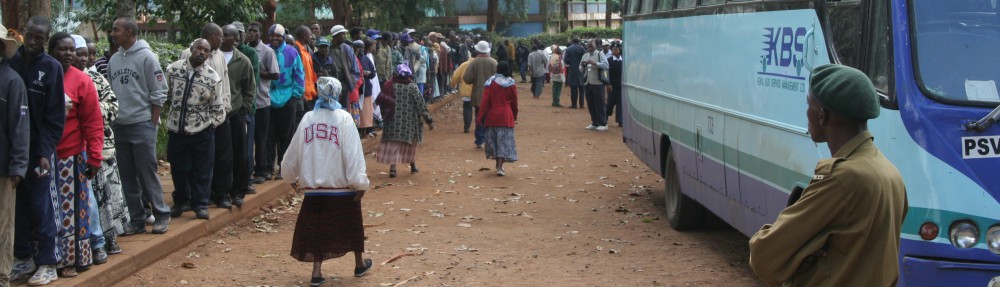
The Weekend Star: “A Road Still Under Construction”
The Standard this afternoon: Nation Dialogue report questions readiness for credible election.
The full report from South Consulting for the team led by Kofi Annan is here.Among the conclusions:
*The IEBC is also highly rated by Kenyans. Over 90 per cent of respondents said they have confidence in the IEBC, and a similar number believe that the IEBC is independent enough to conduct the next elections. However, there are concerns that the IEBC has been inconsistent with deadlines. While the eventual levels of registration achieved are respectable by any standards, the Commission had to lower its targets and expectations on voter registration to what was achievable. Furthermore, the requisite managerial capacity of the IEBC to conduct elections is yet to be properly tested. Elections comprise several tasks, all rolled into one major task, and carried out in a few days. On account of this, the Commission should carefully test and review its systems and address any weaknesses before the actual date of the election. This is important to ensure there are no feelings of false security.
*Confidence in the police and in political parties remains relatively low compared to the Judiciary and the IEBC. Although public confidence in the police and political parties is relatively low, the appointment to of an Inspector General of Police alongside the promise to undertake fundamental reforms is likely to draw public trust. Gaining this trust is critical, given the poor level of preparedness that the police have shown in halting the violence taking place in some parts of the country.
*Political parties continue in their old ways; some are allegedly recruiting members through fraud. Parties are still tied to individuals who founded them, and some are still based on ethnic identities and loyalties. As a result of this party primaries conducted in January failed to demonstrate any clear break with the past. The behaviour of political parties has detracted from requirements of the Political Parties Act, 2011, and the Elections Act, 2011, which legislators have mutilated or watered down to serve their political survival interests.
*Party hopping, formation of alliances by elites who do not consult members, and founding parties on ethno-regional platforms is happening in spite of the law and the new Constitution. Unfortunately, responsible public officials are yet to apply sanctions on political parties and the key leaders. Without injurious consequences for their actions, politicians will continue ignoring the rule of law and by that weaken the foundation of a credible election.
Meanwhile, The Nation reports on a dispute between the new Inspector General of the Police and the chair of the National Police Service Commission which resulted in intervention by the Permanent Secretary in the Office of the President and comment from the Independent Police Oversight Authority.
I am working on a more detailed discussion of the problems with the readiness of the Kenya Police Service where reforms have just started to scratch the surface due to delayed implementation of the mandates that were called for by the new constitution. In the meantime, here is the link to the full report released by Amnesty International on January 30 entitled “Kenya Police Reform: A Drop in the Ocean.”
UPDATED 10/24: IEBC Chairman Hassan spoke to the press Wednesday afternoon Nairobi time. Bottom line is that he is “cautiously optimistic” that the Government will follow through with a commitment to make a remaining authorization of the outstanding 60% due for the first major shipment of the Biometric Voter Registration Kits. If this happens so that the kits arrive by Tuesday, the IEBC can conduct the voter registration in November. Any further delay would have “grave consequences” rippling through the election preparations–thus jeopardizing the March 4 date.
UPDATED 10/23: New development from Capital FM:
NAIROBI, Kenya, Oct 23 – The government has assured that the next General Election will be held on schedule after the Treasury and the Attorney General approved the financing agreement for Biometric Voter Registration (BVR) kits.
Finance Minister Njeru Githae on Tuesday morning said the delay in approval of the financing agreement was due to its late arrival from France.
He said that neither the Treasury nor the Attorney General was to blame for the setback since the agreement was only received on Monday.
Original post:
Nevermind my previous post about biometric voter registration in Kenya that was to have started almost two weeks ago. The latest glitch, as reported in The Nation, is the need for the Attorney General’s office to approve a letter of credit so the French manufacturer of the BVR kits will ship them:
According to deadlines set by IEBC in August, voter registration was supposed to be carried out in September and October. However, the exercise was now set to start on November 14.
The commission has been forced to amend its timelines several times over the past three months due to the BVR crisis.
With only 133 days left to the March 4 election, it will take 60 days to complete a proper voter listing programme involving 18 million Kenyans with 30 days being set aside for the actual registration and another 30 days for voter inspection.
The frustrated elections boss revealed that he met Prof Muigai at the sidelines of the Mashujaa Day celebrations on Saturday and pleaded with him to save the country by signing the document.
This is the sort of problem or issue that is going to be testing everyone’s patience for the duration of the process of electing a new government.
Is it necessary and legitimate for questions to be raised in granting legal approval for the letter of credit? Hard to say; that some players in the process openly desire to delay the election, in the context of the controversial nature of the Attorney General’s appointment in the first place, means that public and private skepticism are inevitable.
The Independent Electoral and Boundaries Commission announced today that it will open a thirty-day voter registration period on October 11. iEBC Chairman Hassan said the Kenyan government was ready to sign the contract for biometric voter registration kits and an initial shipment would be available to begin by that date. The IEBC expects to register roughly 18 million voters before the March 4 election date. Here is the story from CapitalFM.
A three judge bench Friday ruled that the Independent Electoral and Boundaries Commission (IEBC) sets the date for the general election.
In a one hour ruling by constitutional court judges Isaac lenaola, David Majanja and Mumbi Ngugi, IEBC should set the election date 60 days after the expiry of the current parliament which is January 15,2013.
Going by the ruling, the general election is likely to be held in 2013. The judges who took time to read through the appeals by different petitioners said it was prudent for the IEBC to determine the date since it is the one bestowed with the mandate to conduct elections.
They ruled that the General Election can only be held in 2012 if President Kibaki and Prime Minister Raila Odinga agree, in writing, to dissolve the Grand Coalition Government. This would be 60 days after the Principals agree to terminate the National Accord that holds the coalition parties, PNU and ODM, together.
Deputy Prime Minister Uhuru Kenyatta says his KANU party will respect the court’s verdict.
Narck Kenya leader Martha Karua posted her immediate reaction on twitter saying she totally disagree’s with the court’s ruling.
She argues that the term of office must include the election period and that’s the interpretation world over.
“I totally disagree with the court’s ruling. Term of office must include the election period and that’s the interpretation world over.”
. . . .
Sloppy or deliberately ambiguous work on the new Constitution strikes again. The big picture here is that the Kenyan voters end up having foisted on them a “grand coalition” of all the major players from the last election until an election that is LATER rather than SOONER in the wake of the failure of the 2007 election. Hopefully civil society, democracy activists and donors will use the extra time productively to push the political class further forward on the reforms required to implement the new Constitution and prepare for a better election. No reason to be optimistic that extra time will help, but we can always hope>
From Wambui Ndonga on Capital FM:
NAIROBI, Kenya, Jan 9 – Kenyans have the next 21 days to submit their views on a preliminary report proposing the review of electoral boundaries that was launched on
Monday by the Independent Electoral and Boundaries Commission (IEBC).
The commission said it would conduct public hearings in all the 47 counties to get Kenyans’ views on the boundaries for constituencies and wards.
IEBC Chairman Issack Hassan said his team would also accept emails and written submissions hand delivered to the Constituency Election Coordination Office.
The schedules for the public hearings will be released on Tuesday.
“We are going to have eight teams going round the country to collect views from the public on what they think. The teams will go round the country for 21 days to hear out Kenyans,” he said.
However concerns have already started mounting over the report, which is almost a replica of the report prepared by the now defunct Interim Independent Boundaries Review Commission (IIBRC), led by Andrew Ligale.
Hassan explained that the IEBC had to use the IIBRC report as their primary reference point as required by the Constitution and didn’t have much choice. The IEBC also used the parliamentary report on the Ligale document as its second reference point.
He further asked Kenyans to exercise decorum and remain objective as they familiarised themselves with the contents of the report so as to ensure that the country attained the gains of devolution.
“Allow me to make a humble plea to all Kenyans, particularly to politicians; let us exercise restraint. The commission recognises the sensitivity of some of the issues at hand and we reiterate our devotion to diligently uphold the law,” he assured.
After the 21-day period for public participation, the commission will take 14 days to look into any concerns raised before considering them in the final report. The report will then be forwarded to the parliamentary committee on Justice and Legal Affairs, which will again take another 14 days to scrutinise it before presenting it in Parliament.
Members of Parliament will then have seven days to debate the report and adopt it with or without amendments after which it will be returned to the IEBC for an extra 14 days before it is gazetted and published.
“Kenyans will then get 30 days to raise their objections at the High Court which will take 30 days to resolve. Only then can the IEBC proceed to map out the new electoral units for purposes of voter registration and other electoral processes,” he explained.
Although the IEBC Act states that the High Court should determine any such issues within 30 days, the Constitution states that such an application shall be heard and determined within three months from the date it was filed.
. . . .
This should be interesting. If everything goes exceedingly well, Kenyans will be within a few months ready to register to vote in new constituencies for the next election.
A key variable to watch for in the process will be transparency and how serious “the donors” supporting the process are about making sure that Kenyans ultimately know how and why they end up with the constituencies they end up with.
Daily Nation: “British envoy warns of election crisis”
This was a headline from mid-June, almost four months ago.
Uncertainty over the date of the next General Election and lack of a substantive electoral body could expose the country to chaos.
This was the message of British high commissioner Rob Macaire to the principals and MPs on Thursday.
Mr Macaire said the country needed a transparent Independent Electoral and Boundaries Commission that will restore confidence in national elections.Speed up reform
The envoy noted that delays in passing key reform laws could undermine growth, and make investors shun the country.
And as we stand here in June 2011, still without an Electoral and Boundaries Commission in place for elections in 2012 and, above all, without an agreed date for those elections, it is difficult to avoid the conclusion that political manoeuvring is taking us into the danger zone.
“No one wants to see the country go into elections with uncertainty or division over the fairness and transparency of the institutions governing the process,” Mr Macaire said.