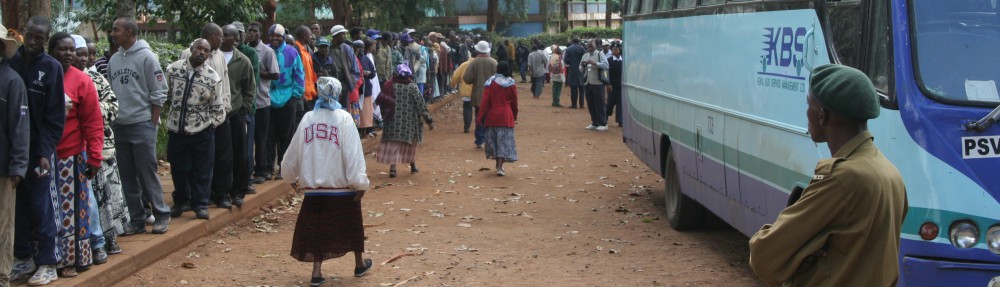
“Political Stability”, “Investor Confidence” and meaningful elections in East Africa

Wednesday’s Nairobi Business Daily features a story headlined “Political stability lifts investor confidence in East Africa“:

Easing political tensions and the ongoing search for uniform governance standards in East Africa has lifted business confidence in the region and is encouraging investments that could boost employment.

Buoyed by recent peaceful elections, investors in the five EAC member countries said governance based on the rule of law had significantly lowered political risk, creating a stability that has allowed them to engage their expansion gears once again.

Rwanda and Burundi successfully concluded presidential elections last month, a trend that has been crowned by Kenya and Zanzibar early this month when they conducted peaceful referenda.

“It is satisfying for investors — and regional blue chip players in particular — when elections are peaceful the way we are witnessing them,” said Mr Peter Munyiri, KCB deputy CEO in charge of group business.

The bank, which has just raised Sh12.5 billion from its highly publicised rights issue, says it will use part of the money to mobilise savings and create a large pool of credit across the region, “Certainly the political and sovereign risks in the region set an attractive business environment and KCB can comfortably lend more money, with the region also expected to become the home for lots of overseas funds looking for investment destinations,” said Mr Munyiri.

It is certainly striking to see the presidential elections in Rwanda and Burundi labeled as “successful” when in both cases the sitting administrations essentially disqualified the opposition and conducted elections without meaninful competition–in Burundi without even a token alternative on the ballot. The notion of a security tradeoff between “stablity” and democratic political openness is certainly a familiar refrain in East Africa but it is rare to see a statement this explicit of an attractiveness to investors of meaningless but peaceful voting.

A follow up question is whether investors care about the political reforms so fervently hoped for as a result of the safe passage of the new Kenyan constitution, or is it just that fact that the vote was held without significant violence? Each of these countries presents a very different situation in many respects: at one extreme, Rwanda is relatively underdeveloped and poor outside Kigali and is hugely dependent on aid, but gets high marks for having relatively little corruption, and rapid progress in some areas of development while seeming to move further away from political openness. Kenya has had fairly robust overall growth most years post-Moi and receives a relatively small amount of its direct government budget from official assistance; at the same time it remains notoriously corrupt, has huge inequality and radically uneven development. In recent months, Kenya reformed its election commission and midwifed a new constitution that 90% of Kenyans reportedly are glad to have passed. So the trend on democracy in Kenya seems to be running now in the opposite direction from Burundi and Rwanda.

With security concerns rising with the latest bomb blast killing 6 MPs in Mogadishu and the July bombings in Kampala, how does the “investor confidence” factor play out in assessing the risks that are worth taking to support democracy in Uganda with elections coming in February?

Time covers Burundi’s “High Stakes” Presidential Election Monday

From Ioannis Gatsiounis in Time, “Why All of East Africa is Watching Burundi’s Election”:

When Burundi goes to the polls on June 28, it will be the first of four countries in the East African Community (EAC) to hold presidential elections over the next eight months. Neighboring leaders and international observers were hoping the war-torn country would set a positive precedent for the others in the EAC — an intergovernmental organization intended to create political and economic link between countries that include Rwanda, Uganda, Kenya, and Tanzania — and complete its transition to democracy in the process. But in recent weeks, an escalating series of political clashes and violent incidents has made it unlikely that Burundi will serve as a role model for the region.

The trouble began on May 24 when voters in the country’s local elections handed power to the ruling National Council for the Defense of Democracy-Forces for the Defense of Democracy (CNDD-FDD). Accusing the CNDD-FDD of fraud, the 13 opposition parties withdrew from the presidential race, leaving incumbent Pierre Nkurunziza as the only candidate.
. . . .
“Burundi is facing a serious crisis,” says Fabien Nsengimana, program coordinator of the Burundi Leadership Training Program. And it could endanger not only national but regional stability. Glancing at Burundi’s vital statistics, it’s hard to imagine that what goes on in the country could have such an impact — Burundi is landlocked, it’s one of Africa’s smallest countries and one of the world’s poorest, with little in the way of prized natural resources. Yet time and again the former Belgian colony has proved pivotal to east Africa’s security, serving as a crossroads for the illegal arms trade and a floodgate for refugees. It even played a part in the 1994 Rwandan genocide, with strife between Hutus and Tutsis in Burundi igniting tensions across the border.
. . . .
Burundi is no stranger to political strife, but traditionally it would cut along racial lines, with Hutus pitted against Tutsis. But a 2001 power-sharing agreement has effectively rendered race a non-issue. Today, four of President Nkurunziza’s 12 ministers, including his vice president, are Tutsi. These days, unrest is fed by social inequality: undereducated and unskilled youth, high unemployment, and a scarcity of land in a country where the majority of people survive as subsistent farmers.

Burundi vote; Coke(TM) in Somaliland

“This is Africa” has a good new discussion of the state of things after the first round of elections in Burundi.

Meanwhile, with the presidential election in Somaliland now just less than a month away, plans for a local Coca-Cola bottling plant between Hargeisa and Berbera hit the media this week:

Coke will be supplied in Somaliland by SBI (Somaliland Beverages Industries) and after the launch of the factory, bottles of Coke products will be priced to compete with locally bottled no-name brands and all Somalilanders will be able to take advantage of the great Coke taste at a great price.

There is no word yet as to whether or not SBI has considered recycling options for their output, however, perhaps somewhere in the future we can read about another group of Somaliland Entrepreneurs opening the country’s first recycling plant.