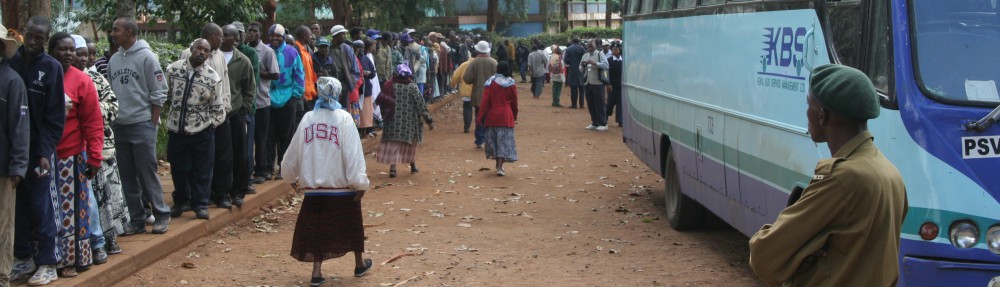
“Christianity’s explosive growth in Kenya,” by Philip Jenkins in The Christian Century.
Here is an interesting paper regarding the choice of the instrumental use of election violence:
Stealing an Election: Violence or Fraud?∗
Dawn Brancati, (corresponding author) Yale University
Elizabeth M. Penn, Emory University
Spring 2020
Abstract
Political actors often resort to electoral violence in order to gain an edge over their competitors even though violence is much harder to hide than fraud and more likely to delegitimize elections as a result. The existing literature tends to treat violence and fraud as equivalent strategies or to treat violence as a means of last resorts due to its overtness. We argue, in contrast, that violence is neither and, in fact, that political actors often use violence for the very reason that it is hard to hide. Its overtness, we argue, allows political actors to observe whether the agents they enlist to manipulate elections for them do so and reduces these agents’ likelihood of shirking in turn. We develop our argument through a formal model, illustrating how increasing incentives to shirk due to electoral monitoring induces actors to use violence, and use process tracing to test the implications of this model through the example of pre-2011 Egypt.
And new poetry from Sonya Kassam at “Follow Your Shadow” with a “quarantine music” interlude.

Like this:
Like Loading...