“Media Zombie” stirs as Kenyan legal process moves forward [updated]

[Update: here is the Sunday Standard, “How Raila’s poll petition may change the whole game”]

“The many questions IEBC needs to clear with Kenyans over elections.” The Saturday Nation

The “media zombie” awakes with a recitation of damning basic questions about the systems employed by the IEBC.

AfriCOG and other Kenyan civil society groups were left as lonely voices before the election while the public relations of the IEBC and the rest of the Kenyan Government, propped up as best I can see so far by the “western donors” (with money from taxpayers like me) and the “aid industry” peddled false assurance. I will have to admit that the situation is significantly worse than I had realized.

And then beyond the systems that were not even seriously in place, we have the specifics of bogus numbers coming out with election challenge petitions by AfriCOG and by the CORD campaign filed today. So much like 2007 only worse in terms of a mass “overvote” in the presidential race.

“Halt the Party, It’s not yet Uhuru”, Wycliffe Muga in The Star.

In the New York Times, Jeffrey Gettleman notes the extreme pressure on Kenya’s judges:

The case is sure to be a test of Kenya’s recently overhauled judiciary. It is now much more widely respected, but some analysts have questioned whether all six Supreme Court justices will be able to withstand the pressure of refereeing such a high stakes contest for power. Even before the election, the chief justice received death threats, and analysts have raised questions about the independence of some of the other justices.

To avoid confusion about the Kenyan ELOG “Parallel Vote Tabulation” . . .

Quote

Freeandfair Kenya on March 11, 2013 at 11:14 am said:

The most publicly available check on the elections — the Parallel Vote Tabulation done by ELOG did everyone a disservice by saying their results were “consistent” with the IEBC’s. This makes it sound as if it supported the IEBC’s count. It does nothing of the kind. See http://www.ndi.org/files/Kenya-ELOG-PVT-statement-030913.pdf. Not only do they find that Uhuru received 49.7% of the vote, they have a margin of error of 2.7%. This means that MOST of their prediction is for a RUNOFF. A tragic, incorrect, and unprofessional use of terms.

This was a comment in response to my post “Overall Observation on the Observations”–this is important and apparently there has been some confusion.

“Peace,” “Truth” and American commentary in the wake of the election

“Peace versus Truth: A Story of Unnecessary Trade-Offs”.

“Indictee for President!”  Michella Wrong writes in the New York Times Latitude blog on how “being prosecuted by the ICC helped Uhuru Kenyatta’s chances in the Kenyan election.”  I would go a little further back and identify the ICC indictment as the impetus for Uhuru’s launching of his TNA party and his run for President in the first place, through his emergence as the dominant Kikuyu candidate.  In other words, absent the ICC factor, I doubt Kenyatta would have run, or at least run seriously, and if he had, I doubt he would have gotten very far early on.

Here is Jendayi Frazer’s solo interview on PBS NewsHour last night: “Western Allies Have ‘Muted’ Response to Kenya’s Presidential Election”:  

GWEN IFILL: After all the violence in 2007 and 2008 after the last presidential election, we were all bracing to see if the same thing would happen this time. And so far it has not. Why do you think that is?

JENDAYI FRAZER: Right.

Well, I think the Kenyans learned lessons from 2007. And the civil society very much was guarding their country and guarding against future violence.

They also had this election under entirely new institutions. There’s a brand-new constitution. There’s a de-evolution of power from the center, from the presidency, to governors of 47 counties. There’s county assemblies. And so I think the diffusion of power, the expectations about their new institutions and the lessons learned from 2007 account for the lack of violence this time.

Frazer is right in identifying why the situation in 2013 was different and “the same thing” that happened in 2007-08 was not going to happen this year.  There is an irony, however, for her to invoke the work of Kenyan civil society, and the reforms of the new Constitution, in the context of her advocacy now in regard to this election when William Ruto was the leader of the “reds” who campaigned against the Constitution and  Uhuru Kenyatta was seen as a “watermelon”, nominally “green” or pro-Constitution on the surface, but “red” in substance.  The “Uhuruto” Jubillee Coalition took the position pre-election that it wished to restrict civil society if it took power.

Otherwise, there is much that is very telling in this solo interview about how the American media covers politics in the “developing world” and Africa in particular, and much that is telling about America’s official and unofficial interaction with foreign politicians and leaders.

It should be noted that for someone that served only a short time in the State Department, Frazier has positioned herself as a dominant figure in the Washington media in commenting on this election.  A plausible reason for this relates to the fact that she has deeper roots in the Kenyan scene than her service as Ambassador to South Africa and then Assistant Secretary of State for African Affairs in the Bush Administration.  These roots, however, are not discussed publicly in the context of her commentary on this Kenyan election.  By reputation in Kenya, Frazer is identified widely but privately as a close family friend of the Kenyattas,  Read the following exchange in this context:

GWEN IFILL: Uhuru Kenyatta, you have met him. You know something of him. What do we know about him, other than he’s the son of a very famous leader of the country, a very wealthy man and now is under this cloud?

JENDAYI FRAZER: Well, he’s also very much a person who respects the West. He was educated in the United States. He’s been pro-Western in his outlook.

He’s been the minister of finance before and the deputy prime minister. He’s always had strong relations with the United States. Now, the case against him is problematic. And as it was stated, it’s falling apart. The co-conspirators have all — that were charged with him are charged with attending a particular meeting at statehouse and in that meeting planning reprisals against the violence that was being meted out against the Kikuyus.

But the key eyewitness has now said that he lied and he’s been changing his testimony and has — and even said that he’s taken bribes. And so the case is falling apart.

There is much that is unsaid that may be of vital import.  One question is simply whether Dr. Frazer, especially as a private citizen engaging with this is in a position to be objective about Kenyatta personally beyond describing the basic relationship to the U.S.  Second, and relatedly, there is much more involved here than just the actual status of ICC prosecution’s case: there is also the bigger moral question of whether or not Kenyatta, and his running mate Ruto, are in fact innocent of being directly involved in deliberate killing of innocent Kenyans on the basis of their ethnicity for instrumental political reasons.

From a standpoint of pragmatic realpolitik, as well as for Western private and business interests, it might be convenient now for the ICC cases, especially the case against Kenyatta, to “go away” to protect the ability to do “business as usual”.  Frazer is right that Kenyatta has had ties in the U.S.–he would have been a favorite of some others in the U.S. but for the post-election violence in 2008.  But I do not believe that there are very many Kenyans at all–whether Kenyatta voters or not–who do believe that both Kenyatta and Ruto did not in fact do in essence, if not in exact detail that can be proven in court now, what they are accused of doing in terms of engaging in leadership of “militia” killings.  Kenyatta’s appeal in fact relates to the notion that the use of the Mungiki to kill in the eastern Rift Valley was in some notion “defensive” of Kikuyu killed by members of other tribes in other places further west in the Rift Valley (what Ruto is accused of being involved in).

Part of what is happening here is that by attacking the shortcomings of the ICC and the Western media among others, some are seeking to relieve themselves of some of the moral tension associated with the haunting question of whether “peace” is being bought by the (possible) election of “killers”.

In this context, here is a link to Dr. Frazer’s aggressive interview with Michelle Martin on NPR’s “Tell Me More” this afternoon.
Kenya Election: Overall Observation on Observations [Updated]

This is a quote from an e-mail I sent to an expert back in the U.S. on my way home from Kenya, where I am now. As far as a candid summary of what I think happened in the Kenya elections:

Overall situation with observers was that they were extremely reticent to say anything of substance because of the fear of violence and the fact that IEBC process was ongoing. Further, because of Jubilee attacks on the British High Commission and the West more generally (in my opinion at least) there was an extra level of reticence to say anything that would confront the Government of Kenya election process. We ended up with little impact, if not window dressing, as far as I can see. Someday they will write final reports that might, I hope, involve a deeper look into the original vote count and subsequent events, as well as the prior problems that led to a small voter registration pool, etc.

See Robyn Dixon’s piece in the Los Angeles Times , “Kenya election over, dispute over outcome heads to Supreme Court”::

The narrow margin and repeated failures of the election commission raise the possibility that the Supreme Court could call for an audit of the election result, analysts said.

Kenyatta got 50.07% of the vote, crossing the line with a margin of some 8,000 votes out of more than 12 million cast.

Despite the failures, Kenya’s news media were muted in their reportage of the commission problems. Even international observers have tip-toed around the subject.
However, respected Kenyan anti-corruption crusader John Githongo called the election a failure Sunday. Githongo, an election monitor, said for months a group of community organizations had tried in vain to warn the election commission of problems in its systems and approach.

“In my personal opinion, it’s a failed election,” Githongo said in an interview with The Times. “I think the IEBC performance was catastrophic. I was part of a group of organizations that repeatedly warned them that these problems were there and on the way.”

Commission Chairman Issack Hassan denied the problems and failed to turn up for meetings with the organizations, according to Githongo.

Githongo said Kenyans were so keen to avoid a repeat of the violence that followed the disputed 2007 poll that many, especially in the Kenyan media, kept silent about the obvious problems in the election commission.

. . . .

Githongo’s criticisms come after reports that Safaricom, the mobile phone provider involved in the electronic system that was supposed to transmit results to the central tallying point, also warned the commission of looming failures in the weeks before the election, and was also ignored.

Patrick Smith, editor of the journal Africa Confidential, said Western officials privately condemned the commission’s appalling performance but said nothing publicly “for fear of being seen as interfering in the election”.

. . . .

Election Observers and the “Emperor With No Clothes” Phenomenon

Surely there is embarrassment over the allegation made by observers that hundreds of thousands of Kenyan voters confused the green ballots for National Assembly and blue ballots for Senator, and made similar improbable errors, due to “lack of civic education”.

This was offered as an explanation for huge numbers of “invalid ballots,” which turned out to be the bogus data from the IEBC from their electronic reporting system before it was taken down.

In other words, when the Kenyan IEBC reported something that did not make sense–and clearly was contradictory to what actual observers SAW in the field with their own eyes since it did not really happen–some self described International Election Observers, rather than point out that they did not see what the IEBC was reporting, instead, sought to concoct specific explanations for why the voters instead of the electoral commission (or hackers or whomever caused the data fault) was responsible.

Who would have the outrageous moral audacity to go to court to question 4100 votes out of 12M rather than defer to “crimes against humanity” suspects?

A simple question of what Kenyans chose to expect of and hope for themselves really, for them to answer.

Everyone is tired, no question. Most Kenyans are poor, and the breakdown of the IEBC process caused loss in the economy which hurts poor Kenyans the most. At the same time, the short term value of sweeping another electoral commission fiasco under the rug would be balanced by a huge cost in terms of the dreams of democracy that seemed to have been achieved in the 2002 vote.

The situation regarding the vote is less clear than in 2007, but the meaningful ability to go to court exists this time, unlike in 2007. Should the legal process be shelved now that it is finally available–and if so, will it be available again?

Kenyan High Court, while finding no jurisdiction to examine IEBC’s process because it touches on the election of a President, states that civil society case raises issue that should be examined in appropriate forum

My personal heroes with Kenyan civil society, the African Centre for Open Governance, went to the Kenyan High Court this morning with a petition seeking equitable relief to direct the IEBC to follow the election law, focusing on the verification of actual voting by polling station as discussed in my previous post.

The court ordered argument on jurisdiction alone at 11:00am in front of a three judge panel appointed by the Supreme Court, with ruling to be announced at 3:00. The ruling was not announced until 4:30. The court ruled essentially that any challenge to IEBC procedure related to the presidential election such that it could only be brought in the Supreme Court of Kenya. IEBC’s lawyer also argued that the Supreme Court could only hear the case after the IEBC declares an election result, although that would presumably be a decision for the Supreme Court itself. Thus the High Court “struck off” the case, finding no jurisdiction to act.

However, the Court did state that they had reviewed the affidavits and other evidence presented in support of the petition and found that they raised issues that were “not idle” and should be pursued in the appropriate forum. And ruled that each side to bear its own costs.

Things remain with the IEBC the time being.

Taking Down My Last Post . . . Kenyan Election Is “Overeported” and “Under Researched” based on lack of transparency

The voting was over by Tuesday, March 5. The IEBC (the Kenyan replacement for the previous discredited Electoral Commission of Kenya or “ECK”) then has seven days to announce final results from the votes, which are cast by paper ballot and counted (only) at the individual polling stations around the country. The results at each of the more than 30,000 polling stations around the country are set out on multiple original official forms which are signed by the election official and the political party agents. One original is then posted on the door of the polling station where the counting has been done. This way the public can see the results while the armed guards at the door keep the public out of the room where the physical ballots are secured back in the sealed ballot box after counting.

Since the digital transmission of results failed for reasons that remain unexplained factually but much pontificated about, we are left with less information early than we would have hoped. But, as long as the forms remain available for each polling station, and are open to the public, we ought to be able to nail down how people voted–at least as the votes were counted.

Unfortunately, there is much pressure to rush and do something less than verification based on the actual documented count of the votes.

In 2007, the actual voting results were ultimately never released or disclosed, and while many court petitions were successfully adjudicated in parliamentary and local races, the Kreigler Commission appointed under the post election settlement to investigate the failed election passed on any further effort to actually determine the presidential votes as counted and announced at the polling stations. While there are alleged “official results” published by the ECK, they are only alleged aggregated numbers by parliamentary constituency, not by actual unit of voting and counting.

For my American readers, imagine results for the presidential election that are announced only in aggregate by Congressional District.

See my previous post for the results at the polling station where I observed. This information should be available for each polling station, and should then add up to what is reported as a matter derivatively on up the chain.

Kenyan Election Day–voting, counting, posting Form 34 on the door

20130305-001845.jpg

20130305-001939.jpg

20130305-001748.jpg

20130305-001831.jpg

Closing out polling station and presidential count: amazing Kenyans exceed 80% turnout in spite of technology failure

Okay, congratulations are in order for a great job by presiding officers and polling clerks, and incredibly patient voters at the polling centre where I spent the late afternoon and on until finishing the presidential count and posting the signed off results on the door to be photographed at the stream I was covering.

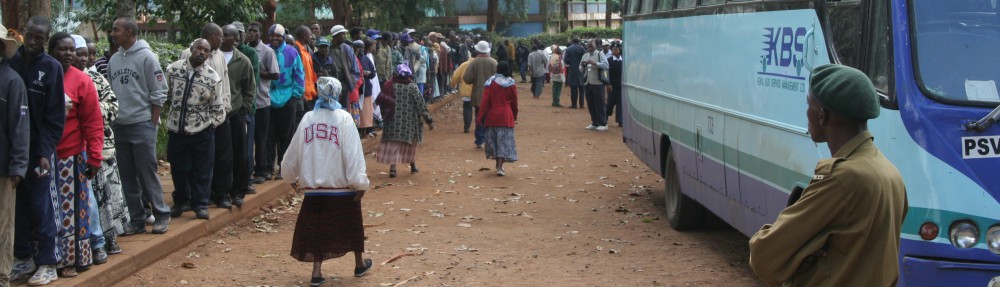
Everyone got better at adapting to the absence of the technology and the cumbersome process and voters moved much faster through the remaining lines in late afternoon and early evening. Having stood in the hot son all day in huge lines surely motivated everyone to get done, but essentially no grousing was to be heard where I was at that point.

Turnout at the stream I closed was 626 valid votes cast for president from 755 registered voters. So over 80%. The boxes were jammed full of ballots but the system worked. Totals for president were Odinga 433, Kenyatta 170, Mudavadi 8, Kenneth 7 and the rest less. Dida was the only presidential candidate in that stream to get 0.

Will post “snaps” soon.