It’s nice to have the American election over with more than 3 months to go in Kenya . . .

Donkey

Mara Herd

With the same division in Congress and a second Obama Administration to be formed, at least the opportunity for continuity and maximum cooperation exits on the U.S. side in addressing the challenges presented by another possibly controversial and high-risk election in Kenya.


Kenyan Military to deploy to Samburu

The Kenyan government announced this evening that the Kenya Defense Forces (KDF) would be deployed domestically to participate in responding to the massacre of, at latest count, 42 Kenyan police officers in an ambush by cattle raiding “bandits” with sophisticated weapons.

It goes without saying that this mass killing of police is a shock in itself.  It is also troubling for its implications for the capacity of the police to address violence in other instances, such as unrest related to the upcoming March election.  The “bandits” are reported to have had weapons such as rocket-propelled grenades that are well beyond the “firepower” associated with the usual run of cattle raids.


Readings to prepare for the Kenyan election

Kenya Voting: "Curriculum Cooking"

The new report “Kenya’s 2013 Election: A Review of the Environment and Electoral Preparedness”, the latest installment for The Kenya National Dialogue and Monitoring Project from South Consulting was released last week.

No big surprises here, but worth reading for anyone planning to be involved from here forward.  The most unique thing about these reports is monitoring of public opinion in regard to the various reform and election preparations issues.  Takeaways: confirmation that the public nationally has still had a high level of support for the ICC process.  In Central and Rift Valley, support is significantly less than elsewhere, but still nears 50%. Confidence in the independence and expected effectiveness of the IEBC was holding up in spite of the problems with the BVR tender.  The reform process for the judiciary has been well received with a big increase in confidence in the courts versus the past.  On the other hand, nothing of significance has been done in regard to land issues, there has been little done of police reform, and the early pre-election violence has contributed to a large increase in the level of insecurity and expectations for violence around the elections.  Interestingly, however, there has been some uptick in perceptions of the police in spite of the lack of progress in implementing major reform.

A personal observation is that confidence in the IEBC is a double-edged sword.  If the IEBC has a real chance to deliver a fair and fully legitimate election, then a high level of public support going in can have significant advantages in encouraging the public to avoid cynicism, participate in the process, tone down “negative ethnicity” and avoid pre-election violence, etc.  Perhaps most importantly, it could help buy patience in addressing issues and problems that will inevitably arise in the final stages of a close election.  On the other hand, if the 2013 election turns out to be openly irregular as in 2007, the dashed expectations should be expected to be naturally volatile.

More important reading on what happened in 2007-08 from a study, Spontaneous or Premeditated? Post-Election Violence in Kenya, from Dr. Godwin Murunga published last year by the Nordic Africa Institute.
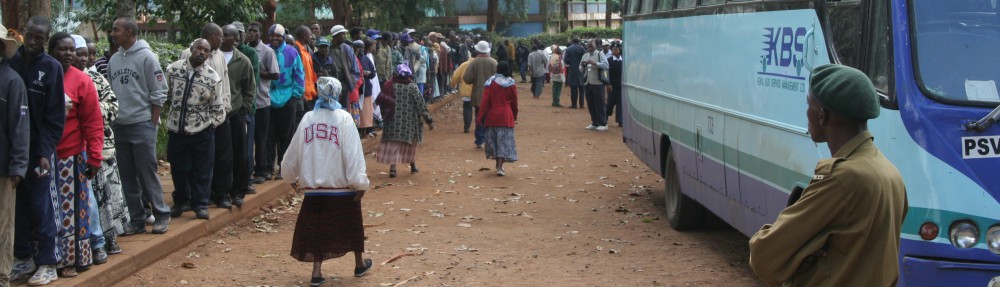
BVR Kits start arriving in Nairobi

The first two air deliveries of Biometric Voter Registration kits arrived in Nairobi from France today.  Here is the story from The Star, with some additional background:

The IEBC met with President Kibaki on Monday during which they sought to assure him of their preparedness to oversee the election.

The meeting with Kibaki followed a similar one with Prime Minister Raila Odinga where the government undertook to pay the entire cost of procuring the kits from its own resources but with the expectation that the government of Canada would sign off the concessionary loan to refund the cost which has now risen to more than Sh9 billion.

The manufacturer, Morpho Inc of France, had demanded full payment before delivering the kits. At the time, the government had only paid 40 per cent of the cost. Government then signed a loan facility of Sh7.2 billion with Standard Chartered Bank to pay for the 15,000 kits to clear the balance.

The Daily Nation reports that the IEBC is expected to announce the new compressed voter registration schedule tomorrow: 

A massive campaign to mobilise voters is expected to be put in place so as to attract a large number of Kenyans to register within one month due to time constraints.

“We want Kenyans to respond within a month because we will not extend the registration period. We will use the media and other available means to enhance our campaigns to target as many people as possible. We also expect politicians campaigning for various positions to pass this message to the targeted population,” Mr Hassan told a previous media briefing.

The delayed delivery of the equipment has been a major concern in the country forcing the shifting of various crucial timelines.

IFES to webcast Friday workshop on Kenya Diaspora voting

The live event will take place at the International Foundation for Electoral Systems headquarters in Washington from 10:00am to 2:00pm Eastern Daylight Time on Friday, November 2 (5:00pm to 9:00pm Nairobi):
A mandate of the newly appointed Independent Electoral and Boundaries Commission (IEBC) of Kenya is to enable diaspora voting. With this, there is immense pressure from political parties and diaspora groups to fully enable out-of-country voting during the March 2013 elections. The IEBC has enacted a policy that will allow Kenyan voters to register and vote at 47 embassies worldwide.
 
However, this policy may not completely satisfy the demands for out-of-country voting accessibility.
 
To promote better understanding of this issue among officials and leaders of the Kenyan diaspora, IFES will broadcast a workshop via live webcast to describe the complexities surrounding the out-of-country voting process.
 
Invited experts will examine key topics, including:
  • Implementation of out-of-country voting
  • Biometric voter registration and its significance in Kenya’s elections
  • Costs and benefits of Internet voting
  • Registration and voting procedures for members of the Kenyan diaspora
Featured speakers will include:
  • Ahmed Issack Hassan, Chairman, IEBC
  • Peter Erben, Senior Global Electoral Adviser and Chief of Party in Indonesia, IFES
  • J. Alex Halderman, Assistant Professor of Computer Science, University of Michigan
Moderated by Mike Yard, Chief of Party in Kenya, IFES
 
This event will be webcast.
Here is the link for the IFES Multimedia page for the webcast.