USAID Administrator Rajiv Shah blogs from Kenya

USAID Administrator Rajiv Shah has been in Nairobi this week as part of a six day visit to Africa, his first since taking office.

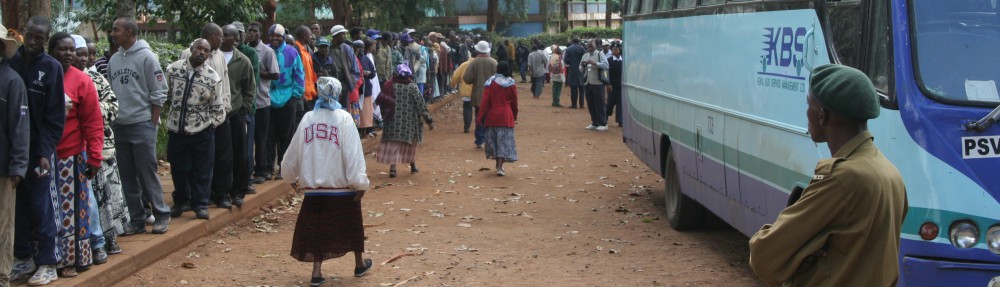
The new USAID blog has items from several site visits to projects supported by USAID. Shah’s entry here highlights USAID support for the pilot project for electronic voter registration in 18 constituencies. Here he talks about internet entrepreneurs in “Silicon Valley in the Savannah”.

GAO says U.S. Dept. of Defense needs to determine future of Horn of Africa Task Force; report highlights challenges regarding coordination and effectiveness of civil affairs/development work

Government Accountability Office release.

The full 45 page report is here.

When we met with CJTF-HOA officials in October 2009, they estimated that, in addition to other tasks, about 60 percent of the task force’s activities focus on civil affairs projects. To conduct these quick, short-term projects, CJTF-HOA has established small civil affairs teams (for example, five or six personnel) who deploy to remote areas to engage the local communities and perform activities such as medical and veterinary care for local communities. While deployed, the teams generally nominate project proposals based on assessments they conduct as to what the communities need. The proposals are reviewed for approval by USAID, the embassy, CJTF-HOA, and AFRICOM prior to execution. During our October 2009 visit to the U.S. embassy in Ethiopia, we learned of several project proposals from civil affairs teams deployed in the country, ranging from under $10,000 to about $200,000—including the construction of a teaching farm, school renovations, training for local mechanics,

construction of an orphanage, and renovation of a bridge. None of the project proposals in Ethiopia had been approved at the time of our visit. CJTF-HOA officials told us that the project approval process can be lengthy, potentially lasting an entire year. This is generally longer than the tour rotations of some CJTF-HOA civil affairs team personnel.

. . . .

Furthermore, CJTF-HOA is coordinating with the Navy and coalition partners in CENTCOM’s Coalition Task Force 151, which conducts maritime security operations to protect shipping routes in the Gulf of Aden, Gulf of Oman, Arabian Sea, Red Sea, and Indian Ocean. AFRICOM has also established a socio-cultural research and advisory team on a semipermanent basis at Camp Lemonnier. The team consists of one to five social scientists who conduct research and provide cultural advice to the command.

. . . .

Other CJTF-HOA proposed activities may not consider the full range of possible effects or may not be clearly aligned with AFRICOM’s mission. For example, Department of State and USAID officials we contacted at one U.S. embassy expressed concern that some of the activities that CJTF-HOA had previously proposed, such as building schools for the partner nation, did not appear to fit into a larger strategic framework, and said that they did not believe CJTF-HOA was monitoring its activities as needed to enable it to demonstrate a link between activities and mission. These officials told us that instead of leveraging long-term data to guide future activity planning, CJTF-HOA may be proposing activities without considering the full range of potential consequences. The embassy officials cited a past example where CJTF-HOA had proposed drilling a well without considering how its placement could cause conflict in clan relationships or affect pastoral routes. Officials at other embassies described similar problems with CJTF-HOA proposals. To mitigate such issues, U.S. embassies have steered CJTF-HOA toward contributing to projects identified by USAID, which are better aligned with embassy and U.S. foreign policy goals. Moreover, some CJTF-HOA activities appear to be sporadic, short-term events that may not promote sustained or long-term security engagement. Continue reading

A little good news . . .

In spite of some serious flooding, the overall good rains in Kenya have resulted in “major improvements” in food security, reports the Famine Early Warning System Network.

Rift Valley Railroad–Eastern Province, Kenya

Meanwhile, back inside the Beltway . . .

Three Republican Congressmen have asked the Inspectors General of USAID and the State Department to investigate the notion that Ambassador to Kenya Michael Ranneberger and others are violating U.S. law prohibiting the use of foreign aid funds to lobby for or against abortion. The theory here is that activities supporting passage of a new Kenyan constitution constitute lobbying for abortion because the final proposed draft, which states that life begins at conception (unlike the current constitution) and makes abortion generally unconstitutional also has potentially ambiguous language that allows some “health of the mother” exception.

In other words, the proposed new Kenyan constitution is much more favorable from a pro-life perspective than the U.S. Constitution as interpreted by the U.S. Supreme Court over the past thirty-plus years.

I remain convinced that Kenyans are wholly qualified to make up their own “hearts and minds” and cast their own votes. If we can avoid confusion and help the process of the vote itself that’s good. We don’t have a great track record, especially in the last election, and in the past in giving too much public and private support for too long to Moi. We should be humble and careful.

Jeffrey Gettleman has a rundown of the American culture wars, East African front, in the NYTimes.

Trade and Aid [Update]

A Good African Tale: an African entrepreneur struggles for recognition in rich county markets from the Economist.

Update: “Rwanda Coffee Success Story” from William Easterly’s AidWatch (HT Texas in Africa)

Nick Wadham’s latest in Time: Bad Charity (All I got was this lousy t-shirt) — and his related blog post, Top-Down Aid for Africa.

Texas in Africa has a great related multi-part series of discussion questions May 4-7 about the Western approach to aid and development in Africa:

This week I’ve been trying to sketch an outline of how Westerners tend to develop and characterize our relationship with Africa and the people who live there, specifically with reference to the international aid and development system. I’ve argued that the savior mentality is misguided, that Africa is not rightfully ours to save, and that a better way to assist would be through a paradigm of empowerment. . . .
Today I want to conclude this series by thinking about what is probably the biggest barrier to moving into an empowerment paradigm: the governments that give and receive aid. . . .
Why? Because aid – for donor governments and the governments which receive the bulk of aid – is inherently political. Except in cases involving natural disasters or epidemic disease, donors don’t typically give freely to everyone out of the goodness of their intentions. Aid projects are funded at least in part (and sometimes entirely) on the basis of donor priorities. When aid projects take into account the real, expressed needs of recipients (which is, I’m glad to say, increasingly real for most project), they are often structured in such a way as to advantage suppliers or producers in the donor state, or to reward good governance or provide support to an ally.
As we might expect, there is often a contrast between donor goals and what is actually needed in order to improve the material situations of the recipients. . . .


UPDATE
NYTimes: “At Front Lines, AIDs War is Falling Apart”; “Paper Cuts: How Obama’s Father Came to Hawaii”; “Letters: From Kenya to America”

Reuters: Donors to slash Tanzania budget aid.

Nick Wadhams at NPR:“Somali Pirates Take the Money and Run, to Kenya”

The Times (London): Book review–“War Games: The Story of Aid and War in Modern Times by Linda Polman
Humanitarian aid prolongs conflict and misery because the bad guys learn how to exploit it”
;
“Easy Money: the great aid scam”

Reuters Stories from Helen Nyambura-Mwaura in Burnt Forest, Eldoret and Nakuru–Rift Valley Arms Race?

Kenyan Tribes Arming Ahead of Elections: Group

Fear stalks Kenya’s Rift Valley ahead of votes

Q+A: Why is Land in Kenya a perennial flashpoint?

U.S. House Speaker Pelosi Visits AFRICOM Headquarters in Stuttgart

U.S. Africa Command Home

The Speaker is no stranger to Africa.

“I met my husband at a course called the History of Africa South of the Sahara, and I have been studying Africa for decades,” Pelosi said in a brief interview.

“At long last the United States and the world is treating the continent, and individual countries, with the respect that they deserve,” she added.

At the conclusion of her U.S. AFRICOM engagement, Pelosi said that she was leaving confident “that General Ward and all of those working with him have a respectful attitude to the countries of Africa, want to work with them to develop solutions, and I have confidence that they will succeed.”

Kenyan Constitution and the Rule of Law

Most people that I have talked to expect the new Kenyan constitution to pass in the upcoming August referendum in spite of opposition from several church groups and politicians. This is also the view of the US-based consultancy STRATFOR in a new report on Kenya. The Synovate poll taken in late April showed a heavy balance in favor of a “Yes” vote, including among those who had disagreements with some specific points in the draft.

Looking ahead, the question may become, how much will the changes in the law really matter?

The Brookings Institution published an interesting study by Daniel Kaufmann  earlier this year criticizing the tendency to focus too much on the de jure rules of law rather than the de facto workings experienced in practice, citing the current situations in Kenya and the U.S. as examples:

First, consider Kenya in 2007. The main aid donors, led by the World Bank and the United Kingdom’s aid agency, DfID, tended to praise the governance reform efforts of the Kenyan authorities, including those on legal initiatives and anti-corruption.[1] Subsequently, in the run-up to the presidential elections, these top donors, also including the United States, flooded the Kenyan government with funds. Kenya’s government was even awarded a special international prize recognizing its good governance efforts.[2]

Elections were held a few short days after the last 2007 World Bank press release in Kenya, which announced approval of funding yet another project for the government.[3] The elections were widely regarded by external organizations, such as the EU, and by many Kenyans[4] as rigged, in what was the culmination of years of systemic political corruption that infiltrated key legal and judicial institutions. Civil strife erupted and the full extent of the breakdown of law and order was exposed at a dire cost—thousands of lives were lost and vast socio-economic damages were inflicted.[5] Yet, the main aid donors appeared to be shocked that such corruption, electoral mismanagement, and turmoil could take place in Kenya.[6]

Around the same time and half the globe away, some rule-of-law institutions were being quietly undermined inside the world’s superpower: the United States. In April 2004, amidst euphoric financial sector growth, a meeting was held in the basement of the Securities and Exchange Commission (SEC).[7] The top executives of the main Wall Street investment banks gathered to weigh in on proposed SEC regulations that would relax restrictions on their investment houses.[8] A scant 55 minutes later, the investment bankers emerged with SEC approval; the new regulations exempted the investment groups from the leverage restrictions that apply to commercial banks, allowing the banks to massively expand their debt.[9]

In return for the green light to an enormous expansion of indebtedness, the investment banks agreed that the SEC would have more oversight over them, for which a special unit would be formed.[10] In practice, the oversight did not take place. In fact, the head of the SEC never created or staffed any such oversight unit.[11] The resulting financial debacle that followed is now well known. What is insufficiently appreciated is the fact that various manifestations of “soft” and “hard” forms of regulatory and legal capture by the elite financials were a factor leading to the crisis.[12]

There are many salutary features in the draft constitution, on paper, but the real question will be making them work in practice. Rule of law will crucially depend on reform of the police, consistently rated as among Kenya’s most corrupt institutions, as well as better access and more effectiveness in the court system.

The outstanding issue of prosecutions for post-election violence is a good immediate test. ICC prosecutor Luis Moreno-Ocampo is in Kenya now, and is said to have informed the government that he will seek to bring two cases against three key individuals each, in the Hague in the September-October timeframe. The government continues to pledge cooperation, but continues not to take specific steps to effectuate the law passed by Parliament to provide for witness protection.
“Electoral Fraud and the Erosion of Democratic Gains in Kenya” — James Long of UCSD Center for Study of African Political Economy presents new draft paper on Kenyan election

James Long with whom I worked on the USAID/IRI/UCSD/Strategic exit poll has more detailed study of fraud in the 2007 Kenya elections along with further discussion of the exit poll and its handling.

Read Long’s working paper as presented May 1 to the Working Group in African Political Economy meeting at Pomona College.