IRIN Africa | SUDAN: What they’re saying about the referendum

IRIN Africa | SUDAN: What they’re saying about the referendum The UN humanitarian news service has a run down of links to major recent reports relating to Sunday’s referendum from the International Crisis Group, the Small Arms Survey, the Enough Project, the US Institute for Peace and the AU High-level Implementation Panel.

Sudan referendum voter registation begins Monday amid complaints by registrar

The head of Sudan’s voter registation effort blasted the Western donors for funding third parties to work in support of the registation effort for the referendum rather than fund the official agency receiving funds from the Northern/National and Southern governments, reports Reuters.

Sudan Update

Major State Department briefing today with Special Envoy Gration, Assistant Secretary Carson and Samantha Power from NSC on Sudan diplomacy.
Interesting reference to Kenya leadership: “Regional leaders have a central role in the implementation of the CPA. The U.S. has been in close contact with Uganda’s Museveni, Ethiopia’s Zenawi, Kenya’s Odinga, and chair of the Pan-African Union Jean Ping.”

Maggie Fick writes at Foreign Policy about the risk of internal fighting within the South even if the referendum succeeds and things are stable between North and South. This is well beyond any claimed expertise on my part, but I have a hard time imagining that she isn’t completely right–and I would certainly hope that serious consideration and planning has been going on within the U.S. foreign policy and security establishment on this for quite some time. The “gold rush” mentality coming from foreign investors and even NGOs–will certainly be a factor. Remember that Rolling Stone article about the Americans and warlords and mass tracts of farmland just south of the North/South border?

Kenya v2.0 or 1.3?

A week after the big party, several thoughts on where Kenya stands with the new constitution.

First, I do think the successful referendum and passage of the new constitution is consequential in itself. Kenyans got to make up their minds, go vote, and their votes counted. This process can work in Kenya.

In this sense, the Government of National Unity has carried out one of the core functions under the original post-election agreement from 2008 and compared to how things looked in December of last year when I started this blog, the GNU has made a better account of itself not so much for affirmative acts, but for letting the process established work.

These things said, the Constitution provides an outline of the “functionalities” needed for a “Second Republic”–writing working “code” to execute these in practice is the work at hand.

While the passage of the Constitution itself is a long-awaited breakthrough, I did chose to quote in my “historic day” post from the Standard article noting the highest expectations since the election of the NARC ticket in 2002 with full appreciation for the cautionary tale to be had from looking at how those expectations were dashed. Right now the new Constitution is a milestone; what else it will be is to be determined.

A new Republic with require people as well as systems. Right now, we have in Kenya the same people in political power. Their judgment is reflected in the how they managed to taint the celebration of the accomplishment of the country in passing the new Constitution. Apparently the thinking went like this: “We are having a picnic. What is a picnic without a skunk? Let’s invite Bashir!”

The Tally

Calculating the Totals

Kenyans Vote (Updated)

UPDATE: Polls have closed at 5pm in Kenya, 10am Eastern in the US. See new Gettleman story “Kenyans vote on new constitution”.

Follow the voting and results through live updates with this Global Voices page as well as at Uchaguzi.

My sense going into the vote is that the constitution would pass by a good margin and the level of violence would be relatively lower than feared. Things do seem to be going smoothly so far. Violence in the past has either been state-supported or tied to the misconduct in counting the votes. With what seems to be a serious effort by the security services to work against violence this time, reflecting President Kibaki’s apparent commitment, the environment seems quite different for this vote.

See Gettleman in this morning’s NYTimes on the atmosphere in the Rift Valley prior to the voting, and this story from the BBC.

Kenya–All over but the voting?

This is a little girl in one of the areas affected by violence in the last election. Please pray for a peaceful and fair election. Thanks.

IMG_0514_1

Watch reporting on Uchagazi.

The Daily Nation reports “It’s all systems go for Kenya’s referendum” (Subliminal “Green”/”Yes” message there?)

The Economist also has a late take on tomorrow’s vote: Kenya’s constitutional referendum: a chance to improve how Kenya is run

At the end of the day, they wisely conclude, much work remains:

Even if the constitution is endorsed by a fat majority, the dangers that have afflicted Kenya will not evaporate. There has been a lot of talk about peace. But the power-sharing government formed after the violence of early 2008 by President Kibaki and his rival, Mr Odinga, has dismally failed to address the main causes of instability: a lack of land and jobs. Far too many young men have no chance of getting their hands on either, especially in the volatile and tribally mixed Rift Valley and in the teeming, fetid slums of Nairobi. Many Kenyans fear that the anger of such people could boil over again in 2012.

A comment worth quoting:

Whatever the outcome in the plebiscite, we must put in place better mechanisms to hold leaders to account and stop this abuse and impunity. Leadership connotes serving as a faithfully fiduciary and finding the best solution to intractable challenges the nation faces. Good leaders are not necessarily those who brandish the sharpest intellect, or possess the most alluring visage, but those who, through determination, ingenuity and wise counsel, achieve the aims of the nation. These qualities are severely wanting in Kenyan leaders if the misery that bedevils the nation five decades after independence is considered.

We all know that even with a very good constitution, if we have poor leaders and people are not vigilant in holding them to account, Kenya will not make progress. What we need is a good constitution coupled with good leaders keen on fighting corruption, curbing negative ethnicity, appointing officials on merit and improving efficiency in the bureaucracy. We need a leadership that will abandon slogans and platitudes and work hard to lift the millions of people in want out of poverty.

How to have quieter, safer elections in Kenya?

One of the other writing suggestions I have had recently was the topic of how to move Kenya in the direction of countries where elections are routine, quiet and uneventful–part of the ordinary course of affairs as opposed to occasions for violence and even deaths and displacement.

Lots of things to point to here:

1. Be careful what you wish for and appreciate what you have. There is good in the fact that Kenyans care about elections and are engaged and motivated politically. I could give you some opposite examples of apathy and distraction in the United States during the housing and internet bubbles. Part of the reasons elections are quieter in South Africa, for instance, is probably the dominance and unique status of the ANC.

2. In Kenya, job opportunities and economic activity for younger people outside Nairobi would help a great deal with reducing the “drama” associated with campaigns and elections–as of course would economic development improving circumstances in the Nairobi “slums”. This would greatly inconvenience the current political class by raising the cost of raising gangs, for instance, as well as more generally raising the cost of menial labor in Nairobi, so there will continue to be entrenched resistance.

3. Violence in the elections in Kenya is mostly, at root, a product of bad acts by bad politicians. They do what they do because it works and serves their interests. Overwhelmingly, Kenyan citizens want criminal prosecution of key political actors in the 2007-2008 post election violence. To date, however, impunity reigns. Citizen activism and engagement will be crucial to winning this fight. I recommend that Kenyans do their best to “name and shame” those from the West that continue to vacillate and demonstrate hypocrisy in making sure that violence doesn’t pay. Why would Americans, for instance, be in bed with Moi in particular? Or Ruto or Uhuru while they are identified as key suspects? Especially my fellow Christians and those saying they want to help Kenyans build democracy?

4. Suppression of civil liberties as well as outright use of force to retain power by the incumbent administration was very much a key cause of much of the violence following the 2007 election. Kenyans were not allowed to protest peacefully as the election appeared to be stolen. Kenyans were generally not allowed to protest peacefully before the election. Kenyans peacefully and spontaneously celebrating the “peace deal” settlement of February 28, 2008 were tear gassed. If you are not a Kenyan, ask yourself what you would do if this were your country?

5. It does seem to me that legal reform is key to stopping a climate of violence surrounding the elections. There are several things in the proposed new Constitution that I think can help, in particular changing from the “first past the post” presidential election which has resulted in candidates winning with a plurality of the vote but minority support nationally, to a runoff system that will call on a successful campaign to build majority support. The dynamics of presidential campaigns under a runoff system would, I think, be substantially different, and I think, better. Getting some grip on overwhelming presidential power and making general progress toward the rule of “law” rather than of “men” is the way to elections in which the stakes are not so high, or seem so high, that people get killed.

6. And of course, the biggest reason that elections have exaggerated stakes in Kenya is corruption. Elections are not just about control of government, but also control of the business/parastatal complexes and networks developed from control of government. A key government official early on in my time in Kenya told me that 2007 was not the year for a new generation of leadership to come into power because there was too much corruption in the past that would be at risk of exposure and that the people involved were not ready to step aside for that reason.
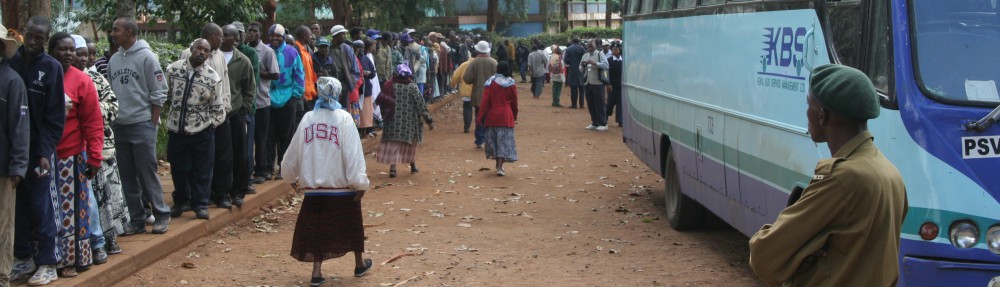
Quentessential Stories on the State of Politics in Kenya

What an inconvenience it is for many of Kenya’s leading politicians to find themselves nominally on the same side of the Referendum campaign. It isn’t stopping them from fighting about the real prize, the presidency in 2012, but surely it will be a relief when the distractions of dealing with whether or not to have a new constitution are over and done with and the main event can proceed apace. “Referendum: Chopper stoned as “Yes” rivals face off” from the Nation.

“Hell breaks loose in Government” from the Standard: more evidence that Kenya’s politicians just don’t get it. And it’s not that they need “training” or “education”–they are sophisticated and well educated, they know the score; rather, they would need to care. Since they don’t, the better approach would be to allow the citizens to decide who to elect next time. I think the new constitution will be approved in substantial part because the voters are not satisfied with the current leadership and see an opportunity for incremental improvements. But let’s have a real count of the votes this time.

Update: NCIC Warns of Violence in “Hot Spots” from the Star via Mars Group.

Referendum campaign coverage relects tenions, challenges

Daily Nation “Khadi court focus of groups’ opposition to new Kenya law”

Kevin J. Kelly reviews the American “culture wars” angle. My take: I hope everyone who cares enough to get deeply involved in the campaign on the Kenyan constitution cares enough to say, live in Kenya for awhile. Kenya’s need for a new constitution has been clear enough that both sides made it a major campaign pledge and constitutional reform was a key commitment of the mediation settlement forming the Government of National Unity. It would seem to be a matter of bad timing that the referedum has coincided with heighted tension on certain “contentious issues” from outside on a globalized basis–as well as with the shift of focus by key politicians to their tactics for the 2012 campaign.

Daily Nation “Crowd heckles Rutp at ‘No’ rally”

Standard “Church leaders declare support for proposed law”

“We want Kenyans to know that churches in Nyeri are in support of the draft constitution, and the clergy who are traversing the country campaigning for the ‘Reds’ are not genuine,” said Githinji.

Stand firm

In a statement read by Pastor Joshua Wambugu of the AIPCA church, the leaders admitted the draft had flaws, but noted that only a few sections were contentious.

“We cannot therefore reject the whole document just because of the Kadhi courts, the abortion clause and the section on lands,” he said.

“Kenyans should stand firm and say yes to this law without fear. Most political leaders, among them President Kibaki, Prime Minister Raila Odinga and Vice-President Kalonzo Musyoka have supported the draft. This is an indication that Kenya can see a new dawn on August 4,” said Wachira Kimotho from the PCEA.

Kieni MP Nemesyus Warugongo, who convened the meeting, warned Christians against being swayed by their church leaders.

“Christians should decide for themselves, without letting their leaders dictate to them how to vote,” said Warugongo.

Standard “Referendum race hots up as Commission warns hecklers”

Standard “Claims by ‘No’ camp against U.S. Ambassador are distortions of the truth”