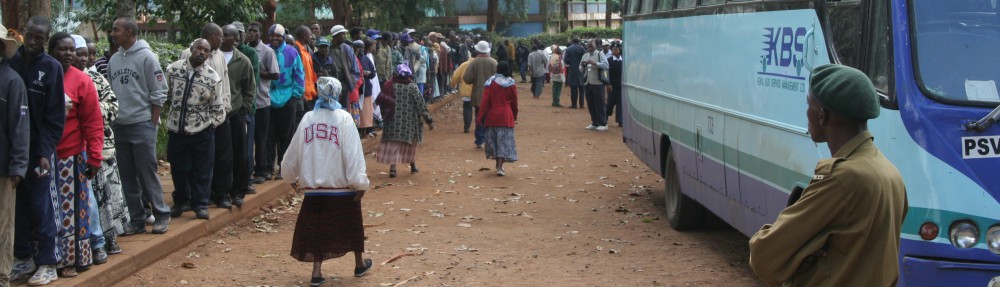
At Easter, chicks come home to roost for U.S. for helping to underwrite impunity in Kenya; but “we” do not need Uhuruto

The United States looked the other way on a stolen 2007 election in Kenya.

Even though our Ambassador himself saw the changed tally forms at the Electoral Commission in Nairobi. We supported a “settlement” that created a temporary prime minister spot, without defined authority, for the apparent winner (not only did the exit poll done at the instance of the Ambassador and funded by USAID show a substantial win for the opposition candidate Odinga, but a separate State Department analysis in January concluded “advantage Raila.”).  “We” nonetheless called on Kenyans to accept the “results”. While we withdrew our congratulations to Kibaki and later asserted that we did not know who won, we were not willing to be publicly honest about what “we” had seen at the ECK as well as what else we did know.

To help pressure for a settlement, we eventually issued “visa ban” letters to three members of the Electoral Commission on the basis of evidence of bribery–but we never revealed this fact or the evidence–it only came to light through stolen cables published in the Daily Nation years later.

We rejected accountability for election theft–thus supporting impunity in this regard.  We supported, in concept, justice for the the post-election killings and mayhem. We had a hybrid position; let’s call it “limited, modified impunity”. Of course, the reality is that our supposed solution of “local tribunals” in Kenya for the post-election violence was always a complete pipe dream under the “power sharing” government we helped broker because that government was never going to implement any such thing.

Thus the role of the International Criminal Court as a last resort due to the initiative of the commission led by Justice Waki to provide the names to the ICC as a fallback.  We should pat ourselves on the back, I suppose, for helping to pay for the commission at least. Likewise, we have over the subsequent years now declined to go along with the aggressive activities of the Government of Kenya in requesting action from the UN Security Council to squelch the ICC’s prosecution, so we have at least refused to stand in the way of the ICC.  At the same time, we haven’t seemed to accomplish anything very noticeable on the protection of witnesses and the other core issues that enshrine impunity in Kenya.

Now, just like in 2007, we have helped pay for another flawed election, this time one which has ended up with a victory for the ticket of “Uhuruto” composed of the two leading politicians charged by the ICC for allegedly having key responsibility for the instrumental political killings of 2008. While it appears plausibly that Uhuruto on March 4 had a higher percentage of support than did Kibaki in 2007, it is also clear that there were substantial irregularities in the handling of the election, over a period of many months, by the “new and improved” IEBC–which was in fact caught even within the Kenya government itself, engaging in unlawful procurement corruption in regard to key technology–technology which was supposed to provide safeguards against the shambolic 2007 tallying process, but failed to be deployed or work.

So after an extraordinary sum of perhaps $240M was spent on an election with only somewhere around 14M registered voters (not sure exactly how many since the register was a series of 33,400 separate paper print outs which were reported by the IEBC to be unavailable for review in the Supreme Court)–we ended up with the same manual count fiasco as in 2007.  More system purchases were more opportunities to “eat”, not more reliability.

The IEBC was perceived as being corrupted on both sides instead of stacked completely only on one side like the ECK last time–but there was no one individual trusted like Kivuitu to let everyone down this time. In one respect that helped diffuse the prospect of violence because the voters this time were much more subdued and had lower expectations–and knew what could happen. And there were some other things different this time based on lower expectations from the “international community”–the observer groups spoke out early to bless the IEBC before it was anywhere close to completing its tally and gave it some cover for whatever it would chose to do. Last time, only IRI really did that–and it was rightly criticized for doing so as the count became problematic.  This time, private conversation before the election about what to say hearkened back to what observers had said in the first full blown observations of Kenya’s first multi-party elections in 1992 under Moi–the terminology “reflects the will of the Kenyan people” as a way to say the process run by the Government of Kenya could not stand scrutiny but the official candidate had a plurality anyway. The difference being that this time Kenyans had passed a new Constitution that was supposed to end the old first-past-the-post system in favor of a runoff-to-majority that meant that the opposition did not have to unite behind one candidate ahead of time to have any chance against a minority candidate supported by the State.

The U.S. knew, and Kibaki and his supporters, including Uhuru Kenyatta, knew that in 2007 we gave the Government of Kenya a pass on election rigging.  This time we didn’t step in and blow the whistle on procurement corruption or otherwise as the process moved towards its unsuccessful conclusion–and we gave the powers that be in Kenya no real reason so far as I know to believe that we had really changed the terms of the deal from 2007.

Now we have another incoherent vote count, but everyone is relieved that major violence did not erupt.  The new Electoral Commission argued to the Supreme Court that the Court could not set aside the IEBC’s pronounced premature results on the basis of the irregularities that had been revealed so far, or the known uncertainties, because to do so would create a constitutional crisis–the only way to have another election would be to use the same flawed register and the same flawed Electoral Commission itself.  In other words, the Court did not, according to the IEBC, really have the power to challenge its work and its decision which was now fait accompli.  The Court announced its ruling–at the last allowable moment (a few hours later than the two weeks permitted if it were as strict with itself as it was with those before it)–yet could not muster any explanation or reasoning whatsoever.  It declared itself to have the power, and to be exercising it, to ratify the IEBC’s result, but either couldn’t agree on why or was not comfortable saying until a future date–after the swearing in.

The bottom line here is that the United States has been helping to underwrite failure in Kenya for too long.  We got taken for a ride–again.  We ought to have more self respect.

The British government has groveled to “get right” with an incoming Uhuruto administration, but we simply do not need to do so.

We provide a disproportionate amount of aid to Kenya–officially roughly a Billion U.S. Dollars each year–unofficiallly I am sure there is more; not to mention extensive private aid that also helps alleviate the suffering of Kenyans left adrift by the corruption and bad priorities of their governments.  As far as I can see, we spend a lot of money in Kenya for sentimental rather than legitimate programmatic reasons.  And the restaurants and resorts are more upscale and Kenya is more oriented for tourism accompanying official travel and postings.  But a lot of the tourist infrastructure is owned by the Kenyatta and Moi families themselves.  We ought to grow up and take our responsibilities more seriously.

What has all this spending been adding up to aside from bad elections?  Kenya’s Human Development Index score for 2000 was .513 for a “Medium Human Development” ranking of 134th among the scored countries.  The 2012 score was .519, for a rank of 145th.  Among the 45 “Low Human Development” countries Kenya stands out, along with Zimbabwe for having by far the highest “Mean Years of Schooling”.  Yes, from 2000 to 2012 Kenya’s GDP per capita increased by roughly fifty percent–it just didn’t result in much relative overall human development progress for the country as a whole.

The Cold War has been over for almost 25 years.  What we have been doing has not been working very well and we can do better.

Initial thoughts on Kenya’s Supreme Court ruling

Congratulations to Kenyans on a peaceful resolution and Happy Easter.

First comment: we do all see that election violence in Kenya is not inevitable; what happened in 2007 has identifiable causes even if they have not been acknowledged or addressed, primarily the conduct of various politicians. People in Kenya do not simply run out and start killing their neighbors because their side lost an election. Having a credible Court helps a great deal, thanks to the passage of the new Constitution after all these years; kudos to those that made it happen through years of struggle.

Second: I am very proud of AfriCOG for carrying forward a tremendous amount of work in an unconscionably short amount of time to show that there were many unanswered questions about how the election was conducted and why, and how the votes cast at the polling stations were transformed into the March 9 “final results”. They carried a burden that should have been borne by an objective and independent IEBC, rather than facing a united front of the Government of Kenya aligned against scrutiny.

Third: I assume the Court announced what they agreed on unanimously, which was that the outcome was to deny the petitions. Whether or not all six justices individually agreed is something that we will probably never really know, but we will have to wait for the Court’s opinion in two weeks to learn more. Given the short amount of time and the schedule they have already been on, I suspect we will not get as much detail then as many have hoped for, but we will have to see.

Fourth: The Court ruled that each side was to bear its own costs–not the ordinary practice. I think this disposes of the claims by some on the Government side that the ruling indicates that the challenges were not substantial.

Kenya needs a better election review process next time . . . as respondents argue that IEBC has done “so much” that presidential election announcement should stand as good enough

So we are down to the hearing of the challenge to the presidential election involving some ten to twelve million voters in a country of over forty million. All of the voting was done by paper ballot and counting by hand. At the time of the hearing there is no list available to the petitioners or the court of who did and did not vote, nor one defined list of who was eligible as a voter.

Even with the breakdown of the intended election technology across the board, the IEBC announced a final vote count on the evening of March 8, just over three days after completion of the voting, in spite of having seven days available for the process, then formalized the result the next day, March 9.

It now comes down to one day of oral argument on each side in an adversarial proceeding between the IEBC represented by government counsel and AfriCOG and CORD for the Supreme Court to decide whether to let the IEBC pronouncement stand, or not.

There has been no administrative process or review, there has been no neutral body involved prior to the Supreme Court. The IEBC has been in an adversarial mode in defending its decision since the decision was made. The Court has determined that there is no time for detailed discovery of evidence sought by petitioners.

The Court will ultimately have to decide this case on the basis of generalities–either recognizing the standards required by the Constitution for voting were not met systemically:

Article 86:

At every election, the Independent Electoral and Boundaries Commission shall ensure that—

(a) whatever voting method is used, the system is simple,
accurate, verifiable, secure, accountable and transparent;
(b) the votes cast are counted, tabulated and the results
announced promptly by the presiding officer at each polling station;
(c) the results from the polling stations are openly and
accurately collated and promptly announced by the
returning officer; and
(d) appropriate structures and mechanisms to eliminate
electoral malpractice are put in place, including the
safekeeping of election materials.

or, alternatively, the Court will defer to the the IEBC on the basis that its decision is unimpeachable except to the extent that it can be disproven vote by vote in detail through admissible evidence in adversarial litigation in one day.

[Updated Wednesday] Kenyan election: What kind of “audit” did the IEBC do without the actual voter registration lists used? Will the Supreme Court require the registers to be disclosed as sought by AfriCOG?

Watch the hearings live: Citizen TV; or the other Kenyan networks.

At 9am tomorrow [Wednesday] in Nairobi, the Kenyan Supreme Court is scheduled to announce a key ruling. The issue is whether or not the Independent Electoral and Boundaries Commission (IEBC) will be required to produce for scrutiny the actual voter registration lists used in the voting.

[Update: On Wednesday morning, the Supreme Court denied the production request from AfriCOG as time-barred, saying it needed to have been filed with the original petition. Once again, the Court seems to be treating this as ordinary civil litigation subject to procedures but without the months or years that would ordinarily be involved in developing the facts of the case. The hearing has begun and the case will be decided without much evidence, which at some level was always inevitable given the time frame and the position of the IEBC as party litigant rather than a neutral body that would willingly cooperate with scrutiny.]

The issue is before the Court due to the vigorous opposition, played out over two days in preliminary hearings, by the IEBC and the proponents of its March 9 “final results” to a request for these public records from AfriCOG.  On Monday afternoon, the Court heard the complaints of the IEBC side that AfriCOG had not formally served copies on enough of the various lawyers for the government and the other respondents for parties who are not directly implicated in the custody of the records.  Thus, more copies served, arguments were held this morning, with decision tomorrow.

Here is CapitalFM on the procedural arguments against production: “AFRICOG plea for voter register opposed.”

AfriCOG’s vital role as Petioner 4 challenging the Kenya’s IEBC

Like everyone else who is engaged but not able to be in the courtroom, I am watching live broadcast of the preliminary hearings in Kenya’s Supreme Court of the petitions challenging the Independent Electoral and Boundaries Commission’s March 9 announcement of “final” election results.

The live broadcast of these proceedings is an amazing development–to me of much greater significance than the presidential campaign debates.

I wanted to take just a moment to stress the role of Gladwell Otieno as petitioner as executive director of AfriCOG. The AfriCOG filing is petition no. 4–followed by CORD’s petition no. 5. Although the court has tended to give an unbalanced share of time to the array of government-paid lawyers representing the two defendants who are in lock-step, Hassan as the national returning officer in the presidential vote, and the IEBC which he chairs, AfriCOG, as an open governance organization, has taken on the challenge of defending the interests of the voters and integrity of the process itself.

This is not about Raila Odinga and Uhuru Kenyatta–this is about the Kenyan democracy.

It has been interesting to see the respondents file replies to AFriCOG’s petition trying to ignore the issues by simply referring to the “already filed” responses to the subsequent CORD petition–it is in their interest to try to frame the issue as one about a challenge by a losing candidate rather than about why the IEBC did not do its job, and meet its obligation to each citizen under the Constitution, of holding a simple, fair and transparent election.

Here is a Question and Answer release from AfriCOG on the Petition.


Attacks on Kenyan Civil Society prefigured in Jubilee “manifesto”

The Jubilee (UhuRuto) Coalition manifesto contains a section entitled “Good Governance” which strikingly in a country with so many governance challenges, contains only one section, on “the challenge” of “managing our relationship” with civil society:

THE CHALLENGE

The influence of Civil Society has expanded over the years to the point where the various Civil Society groups play an important role in the country’s political and economic development. In the years following the signing of the National Accord, the sector has grown in stature, influencing government decisions, political culture, and key appointments. We must identify new and innovative ways of working with the sector so that the country can fully benefit from its expertise and experience.

THE OPPORTUNITY

We believe that NGOs have a valuable role to play in monitoring government and helping to strengthen the social infrastructure in our country. We shall manage our relationship with the NGO sector in accordance with internationally recognized best practices.

SOLUTIONS

The Coalition government will:

  • Introduce a Charities Act to regulate political campaigning by NGOs, to ensure that they only campaign on issues that promote their core remit and do not engage in party politics. This will also establish full transparency in funding both for NGOs and individual projects.
  • Establish a Charities Agency to provide an annual budgetary allocation to the NGO sector.
  • Promote accountability and coordination between the NGO sector and national and county governments.
  • Develop strong partnership with the NGO sector that enhances the country’s development agenda and promotes the interests of the people of Kenya.

So what does this mean?  Clearly, what is proposed is substantial “regulation” and government involvement in the workings of civil society.  This was understood by many in civil society before the election to refer to “Ethiopian” style control–you could also look at Rwanda and Uganda for other regimes in the EAC.

Since the election, we have seen some nasty, conspiratorialist, attacks on civil society for not getting in line with the IEBC’s announced result. See “Kenyans fundamental rights under attack” from Mugambi Kiai in the Nation, responding.


Why would we trust the Kenyan IEBC vote tally when they engaged in fraudulent procurement practices for key technology?

It has been clear for many months that the IEBC’s procurement of BVR kits was irregular.  It is now quite clear that even after Kenyan civil society called the IEBC on the carpet on that problem, the IEBC engaged in clear misconduct in buying the “poll book” system.  When they were caught, the procurement was allowed to go through because of the limited amount of time before the election.  The “poll book” book system largely failed and on election day polling stations used a wholly manual system–a printout on paper.

See the details on the fraudulent bidding here from the today’s Standard: “Minutes reveal how IEBC bought faulty gadgets”:

A review of the tendering procedure by the public procurement regulator found out the tender to supply poll books was awarded to the South African firm, which participated in the Anglo Leasing scandal, on September 29 last year, three weeks before the technical evaluation among the shortlisted bidders.

In other words, the bidding was a sham, because the “winner”, which never could produce a working system, was selected in advance, before the evaluation of which  systems worked–and thus the working systems never had a real rather than a pretend opportunity to be selected over the non-working system.

Getting down into details, the failure of this key procurement left a situation in which much of the presumed value of the Biometric Voter Registration was lost because there was no ability to use any automated voter list at the polls.  The use of the paper print out opens a big window for fraud because one would have to obtain and verify each of the individual print outs from more than 33,000 polling stations to know whether what was used on paper matched up with the central voter registration list in Nairobi (leaving aside the fact that the IEBC never finalized and published a uniform voter registration list as required, which makes the issue doubly important).

I have no way to know whether the IEBC was simply corrupt in its procurement practices resulting unintentionally in the failure of the poll book system, or whether there was some deliberate intent within the IEBC to avoid the application of the electronic system.

Assuming for the sake of argument that no one at the IEBC deliberately wanted to undermine the intended voting systems, it remains quite clear that the IEBC engaged in conduct that clearly violated the public trust in preparing for the election.  So how can we simply trust the same body on the vote tally itself?

“Social Corner” “Jokes” “How to Mark a ballot Paper” “Voting Procedure”

Image

Africa Bureau under Frazer coordinated “recharacterization” of 2007 Kenya Exit Poll showing Odinga win (New Documents–FOIA Series No. 12)

Over the weekend I finally received the first documents from the State Department’s Africa Bureau from my September 2009 Freedom of Information Act request for State Department documents about the 2007 Exit Poll for the Kenyan Elections. This is the exit poll funded by the USAID, through the International Republican Institute (IRI) that I managed as East Africa Director for IRI. By letter dated March 5 (the day after the new Kenyan election) but not mailed for another week, the State Department released five documents, while stating that it was withholding one unidentified document in full “because it consists of pre-decisional deliberative process material.”

Long story short:

1) as described by the Embassy, “auxiliary to efforts in this regard by Kenya’s vibrant press, active civil society, and credible, proven electoral commission,” the U.S. government undertook several efforts to “preserve Kenya’s democratic success and contain the prospects of violence and voting irregularities if the presidential election is tight.”

2) one of these efforts was “Public Opinion Polling” described as follows:

* This USAID-funded program seeks to increase the availability of objective and reliable polling data and to provide an independent source of verification of electoral outcomes via exit polls. Implementer: IRI

3) after this same Exit Poll became a source of political contention because it showed the opposition candidate winning rather than the incumbent as named by the “credible, proven electoral commission”–the Africa Bureau engaged in a practice of mischaracterizing the USAID program and the Exit Poll.

For example: when the McClatchy newspapers ran a story on July 9, 2008 by Shashank Bengali reporting that “Kenya’s President Lost Disputed Election, Poll Shows” after the release of the exit poll results by the researchers from The University of California, San Diego at the Center for Strategic and International Studies, the Africa Bureau generated “AF Press Guidance” as follows:

Q: Please provide details on the U.S.-funded exit poll for elections in Kenya. Do we have a comment/reaction to the poll results?

* The International Republican Institute (IRI) provided funding to Strategic as a capacity building exercise for the organization.

* IRI did not have confidence in the results of the poll once they received them due to questions about the methodology, so the results of the poll were never officially released.

* Given the potentially significant nature of the results, however, IRI commissioned an audit of Strategic’s poll results. We have yet to see the results of that audit.

* Our Embassy in Nairobi was not informed by Strategic or IRI of the exit poll results by 3pm on Election Day.

It is simply false to suggest that IRI gave money, from USAID, to Strategic, a private Kenyan firm, simply as a “capacity building exercise” for either Strategic or for IRI, whichever is intended here. No, as described by the State Department before the exit poll became a “hot potato” after Kibaki was serving a second term based on the ECK’s announcement of an alleged election win on his behalf, we paid Strategic for their work “in providing an independent verification of electoral outcomes via exit poll” in the State Department’s own words. Strategic was hired based on already proven capacity having conducted the exit polls in 2002 and 2005. I have noted before that the Ambassador claimed this excuse–that the poll was only an “exercise” and never intended to be released–in a March 2008 on-line Q-and-A, but this is the first time I see this characterization stated from Washington.  See Lessons from the 2007 Kenyan Election and the new FOIA Cables–Part Three, here.

As I have noted, the concern that I was aware of and discussed within IRI during the immediate post-election in Nairobi was how people would react to the release of the poll, not about its “methodology”.

The guidance notes that IRI has “commissioned an audit” but doesn’t say when it was commissioned, or whether the State Department has asked to see it. [Note also that an “audit” could not fix the “methodology” of the poll if it had been flawed.  IRI released the poll the next month, in August 2008, the day before the technical consultants from UCSD were to testify about the poll before the Kriegler Commission investigating the elections.]

Finally, the statement that the Embassy “was not informed . . . of the exit poll results by 3pm on Election Day” is precious. They were informed of the results at closer to 5pm.

I’m quite curious about the “pre-decisional deliberative process material” that they decline to produce. Were they deliberating about whether to tell the truth about the USAID poll? Does this qualify for exemption? [Update: I appealed the withholding of this document to the State Department’s internal FOIA appeals board; the appeal remains pending as of March 2014.]

FREEDOM OF INFORMATION SERIES

Was Kenya’s “Election Observation Group” or ELOG intended to be truly independent of IEBC? Or was it to “build confidence”? [Update 3-30 Further on “Overselling” ELOG and ELOG’s use by Counsel for the Gov’t in Court]

By appearances, ELOG certainly looks more like part of the effort to “build confidence” in the IEBC (to “promote peace”) rather than an independent watchdog.

Which would explain the problem noted in my previous post that their Parallel Vote Tabulation results by their own numbers indicate that most likely there should be a runoff between Kenyatta and Odinga but they announced that their results “confirm” the IEBC which found otherwise.  It would also explain why they have announced “conclusions” in support of the IEBC but not released their data or even their methodology.  Ironically, USAID, which supported the Parallel Vote Tabulation, also spent a lot of money over a period of years promoting greater sophistication in the Kenyan media in expecting transparency regarding polling methodology.  Today, in Kenya, the media would not ordinarily publish polling results with the lack of transparency that has accompanied ELOG’s PVT, which is based on some sort of an undisclosed “sampling” methodology akin to that used in other polling.

“Must reads” follow:

Kenya’s Election Observation Group (ELOG) announces its Parallel Vote Tabulation (PVT) program as monitoring tool. (Daily Nation, Feb. 18, 2013)

“This (information) will be important to help remove any uncertainties by providing validation to the results given by the IEBC,” he added. . . .

“PVT will measure the votes cast and indicate whether the data should be trusted, based on information about voting and counting of the votes,” said Elog Chairman Kennedy Masime.

“This information will be specific and can be actionable for improving the process next time” he added.

But Elog was quick to warn that it would not be announcing results, a task only IEBC is mandated to perform.

While they will be tabulating results from the polling stations, the Observers said they would be in constant consultation with the Commission before releasing their verdict.

“We foresee a situation where if the elections are well managed, then there will be no fundamental differences with IEBC. But in the event that there is, then we would consult with the Commission,” Elog said in a joint statement.

USAID/Kenya–Success Stories: “Giving Fresh Credibility to Kenya’s Electoral System” (Feb. 8, 2013)

The Independent Electoral and Boundaries Commission registered 14.3 million voters using the biometric voter registration technology system. Biometric data captured during the registration is  is being  linked with electronic voter identifiers (electronic poll books)  while text data is being used  for real time electronic result transmission and display systems. The United States Agency for International Development (USAID) invested over $ 6 million USD in the two systems, through United Nations Development Programme (UNDP) and International Foundation for Electoral Systems (IFES). According to analyses, two of the most significant factors attributed to the failure of the 2007 election were the inability of the Electoral Commission of Kenya to compile a credible voter register, and the lack of an efficient results reporting system.

USAID has partnered with Civil Society Organizations  to ensure the effective use of the biometric voter registration technology in the upcoming 2013 presidential elections, to prevent fraud and reduce the likelihood of violence. . . .

Too bad the voter register was not finalized and published as required by law and the technology tools never fully designed and for the most part not implemented “on the ground” in the actual election.  A robust independent monitoring organization would, one would think, have more to say about that but, if these efforts were already a “success story” before the voting for bringing “fresh credibility” it becomes awkward . . .

USAID/Kenya–Success Stories: Parallel Vote Tabulation Restores Confidence in Kenyan Voters (Dec. 14, 2010):

The PVT – as acknowledged by the IIEC Chairman Ahmed Issack Hassan – was crucial in verifying the legitimacy of the referendum process as a whole and in restoring public confidence in the electoral process in Kenya.

Again, the overriding goal, achieving “success story” status, is to give the Kenyan public “confidence”.

 UPDATE:

An example of how the PVT has been oversold is a quote from the CapitalFM story covering the ELOG announcement on Saturday March 9 under the headline “Yes, Uhuru won–parallel vote tally shows”:  
 

“Thus the PVT can confidently verify that the official results for each candidate are accurate,” the group’s chairman, Kennedy Masime, said on Saturday afternoon.”

 
This is the basic point–the PVT result of 49.7 cannot “confidently verify” that Uhuru got 50%+1 at all.
 
Such statements then got translated further into statements like this from Ken Opalo in an interview in The Atlantic:

I don’t think the system meltdown affected the eventual result – a Parallel Vote Tabulation done by Elections Observation Group confirmed IEBC’s findings – but it raised concerns over IEBC’s vulnerability to manipulation. (emphasis added)

If ELOG does not wish to be a party to this, they can dial it back and have had more than two three weeks to do so; and more than two three weeks to release the details of their methodology and how it was executed as reputable polling firms are expected to do these days in Kenya.
Ultimately, ELOG’s initial statement was cited by respondents in the Supreme Court as evidence to uphold the IEBC’s decision to avoid a runoff even though ELOG had declined to be transparent and neutral by withholding its methodology and data.  Given the nature of the proceedings, there was no time in Court for either AfriCOG or CORD to probe or rebut the purported evidence from the Goverment.