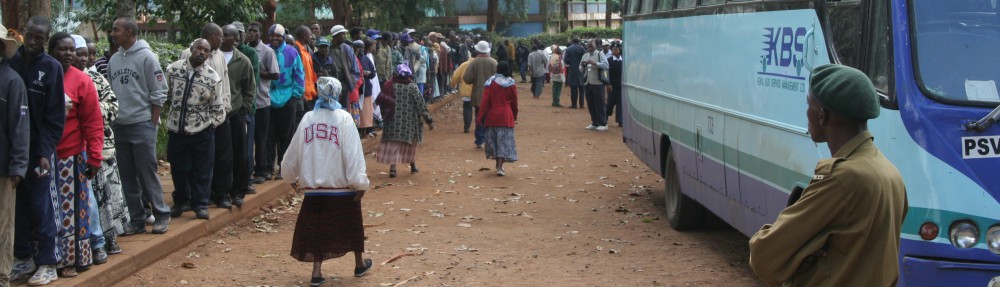
Part Ten–FOIA Documents from Kenya’s 2007 Elections–Ranneberger at the ECK: “[M]uch can happen between the casting of votes and final tabulation of ballots and it did”

Westlands Primary-Line to Vote X

Another document released to me from my FOIA request to the State Department for documentation of the State Department observation of the Kenya elections is a cable from Ambassador Ranneberger from January 2, 2008 reflecting what he witnessed at the ECK. This was primarily declassified, with a few redactions.

Here are key excerpts, which deserve to be read carefully by those preparing to try for better elections this time.  It pretty well clarifies what Ranneberger saw as a credentialed observer at the ECK, and what he wanted to do, or not do, about it.

2. As previewed in ref B, much can happen between the
casting of votes and the final tabulation of ballots and it did.
This message recaps developments reported in refs, provides current
state of play, and discusses next steps. Much of our reporting
during the past three days has been done by phone given our
intensive focus on operational issues, particularly efforts to
promote a positive outcome to the election imbroglio.

3. Elaborate procedures were in place (much of it with U.S.
support) to ensure transparency and accountability of the ballot
tabulation process. . . .

5. ECK officials and observers pursued these
allegations to some extent, but the ability to do so was
constrained by lack of time, original data from polling
stations, and by the behavior of a number of ECK officials
who delayed returning results and submitted incomplete or
clearly altered documentation. Moreover, the ECK has no
authority to open ballot boxes; only the courts do. During
the night of Dec. 29, ECK officials together with
representatives of the PNU and ODM, reviewed the tabulations,
but neither side was satisfied that the review had fully
addressed their concerns. The ECK partial review of the
irregularities was also of questionable credibility, given
that all of the commission members were appointed by the
Kibaki government, and a number of them were suspected of
being clearly biased and/or involved in doctoring at ECK
headquarters. The Chairman of the ECK, Samuel Kivuitu, who
was widely respected, was surrounded by staff of uncertain
reliability and competence. It is worth noting that
parliamentary results were not disputed because they were
tabulated and announced at constituency tabulation centers,
thus allowing no interference at ECK headquarters.

6. Kivuitu has only limited authority as head of the
ECK. The ECK works on a majority vote system. It is also
important to note that the ECK is required by law to announce
the results as received at the ECK from the tabulation
centers. Some obvious irregularities like reporting
unrealistically high turnout or clearly altered results can
be rejected. There was, however, only a rejection of the
results in one constituency in which violence resulted in
destroyed ballots. Other alleged irregularities, such as
announcing results that ECK personnel personally inflated
should have been, could have been, but were not corrected. At
one point Kivuitu told me that his concerns about the
tabulation process were serious enough that “if it were up
to me, I would not announce the results.” In the end, he
participated with other commissioners in an announcement late
on the 30th, which turned rowdy when Odinga walked with armed
bodyguards into a room packed with observers, including me,
party agents, and media Kivuitu and the other commissioners
retreated to their upstairs offices, where the results were
announced. Kibaki was quickly sworn in (this was Continue reading

Nuts and Bolts of the American-Kenyan relationship . . . .

A release today from the State Department:

Assistant Secretary of State Thomas M. Countryman welcomes a senior-level Kenyan delegation to Washington, D.C. from April 30 – May 5, 2012 for a Legal-Regulatory Implementation Workshop on Strategic Trade Controls and Border Security.  The Bureau of International Security and Nonproliferation (ISN) will host the Kenyan delegation, which will be led by the Assistant Defense Minister of Kenya; Major General Joseph Nkaisserry (retired).  Ambassador Ochieng Adala, Executive Director of the Africa Peace Forum, and other senior Kenyan officials involved in strategic trade control issues will also participate in the workshop. 

 The training, supported by the Export Control and Related Border Security (EXBS) program, is organized by the Center for International Trade and Security at the University of Georgia.  The five-day workshop will cover the spectrum of issues pertaining to the development, implementation, and enforcement of an effective strategic trade control and border management system in Kenya, which will advance the dual goals of improving international security and fostering sustainable economic growth.

 This visit provides a unique opportunity to discuss the fundamentals of an effective strategic trade control system with key Kenyan legislators and government officials and to help them incorporate strategic trade controls into future legislation. 

Saturday Prime Minister Odinga will be among the commencement speakers at Florida A & M University in Tallahassee:

State Sen. Arthenia Joyner, chair-elect of the Florida Legislative Black Caucus, will lead the lineup of speakers scheduled for Florida A&M University’s Spring 2012 Commencement on Saturday, April 28.

Joyner, D-Tampa, will address students slated to receive degrees at the first of three sessions beginning at 9 a.m. at the Lawson Center.

U.S. House Assistant Democratic Leader James E. Clyburn will speak at 2 p.m. Kenya Prime Minister Raila Amolo Odinga will speak at 6 p.m.

For those not familiar with Florida A & M, here is a history capsule from the website “Alumni Roundup”:

Florida Agricultural and Mechanical University was founded as the State Normal College for Colored Students, and on October 3, 1887, it began classes with fifteen students and two instructors. Today, FAMU, as it has become affectionately known, is the premiere school among historically black colleges and universities.

Prominently located on the highest hill in Florida’s capital city of Tallahassee, Florida A&M University remains the only historically black university in the eleven member State University System of Florida.

Here is coverage of Odinga’s Friday speech to the Atlanta World Affairs Council.

And elsewhere in the United States, being another election year, some of my old right wing friends seem to be promoting a movie that claims that Obama was born in Kenya but that his father was American, not Kenyan (!).  And of course complaining again about Odinga.

Observations from the IFES Kenyan Election Event in Washington

The International Foundation for Electoral Systems (IFES) has the video up from their program last week in Washington with Kenyan IEBC Chairman Ahmed Issack Hassan and IFES Country Director Michael Yard.

I found the program very useful and want to thank IFES for making this available.  With so many things going on right now in the region I have been hearing that people in Washington have not begun an intense focus on the Kenyan election preparation at this point, and I hope that this program will serve as a useful reminder of the huge scope of work to be accomplished in a relatively short period of time if Kenya is to be ready for a credible election process.

Michael Yard did a good job of emphasizing the magnitude of the task.  It has been widely recognized through the report of the Kreigler Commission and otherwise that the voter registration process was wholly inadequate in the last election (as reflected in Undersecretary of State Maria Otero‘s comment that “we recognize that over 2 million dead people voted”).    The IEBC says that they intend to implement a biometric registration system, which will obviously be a major undertaking.

In 2007 the number of polling stations was dramatically expanded to more than 20,000.  The domestic election monitoring program which had proven successful in 2002 was unfortunately not funded to make a commensurate increase and a high percentage of the polling stations were thus left without outside observers.  Nonetheless, with the increased demands placed on the voting system from the addition of voting for the new senate and the devolved local governments under the new constitution, the IEBC feels that they need to further reduce the number of voters at each polling station.  Their plans thus call for more than 40,000 polling stations.  This will place huge demands on both observation efforts and on the parties in deploying agents.

Hassan comes across as a “straight shooting” but soft spoken attorney, in contrast to the sometimes irascible Kivuitu from the 2007 ECK, and everyone is encouraged by the competitive screening and selection process for the new IEBC.  Nonetheless, we know now from hard experience that the pressures placed on the commissioners can be huge and it is crucial that active and transparent oversight by the donors supporting the election process be maintained throughout the effort to design and build a new national voting system.

It should also be noted that Parliament has not yet completed all of the necessary implementing legislation, including campaign finance laws, and most especially that the mechanism to handle the constitutional commitment to minimum representation of women in Parliament has not been resolved.  Of the major factors identified in the post-election settlement after the disaster in 2007, land reform has essentially been set aside and we can expect the new election to take place with IDPs outstanding from 2007-08, as well as from previous elections.  The cost of living, especially for food staples is more of a challenge than last time, and there has been no apparent counter to the reported flow of small arms into the potential Kenyan conflict zones following 2008.

Normally quiet American ambassador speaks out to condemn police repression amid rising ethnic/political tensions in Kenya

Having marked a year in the post this week, U.S. Ambassador Scott Gration has generally “kept his powder dry” in terms of availing himself of the Kenyan media to speak out on the Kenyan issues of the day and exhort better behavior from Kenyan politicians and officials.  This is a marked contrast from what we had been used to during the 2008-11 period.

Today, however, is different.  Ambassador Gration is in both the Saturday Nation and The Standard condemning the Kenyan Police for violently blocking a youth-oriented meeting in Limuru called to counter the recent gathering there to revive the old GEMA (Gikuyu, Embu, Meru Association) to foster “Mount Kenya” solidarity against the International Criminal Court on behalf of the suspects, among other apparently divisive purposes.

The U.S. message leads both stories.  From the Nation‘s “US condemns Kenya Police over anti-Gema meeting”:

The United States has condemned the use of force by police to block the Limuru 2B meeting as calls for the resignation of their boss Mathew Iteere over the incident intensified.

US Ambassador to Kenya Scott Gration said the police action undermined the basic democratic tenets in the country.

“It was a grim reminder of Kenya’s past,” said Mr Gration in a statement Saturday.

“Fear tactics and political intimidation should have no place in Kenya under the new Constitution for they can threaten the brighter future we all desire for all Kenyans.”

He said the whole world looked at Kenya with admiration after the passage of the new Constitution two years ago, which enshrined universal rights as freedom of speech and assembly.

This he said, laid the ground for a free and fair election.

While both stories note criticism of the police from figures on “both sides” of the Government of National Unity, the Nation includes a defense from Kenyan Police head Matthew Iteere who alleges that the meeting was being used as a front to organize for the Mungiki sect.  Of course the Mungiki have a role in being a real problem in terms of crime, including ironically the instrumental political violence forming the basis of the ICC charges against Uhuru Kenyatta who the revival of GEMA seeks to protect; they also have served as a “bloody shirt” waived by state security forces including the police to justify extrajudicial killing in recent years.

[Update:  See Muthoni Wanyaki’s “Now we know: Only ethnic mobilization is allowed” in the East African.

Reuters: IEBC touts ICT solutions for Kenya vote tally

Ahmed Hassan is making the rounds to explain the new Independent Electoral and Boundary Commission’s plans for a better tallying and reporting process in the upcoming election.  From Reuters today, under the headline “ICC trials main threat to Kenyan polls”, here is the pitch:

Speaking at the Reuters Africa Investment Summit, Hassan said judicial and electoral reforms included in a new constitution adopted in 2010 and new technology should deliver a fair election that would avoid the cycle of bloodletting.

Under a new system, the tally of ballots for a presidential candidate, cast at thousands of polling stations across the country of about 40 million, will be transmitted electronically to a national counting centre and broadcast live on television.

Previous elections have suffered from claims that votes were interfered with while being transported from polling stations to regional tallying centres.

The new system, which cost $1 million to install, uses the 3G data network used by mobile phone companies and was first tried in a 2010 referendum to ratify the constitution.

Kenya will also switch to an electronic register of voters after ballot boxes at the 2007 elections were found to contain the votes of people who had not registered and even some who were dead.

“Technology can enhance confidence in the results. We are the first country in Africa to use the transmission of ballots counted real-time, live,” said Hassan, who won praise for using technology for the referendum, earning the 42-year-old lawyer the president and parliament’s nod for the IEBC job.


I am looking forward to attending an event (Kenya Elections:  Building a Peaceful, Credible Process) at the International Foundation of Electoral Systems tomorrow with the IEBC and IFES leadership to hear more.

(h/t Texas in Africa)

“Competition for Military Superiority” between Uganda and Kenya not a sign of political maturity

British Helicopter

British Helicopter at base near Nanyuki


The Daily Nation reports on new data on Ugandan and Kenyan defense spending from SIPRI, “Arms race hots up in East Africa”:

Competition for military superiority in the East African Community has seen Uganda’s arms expenditure surpass Kenya’s for the first time this year, a new global arms report shows.

Kampala spent US$1.02 billion (Sh83 billion) — much more than Kenya’s US$735 million (Sh61 billion), the Stockholm International Peace Research Institute (Sipri) says. The institute does research into conflict and arms control.

The most advanced

In particular, Uganda’s acquisition of six SU-30MK Russian jets is said to have elevated its air force to one of the most advanced in East and Central Africa.

The reasons for the increased budget, according to the report, include competition for regional military superiority, especially with Kenya, and the threat of a spillover from potential conflict between Sudan and South Sudan.

Others included the operation in Somalia against Al-Shabaab where the region’s armies, including Kenya’s, are fighting under the African Mission in Somalia (Amisom), and against Joseph Kony’s rebels in the DR Congo are quoted as reasons for Uganda’s ballooning military expenditure.

The friction with Kenya over Migingo Island almost sparked a confrontation and this is also cited as justification for more military spending by Kampala.

Kenya’s military expenditure has also been going up in the last decade. The country spent only Sh14 billion on the military in 2000 compared to more than Sh60 billion today.  .  .  .

There are plenty of positive opportunities for competition and national pride within the East African Community, but acquisition of military hardware in support of governing egos is not something that is affordable for either country in the context of need, and supports the temptations of saber rattling for political gamesmanship.  Any type of military confrontation within the EAC would be an absurd tragedy.  Since the U.S. and our European allies are heavily engaged in interacting with the Ugandan and Kenyan militaries, perhaps we can be positively influential in dissuading this type of behavior in conjunction with our support for less tangible types of political reform.

A little Kenyan-American history: Kissinger, Waiyaki, Kibaki; getting the F-5s, safaris and slums

History–Kenyatta, the Kenyan military and GSU; origins of U.S. military assistance

More Kenyan-American diplomatic history: Kenyatta’s health and succession; status of whites; military assistance