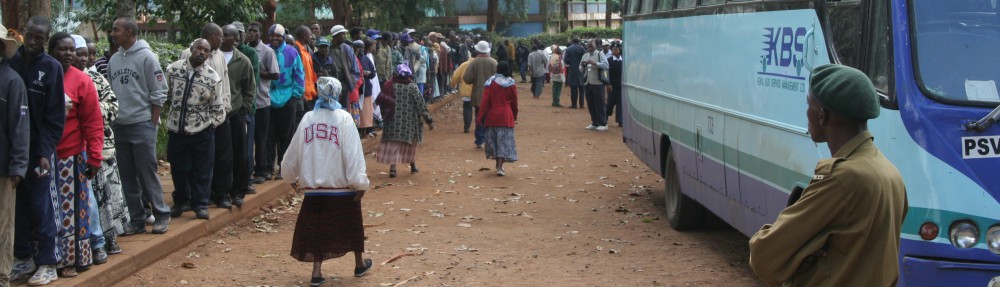
“Tribute to Dr. Peter Oriare: Media Scholar of Great Repute” and a friend to me, to the International Republican Institute, and to Americans who believe in democracy

Dr. Peter Oriare

“Tribute to Dr. Peter Oriare, Media Scholar of Great Repute”

“University of Nairobi mourns committed teacher”

My friend, Dr. Peter Oriare, was in his own way one of those who got hurt because of the election misconduct in 2007. I was very sad to hear on my return from Washington that while I was at the African Studies Association meeting, Peter died back in Nairobi.  At 45 he was too young, the proud father of young children.  I would greatly encourage anyone interested in Kenyan democracy to read the tribute and story linked above.

I am thankful to have known and worked with Peter.  I certainly relied on him in Kenya.   Along with the local staff at the International Republican Institute in Nairobi he was one of the people that made my year working in Kenya an experience that I will always treasure.  When I arrived in Nairobi in June of 2007, we had funded only our baseline National Endowment for Democracy programming working with parliamentary candidates and our ongoing USAID polling program for which I was approved as Chief of Party the week before.  The current polling program had been in place since an exit poll for the 2005 constitutional referendum,and had most recently included a public opinion survey from that spring which we were just then briefing to prospective presidential candidates.  Peter worked with Strategic Public Relations and Research and was our primary point of contact with the firm as well as teaching and working to finish his doctorate at the University of Nairobi.

When I took over as the fourth American to lead the IRI office under that 2005 polling program, my ability to do my job depended on Peter’s expertise and continuity. Peter had worked with everyone in the IRI office and had been our primary local polling expert partner since 2000, before the IRI office opened in 2002.  The polling program was touted as a major success story for both USAID and for the International Republican Institute in Kenya and Peter was the single most consistent element.  Peter had a strong relationship not only with IRI and the USAID Democracy and Governance program locally but with others in the international democracy community.  He led important work in media monitoring for the 2007 election that was crucial to the international understanding of the situation in Kenya.

Peter believed in transparency and he advocated internally for release of the presidential “horse race” figures from our September 2007 public opinion survey which showed Kibaki leading when most polls were showing Raila as having pulled ahead, and when our contract with USAID was amended to add the 2007 exit poll, he expected to release it as well.  The established policy reason that IRI did not release the “horse race” numbers comparing the presidential candidates in our pre-election public opinion surveys–that we wanted to support democracy by informing the public, policy makers and politicians with out having a direct impact on the race itself–obviously did not come into play on the exit poll when people would have already voted when it would be released.

I pushed Peter and Strategic hard in negotiating the contract for the exit poll in the fall of 2007.  We had a modest amount of additional funding from USAID, and some money from Dr. Clark Gibson at the University of California, San Diego–and we had overhead in Washington and Nairobi.  Because it was obviously a close race, we needed results that were methodologically sound and statistically valid at the provincial level and not just the national level, to be able to evaluate the presidential threshold of 25% of the vote in five provinces.   I needed substantially more work from Strategic than they had done in the 2002 and 2005 exit polls, which were universally accepted as successful, but in elections that were not as close.  Ultimately we agreed on the additional work for very little additional money given Kenya’s inflation, and the poll was well executed as millions of Kenyas voted peacefully.

The preliminary results called in by cellphone–which were  obtained by USAID and given to the Ambassador on election day–even though such reporting was entirely outside the scope of anything in the USAID agreement with IRI and I didn’t want anything to get out while the polls were still open–had Raila ahead by a margin of roughly 8 points.  When the actual surveys were obtained and coded and necessary adjustments made for situations such as the seizure of some questionnaires by police–some of which were recovered and some not–the final figure was roughly 6 points.  This was the number in Nairobi in mid-January, 2008 with all the surveys back and coded.  That  was the number on February 7 when someone “inside the Beltway” in Washington decided to throw Peter under the bus by publishing internationally a statement from IRI that poll was “invalid” after State Department and USAID officials were questioned about it by then Subcommittee Chairman Feingold at his hearing in the Senate.  That was the number when I turned over the original questionnaires to my successor in Nairobi in May 2008; the number when the results were released in July at CSIS in Washington by UCSD after IRI’s six month embargo; and the number soon thereafter when the New York Times called me working on their story and asked for an interview.   It was still the number when IRI released the results in August–reconfirmed by a firm in Oklahoma–the day before the UCSD testimony at the Kriegler Commission;  and it is still the number  today, when the poll has been used in published work from scholars in Asia and Europe, as well as in Africa and the United States.

Peter had every right to be proud of his work on this exit poll and it was rightly noted by Rosemary Okello in her tribute as a part of his positive legacy for Kenyan democracy, and for polling and scholarship everywhere.

This is what I wrote in recommending Peter on Linked-In in 2009:

Peter is a true professional, with a strong commitment to his work and high values. He is calm under pressure. He offers deep knowledge and experience and I would be very pleased to have the opportunity to work with him again in the future. July 6, 2009

Top qualities: Personable , Expert

Ken hired Peter in 2007, and hired him/her more than once.

_______________________________________________________________________

The challenge for the West in Kenya’s 2012 election–and how we can learn and do better this time

Toi Market-Nairobi

I just returned from a few days at the annual conference of the African Studies Association, held in Washington this year.  This gave me the chance to hear presentations by and informally rub elbows with some of the most knowledgeable experts on Kenya and African democracy and governance from a variety of places and institutions around the world.  The summary overview is that as we approach four years from the last election, there is so much that is still “up in the air” about the next one that it is impossible to know much about how it will play out.

Here is my view of where things are:

1.  The election date remains in active dispute.  Much Kenyan opinion holds that the new Constitution mandates an election in August of 2012 which is fast approaching.  The members of the brand new electoral commission have said in the recent past that they cannot be ready by then.  The Cabinet has just withdrawn a bill in Parliament to amend the Constitution to move the date [update: the Speaker has ruled that the bill may be re-filed tomorrow and be heard] and the Supreme Court has ruled that the matter must come up through normal channels through the High Court rather than be determined by an advisory opinion.

2.  While it is positive that the new Independent Electoral and Boundary Commission has been formed in a process widely seen as appropriate, the time involved means that we do not yet even know the constituencies and boundaries for the new elections; further this new Commission is untested.

3.  The issue of implementing the gender balance in Parliament under the new Constitution remains unsettled.  A lot of seats and salaries are at stake on this issue.

4.  Candidates, parties and coalitions remain very much unsettled and can be expected to remain so.   There has been very little obvious progress in actually enforcing the laws governing political parties and elected officials in relation to parties.  The relationship between “parties” and “coalitions” remains elusive.

5.  Politics in Kenya certainly seems more openly ethnic now than at a similar time in the 2007 election cycle.  One could perhaps make the argument that it is better to have it more “on the table” rather than “under the table”, but I do not necessarily buy that.  Regardless, there is this time no basis for outsiders to underestimate it.  How this will play out in the campaigns is unknown.

6.  Like in 2007, we have high inflation rates for staples such that the wananchi are being squeezed on the basic cost of living–while the GDP growth rate in the region and in Kenya is much less robust than in 2006-07–all aside from the drought and food crisis in many regions.  Whether this will get better or worse as the election approaches is unknown.

7.  Corruption remains a huge issue.  Overall there may have been some small progress at the margins, but in reality the accumulation of exposed cases of major graft in which no one major has been prosecuted just continues to grow.  The corruption in the 2007 election specifically was swept under the rug.  No one has been held accountable and the facts have remained concealed enough that any politician or spokesman can say whatever they want about what happened last time.  It seems to me hard to argue that there is much deterrent in place to attempts to corrupt the 2012 elections.

8.  The threat from terrorism seems to be greater and this time Kenya itself rather than Ethiopia is at war in Somalia.

No one that I heard or talked to seemed to feel that we knew much more about how the next Kenyan election might play out now than we did when I attended the same conference in New Orleans in 2009.

And yet, I picked up on what I see as disturbing reports of a repetition of the complacency that we got burned by in 2007.  At the risk of sounding “preachy” I want to argue passionately that this is a mistake.

Okay, Kenya had a peaceful and well accepted referendum in 2010 when there were worries about violence.  Let me explain why I don’t think at means so much in regard to 2012.

First, the referendum was not a close election–just as the 2002 NARC election was not a close election.  The question in the referendum was how big the margin would be, not whether it would pass.  Since the outcome of the referendum was not in play it would not have been impacted by violence or protests one way or the other.  In 2007 the outcome was in play and disputed and violence served the interests of both sides to a point.

If there had been no protests regarding the election Odinga would never have become Prime Minister–and the incumbent government was clearly committed to not allowing protests, and clearly prioritized keeping power over security for the public.  At the same time, if there had not been a murderous mobilization of Kalenjin militias against Kikuyu in the Rift Valley to the point of what Assistant Secretary of State Jendayi Frazer controversially labeled “ethnic cleansing” there might have been some remedial action about the subversion of the election count itself.   This was the approach initially advocated by the EU and other Western countries.  I would like to think that if this militia violence in the Rift Valley had been less egregious that perhaps the higher levels of the U.S. government might have come around to some form of election remediation in spite of the U.S. Ambassador’s approach.  Obviously I have no way to know–but the point remains, I think, that even the violence against Kikuyu in the Rift Valley in a way indirectly helped keep for Kibaki the new five year term that the ECK awarded him.

The bottom line is that violence ended up “working” in a sense for certain political interests in 2007-08–and the price was paid only by the wananchi so far–whereas there was no political utility for such violence in 2010.

Further, the referendum was a national vote and the outcome at individual polling centres and in localities and regions did not directly matter–very unlike the simultaneous election of the President and MPs and local officials in Kenyan General Elections.

On balance, the 2010 Referendum seems to me to provide less reasonable assurance about a clean and safe General Election in 2012 than the2002 General Election and the 2005 Referendum would have provided in 2007.

There are Kenyans whose opinions I respect who think that the era of election violence is over in Kenya because of the actions of the ICC to date.  Perhaps.  I hope they are right, but I do not see that it makes sense to bet anyone’s life on it. Which presidential contender today is showing up in the polls as less popular because he was charged by the ICC prosecutor and named in various investigative reports about the post election violence?  Who knows what will happen with the ICC process or what impact it will ultimately have?

The key for Western donors is to be prepared for contingencies rather than guessing and gambling about what might or might not happen.  To have the political will to “call out” the electoral commission before the election if it abandons the practices and tools that are clearly necessary to have a transparent and reliable election.  To reserve judgment on the process until it is concluded.  To speak out, at least, if Kenya’s paramilitary  security forces are diverted for political purposes such as sealing off Kibera and defending Uhuru Park to keep it free of protestors.  To commit to transparency to assure trust.  And to decide now how to respond to violence if things go wrong later.

To close this, I am going to fulfill a personal request from someone from the West who was importantly involved in trying to help the process last time by linking to an account of a Kenyan investigative journalist to the Kriegler Commission about what was happening in Kibera in the last election.  I have to do this with a READER DISCRETION ADVISED WARNING–this is not “family-friendly” reading.  I have no personal knowledge of any of the specifics but this does come with the personal recommendation of someone very credible who knows the source well.  We all know that Kenyan politics can be murderous and there is no reason to be complacent.

What Kenya did for democracy in Ghana . . . and a “must see” movie

The Africa Center for Strategic Studies has published last week its “Special Report No. 1,” an extensive analysis of “Africa and the Arab Spring:  A New Era of Democratic Expectations” by a blue ribbon group of experts.  As the title suggests, the basic conclusion is that the environment in Sub-Saharan Africa has been and will continue to be influenced by the dynamic of anti-authoritarian change from the Arab Spring, whereas in general the non-Arab states in Africa have advanced much further in democratization since the end of the Cold War, such that the pressure for the popular ouster of current governments is not comparable.

One example of progress from “lessons learned” is seen in the performance of the election authorities in Ghana in 2008 following the disaster in Kenya in 2007:

A key turning point in the recognition of the critical need for stronger EMBs [Electoral Management Bodies] in Africa came in 2007/2008. The run-up to a hotly contested presidential election on December 28, 2007 in Kenya had generated strong emotions that had become polarized along ethnic lines. Yet, bolstered by increasingly credible voting in 1997 and 2002, many assumed Kenya’s 2007 elections would be managed effectively. Accordingly, relatively fewer international observers participated. In fact, the voting itself went smoothly — with 70 percent turnout. However, blatant ballot-stuffing during the vote-tallying ensued. Unexplained delays in the reporting of results generated a swirl of rumors and further escalated tensions. At nightfall three days later, the Electoral Commission of Kenya, members of which had been appointed by incumbent President Mwai Kibaki, announced that the president had won the election by a difference of 2 percentage points, and promptly certified the results. Kibaki was sworn in at a closed ceremony within hours. Destruction of most of the physical ballots before the official result was announced prevented any authoritative followup inquiry.

The announcement immediately set off clashes throughout Kenya leading to more than 1,500 deaths and the estimated displacement of 350,000 people. Occurring in one of Africa’s most cosmopolitan  the Kenyan tragedy had broad reverberations around the continent. Indeed, many observers argued that, despite the charged atmosphere and other shortcomings of the process, if Kenya’s electoral commission had simply done its job and not certified elections until allegations of fraud were investigated, the violent aftermath could have been averted.

The distillation of this lesson was put into sharp relief with Ghana’s electoral experience exactly one year later. In a tightly contended second-round presidential election, the opposition candidate, John Atta Mills, of the National Democratic Congress, eked out a victory — 50.2 to 49.8 percent — over the incumbent party candidate, Nana Akufo-Addo. Yet stability prevailed. Akufo-Addo publicly congratulated his rival and called on all Ghanaians to rally behind their new president.

Key to the successful outcome was the equanimity of Electoral Commission of Ghana (ECG).  Despite enormous pressure to announce a result immediately following the close of the polls, the electoral commission waited five days for the votes from all jurisdictions to be counted and charges of irregularities investigated before certifying the results. The integrity of the process and the chairman of the ECG, Dr. Kwadwo Afari-Gyan, reassured the Ghanaian public that the outcome was fair.  Empowered with this legitimacy, Atta Mills has subsequently overseen Ghana’s continued rapid rate of economic growth.

The drama of the 2008 Ghanaian election is well captured in the documentary movie “An African Election” by Jarreth Merz which is reviewed in the Los Angeles Times this week.  The film will be screened Saturday evening in Washington at the African Studies Association.  I highly recommend it.  My daughter and I were able to see it at the New Orleans Film Festival a few weeks ago and we were both impressed and moved in the context of our experience in Kenya in 2007.

Inter-faith peace efforts in North Eastern Province after Garissa church attack

There are encouraging signs that Kenyans are sticking together in spite of the tensions associated with the Al Shabaab conflict:

Nairobi, Kenya (ENInews). After grenade attacks on a church in northern Kenya blamed on Islamic extremists, religious leaders said they were redoubling inter-faith peace efforts. At the same time, about 100 kilometers away, Christian relief agencies were carrying out humanitarian work in Dadaab, the world’s biggest refugee camp, despite security threats.

Two grenades were lobbed into the East Africa Pentecostal Church compound in the town of Garissa on 5 November, killing two people and injuring five others. The attack has been blamed on al-Shabab militants who are facing a Kenyan military operation in southern Somalia.

“We are alarmed by this blatant attempt by evil forces to drive a wedge between Christians and Muslims,” Sheikh Adan Wachu, general secretary of the Supreme Council of Kenya Muslims told a news conference on 10 November in Nairobi.

Speaking under the auspices of the Interreligious Council of Kenya, he said the militants had hoped to ignite Christians-Muslims violence, but had failed. He said the faiths were united against groups that misuse religion to cause anarchy and would be preaching that message in churches, mosques and temples.

“We have lived peacefully with one another for long. Therefore we choose not to interpret this as religious war,” the Rev. Joseph Mwasya, a clergyman from Garissa said on 8 November at a news conference.

At Dadaab, many agencies have scaled down since October when threats escalated, but the Rev. Eberhard Hitzler, the director of the Department for World Service of the Lutheran World Federation said on 8 November the organization will continue to deliver humanitarian relief at the camp.

“We have not yet the impression that the current situation in Dadaab constitutes a serious crisis, despite the security risks increasing for the organization; so we should set up a team to respond to it,” said Hitzler whose organization is responsible for housing and security in the camp. The 20-year-old settlement now contains more than 460,000 refugees who have fled war, famine and disease in Somalia.

[With acknowledgements to ENInews. ENInews, formerly Ecumenical News International, is jointly sponsored by the World Council of Churches, the Lutheran World Federation, the World Communion of Reformed Churches, and the Conference of European Churches.]

A little Kenyan-American history: Kissinger, Waiyaki, Kibaki–getting the F-5s, safaris and slums

A priceless bit of diplomatic history, from October 1, 1975, U.S. Secretary of State Henry Kissinger meets with Kenyan Foreign Minister Waiyaki  at the U.S. United Nations Mission in New York.  You just have to read it:

The Secretary: It is good to see you here.

Foreign Minister Waiyaki: We are enjoying ourselves very much.

The Secretary: I was in Nairobi before your independence. I went to see the animals. I was there in June. It was very pleasant. How long are you staying here?

Foreign Minister Waiyaki: I hope to leave tomorrow. I have been here a long time.

The Secretary: You were here for the Special Session of the UN?

Foreign Minister Waiyaki: Yes.

The Secretary: How did you get into your present job? Were you a career officer in the Foreign Ministry?

Foreign Minister Waiyaki: No, I am a member of Parliament. I was formerly Deputy Speaker of the Assembly.

The Secretary: The only way I could get into the State Department was to be appointed Secretary of State. I was told that I don’t have the qualifications for entry into the Foreign Service.

The Secretary: What are the major problems in our relations?

Foreign Minister Waiyaki: Our relations are good.

The Secretary: I can’t understand Foreign Ministers saying that our relations are good. Normally everyone says they are lousy.

Foreign Minister Waiyaki: Relations are good.

The Secretary: I agree with you. Our relations are good. It is pleasant to hear this. Usually I am told that everything we are doing is wrong. You have a very constructive policy and our intention is to support you within the limits the Congress will go along with.

Foreign Minister Waiyaki: I hope Congress will understand the requests which we make.

The Secretary: Congress does not go along with the requests I make, but we are going to get them under control soon.

Foreign Minister Waiyaki: I am in the strange position where I am a congressman myself, but I still get pushed around by other congressmen.

The Secretary: You have a parliamentary system?

Foreign Minister Waiyaki: Yes.

The Secretary: You have only one party?

Foreign Minister Waiyaki: Yes, but I am questioned by backbenchers and also by assistant ministers sometimes.

The Secretary: We have had some talks on arms. We are trying to put together a military assistance package for Kenya.

Foreign Minister Waiyaki: I hope you can move quickly.

The Secretary: What is holding things up?

Mr. Coote: We thought we had some F5A aircraft lined up for Kenya. They would have been available immediately at a low cost. This was the big advantage of that package. However, it did not work out.

The Secretary: Why didn’t it work out?

Continue reading

Upcoming: Panel on challenges to independent media in East Africa

For readers in the Washington area, Tuesday morning from 10:00 – 11:30am, the Center for International Media Assistance, the National Endowment for Democracy Africa Program and the Solidarity Center will be hosting a roundtable discussion entitled “Independent Media in East Africa: Democratic Pillar in Peril?”  Looks like an interesting event with a distinguished panel:

New challenges to independent media are emerging in East Africa. Recently passed anti-terrorism and information laws allow governments to harass and imprison journalists with impunity. Under these new laws, six journalists have been arrested in Ethiopia since June 2011, and Somali journalists are facing tremendous threats covering conflict and famine in their country. How do local media react when their fellow journalists come under attack? How can an independent press play its crucial role as a pillar of democracy and overcome challenges in places such as Sudan and South Sudan, Somalia, Uganda, Rwanda, and Kenya? The discussion will also examine the development of unions and media associations as well as the international donor community’s role in supporting independent media in East Africa.

Information and registration here.

Are we watching the early stages of a broader conflict in the Greater Horn of Africa?

Now that Kenya has initiated a full-fledged ground war in Southern Somalia, the obvious and necessary question becomes “what are the near term unintended consequences?”. It is hard to be too clear about what is “unintended” because Kenya’s intentions, on either the military or the political side, are not altogether clear in the first place, but here is one possibility that few would desire:

Simon Allison posits in South Africa’s Daily Maverick: “Kenya’s Somali raid threatens to explode into regional conflict”, noting Kenya’s confrontation with Eritrea regarding alleged arms flights to supply Al Shabaab:

. . . This begs the question: what does Eritrea have to gain by funding a Somali Islamic fundamentalist militia?

The answer lies neither in Somalia nor Eritrea, but in the country that looms large between them: Ethiopia. Ethiopia is Eritrea’s nemesis, having occupied Eritrea for decades until Eritrea achieved its modern independence with a hard-fought and vicious civil war. But Eritrea can’t relax, ever, because it has the one thing that land-locked Ethiopia wants more than anything else in this world: a port. And rapprochement is not the style of Eritrea’s slightly mad President Isaias Afwerki, whose militaristic foreign policy has left Eritrea in the international wilderness.

Instead, Afwerki has fomented instability in Somalia, hoping the chaos next door will keep Ethiopia and its military occupied. Ethiopia is deeply involved in the Somali conflict itself, and its troops make frequent cross-border raids to chase rebels who are agitating against the Ethiopian government in the ethnically Somali province of the Ogaden. As International Crisis Group’s Somalia expert Rashid Abdi explains: “Eritrea definitely has been supportive of Al Shabaab for a long time and this support is not ideological. It’s essentially meant to counter Ethiopia’s influence in Somalia.”

So while we don’t know if it really was Eritrea sending planeloads of weapons to Al Shabaab during the current conflict with Kenya, this nonetheless represents the first step in turning what is a domestic conflict into a larger, regional issue. In a way, it doesn’t really matter if Eritrea was involved or not, as long as Kenya thinks they were, they will be implicated.

Kenya has said it will pursue its claims against Eritrea, saying that it has a “series of options” to deal with them. It’s unclear what these options are, but it’s unlikely that any of them will ease tensions in the Horn of Africa. And whenever Eritrea gets involved in something, it’s not long before Ethiopia follows suit – on the opposite side, of course. So what started out as a Somali issue might just turn into something much, much bigger, not forgetting that Uganda and Burundi are already involved as they are the only countries to have contributed troops to the African Union mission in Somalia.

Kenya hoped its Somali incursion would be quick and easy. But its troops are getting bogged down in the mud and are struggling to even find the enemy. And on the diplomatic front, as the incursion starts looking more and more like an invasion, other countries are inevitably getting involved, making it even less likely that Kenya can extricate itself from Somalia quickly or easily.

And a key scholarly book to study on the 2007 Kenyan elections . . .

Karuti Kanyinga and Duncan Okello, eds. Tensions and Reversals in Democratic Transitions:  The Kenya 2007 General Elections.

Nairobi:  Society for International Development, in conjunction with the Institute for Development Studies, University of Nairobi, 2010.  709 pp. Notes.  Paper.

Reviewed by Frank Holmquist of Hampshire College in the African Studies Review, Volume 54, No. 2:

This is a big book of more than seven hundred pages with eighteen lengthy, theoretically engaged, and well-referenced essays.  There are editorial mistakes, but they are not significant diversions.  The authors, who represent a variety of disciplines, are almost all Kenyan scholars.  The essays speak more to the nature of Kenyan politics that led up to the election with the near collapse of the state, and less to the violence itself.  As a result, they are an important contribution to understanding the election crises and its aftermath, and to the broad study of Kenyan politics and democratization.

I would also note that Holmquist identifies the piece by Karuti Kanyinga, James Long and David Ndii as “the best assessment to date” of how the voting actually went in the presidential election.

I will be at the African Studies Association annual meeting in Washington next week and didn’t want to neglect to include my friends from the academy in reminding readers of what is available now to better understand what might play out over the next year in Kenyan politics.

The book was “launched” in Nairobi just before the constitutional referendum, but the message was considered inconvenient by some of my esteemed friends in the media and it did not get as much coverage as it might have otherwise.  This is from The Standard on July 26, 2010:

Interim Independent Electoral Commission (IIEC) Chairman Isaack Hassan has assured Kenyans of a free and fair vote at the referendum.

This comes at a time when some ‘No’ leaders have accused ‘Yes’ of plotting to rig the August 4 plebiscite.

The IIEC boss said he was keen to prove to Kenyans and the world the country has moved on after the bungled 2007 General Election.

“Before the violence, Kenya was seen as a beacon of democracy in Africa. That is why we want to repair that shameful part of our history by having a clean and fair referendum,” he said.

Added Hassan: “Many of our leaders don’t seem to have learnt from the post-election violence. For them, campaigns are just a matter of hurling insults and making loose claims. This must change to save this country.

Dark chapter

He spoke during the launch of a book, Tensions and Reversals in Democratic Transitions: The Kenya 2007 General Elections at Serena Hotel, yesterday.

Swedish Ambassador to Kenya Ann Dismorr urged the IIEC to conduct an unimpeachable referendum.

University of Nairobi lecturer Karuti Kanyinga, a co-editor of the book, said election malpractices should be punishable by death since they are the main cause of election violence.

THE Book on Recent Kenyan Politics to Read in 2011

The Politics of Betrayal; Diary of a Kenyan Legislator by former journalist and MP Joe Khamisi was published early this year and made a big stir in Nairobi with portions being serialized in The Nation.  Khamisi is definitely not your average politician in that he got a journalism degree from the University of Maryland, worked for years as a journalist, and became managing director of the Kenya Broadcasting Corporation and worked in the foreign service before being elected to parliament from Bahari on the Coast in 2002.

Khamisi was part of the LDP, the Liberal Democratic Party, and in 2007 became an ODM-K insider with Kalonzo.  While there is inherent subjectivity in a political memoir from one particular actor, Khamisi’s background in journalism serves him well.  While I cannot vouch for his accounts of specific incidents that I do not have any direct knowledge of, and I do not necessarily agree with his perspective on some things and people, he seems to try to be fair and there is much that he writes that rings true to me from my own interactions and observations in the 2007 campaign.

From his chapter on “The Final Moments” of the 2007 race, at page 223:

It needs to be said at this point that Kalonzo’s appointment as Vice President was neither an afterthought by Kibaki, nor a patriotic move by Kalonzo to save the country from chaos.  It was not a miracle either.  It was a deliberate, calculated, and planned affair meant to stop the ODM from winning the presidency.  It was conceived, discussed and sealed more than two months before the elections.  It was purely a strategic political move; a sort of pre-election pact between two major political players.  It was s survival technique meant to save Kibaki and Kalonzo from possible humiliation.

In our secret discussions with Kibaki, we did not go beyond the issue of the Vice Presidency and the need for an alliance between ODM-Kenya and PNU.  We, for example, did not discuss the elections themselves; the mechanisms to be used to stop Raila; nor did we discuss whether part of that mechanism was to be the manipulation of the elections.  It appeared though that PNU insiders had a far wider plan, and the plan, whatever it was, was executed with the full connivance of the ECK .  What happened at the KICC tallying centre–even without thinking about who won or lost–lack transparency and appeared to be a serious case of collusion involving the ECK and officials at the highest levels of government.  It was not a coincidence that the lights went off at the very crucial moment when the results were about to be announced; nor was it necessary for the para-military units to intervene in what was purely an administrative matter.  The entire performance of ECK Chairman Kivuitu and some of the Commissioners was also suspect and without doubt contributed to the violence that followed.

Happy Birthday to USAID and Walter Cronkite

USAID turned 50 today.  The agency began in the first year of the Kennedy Presidency and has been an important part of his legacy and a symbol perhaps of American optimism and hopeful leadership in development.  It was a product of those years between Sputnik and Vietnam when America felt challenged, but seems to have retained a certain expectation of effectiveness, and faith in the ability to set and achieve goals as a country.  1961 was the independence era in Africa, and the time of the  “airlift” of students including Wangari Maathai and President Obama’s father to the United States.  It was also in the rising time of the Civil Rights Movement in the United States and its is clear in hindsight that we were not yet fully prepared psychologically for complete African sovereignty in the context of the Cold War–but at least it was a beginning.

Walter Cronkite, a worldly man of Middle America, turned 45 on USAID’s first day.  As part of a generation born during one World War and in his 20s in the next, Cronkite I expect would have approved.  The next year he became the anchor of the CBS Evening News and soon “The Most Trusted Man in America”.  (This was before the Rupert Murdoch era in the United States . . .)

In 2011, the Cold War is long over.  Osama bin Laden is dead.  Democracy is stirring in the most unlikely places and the world is far more prosperous than it was 50 years ago.  We have been learning a lot about development.  We are starting to feel challenged again by a rising China–perhaps this will provide the inspiration and motivation for a renewed ability to look hopefully beyond the next election cycle into a future in which we have helped to solve some of the world’s problems.

From the official history at the USAID website:

On September 4, 1961, the Congress passed the Foreign Assistance Act, which reorganized the U.S. foreign assistance programs including separating military and non-military aid. The Act mandated the creation of an agency to administer economic assistance programs, and on November 3, 1961, President John F. Kennedy established the U.S. Agency for International Development (USAID).

USAID became the first U.S. foreign assistance organization whose primary emphasis was on long-range economic and social development assistance efforts. Freed from political and military functions that plagued its predecessor organizations, USAID was able to offer direct support to the developing nations of the world.  (emphasis added)