Politics, Development and the Tea Strike in Kenya

“More than just a gathering storm in Kenya’s tea cup”

Tea Plantation Housing

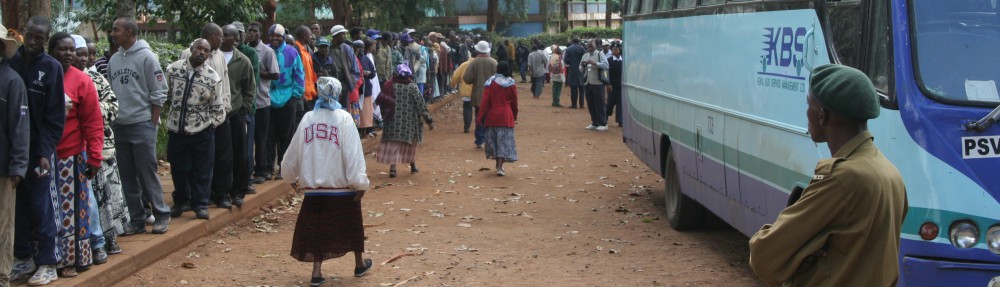
The banner “theme” photograph for this blog and the inset above were taken on a James Finlay Co. tea plantation outside Kericho, Kenya only a few weeks before post-election violence swept the area at the end of December 2007. I have other pictures from the area on Flickr. This is an old story–mechanization versus manual labor. Efficiency for the firm against social costs. Foreign or multinational firms, local workers. Ethnic and class issues among owners, managers and “pickers”. (I write from Mississippi, where cotton was once king . . . )

Kenya is the world’s leading exporter of black tea. This is an important part of the overall GNP. Much tea is grown on small estates–much is also on plantations, some owned by multinational businesses such as Finlay, some owned by politicians, most notably former president Moi. Like horticulture, it provides a large number of low wage jobs with associated rural housing. Surely no one’s ideal for long term development (unless you happen to own a large farm yourself) but a lot better than nothing (and very photogenic). Over time presumably the pickers lose the basic argument to the owners of the land suitable for tea production on the inexorable logic of the firm–lower cost production.

To first-time visitors in Kericho and adjoining highlands of Nandi, Nyamira and Kisii, the well-trimmed tea bushes, dotted with pickers with extended baskets, is a sight to behold.

The visions of tea-pickers have been revised somewhat; the baskets have been replaced with gadgets that are pulled by two pickers hauling select leaves into its storage space.

But this calm view of the tea plantations is deceptive; the low hum of the tea-picking machines has been replaced by angry shouts that hit a crescendo Monday, as workers protested unemployment accelerated by machine use.

Workers at James Finlays Tea Estate operate a tea plucking machine, which has been blamed for job losses, triggering a workers’ strike. [PHOTO: VITALIS KIMUTAI/STANDARD]

Some 50,000 tea pluckers in the tea estates spread across Kericho, Bomet, Nandi, Nyamira and Kisii counties protesting the mechanisation of picking green leaf were expected to participate in the labour protest, although its success appeared partial.

The strike was called by Kenya Plantation and Agricultural Workers Union (KPAWU) yesterday, and whose members work in tea estates under the Kenya Tea Growers Association (KTGA).

The affected companies are James Finlays Tea Kenya, Unilever Tea Kenya, George Williamsons, Sotik Tea and Eastern Produce, among others.

Mechanical Plucking

In 2006, when Central Organisation of Trade Unions (Cotu) first called tea pickers’ strike to protest mechanisation, the area under mechanical plucking consisted of 694 hectares or 2.3 per cent of the total area under tea in the association’s 42 members estates, which has 30,000 hectares.

Then, James Finlay had 600 hectares under mechanised production, Unilever had 54 hectares while Sotik Tea had 32 hectares.

“We have tried to reason with the multinational tea companies over the issue but they have refused to listen. The only way out for us is to let workers down their tools,” said Issa Wafula, KPAWU assistant secretary general.
. . . .
Tom Okinda, a worker at a multinational tea company in Kericho County said favouritism, tribalism and nepotism were rife in employment tea plucking machine operators.

“Those retained are relatives, friends or neighbours of senior managers who have the final say in employment matters, while those who do not have any connection with the management are laid off,” he claimed.

Hellen Tangi, a businesswoman, said there were days when it was prestigious for one to work for a multinational tea firm as some of the unskilled jobs offered a good pay.

But not anymore.

“Despite raking in millions from the fertile farms, these foreigners do not care about locals working for them,” she lamented. Francis Atwoli, the Cotu Secretary General said mechanisation in the tea industry should be discouraged, as it was not good for the economy of developing countries like Kenya.

“The direct and multiplier effect of mechanisation of tea plucking and pruning in the country outweighs the implied cost-savings that employers are claiming,” Atwoli said.

Atwoli further claimed introduction of machines compromised the quality of tea thus affecting the overall auction prices. “Quality of tea is bound to drop with use of the machines since selective plucking of two leaves and a bud will not be adhered to as should be the case,” Atwoli said.

Democratic governance–one man, one vote, rather than one acre or one shilling–can support opportunities for policies that account for needs and interests of displaced workers, such as support for alternative development over time, education and training and such. Another theory of course would be that this isn’t a governance question at all and the government should have as little to do with any of this as possible other than to, say, keep the Ugandans out.

AFRICOM and the “Whale of Government” Approach? [Updated]

Ok, maybe it’s tilapia instead of whale, but I thought this blog post from AFRICOM public affairs was worth a look:

By Dace Mahanay, Bush School of Government and Public Service at Texas A&M University graduate student

Note: Dace Mahanay is currently interning with the Borlaug Institute on an AFRICOM agriculture project in Kisangani, DRC. He is sending periodic blogs detailing the project’s progress.

At Camp Base, just outside of Kisangani in the Democratic Republic of the Congo, the Norman Borlaug Institute for International Agriculture continues to work with Agriculture Company (AgCo), a company of Congolese soldiers (Forces Armes de la Republique Democratique du Congo, widely known as FARDC), in an effort to provide sustainable methods of food production for the training center and U.S.-trained light infantry battalion. From fish farming to the cultivation of cassava, the needs of soldiers are being met in a sustainable way that is positive for the future of Camp Base and the community of Kisangani as a whole.

The last few weeks have been an exciting time for the agricultural project. A fish farming expert from the U.S. visited the project and provided valuable recommendations for increased production of tilapia and African catfish. The first batch of harvestable tilapia will be ready in the next couple of months and will be an excellent source of protein for FARDC soldiers.

The President’s new development policy invokes a “whole of government” approach, and I did learn last week about some encouraging specifics in coordination, such as the fact that the MCC has, for the first time, executed an actual Memorandum of Understanding with USAID. Nonetheless, if AFRICOM as a military combatant command, is going to be leading agricultural projects in places where we are not openly militarily engaged except in “permanent” and ongoing training and related activities, what are the lines between civilian and military? Between defense/security/diplomacy and development/agriculture assistance?

It sounds like a great program from an agricultural standpoint. Also sounds like it gets into areas that could involve unintended consequences if all the local circumstances are not well understood.

Update: Here is a story raising the issue of reports of rape and murder by the Congolese army:

Government troops are raping, killing and robbing civilians in the same area of eastern Democratic Republic of Congo where militias carried out mass rapes more than two months ago, a top United Nations envoy said.

Margot Wallstrom, who is responsible for UN efforts to combat sexual violence in conflict, told the Security Council that UN peacekeepers have received reports of rapes, killings and looting by government soldiers.

“The possibility that the same communities who were brutalised in July and August by FDLR and Mai Mai elements are now also suffering [at the hands of the army] is unimaginable and unacceptable,” she said, referring to the Rwandan-led rebels from the Democratic Front for the Liberation of Rwanda.

“Central Province” leadership, the 2012 Kenyan Presidency, the ICC and the United States


The Standard has posted an interesting story on-line for the Sunday paper under the headline: “The hidden battle of class and power in Central Kenya”.

The endorsement of Uhuru Kenyatta as the leader of the Kikuyu by the Minister for Environment, John Michuki, has raised eyebrows but many think there is more to the statement.

Several personalities and political forces are digging in to inherit President Kibaki’s Central Province voting bloc and mantle, which is estimated to be worth four million-plus votes.

However, underlying this succession battle is a simmering rivalry in the politics of class and power that has been playing out for about a century.

Macharia Munene, a professor of history at the United States International University, Nairobi, says this class struggle dates back to colonial times. Then, peasants invented a tradition of resistance against colonialism.

However, a section of Africans, the so-called loyalists, collaborators and homeguards, opted to work for the colonial authorities in exchange for privileges and goodies like education, land, and jobs.

The resistance would culminate in the violent confrontation between the natives coming together under the Mau Mau resistance movement, and the British colonial government.

Central Province saw the most intense action for the seven years the Mau Mau uprising lasted. The relationship and roles of both loyalists and nationalists was more pronounced and hostile in the region than in other areas.

However, at independence, collaborators seized the levers of power and proceeded to economically and politically dominate State affairs, including distribution of resources, opportunities, senior civil service and parastatal jobs.

“Unfortunately, it was the loyalists who were better placed to take over power, having enjoyed cosy relationships with the departing colonial powers, but also having enjoyed privileges like better education than their nationalist brethren,” says Macharia.

Perpetual struggle

It is in this context that Michuki’s statement has re-ignited the twin narrative that has defined Kenya’s and central Kenya politics.

The narrative of one community, two classes in perpetual struggle for political and economic power. It is a context in which a wealthy minority uses its access to political power to increase its economic fortunes at the expense of the majority.

First it was the British colonial settler minority (1895-1963), and then the Kenyan political and economic elite (1963-to date).

The scholar says this elite in central Kenya has dominated regional politics and seeks to succeed Kibaki.

President Kibaki himself was through out the Kenyatta regime considered an outsider. Even in 2002, he only made it to power on the back of a broad and most inclusive political movement the original National Rainbow Coalition and was even abandoned by his erstwhile ally Njenga Karume.

The foremost politician seeking to destabilise the status quo in Central Province is Gichugu MP Martha Karua who has made it clear she would be gunning for president in 2012. Political analysts saw Michuki’s statement as a warning to Karua, whom this vcartel sees as a spoiler.

Former Subukia MP, Koigi Wamwere, says Michuki’s endorsement of Uhuru is an attempt by this economic elite to perpetuate itself.

“Michuki is warning other pretenders to the throne not to dare even try,” Koigi said.

By coincidence I started reading Koigi Wamwere’s autobiography I Refuse to Die during my trip to Washington to the MCC this week, so this is especially topical for me.

As I noted previously, Uhuru Kenyatta has been in New York and Washington of late as Kenya’s Finance Minister, as well as co-Deputy Prime Minister, attending UN and World Bank meetings and advocating for MCC compact status for Kenya. Amos Kimunya was Kibaki’s initial appointment to the Finance Ministry when he named the key cabinet spots during the post-election period. When Kimunya was forced to step aside due to the scandal over the sale of the Grand Regency hotel, Kibaki tapped Michuki, who was then succeeded by Kenyatta.

It’s especially interesting to look at how this plays in relation to the U.S. During the post-colonial heyday of the Cold War of course, the U.S. aligned with Jomo Kenyatta (and reportedly helped fund Tom Mboya covertly while the Soviets reportedly helped fund Oginga Odinga) and KANU “conservatives”, including Moi in his day. The U.S. interests supposedly served were both direct military alliance (access to bases and such) and other security cooperation, and seemingly some sort of ideological alliance based on the notion that the Kenyan model of one party formal “African socialism” involving conservative patronage, and state-created and supported oligarchy was preferable from a U.S. perspective to a version more akin to Nyerere’s or other more traditional, populist or radical “socialisms”.

Since the end of the Cold War and the fall of the Berlin Wall things have been complicated. Smith Hempstone, George H.W. Bush’s political appointment to the Ambassadorship, really stuck his neck out to push democratic reform and made a major contribution to forcing Moi to amend the constitution to allow competing parties, while maintaining military and security cooperation. Hempstone, a former editor of the Washington Times clearly came to the post with U.S. conservative bona fides and was vigorously anti-socialist. At the same time, however, other Americans continued to support Moi. As I noted in a previous post, one of Washington’s leading conservative think tanks generated a pro-Moi position paper in 1990 and Republican consultant and lobbyist Charlie Black and his firm represented Moi on past the first multi-party election in 1992 and into 1993 according to their foreign agent registration filings.

Hempstone believed that supporting democratic ideals, in itself, was a key part of the United States’ proper role in world affairs. In his book Rogue Ambassador: an African Memoir he writes “I told Raila it was untrue that the U.S. would not accept because of his leftist past his father’s election as president if he won freely, fairly, and lawfully. The mistakes of thirty years ago were water over the dam. Raila said he had never believed otherwise.” After Hempstone’s term ended in 1993, however, active U.S. interest in supporting democratic opposition to Moi waned.

Just as Hempstone did not think there were major ideological differences between the opposition candidates in 1992, the USAID officials that I spoke to in the run up to the 2007 election did not see major ideological differences among the opposition contenders or between Raila as ODM nominee and Kibaki. Nonetheless, the U.S. through Ambassador Ranneberger took a pro-Kibaki stance toward the election (this was not just my direct experience “on the ground”, but also the perception of one of America’s leading Africanists and Kenya experts who said on a panel at the African Studies Association last fall that he was convinced that the U.S. had supported Kibaki).

In their January 2009 New York Times story on the exit poll and election controversy, Mike McIntire and Jeffrey Gettleman wrote:

Despite initial economic successes and popular support after his election in 2002, Mr. Kibaki had gained a reputation for playing divisive tribal politics, and his administration had become tainted by scandal. Still, he had a good relationship with the Bush administration and generally supported American counterterrorism policies in East Africa.

Mr. Odinga was viewed skeptically by some in Washington because of his flamboyant manner and his background: he was educated in East Germany and named his son after Fidel Castro.

At the same time, then-Assistant Secretary of State for African Affairs Jendayi Frazer, now with the Whitaker Group lobby firm and Carnegie Mellon University, was by reputation thought of as close to the Kenyatta family. Uhuru, however, was named in the Waki Commission report on the post-election violence as a suspect in playing a role in supporting revenge attacks by tribal militia and he is said to be likewise a key suspect in the current International Criminal Court investigation on this basis.

Ironically the Washington Times was conspicuous in publishing 2008 attacks on Raila Odinga, and linking him to Obama and the U.S. presidential race. Now, Glenn Beck attacks the new Kenyan constitution and Dinesh D’Souza and Newt Gingrich are attacking President Obama for being linked to his father who was of the same “tribe” as Oginga Odinga (even though Obama, Sr. was part of the U.S. government “airlift” to study in the United States while Raila is criticized for having studied in the Eastern bloc).

Looking ahead to a 2012 race in Kenya, during the 2012 race in the United States, if the Kenyan contest comes down to Raila Odinga versus Uhuru Kenyatta, with rich “class” and “tribal” subtexts understood by few Americans, what will the United States and other Americans do officially and unofficially? Will we prioritize democracy?; stability?; some notion of ideological compatibility?; some particular policy objective? And where does the issue of the post-election violence and the ICC fit in?


Millennium Challenge Corporation roundtable

The Millennium Challenge Corporation was kind enough to include me this morning in a roundtable discussion on the President’s new global development policy with around a dozen bloggers and Sheila Herrling, Vice President of Policy and Evaluation and Charles Cooper, Vice President of Congressional and Public Affairs.

It was fun for me as someone outside of Washington blogging as a matter of personal interest in the issues I write about to have a place at this table and I certainly learned a good bit about what the administration is getting at with their approach, as well as getting some insight into what some of the “thought leaders” and groups are interested in. Hopefully I contributed to the overall dialogue.

Well worth a vacation morning in Washington. I’ll hope to follow up with some of the other participants and read up a bit and have more on this event over the weekend, but in the meantime, I wanted to make sure to post a public thanks to everyone at MCC who made this available.

Kenyatta reports frustration with US on aid, but new reports show more corruption problems

From an AP report today, in the Boston Globe:

Kenya’s deputy prime minister, Uhuru Kenyatta, said he also would like to see more cooperation from the United States on stabilizing Somalia and fighting piracy off the Horn of Africa.

Kenyatta said U.S. officials, including Vice President Joe Biden, had said that Kenya could expect more aid through an agreement with the Millennium Challenge Corp. after it pushed through a new constitution.

The constitution was signed in August, but Kenyatta says U.S. development agencies are insisting on evidence of progress in taming corruption.

Kenyatta asked, in his words, “Why do they keep changing the goal posts?”

At the same time, however, the Daily Nation ran a story headlined “Revealed: Fraud and waste of tax billions”:

The government lost billions of shillings from the tax kitty during the 2008/2009, according to the latest Controller and Auditor-General’s report.

Discipline was so poor that ministries spent fortunes and then pushed the bills to the following financial year in the so-called pending bills.

But the biggest scandal is in imprests where government officials are given money for travel, accommodation and other official expenses, which they fail to account for. In the period under review, public officials failed to provide proof of how they spent Sh3.4 billion in imprests.

Paid to fake IDPs

In some cases, the officers could not explain how they spent public money. Some of it was paid to fake internally displaced persons (IDPs) in apparent widespread fraud.

A total of Sh7 billion was poured into funny imprests or nobody can explain how the money was spent.

So prevalent is the imprest abuse and fraud that some of the civil servants have left the service holding the money, meaning that it will never be recovered. The auditor questions why officials were allowed to pile up unaccounted for imprests, even though there were rules on accounting for such funds.

I attended a discussion at the National Endowment for Democracy (NED) back in the summer of 2009 with key Kenyan parliamentary leaders–this was the key theme then when I asked a panel what message they would have to Americans interested in being helpful to Kenya: more aid dollars, through the Millennium Challenge Corporation particularly. It seems to me that good governance and limiting corruption have always been understood to be key MCC criteria. Kenya has a lot going for it–a lot of advantages over other poor countries–so why the special pleading? As long as new scandals continue to accrue while the old ones fester unaddressed, it does not seem to me that Kenyan politicians are entitled to be frustrated with the US for not ramping up government-to-government aid expenditures.

Uganda, Iran and the Security-Democracy Trade Space?

Secretary of State Clinton noted this week to the African Chiefs of Mission the Africa Bureau’s efforts on wrangling votes for Iran sanctions:

The bureau was enormously helpful in rounding up votes for the sanctions resolution on Iran – Gabon, Nigeria, Uganda, thank you, because it wasn’t easy. I think I talked to President Museveni three times and Johnnie visited him several times. But – end result was we got strong African support for the international sanctions regime. We are building, and in some – many cases, rebuilding collaboration not only along bilateral lines, but multilateral alliances, most especially in our collaboration and engagement with the African Union, because it’s very important that we do more to build up the African Union and other regional entities like the East African Community, which has a real potential for being an engine of economic prosperity. [emphasis added]

Secretary Clinton’s Remarks at African Chiefs of Mission Conference

Tensions continue building over Uganda’s February 2011 elections–see yesterday’s news about opposition plans for a parallel electronic vote count and the Ugandan government’s strident reaction.

Carl LeVan has an excellent discussion of "Democratization and Securitization in Uganda" that I would highly recommend.

The ruling NRM has cleverly adopted the Global War on Terrorism as a political resource. Even before the terrorist bombing in the capital in July 2010, the government began closing political space in the name of national security while it successfully obtained aid commitments from the United States to fight counter-insurgency wars, one of which is against the brutal Lord’s Resistance Army (LRA) in the north.

. . . .

Looking beyond the Pentagon, Washington is clearly aware of Uganda’s governance drift. For example the US announced that will not renew 10 million dollars committed through Millennium Challenge Corporation to help Uganda move from “threshold” status to a full compact (ie, an agreement) for aid. USAID’s plans call for strengthening democratic institutions, enhancing political competition, and improving parliamentary capacity for oversight through partnerships with civil society. Unfortunately USAID faces an uphill battle, with no increases in the lines funding for either for civil society programs or for its good governance in Uganda, and cuts are planned for programs relating to “political competition and consensus building.” Even aid to fight transnational crime is slated for cuts.

In addition to all the regional security issues involving Somalia, Sudan, Congo and the Lord’s Resistance Army, the Iran sanctions issue adds another interesting twist. I noted back in May that Assistant Secretary Carson and AFRICOM Commander General Ward were seeking Museveni’s support on Iran sanctions during a visit to Kampala, as well as pushing for Museveni to relinquish unilateral control of the Electoral Commission. The U.S. succeeded in persuading Uganda to support sanctions, but did not secure action on the Electoral Commission. Both worthy goals, but is there a trade off?

It is also interesting to note a report that Uganda has now been working with Iran to create a joint bank as a mechanism to allow Uganda to obtain access to $46M in pledged Iranian credits that have impeded by the sanctions:

[A] memo prepared by the ministry for Parliament’s public accounts committee, in response to an audit query, said that sanctions had complicated the money transfer. "The ministry has followed up the implementation of this line of credit. However, it has faced challenges, especially following the imposition of sanctions on Iran," said the memo.

"In a bid to overcome the difficulty in transferring funds to and from Iran because of sanctions and to promote investment and trade, the two countries agreed on the establishment of a bank as a joint venture as the best way forward," it said.

Daily Nation reports that USAID Inspector General has found that US funding did go specifically to encourage “Yes” vote on referendum

Wednesday, the inspector general said the funds were channelled through USaid to eight organisations either based in Washington, Rome or Nairobi which in turn contracted 86 local groups involved in the ‘Yes’ campaign led by President Kibaki and Prime Minister Raila Odinga.

Responding to questions sent by the Nation, the USaid inspector general said: “We did find evidence that USaid specifically spent taxpayer funds to encourage a ‘Yes’ vote.”

The inspector general said Sh1.1 billion ($12.6 million) of the total amount was used to finance activities directly related to the referendum.

“USaid found no evidence that any of this money was spent specifically to lobby for or against abortion,” an agency official said in response to a list of questions.

The USaid’s review did not take a position on whether that law was violated. “We consider this to be an unresolved legal issue this office lacks the authority to decide,” it said.

Mr Smith dismissed the findings and said he has asked the Governmental Accountability Office, a watchdog agency, to investigate afresh.

The full Saturday Nation lead story on the Inspector General’s findings is here.

Open Society Report–Uganda Not Prepared for Free Election; U.S. options?

From AFP in the Daily Nation:

Uganda’s election panel has failed to establish conditions required to hold a free and fair vote less than five months before a scheduled general election, according to report seen by AFP Wednesday.

Intimidation of the opposition and media censorship both remain pervasive and the ruling party uses government structures for political purposes, says the report commissioned by Open Society Initiative for eastern Africa, a pro-democracy group linked to American billionaire George Soros.

OSIEA hired as lead author the UN’s Special Rapporteur on the Situation of Human Rights defenders, Margaret Sekaggya, though the document is not a UN report.

“The electoral commission’s failure to address constant harassment, arrests and intimidation which political groups… are subjected to by police and Kiboko (stick wielding) squads has severely undermined its credibility,” the report says.

“The commission must also address the denial of freedom of expression and speech, especially the domination of broadcast media by the government and ruling party.”

The report states it is too late for Uganda to establish ground work for a free vote, which will likely be held in late February.

This obviously presents a difficult situation for U.S. policy makers. We are training Somali soldiers in Uganda in an environment of heightened tension following the World Cup bombings in Kampala, as well as training the Ugandan military and supporting their deployment in Somalia in the AMISOM mission.

If we know that the election is simply not going to be fully legitimate up front, what are our options? We could, for instance, support Museveni in the run up to the election on the theory that since he is going to stay in power anyway, it is better to help him make it look good to promote stability. And if violence breaks out, we can support nominal power sharing of some type to placate the opposition elites. We could bring open pressure now and try to broker some type of pre-election agreement to change the environment at least to some extent–or do something similar quietly. We could stay neutral and support the process as best we can without a specific agenda and maximize our position to contribute to problem-solving in the aftermath as honest brokers. Interesting choices.

New Mo Ibrahim Foundation rankings for African Governments

Here are the 2010 Ibrahim Index rankings for the East African Community members, plus Ethiopia and Sudan, out of 53 African countries. Overall ranking to left, "Participation and Human Rights" in parenthesis to the right:

15 Tanzania (56.37)
24 Uganda (50.84)
27 Kenya (55.47)
31 Rwanda (37.94)
32 Burundi (48.63)

34 Ethiopia (34.58)
48 Sudan (23.08)

Friday Reading

Texas in Africa has the run down on today’s release of the UN human rights mapping report on the DRC.

Of special interest for East Africa is how this plays out in regard to Museveni now, aside from Rwanda and Burundi. Museveni has recently spoken of withdrawing from support of AMISOM in reaction to the criticism–while his offer to of tens of thousands of additional troops has remained outstanding. Kenya has been calling for more troops for AMISOM for months, and has made noise about changing the arrangements to send its own forces. Kenya’s Foreign Minister Wetangula has said that the international community should stop wasting vast amounts on the anti-piracy maritime efforts and spend the money for "national building" with the TFG, which includes the ramping up of AMISOM. Kenya watchers will remember that Wetangula was one of Kibaki’s core appointments of the key ministries following the 2007 elections prior to the Kofi Annan-led mediation between PNU and ODM. PNU has had some ties with Museveni’s NRM.

In Kenya, the human rights community is deeply offended by the renditions of alleged terrorism suspects to Uganda without due process, while the government has leaked a report showing planned attacks in Nairobi in conjunction with the Kampala bombing during the World Cup. At a time when Kenya needs to focus on the hard work of implementation of the new constitution, the neighborhood keeps getting messier.

On a lighter note, check out the backpackers guide to Somaliland on the Medeshivalley.com blog.