Historic Day as New Constitution Ushers in Kenya’s “Second Republic”

Dropping in
The Standard: Kenyan’s Hopes Highest Since NARC Victory

By ALEX NDEGWA

As Kenyans celebrate a new Constitution that radically improves governance, hope is growing with a survey suggesting the high level of optimism is highest in seven years.

An overwhelming majority (77 per cent) is optimistic about the economic prospects in the next 12 months following the promulgation of the new Constitution by President Kibaki, this Friday.

Such high level of optimism was last recorded in April 2003, four months after the National Rainbow Coalition Government rode to power on a euphoric wave that ended Kanu’s repressive reign.

Kenyans were then rated the most optimistic people in the world, yearning for better governance and service delivery, but the hope dissipated as the new regime that had campaigned on a reform platform got mired in grand corruption and power feuds.

The country’s leadership, which ironically brings together the President and Prime Minister Raila Odinga, who had fired up the optimism before their falling out, has the opportunity to make up to Kenyans.

Remembering Why Kenya Needed a New Constitution–the fundamentals

From a speech by James Orengo in 2000 at Concordia University in Minnesota:

The constitution of Kenya was deliberately designed to fail. We borrowed the worst features of other people’s constitutions. The result is a machine without rhythm or reason. We have borrowed the American presidential system but ignored the checks and balances that make the president accountable to the Americans. We have borrowed the parliamentary system from Britain but none of the parliamentary practices that makes the British parliament effective. We borrowed the Bill of Rights from the Universal Declaration of Human Rights but added in all the exceptions to rights that were common in Stalinist countries. In short, we now have a presidency without checks, a parliament without teeth, and a Bill of Rights that reads more like a Bill of Exceptions rather than Rights.

And M. Munene, 2001,in The Politics of Transition in Kenya 1995-1998 Nairobi, Friends of the Book Foundation:

the republican constitution that Kenyatta talked about rolled the powers of the governor-general and those of the prime minister into one in the name of the president and enabled him to enjoy those powers unfettered by the British government, any party opposition, or constitutional position that he did not like . . . the governor-general and the prime minister became, in 1965, the absolute president.

As quoted in Nasong’o, S.W. and T.O. Ayot (2007) “Women in Kenya’s Politics of Transition and Democratization”, in G.R. Murunga and S.W. Nasong’o, (eds), Kenya: The Struggle for Democracy London: Zed Books

“Political Stability”, “Investor Confidence” and meaningful elections in East Africa

Wednesday’s Nairobi Business Daily features a story headlined “Political stability lifts investor confidence in East Africa“:

Easing political tensions and the ongoing search for uniform governance standards in East Africa has lifted business confidence in the region and is encouraging investments that could boost employment.

Buoyed by recent peaceful elections, investors in the five EAC member countries said governance based on the rule of law had significantly lowered political risk, creating a stability that has allowed them to engage their expansion gears once again.

Rwanda and Burundi successfully concluded presidential elections last month, a trend that has been crowned by Kenya and Zanzibar early this month when they conducted peaceful referenda.

“It is satisfying for investors — and regional blue chip players in particular — when elections are peaceful the way we are witnessing them,” said Mr Peter Munyiri, KCB deputy CEO in charge of group business.

The bank, which has just raised Sh12.5 billion from its highly publicised rights issue, says it will use part of the money to mobilise savings and create a large pool of credit across the region, “Certainly the political and sovereign risks in the region set an attractive business environment and KCB can comfortably lend more money, with the region also expected to become the home for lots of overseas funds looking for investment destinations,” said Mr Munyiri.

It is certainly striking to see the presidential elections in Rwanda and Burundi labeled as “successful” when in both cases the sitting administrations essentially disqualified the opposition and conducted elections without meaninful competition–in Burundi without even a token alternative on the ballot. The notion of a security tradeoff between “stablity” and democratic political openness is certainly a familiar refrain in East Africa but it is rare to see a statement this explicit of an attractiveness to investors of meaningless but peaceful voting.

A follow up question is whether investors care about the political reforms so fervently hoped for as a result of the safe passage of the new Kenyan constitution, or is it just that fact that the vote was held without significant violence? Each of these countries presents a very different situation in many respects: at one extreme, Rwanda is relatively underdeveloped and poor outside Kigali and is hugely dependent on aid, but gets high marks for having relatively little corruption, and rapid progress in some areas of development while seeming to move further away from political openness. Kenya has had fairly robust overall growth most years post-Moi and receives a relatively small amount of its direct government budget from official assistance; at the same time it remains notoriously corrupt, has huge inequality and radically uneven development. In recent months, Kenya reformed its election commission and midwifed a new constitution that 90% of Kenyans reportedly are glad to have passed. So the trend on democracy in Kenya seems to be running now in the opposite direction from Burundi and Rwanda.

With security concerns rising with the latest bomb blast killing 6 MPs in Mogadishu and the July bombings in Kampala, how does the “investor confidence” factor play out in assessing the risks that are worth taking to support democracy in Uganda with elections coming in February?

Kenya Referendum Retrospective–some lessons from the voting and election observation

This week will see the formal implementation of Kenya’s new Constitution to much fanfare. Before looking ahead, I wanted to take time to share by permission this excellent report from a grassroots election observation conducted in Western Kenya by Quaker Peace Network teams through a program called the African Great Lakes Initiative of the Friends Peace Teams.

For those of you who may not be familiar, roughly half the world’s Quakers are said to live in Africa’s Great Lakes region and Quaker Meeting Houses are common and important in Western Kenyan communities, including in areas impacted particularly by the 2007 post-election violence.

Yesterday we had the debriefing for the fifty observers. The feeling was that the new Interim Independent Electoral Commission did an excellent job of conducting the election. Yet there were some concerns:

1. It was not completely clear the criteria for the validity of the votes so that different poling stations rejected votes that other stations accepted.

2. In some communities the youth voted well, but in others very few youth voted. There needs to be more outreach to youth.

3. In some places the cell phones of the observers were confiscated for the day by the voting officials. This meant that the observer was out of communication and could not report something if needed. We felt that observers should be allowed to keep their cell phones, perhaps on vibration mode.

4. In at least one station, election officials were showing voters how they should vote.

5. There were no good guidelines on how illiterate voters should be handled when they did not come in with a family member to assist them.

6. In areas where there was violence after the 2007 election, some voters left to go back to their home community because they were afraid of violence after this election. This meant that these voters were disenfranchised.

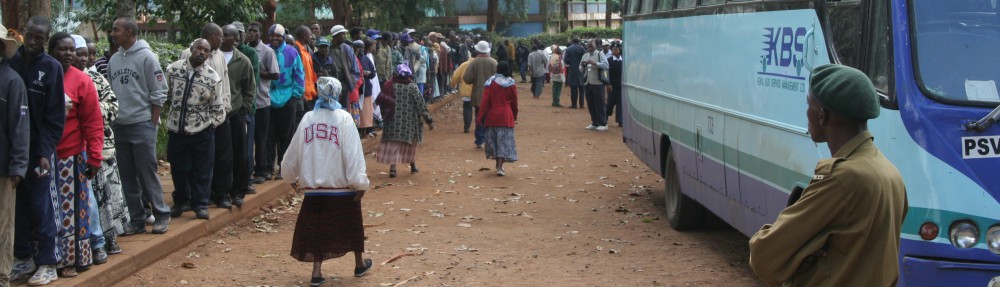
My particular polling station in the hard hit town of Jua Kali had 80% turnout with 81% voting “No.” But it was in one of the 18 (out of 210) constituencies that had electronic registration of voters. Voters put their left thumb on a device that immediately brought up their picture, registration card, etc. on a computer. This worked extremely well with only about 5 people where it did not work These were sent to the Presiding Officer who checked their name manually on the hard copy–in every case the voter was a valid voter and allowed to cast his/her vote. Another significant innovation for most of the country was the Presiding Officer was give a special cell phone so that he/she could send a text message with the results from his/her station to headquarters in Nairobi. Results were being announced two hours after the polls closed and by 10:00 PM it was clear that the Yes side was winning by a landslide. There was no ability or time for rigging of voting returns at the headquarters as happened in the 2007 election. The cell phone results then had to verified by the official documents signed by the Presiding Officer and agents for the two sides.

In other words, as Andrew commented, although not much happened at the polling stations, our presence was a valuable part of the process. We found that most of the polling stations had no neutral election observers and in one constituency, the QPN observer was the only independent observer.

This type of detailed and candid reporting is what is needed to continue to improve the election process and the presence of a neutral peace-oriented group of grassroots observers living and working in the region seems ideal for the challenges presented by elections in this area.

Washington Post names names–and a question

The Washington Post sticks its neck out a bit to publish in its “44” blog a post entitled “Lawmakers and the ‘birther/Muslim’ myths”:

We’ve collected a list of lawmakers whose comments have helped fuel the debate. Most either said outright that the president is a Muslim, that he is not a U.S. citizen or appeared to leave open the possibility that either falsehood could be true.

One question I have on the “birther” stuff: if Obama’s father had been a white Kenyan instead of a black Kenyan, would ANYONE think that he was born in Kenya instead of Hawaii?

The President’s Electoral Commission–is Uganda travelling the road Kenya took to violence in 2007?

“Electoral Commissions, Africa’s New Kingmakers” from The Independent in Kampala.

During the immediate weeks of violence and uncertainty in Kenya following the December 2007 election I had lunch with a politician from the western part of the country. This person had been in parliament but both lost out for re-election as a PNU candidate and was personally impacted by the violence. The story of the election as related from the perspective of this person for whom I have great respect was that as soon as President Kibaki acted unilaterally to appoint his own choices to fill the seats on the Electoral Commission of Kenya in the fall of 2007, the opposition figures in the area represented by this MP felt that it was clear that Kibaki and his team were committed to rigging the elections to stay in power and all bets were off. From that point, this person felt that their own chance for a fair election in an opposition oriented district were also taken away.

An election commission appointed by one candidate, a sitting president running for re-election, is a recipe for serious trouble. In Kenya the mechanism was in place through the 1997 Inter-Party Parliamentary agreement for collaborative appointment of the ECK membership. Unfortunately, the agreement had not been given binding force of law. When Kibaki chose to ignore the prior agreement and acted to fill the ECK with his own people, Western donors in public consoled themselves with the notion that the Kibaki’s last minute reappointment of the ECK chairman Samuel Kivuitu, who had acquited himself appropriately in the 2002 election and the 2005 referendum (both landslides) would be enough to save the day. And Kibaki had not technically violated the letter of the law in making unilateral appointments.

Ultimately, we now know, Kivuitu was sidelined to allow the manipulation of the vote tallies, and was successfully pressured to go ahead and declare Kibaki the winner when he admittedly did not know who had won and to facilitate an extraordinary “quickie” swearing in of Kibaki that Sunday evening at State House.

In the case of Uganda, we have the determination of the Ugandan Supreme Court that there were serious problems with the last election in 2006. Althought the Ugandan Electoral Commission has just issued a statement denying incompetence and asserting that past problems have been addressed, this message on behalf of “the government” does not attempt to argue that the Commission is substantively independent from the incumbent administration.

What real excuse has Museveni offered to reject the concerns of donors to reform the Commission to secure a level playing field for 2011?

Freedom and Razor Wire, Kampala

People in Kampala and towns around Uganda move past signs and slogans of this type going about their business every day.

Freedom of expression is your right

Gration spoke out on Obama/Odinga “smears” in 2008 campaign

It is easy to see why President Obama might want retired General Scott Gration as Ambassador to Kenya for the 2012 presidential campaigns in both the U.S. and Kenya. Gration served as a campaign military and foreign policy advisor to Senator Obama in 2008 and spoke out against allegations from the U.S. hard right that Obama played some nefarious role as a secret supporter of Islamic terrorism in respect to Raila Odinga and the 2007 election in Kenya. Gration became acquainted with Obama through accompanying him on his visit as a Senator to Kenya in 2006.

Gration has enhanced credentials as both a retired air force major general and the son of missionaries who grew up in Congo and in Kenya and speaks Swahili. He has said that he was a Republican prior to the 2008 campaign.

Here is Gration’s October 17, 2008 letter to the Washington Times:

Mark Hyman’s “Obama’s Kenya ghosts,” (Commentary, Sunday), was a disgraceful smear on Sen. Barack Obama. Because I accompanied Mr. Obama on his trip to Kenya, I can say unequivocally that Mr. Hyman’s piece was filled with lies and innuendo.

• Mr. Obama’s 2006 trip to Kenya was authorized by the Republican chairman of the Senate Foreign Relations Committee, who congratulated Mr. Obama on a successful trip when he returned.

• Mr. Obama did not “campaign” on behalf of Raila Odinga, has never endorsed him, and was not “nearly inseparable” from Mr. Odinga during his time in Kenya. Mr. Obama met with a wide range of Kenyan and American officials, including a Nobel Prize winner, human-rights defenders, and President Mwai Kibaki. He did not have a single scheduled meeting with Mr. Odinga.

• Mr. Obama was accompanied throughout his trip by myself and two other active-duty U.S. military officers; and the U.S. ambassador attended meetings and events throughout the trip. The Obama staffer – Mark Lippert – that Mr. Hynes names is a naval reservist and Iraq War veteran whose deployment began several months before the Kenyan elections and continued well past it.

• The Obama speech that Mr. Hyman references was a widely praised effort that condemned corruption and tribalism while urging the promotion of private enterprise and accountable, transparent government.

• Mr. Obama and Mr. Odinga are not cousins, and efforts to assert otherwise have been described as “stretched to the point of ridiculousness” by an independent fact checker.

Mr. Hyman references telephone contacts that Mr. Obama had with Mr. Odinga in January. He fails to mention that those contacts were encouraged by Secretary of State Condoleezza Rice and were accompanied by public statements that Mr. Obama made on Voice of America, Kenyan radio, and in a Kenyan newspaper, calling for calm and a peaceful resolution of Kenya’s political crisis. Repeatedly, Mr. Obama asserted, “the opposition (led by Mr. Odinga) must turn away from the path of mass protest and violence in seeking participation in government.”

Mr. Hyman’s piece concludes with an astonishing attempt to tie Mr. Odinga, the sitting prime minister of Kenya, and, by absurd association, Mr. Obama to acts of terrorism committed against the United States of America. This false and outrageous charge says a lot more about Mark Hyman than it says about Barack Obama.

Given the partisan crossfire from Washington and elsewhere in the U.S. on the Kenyan constitutional referendum, and the partisan crossfire over the 2007-08 Kenyan election crisis, it is hard to imagine that there will not be the same type of attacks on both Obama and Odinga from from the U.S. in the 2012 campaigns.
Discussion about Gration as Ranneberger replacement hits media

On Friday, Foreign Policy’s The Cable blog ran a piece about tension between U.N. Ambassador Susan Rice and Sudan Envoy Scott Gration over Sudan policy ahead of the January referendum, and indicated that there were discussions about assigning Gration to replace Ranneberger as Ambassador to Kenya. This has been a topic of conversation in various forms for quite a long time, but so far as I know this is the first explicit media report since a mention in Al Kamen’s “In the Loop” column in Foreign Policy’s sister publication, the Washington Post in April. The Cable post was picked up by Kevin J. Kelley in the Saturday Nation.

The timing of this continues to get stickier as the date for the Sudan referendum approaches in January–in fact, it seems quite late to make a change in Sudan now. It has been said that the Administration was waiting for Gration to be available to make a change in Kenya. At the same time, Gration has drawn criticism from both sides of the aisle in Congress as well as from activists and the Administration may want a fresh face and voice even if there is no change in policy.

New Release: Inspector General’s Report on Department of State activities on Kenya’s Draft Constitution

Here is the link to the report from the Department of State Office of Inspector General.

Update–but see “Daily Nation reports that USAID’s Inspector General has found that US funding did go  specifically to encourage “Yes” vote on referendum”