A Must Read on the U.S. Government in Africa: “Pack like its Arizona”

There is so much that could be said in regard to a blog post I read and saved last week, but my policy on things related to the U.S. military is not to editorialize but to stay in “I report, you decide” [wink] mode.

If you are interested in understanding AFRICOM, and perhaps more generally the U.S. government in Africa, I think you really do owe it to yourself to just take a moment to read this post, “Pack Like its Arizona” , from AFRICOM public affairs.

“A New Branch of Government on the Gulf”

Since the BP Oil Spill is front page news in Africa, I thought it was time for the AfriCommons Blog to share just a bit of perspective from right here in Katrina-BP Spill Country.

From the Sun Herald, the Knight Ridder daily in Gulfport-Biloxi here on the Mississippi Gulf Coast:

BILOXI — From all appearances, a new branch of government on the Gulf — BP — continues to dictate the response to what is now the nation’s worst man-made disaster.

Coast leaders accustomed to marshaling resources for disaster response are being told BP will clean up any oil that threatens Mississippi marshlands and beaches. After watching the dismal results in Louisiana, mayors and a Harrison County supervisor told the Sun Herald on Thursday they each have their own plans ready and will step in if oil threatens the shoreline.

“Everything that has been told to us is, ‘BP is responsible. BP is going to clean up. BP is going to do this and BP is going to do that,’ ” Biloxi Mayor A.J. Holloway said. “We are not going to depend on that.”

Holloway, Gulfport Mayor George Schloegel, Ocean Springs Mayor Connie Moran and Harrison County Supervisor Windy Swetman said in a meeting at the Sun Herald that DEQ and DMR have not released their near- and onshore response plans and did not seek input from Coast localities in developing them.

Instead, Coast localities have delved into their own solutions.

“We are used to dealing with disaster,” Moran said. “It’s just hard to sit around and do nothing and wait for BP to come to the rescue. Let’s just say we don’t have a warm and fuzzy feeling about that. . . . .

(emphasis added)

Surely if there was an environmental disaster in Kenya caused by private industry, and the Kenyan government deferred to the very company that caused the disaster to govern the response, the US would offer criticism of the lack of autonomy and responsibility shown by the Kenyan government.

Burundi vote; Coke(TM) in Somaliland

“This is Africa” has a good new discussion of the state of things after the first round of elections in Burundi.

Meanwhile, with the presidential election in Somaliland now just less than a month away, plans for a local Coca-Cola bottling plant between Hargeisa and Berbera hit the media this week:

Coke will be supplied in Somaliland by SBI (Somaliland Beverages Industries) and after the launch of the factory, bottles of Coke products will be priced to compete with locally bottled no-name brands and all Somalilanders will be able to take advantage of the great Coke taste at a great price.

There is no word yet as to whether or not SBI has considered recycling options for their output, however, perhaps somewhere in the future we can read about another group of Somaliland Entrepreneurs opening the country’s first recycling plant.

Skullduggery on the Contitution in Kenya

NARC-K, the party now led by Martha Karua, has issued a public warning about powerful forces scheming to derail reforms under the proposed new constitution. As when she raised the alarm some months ago about bribery in parliament she has not named names. Karua, having fronted for the PNU hardliners in the Annan-led “mediation” following the 2007 elections and served as Kibaki’s first Justice Minister, has been on the inside, has been around quite a while, and is  recognized as a sharp lawyer.

It certainly seems that the announced High Court ruling on the 2004 challenge to the Khadi’s courts is being widely viewed as transparently political in timing.  Likewise the investigation into the insertion of “national security” as a general qualifier of individual rights under the proposed Bill of Rights at the Government Printing Office has not been resourced seriously, has stayed away from people in power and extended in duration, seemingly set up to fade into the distance as such investigations normally do.

Credibility of the voting and counting in the referendum on August 4 may well be at issue, and handling this correctly and transparently will be vital for Kenya’s future. I hope that we in the United States are doing a good job with our support for the IIEC especially.

Waking up to the challenges in Kenya

Yesterday’s big news from Kenya was the ruling by a court panel in a 2004 constitutional challenge to the Khadi’s Courts on grounds of discrimination and the separation of church and state. The 2004 plaintiffs were clergy, some of whom are involved in the current “No” campaign (and others not). The Attorney General has announced he will appeal, which will of course carry the case out beyond the date of the August 4 referendum on the new constitution.

While I am not a Kenyan lawyer, I think that the approval of a new constitution at the referendum would render the current case moot before reaching finality, but in the meantime, the ruling will surely energize the “No” campaign and give greater relative attention to the new draft constitution’s provisions continuing the Khadi’s courts for “family law” and related matters among Muslims on a consensual basis. Surveys have shown that large majorities of Kenyans find the draft constitution a mixed bag, with things they prefer and things they don’t, with the balance weighing in favor of the overall reform. This ruling could have some real impact on that balancing act.

As an American Christian I have been favorably impressed by the general ability of Kenya’s Christian majority and Muslim, traditional and other minorities to get along and live among each other respectfully relative to so much of the rest of the world. As with tribalism, this has the potential to be one more opportunity for politicians with wholly irreligious motives to exploit and divide based on emotions, especially fear.

Certainly the last thing the Kenyans need as they work through this is outsiders who also have other priorities injecting themselves and their money into the campaign.

Meles Claims Win in Ethiopia–Preliminary Results Due 9am EDT

Daniel Howden in The Independent with early coverage: “Meles claims election win in Ethiopia despite poll fraud claims”.

The BBC reports that EU observers were “encouraged” by high turnout and relative calm, but will investigate complaints of irregularities. Reuters says preliminary results due at 1500 GMT Monday.

Links from this week

Needed: “A stronger resolve on Kenya’s Internally Displaced Persons” from KenyaImagine.

From New York, Kevin Kelley reports in the Saturday Nation that accused Times Square bomber Faisal Shazhad, cooperating with authorities, has said that he was inspired by Sheik Abdullah al Faisal, the Jamaican deported from Kenya in January.

Ngugi wa Thiong’o interviewed by Reuters on release of the first volume of his memoir “Dreams in a Time of War”.

VOA Special Report: “Ethiopia Votes”. You may remember that Ethiopia started jamming the VOA Amharic service back in March in the lead up to the elections.

At the Economist: “Ethiopia’s elections: Five more years–the results are not in doubt, only the prospects of millions of impoverished and hungry Ethiopians”

“More Repression, Less Democracy, No Real Outcry” from Africa Works. “Rule of law is not enough in lands where repression is a cost of doing business.” Also, if you missed it a good piece titled “The Next Empire” by Howard W. French in the May Atlantic, traveling to observe the Chinese in Africa.

Loose Change?–$2.1B in “Mystery Cash” flowed into Kenya last year

“Mystery of Sh164bn smuggled into Kenya”, from the Daily Nation

Having risen to $2.1 billion, the current level represents a massive 100 per cent increase within a year. The mysterious billions are over and above the combined last year’s export earnings from coffee, tea and horticulture. As a matter of fact, the line ‘errors and omissions’ has grown into the single largest item in the economy’s balance of payments statistics.

The riddle of the mysterious billions has quickly become a major talking point within both Nairobi’s financial community and donor circles. Central Bank of Kenya governor Njuguna Ndung’u conceded that the strange inflows had become a big worry. He said the cash was “artificially driving the country’s balance of payments surplus”.

“We do not know where this money is from,” he added, promising that the Central Bank was designing new systems to trace the sources of such funds. The International Monetary Fund (IMF), which keeps close tabs on international capital flows, has already initiated discussions on the issue with the government, Central Bank of Kenya and some of the large commercial banks and foreign currency dealers.

According to IMF senior resident representative W. Scott Rogers, part of the billions flowing into the economy may be coming from Somali pirates, but he stressed that the situation was not wholly attributable to such activity. He told the Daily Nation that difficulties in capturing foreign exchange inflows by expatriates, the donor community and international NGOs had clearly aggravated the situation.

All the better to run campaigns!

High level U.S. Delegation carries requests to Museveni on fair elections and Iran sanctions

Ambassador Johnnie Carson, Assistant Secretary of State for African Affairs, was joined by the acting Assistant Secretary of State for International Security Affairs and Non-proliferation, and by General “Kip” Ward, AFRICOM Commander, in meeting Wednesday with Ugandan President Museveni. According to the Daily Monitor the U.S. was requesting that Museveni agree to reconstitute the Ugandan Electoral Commission ahead of next year’s election and support a U.S. draft resolution on Iran sanctions with Uganda’s current vote on the UN Security Council.

Museveni rejected the request regarding the Electoral Commission. Inter-Party Cooperation (“IPC”), the grouping of four opposition parties, has said that it will boycott next year’s elections if the composition of the Electoral Commission is not reconfigured. No word on the answer on the U.N. sanctions vote but it doesn’t sound positive.

On the electoral issues, The New Vision reports:

Museveni advised the delegation and other foreigners, who are approached by the “opportunistic” opposition members about Uganda’s problems to always, offer them a cup of coffee and send them back because Uganda has structures that can solve its problems.

On international issues:

Museveni challenged Americans to give him concrete evidence that the Iranians are developing nuclear weapons and that they have refused to comply with the regulations.

On Somalia, the President said there was need to take tougher action against the terrorists and ensure a roadmap towards elections so that the Somali people recover their sovereignty from the gunmen.

Discussing the Sudan issue, the Americans assured Museveni of their commitment to full implementation of the Comprehensive Peace Agreement. Carson said they were preparing for the eventual outcome of the referendum expected to take place in April next year.

Carson’s immediate predecessor at the Africa Bureau, Jendayi Frazer, is with the Whitaker Group, the lobbyists for the Museveni government in Washington.
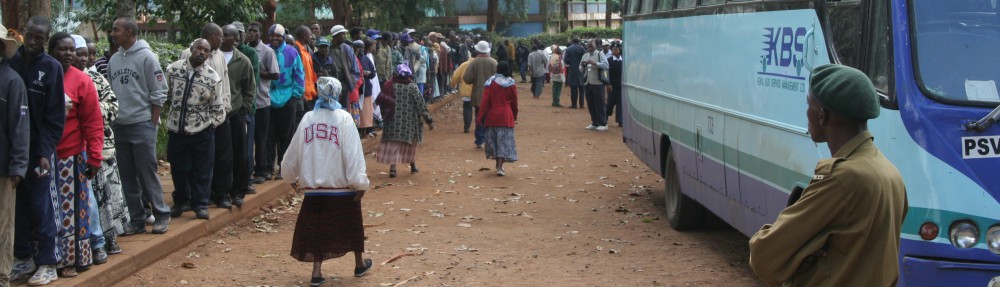
Somaliland Election Set for June 26

Somaliland’s long delayed election has been set by the National Election Commission for June 26, the 50th anniversary of Somaliland’s independence from Great Britain.